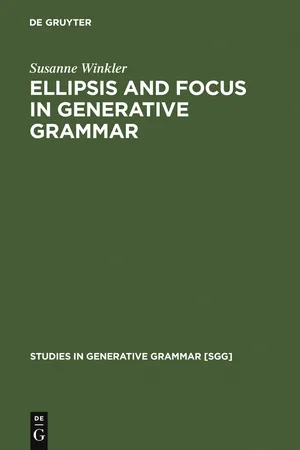
Covering linguistic research on empty categories over more than three decades, this monograph presents the result of an in-depth syntactic and focus-theoretical investigation of ellipsis in generative grammar. The phenomenon of ellipsis most generally refers to the omission of linguistic material, structure and sound. The central aim of this book is to explain on the basis of linguistic theorizing of how it is possible that we understand more than we actually hear. The answer developed throughout this book is that ellipsis is an interface phenomenon which can only be explained on the basis of the complex interaction between syntax, semantics and information structure. Scholars of grammar and cognitive scientists will profit from reading this book.
- 308 pages
- English
- PDF
- Available on iOS & Android
eBook - PDF
Ellipsis and Focus in Generative Grammar
About this book
Information
Table of contents
- Prologue
- Chapter 1: Ellipsis and focus: An introduction
- 1. Introduction
- 2. The derivational model
- 3. The syntax-semantics interface
- 3.1. The cyclic derivation of surface semantic interpretation
- 3.2. The double-cycle information structure hypothesis
- 3.3. Information focus and contrastive focus: A derivational approach
- 4. The hybrid focus analysis of ellipsis
- 5. Conclusion
- 6. Distinguishing sentence-bound and discourse-bound ellipsis: A preview
- Chapter 2: Ellipsis at the interfaces: A proposal
- 1. Introduction
- 2. Deletion vs. deaccentuation
- 2.1. Previous accounts
- 2.2. The parallel computation account
- 3. The pragmatics-PF interface
- 3.1. Anaphoricity and the traditional notion of givenness
- 3.2. Schwarzschild’s proposal: The notion of GIVENness
- 3.3. Objections
- 3.4. E-GIVENness and VP-/IP-ellipsis
- 3.5. Contrastivity and VP-ellipsis
- 4. The syntax-phonology interface
- 4.1. The derivation of intonation by phase
- 4.2. The derivation of ellipsis by phase
- 5. Conclusion
- Chapter 3: VP-anaphora and ellipsis of VP in English and German
- 1. Introduction
- 1.1. In search of VP -ellipsis in German
- 1.2. Roadmap
- 2. The representation of ellipsis
- 2.1. The proform hypothesis vs. the PF-deletion hypothesis
- 2.2. VP-ellipsis: Arguments for an empty proform account
- 2.3. German VPA patterns with English VPE
- 2.4. Evidence from English for the derivational account of VPE
- 3. German auch-ellipsis
- 3.1. Ellipsis of VP in German
- 3.2. Auch-ellipsis is a case of contrastive remnant ellipsis or stripping
- 3.3. A sideward movement account of contrastive remnant ellipsis
- 3.4. Contrastive remnant ellipsis and the syntax-phonology interface
- 4. Conclusion
- Chapter 4: Gapping: A sideward movement account
- 1. Introduction
- 2. The syntax of gapping
- 2.1. Deletion vs. ATB-movement accounts
- 2.2. The proposal: Gapping as sideward movement of vP
- 3. Evidence for the sideward movement account
- 3.1. The information structure of gapping: Paired contrastive remnants
- 3.2. Scope facts as evidence for vP coordination
- 3.3. Intonational evidence for vP coordination
- 3.4. Evidence for an A’-position in vP
- Chapter 5: Conclusion and final remarks
- 1. The informational structural proposal for ellipsis
- 2. Challenges for further research
- 3. Closing remark: Or a note on Wittgenstein’s problem
- Notes
- References
- Subject Index
- Author Index
Trusted by 375,005 students
Access to over 1.5 million titles for a fair monthly price.
Study more efficiently using our study tools.
Frequently asked questions
Yes, you can cancel anytime from the Subscription tab in your account settings on the Perlego website. Your subscription will stay active until the end of your current billing period. Learn how to cancel your subscription
No, books cannot be downloaded as external files, such as PDFs, for use outside of Perlego. However, you can download books within the Perlego app for offline reading on mobile or tablet. Learn how to download books offline
Perlego offers two plans: Essential and Complete
- Essential is ideal for learners and professionals who enjoy exploring a wide range of subjects. Access the Essential Library with 800,000+ trusted titles and best-sellers across business, personal growth, and the humanities. Includes unlimited reading time and Standard Read Aloud voice.
- Complete: Perfect for advanced learners and researchers needing full, unrestricted access. Unlock 1.5M+ books across hundreds of subjects, including academic and specialized titles. The Complete Plan also includes advanced features like Premium Read Aloud and Research Assistant.
We are an online textbook subscription service, where you can get access to an entire online library for less than the price of a single book per month. With over 1.5 million books across 990+ topics, we’ve got you covered! Learn about our mission
Look out for the read-aloud symbol on your next book to see if you can listen to it. The read-aloud tool reads text aloud for you, highlighting the text as it is being read. You can pause it, speed it up and slow it down. Learn more about Read Aloud
Yes! You can use the Perlego app on both iOS and Android devices to read anytime, anywhere — even offline. Perfect for commutes or when you’re on the go.
Please note we cannot support devices running on iOS 13 and Android 7 or earlier. Learn more about using the app
Please note we cannot support devices running on iOS 13 and Android 7 or earlier. Learn more about using the app
Yes, you can access Ellipsis and Focus in Generative Grammar by Susanne Winkler in PDF and/or ePUB format, as well as other popular books in Languages & Linguistics & Languages. We have over 1.5 million books available in our catalogue for you to explore.