From the New York Times bestselling author of Clinton Cash comes an explosive new political expose!
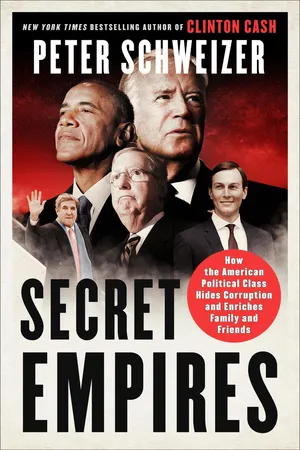
- 336 pages
- English
- ePUB (mobile friendly)
- Available on iOS & Android
eBook - ePub
Secret Empires
About this book
Information
Subtopic
Governo americano1
Corruption by Proxy
Public office is a privilege, not a right, and people who accept the privilege of holding office in the Government must of necessity accept that their entire conduct should be open to inspection by the people they are serving.1
—HARRY TRUMAN
- A new corruption that is extremely difficult to detect is taking over our political system.
- It is most lucrative; instead of thousands of dollars, the sums amount to millions or even billions.
The 2016 election left Americans deeply divided. Some found themselves enthused and encouraged by the outcome. Others were disappointed and depressed. But the vast majority of the American people were unified about one thing: the belief that corruption is rampant in Washington. Polls revealed that three out of four Americans believe that there is “widespread government corruption” in Washington, and perhaps the holdouts are not paying attention. The concern over widespread corruption is growing. The number was two in three back in 2009.2
Politicians who practice corruption have created a crisis of confidence in our government. Only 19 percent of the American people in a recent survey trust the federal government to do the right thing.3
Americans have known for quite some time that some politicians make themselves rich through public service. Who could forget Louisiana congressman William Jefferson stashing $90,000 in bribes in his freezer?4 Or Congressman Randy “Duke” Cunningham who created a “bribery menu” that netted him $2.4 million?5 Then there was the 2006 Jack Abramoff bribery case that led to a flurry of convictions in Washington. The lobbyist had given gifts to politicians in exchange for favors. Abramoff was sentenced to four years in jail.6 Congressman Bob Ney pleaded guilty to taking bribes from Abramoff and was sentenced to thirty months in jail.7 Congressional aides for no less than five congressmen pleaded guilty to corruption, conspiracy, obstruction of justice, and bribery charges, as did executives in the Bush administration from both the Department of the Interior and the Justice Department.
Other forms of corruption have been exposed over the past decade that, while not leading to jail time, have led to great public scrutiny and embarrassment. In my book Throw Them All Out, I exposed insider trading on the stock market by members of Congress. When the book was published and featured on 60 Minutes, it set off a national firestorm that led to the passage of the Stop Trading on Congressional Knowledge (STOCK) Act.8 In my book Extortion, and in another 60 Minutes story, I revealed how politicians enriched themselves using mafia-like tactics.9 In Clinton Cash, I laid out how the Clintons monetized access and official favors.10 Polls conducted in 2015 and 2016 showed that a sizable portion of the American public believed that the Clintons were corrupt.11 And the Federal Bureau of Investigation launched an investigation based on the book’s findings.12
Following the money in those projects was simpler, using financial disclosures required by law.
The corruption by proxy that is the subject of this book is far more troubling and difficult to detect. Because the transactions involved do not fall under disclosure laws, they are invisible or, at least, hidden from public scrutiny. Financial deals channeled through politicians’ family members do not require disclosure. Identifying deals and the parties involved takes intense research. These transactions nevertheless make good money for a politician and his family and friends. Politicians are constitutionally obligated to make decisions that are best for the people they serve. These deals direct the politician’s loyalty elsewhere.
We are used to the typical “revolving door” corruption where government officials will carry out policies and then, after leaving office, take a job from those who benefited. But with most of the deals covered in this book, these politicians do not wait until they leave office. The accumulation begins while they are still serving. Rather than personal accumulation, the wealth flows to someone who is important in their life—a child, another family member, or a close friend. Those relatives are not required to disclose publicly how much money they are making or from whom. It is a pernicious form of what I call corruption by proxy.
Politicians are like the rest of us in that they avoid overtly criminal or publicly embarrassing behavior. Today, only the most arrogant, desperate, or stupid politician would take a direct payment from someone in exchange for a favor. Even without a clear exchange, savvy politicians are likely to avoid transactions that lead to a dramatic increase in their own net worth, lest they draw negative attention from an already skeptical public.
So a new corruption has taken hold. It involves larger sums of money than ever before. Instead of stuffing tens of thousands of dollars into a freezer, they stuff multibillion-dollar equity deals done in the dark corners of the world into family members’ bank accounts.
As some political leaders are making influential decisions that affect everything from national security to our standard of living, large sums of money are funneled to their families and closest friends. Only the most naive would believe that these deals are a coincidence. This money often flows from foreign governments or oligarchs. The timing of these transactions and the amounts involved raise serious questions about the leaders’ integrity and decision making. The high-level policy choices make the news, but the transactions quietly taking place below the surface do not.
How do I define corruption? By corruption, I mean when officials “abuse their positions for private gain . . . Corruption is the dishonest or fraudulent use of power for personal gain.”13
It is often illegal—but not always. Some forms of what most of us would regard as corruption are still technically “legal.”14 These cases, where abuse of power is most certainly occurring, and where the public appears to have no legal recourse short of voting the abuser out of office, are especially demoralizing to Americans. In the old days of the Tammany Hall machine, this was known as “honest graft.” George Washington Plunkitt, who helped run the corrupt Tammany machine, explained that often what he called honest (legal) forms of corruption were more profitable than the illegal forms. “There is so much [honest graft] in this big town that they would be fools to go in for dishonest graft,” he famously said.15
In the world of finance, everyone understands the subterfuge of “offshore” assets. Corporations and high-net-worth individuals stuff their assets and money into obscure limited liability companies or bank accounts in places like Panama, Belize, and Cyprus. By doing so, it becomes very difficult, if not impossible, to map out their transactions. Some do it to avoid taxes. Others try to obscure how and with whom they do business.
When it comes to corruption in Washington, the same sort of thing is occurring. The American political class is “offshoring” its corruption.
Sometimes, politicians will literally offshore corruption by moving the location of the deal, the entities, and the players involved, abroad. Other times, they offshore corruption metaphorically by shifting the cronyism out of their own hands and into those of their children or a close friend to leverage from afar and avoid detection. Either way, the results are the same: like the financier who puts his assets in a bank in Belize, it becomes very hard to track the flow of money and exchange of services. Politicians and their families are increasingly able to avoid public scrutiny and accountability for the selling of influence. And the sums involved are enormous.
So exactly how are politicians “offshoring” their corruption?
First, the foreign entities that are providing the funds and favors for politicians oftentimes have fewer disclosure rules than those in the United States. Again, to use the analogy of offshore banking, the financier who is trying to hide his assets would rather put his money in the Bank of Belize than in the Bank of America. The Bank of Belize has far fewer disclosure rules than the Bank of America. Corrupt politicians like this. A Chinese firm providing deals for them or their family is not required to disclose much of anything when compared to a U.S. publicly traded company. So in a strange way, corrupt politicians would rather seek financial opportunities from shady foreign entities than American corporations. Bigger paydays with less scrutiny result.
Second, by offshoring their corruption via deals for their family and close friends, politicians are not required to disclose such financial gains. In American politics, great scandals have fortunately led to ethics crackdowns. The Bobby Baker scandal, which rocked the U.S. Senate, exposed influence peddling, tax evasion, fraud, and theft by an influential Senate aide. This led to the creation of a Committee on Standards and Conduct in 1964. The Senate created its first ethics code four years later following another financial scandal involving Senator Thomas Dodd. In 1991, a scandal involving then senator David Durenberger forced the Senate to ban members from receiving speaking fees. In the House, a scandal involving Adam Clayton Powell Jr. led the House to establish a Committee on Standards of Official Conduct in 1967 and to pass ethics codes in 1968 and 1970.16
As a positive result of these crackdowns, politicians have been required to disclose their income, assets, and financial transactions, as well as those of their spouses. In short, if a politician or a politician’s spouse directly gets a big payday, it would be illegal to hide. Failing to report it would be a violation of federal law. Yet failing to report that their adult child or friend got a big payday as a result of the politician’s policy actions is not against any law. It is “offshore.” None of those jackpots needs to be disclosed to the public.
Besides being off the disclosure grid, offshore transactions provide plausible deniability when facing scrutiny. If money lands in a politician’s bank account, there is evidence of a direct benefit. Even if it shows up in the bank account of their spouse, questions would be raised. But what if the money, the job, or the business opportunity falls to a politician’s adult child or best friend? Even if that transaction were to become public, there would be an added layer of legal protection.
In short, this is corruption by proxy. It is essentially a form of “political arbitrage,” where friends and family members of powerful political figures have positioned themselves to serve as conduits or middle men between those seeking influence and those who possess political power. This creates previously unimaginable pathways to wealth for the political class. Better still for them, because of limited disclosure rules, much of it can go on undetected.
Foreign governments and oligarchs like this form of corruption because it gives them private and unfettered gateways to the corridors of Washington power. There are a myriad of things they may want: approval to take over an American company; the transfer of sensitive technology; trade deals; or favorable policies concerning military or national security matters. Foreign entities cannot legally make campaign contributions, so using this approach creates an alternative way to curry favor and influence America’s political leaders. Simply camouflaging these transactions as business agreements provides another shield of plausible deniability.
Such corruption is especially bad because it makes American politicians vulnerable to overseas financial pressure. The political leaders identified in the chapters to follow have often seen themselves and their families become wealthy with a single deal provided by a foreign government. So we have American politicians whose wealth is tied up with being in the good graces of foreign governments. What could possibly go wrong?
Using a politician’s adult child or close friend as a proxy may provide only an indirect benefit to a politician, but that does not make it less troubling or threatening to the public interest. Indeed, the law says that if an elected official performs an act for someone’s benefit and that someone provides a benefit to their family or close friend—it is still illegal. Just as a foreign bank account set up under a foreign limited liability company does not shield the financier from scrutiny for trying to avoid taxes, proxy corruption should not limit scrutiny of the politician or his shell game.
Make no mistake: enriching a friend or family member of a politician and getting something in return still constitutes a bribe. The Organisation for Economic Co-operation and Development (OECD) is an international body of the world’s largest economies. As the OECD’s Anti-Bribery Convention notes, “individuals and companies can also be prosecuted when third parties are involved in the bribes transaction, such as when someone other than the official who was bribed received the illegal benefit, including a family member, business partner, or a favourite charity of the official.”17
Direct bribery is only the most obvious form of corruption. Politicians (at least those who are halfway smart) avoid that sort of behavior. It has long been recognized that direct bribes are the least of our concerns when it comes to corruption. Even a century ago, a scholar noted that there are far more troubling and sophisticated forms of bribery. As Professor Robert Brooks wrote back in 1909, “It is this condition of affairs which makes the subtler aspects of corruption so much more dangerous and so much less easy to cope with than common bribery.”18
Brooks also noted that the smart politician of his day would avoid obvious bribery. “Corruption in its more insidious forms is not the vice of low intellects,” he noted.19 And so it still is today. Corru...
Table of contents
- Cover
- Title Page
- Dedication
- Contents
- 1: Corruption by Proxy
- 2: American Princelings: Two Sons and a Roommate
- 3: Nuclear and Other Consequences
- 4: Bidens in Ukraine
- 5: McConnell and Chao: From China with Profits
- 6: The Princelings of K Street
- 7: The Princelings of Chicago
- 8: The Hyesan Youth Copper Mine of North Korea
- 9: Barack Obama’s Best Friend
- 10: More Smashing and Grabbing
- 11: A Real Estate Mogul Goes to Washington
- 12: The Trump Princelings
- Conclusion
- Acknowledgments
- Notes
- Index
- Photos Section
- About the Author
- Also by Peter Schweizer
- Copyright
- About the Publisher
Trusted by 375,005 students
Access to over 1.5 million titles for a fair monthly price.
Study more efficiently using our study tools.
Frequently asked questions
Yes, you can cancel anytime from the Subscription tab in your account settings on the Perlego website. Your subscription will stay active until the end of your current billing period. Learn how to cancel your subscription
No, books cannot be downloaded as external files, such as PDFs, for use outside of Perlego. However, you can download books within the Perlego app for offline reading on mobile or tablet. Learn how to download books offline
Perlego offers two plans: Essential and Complete
- Essential is ideal for learners and professionals who enjoy exploring a wide range of subjects. Access the Essential Library with 800,000+ trusted titles and best-sellers across business, personal growth, and the humanities. Includes unlimited reading time and Standard Read Aloud voice.
- Complete: Perfect for advanced learners and researchers needing full, unrestricted access. Unlock 1.5M+ books across hundreds of subjects, including academic and specialized titles. The Complete Plan also includes advanced features like Premium Read Aloud and Research Assistant.
We are an online textbook subscription service, where you can get access to an entire online library for less than the price of a single book per month. With over 1.5 million books across 990+ topics, we’ve got you covered! Learn about our mission
Look out for the read-aloud symbol on your next book to see if you can listen to it. The read-aloud tool reads text aloud for you, highlighting the text as it is being read. You can pause it, speed it up and slow it down. Learn more about Read Aloud
Yes! You can use the Perlego app on both iOS and Android devices to read anytime, anywhere — even offline. Perfect for commutes or when you’re on the go.
Please note we cannot support devices running on iOS 13 and Android 7 or earlier. Learn more about using the app
Please note we cannot support devices running on iOS 13 and Android 7 or earlier. Learn more about using the app
Yes, you can access Secret Empires by Peter Schweizer in PDF and/or ePUB format, as well as other popular books in Politica e relazioni internazionali & Governo americano. We have over 1.5 million books available in our catalogue for you to explore.