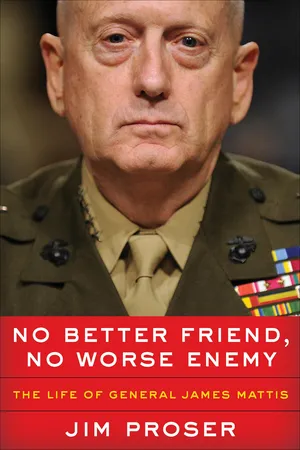
The first in-depth look at the marine hero who has become one of the most beloved and admired men in America today: Secretary of Defense James Mattis.
In the hyper-partisan political atmosphere of 2017, General James Mattis astonishingly received nearly unanimous bipartisan support for his nomination for Secretary of Defense. What is it about Mattis that generates such respect and appreciation across the political spectrum?
In this illuminating biography, Jim Proser takes readers through the general's illustrious career, featuring firsthand accounts of his running some of the most significant military engagements in recent American history. Readers will understand what it feels like to work for, and fight alongside, this remarkable figure.
Mattis is a devout student of history and an erudite reader, revered by rank-and-file Marines, officers, academics, politicians, and civilians alike. In 2003, he shared a message in his "Eve of Battle Speech" with the men and women under his command in the 1st Marine Division, outlining their responsibilities. Emphasizing the importance of the mission and the goal to act with honor, Mattis ended with the motto he had adapted from another great figure, Roman general Lucius Cornelius Sulla: "Demonstrate to the world that there is 'No Better Friend, No Worse Enemy' than a US Marine."
Chronicling how Mattis's martial and personal values have elevated him to the highest levels of personal success and earned him the trust of a nation, Proser proves that America is stronger because of the secretary's service and his example.
"A concise, fast-moving story of the battle career of the introspective and fiery General James Mattis, one of America's most intriguing and gifted military figures of the postwar era. From this lively portrait, Proser's Mattis emerges as our generation's composite of George S. Patton and Omar Bradley." —Victor Davis Hanson, author of
The Second World Wars
- 272 pages
- English
- ePUB (mobile friendly)
- Available on iOS & Android
eBook - ePub
About this book
Information
1
No Better Friend
General Krulak said, when he was commandant of the Marine Corps, every year starting about a week before Christmas he and his wife would bake hundreds and hundreds of Christmas cookies. They would package them in small bundles. Then on Christmas day, he would load his vehicle and drive to every Marine guard post in the Washington-Annapolis-Baltimore area to deliver a small package of Christmas cookies to Marines pulling guard duty that day.
One year, he had gone down to Quantico as one of his stops. He went to the command center and gave a package to the lance corporal on duty. He asked, “Who’s the officer of the day?”
The lance corporal said, “Sir, it’s Brigadier General Mattis.”
And General Krulak said, “No, no, no. I know who General Mattis is. I mean, who’s the officer of the day today, Christmas day?”
The lance corporal, feeling a little anxious, said, “Sir, it is Brigadier General Mattis.”
General Krulak said that he spotted in the back room a cot, or a daybed. He said, “No, Lance Corporal. Who slept in that bed last night?”
The lance corporal said, “Sir, it was Brigadier General Mattis.”
About that time, General Krulak said that General Mattis came in, in a duty uniform with a sword, and General Krulak said, “Jim, what are you doing here on Christmas day? Why do you have duty?”
General Mattis told him that the young officer who was scheduled to have duty had a family, and General Mattis decided it was better for the young officer to spend Christmas Day with his family, and so he chose to have duty on Christmas Day.
—Dr. Albert C. Pierce, the director of the Center for the Study of Professional Military Ethics at the US Naval Academy, introducing General Mattis at the academy
0800 Hours—23 April 2003—Camp Commando, Kuwait
In a large, nondescript military tent, fifty-three-year-old Major General James Mattis, small and lean, with a reputation as a ferocious and brilliant warrior, briefs hundreds of his fellow US Marines. With him is Major General James Amos, who’s in charge of the Third Marine Air Wing of Mattis’s overall command, the First Marine Division. The division is geared up to invade Iraq, just thirty-five miles north, launching Operation Iraqi Freedom.
Mattis, a gentlemanly ladies’ man but a lifelong bachelor, has dedicated his life completely to the success and safety of the warriors he commands. In return, he is deeply beloved by them. His constant study of history and philosophy has earned him the affectionate nickname the Warrior Monk and made being smart and well-read cool, elevating the sometimes anti-intellectual, tribal Marine culture. He ordered every Marine in the First Division to read Russell Braddon’s The Siege, which follows the ill-fated British Expeditionary Force during World War I in what was then called Mesopotamia. Mattis wants every Marine to understand the inhospitable Iraqi terrain and the mistakes that cost the British twenty-five thousand men.
His voice is calm and loud, with a slight sibilance that softens some of his s’s. He speaks without notes, hands on hips or in “knife-hand” gestures, fixing his attention on individual Marines as he scans the rows of officers from the front to the back of the room. Marine commanders sit in rows before him now, Third Air Wing pilots up front in tan flight suits, pistols strapped across their chests, ground commanders behind them in desert camouflage. They are silent, intent on every word. Among the commanders is Lieutenant Colonel Stanton Coerr, who later reports on this meeting, “Gentlemen, this is going to be the most air-centric division in the history of warfare,” Mattis says. “Don’t you worry about the lack of shaping; if we need to kill something, it is going to get killed. I would storm the gates of Hell if Third Marine Air Wing was overhead.”1
By shaping, he means shaping of the battlefield by air power and artillery. This is usually the preparation for battle meant to find and exploit the enemy’s weakest spot. But instead of shaping, Mattis’s new “maneuver warfare” relies on speed and mobility, as he then makes clear with typical good humor.
“There is one way to have a short but exciting conversation with me,” he continues, “and that is to move too slow. Gentlemen, this is not a marathon, this is a sprint. In about a month, I am going to go forward of our Marines up to the border between Iraq and Kuwait. And when I get there, one of two things is going to happen. Either the commander of the Fifty-First Mechanized [Iraqi] Division is going to surrender his army in the field to me, or he and all his guys are going to die.”2
Maps are flashed up, showing the initial battlespace coordination line, and the Marines are given their rules of engagement—they are permitted to kill anything beyond that line that appears to be a threat. But in the summer of 2002, when Mattis assumed command of the First Marine Division, he warned the division staff of several realities. According to one of his public affairs officers, Captain Joe Plenzler, he said, “Iraq has a population of 33 million people, and we sure as hell don’t want to fight all of them. We only want to fight the ones that are working to keep Saddam Hussein in power.”3 He goes on to insist that if the Iraqis they encountered wanted to help, or just to stand aside, they should find no better friend than a US Marine.
This phrase, “no better friend than a US Marine,” came from Mattis’s reading of Roman general Lucius Cornelius Sulla, who once remarked, “No friend ever served me, and no enemy ever wronged me, whom I have not repaid in full.”4 When he took command of the First Division in 2000, Mattis fashioned Sulla’s quote into the division’s now famous motto, “No better friend, no worse enemy.”5
* * *
The second part of the briefing takes place in the open desert inside a bulldozed arena where the Marines and their coalition allies walk through the first five days of the coming battle on a scale replica of the battlefield representing the 345 miles of Iraqi terrain between the Kuwaiti border and Baghdad. Nearly the size of a football field, the sculpted topography includes every road, canal, village, and oil field that the fast-moving attack forces will encounter. Canals and rivers are filled with blue sand, and oil fields are marked with black pyramids representing oil derricks.
Mattis grabs a microphone and, again without notes, explains through a loudspeaker what each unit will do and in what sequence this will occur, emphasizing coordination but rejecting synchronization. No one is to wait, everyone is to advance. Constantly and quickly advance. Their mission is to capture Baghdad, not to get bogged down in firefights in every village.
Next to the gray-haired Mattis stands his surprising lead intelligence analyst, taking it all in. Twenty-year-old Lance Corporal Nathan Osowski is some kind of savant. He knows the Iraqi order of battle—the number and location of forces—better than anyone in the division. Osowski can recall the most intricate details, like the number and kinds of armor in different Iraqi units, on demand, and now he adds the battlefield details before him into his mental database. Mattis, who has always recognized and valued talent over rank, keeps Osowski in his inner circle of advisers, among the majors and generals.
Representatives of each unit wear football jerseys in specific colors, with unit-identifying numbers on their backs. As Mattis describes each advance, the representatives walk to their proper places on the terrain model. About three hundred officers stand and sit on the dune above the battlefield, watching Mattis’s battle plan in action. This is a textbook demonstration of “maneuver warfare,”6 which sliced through Iraq’s defenses in one hundred hours during Operation Desert Storm twelve years earlier. Mattis specifies every objective for every unit at the end of every day for the first five days of the war, an impressive display of study and preparation.
At the end of this rehearsal of concept, questions are answered and Mattis dismisses the group. Mike Murdoch, one of the British company commanders, leans over to Lieutenant Colonel Coerr and asks, “Mate, are all your generals that good?”7
1900 Hours—20 March 2003—Camp Matilda on the Kuwait-Iraq Border
The seven-meter-high earthen berm marking the border between Kuwait and Iraq erupts from the high explosive charges placed by the combat engineers of the First Marine Expeditionary Force, often referred to as I MEF. Fine, chalky dust from the blast drifts down in the night breeze onto the growing traffic jam that will eventually grow to seventy-five thousand American and coalition invaders and their tens of thousands of trucks, amtracs (heavy trucks with tank treads instead of wheels), light armored vehicles (LAVs)—small, fast, tank-like vehicles—Jeep-sized Humvees, and gigantic M1A1 Abrams tanks.
Lieutenant Nathaniel “Nate” Fick, who served under General Mattis in Afghanistan two years earlier just after 9/11, assembles his platoon in the dusty, barren invasion staging area at Camp Matilda. He knows the vital importance Mattis places on every Marine understanding his commander’s intent, and so he reads the general’s “Message to All Hands” to his men:
For decades, Saddam Hussein has tortured, imprisoned, raped and murdered the Iraqi people; invaded neighboring countries without provocation; and threatened the world with weapons of mass destruction.The time has come to end his reign of terror. On your young shoulders rest the hopes of mankind. When I give you the word, together we will cross the Line of Departure, close with those forces that choose to fight, and destroy them. Our fight is not with the Iraqi people, nor is it with members of the Iraqi army who choose to surrender. While we will move swiftly and aggressively against those who resist, we will treat all others with decency, demonstrating chivalry and soldierly compassion for people who have endured a lifetime under Saddam’s oppression. Chemical attack, treachery, and use of the innocent as human shields can be expected, as can other unethical tactics.Take it all in stride. Be the hunter, not the hunted: never allow your unit to be caught with its guard down. Use good judgment and act in the best interests of our nation. You are part of the world’s most feared and trusted force. Engage your brain before you engage your weapon. Share your courage with each other as we enter the uncertain terrain north of the Line of Departure. Keep faith in your comrades on your left and right and Marine Air overhead. Fight with a happy heart and strong spirit.For the mission’s sake, our country’s sake, and the sake of the men who carried the Division’s colors in past battles—who fought for life and never lost their nerve—carry out your mission and keep your honor clean. Demonstrate to the world that there is “No Better Friend, No Worse Enemy” than a US Marine.8
* * *
In the futuristic-looking I MEF geodesic dome command post referred to as the Bug, crammed with computers, TV screens, communication radios, topographical models, and stacks of MRE boxes, Marine intelligence has hacked into the email account of the Iraqi general in command of forces near the border. Mat...
Table of contents
- Contents
- Introduction
- 1: No Better Friend
- 2: No Worse Enemy
- 3: Liberation
- 4: Beyond Baghdad
- 5: A Girl Named Alice
- 6: The Enemy of My Enemy
- 7: Task Force Ripper
- 8: The Sleeping Enemy
- 9: Graveyard of Empires
- 10: City of Mosques
- Epilogue: No Better Friend, No Worse Enemy
- Acknowledgments
- Notes
- About the Author
- Copyright
- About the Publisher
Trusted by 375,005 students
Access to over 1.5 million titles for a fair monthly price.
Study more efficiently using our study tools.
Frequently asked questions
Yes, you can cancel anytime from the Subscription tab in your account settings on the Perlego website. Your subscription will stay active until the end of your current billing period. Learn how to cancel your subscription
No, books cannot be downloaded as external files, such as PDFs, for use outside of Perlego. However, you can download books within the Perlego app for offline reading on mobile or tablet. Learn how to download books offline
Perlego offers two plans: Essential and Complete
- Essential is ideal for learners and professionals who enjoy exploring a wide range of subjects. Access the Essential Library with 800,000+ trusted titles and best-sellers across business, personal growth, and the humanities. Includes unlimited reading time and Standard Read Aloud voice.
- Complete: Perfect for advanced learners and researchers needing full, unrestricted access. Unlock 1.5M+ books across hundreds of subjects, including academic and specialized titles. The Complete Plan also includes advanced features like Premium Read Aloud and Research Assistant.
We are an online textbook subscription service, where you can get access to an entire online library for less than the price of a single book per month. With over 1.5 million books across 990+ topics, we’ve got you covered! Learn about our mission
Look out for the read-aloud symbol on your next book to see if you can listen to it. The read-aloud tool reads text aloud for you, highlighting the text as it is being read. You can pause it, speed it up and slow it down. Learn more about Read Aloud
Yes! You can use the Perlego app on both iOS and Android devices to read anytime, anywhere — even offline. Perfect for commutes or when you’re on the go.
Please note we cannot support devices running on iOS 13 and Android 7 or earlier. Learn more about using the app
Please note we cannot support devices running on iOS 13 and Android 7 or earlier. Learn more about using the app
Yes, you can access No Better Friend, No Worse Enemy by Jim Proser in PDF and/or ePUB format, as well as other popular books in History & Military Biographies. We have over 1.5 million books available in our catalogue for you to explore.