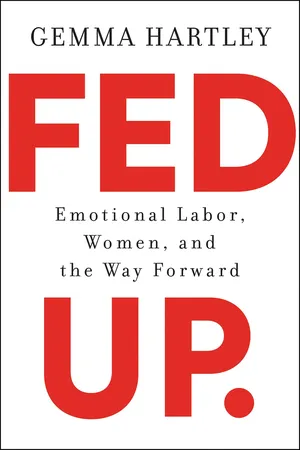
A bold dive into the emotional labor women have shouldered for far too long—and an impassioned vision for creating a better future for us all.
Day in, day out, women anticipate and manage the needs of others. In relationships, we initiate the hard conversations. At home, we shoulder the mental load required to keep our households running. At work, we moderate our tone, explaining patiently and speaking softly. In the world, we step gingerly to keep ourselves safe. We do this largely invisible, draining work whether we want to or not—and we
never clock out. No wonder women everywhere are overtaxed, exhausted, and simply
fed up.
In her ultra-viral article "Women Aren't Nags—We're Just Fed Up," shared by millions of readers, Gemma Hartley gave much-needed voice to the frustration and anger experienced by countless women. Now, in
Fed Up, Hartley expands outward from the everyday frustrations of performing thankless emotional labor to illuminate how the expectation to do this work in all arenas—private and public—fuels gender inequality, limits our opportunities, steals our time, and adversely affects the quality of our lives.
More than just name the problem, though, Hartley teases apart the cultural messaging that has led us here and asks how we can shift the load. Rejecting easy solutions that don't ultimately move the needle, Hartley offers a nuanced, insightful guide to striking real balance, for true partnership in every aspect of our lives. Reframing emotional labor not as a problem to be overcome, but as a genderless virtue men and women can all learn to channel in our quest to make a better, more egalitarian world,
Fed Up is surprising, intelligent, and empathetic essential reading for every woman who has had enough with feeling fed up.
- 272 pages
- English
- ePUB (mobile friendly)
- Available on iOS & Android
eBook - ePub
About this book
Information
Part I
Emotional Labor at Home
Chapter 1
How Did We Get Here?
The two-year-old screamed at the top of his lungs as we pulled out of the driveway. He had been screaming from the moment he woke up, about half an hour earlier. The four-year-old started screaming at him to stop screaming before we reached the end of our road. The six-year-old told them both to stop it, which led to them all pointing and yelling, “Stop it!” at one another, round-robin style. I would say it was a difficult way to start the day, but my day had started hours earlier. I had already dealt with email, budgeting, making breakfast, packing school lunches, cleaning the counters, and washing the dishes—all while listening to a podcast on time management. Even as I managed the toddler meltdown, I had done homework with the six-year-old, checked backpacks, filled water bottles, got everyone dressed, combed and braided my daughter’s hair, and herded the kids into the car. As I drove, I tried to organize my thoughts about everything that needed to be done that day, which was difficult given the noise level around me. I needed to remind my husband to text his mom and ask about dog-sitting over Christmas. I needed to remember we were out of hand soap and low on diapers. I needed to read the school email that was still open on my laptop. I needed to do a lot of things that I knew I was forgetting, because I had to drive while attempting to smooth over the escalating fight taking place in the backseat. That’s when I saw my husband’s car approaching in the opposite direction.
Rob had left for work two hours before, so I knew it wasn’t likely that he had left his keycard or laptop. I had Siri text him to ask why he was home. When I arrived at my daughter’s preschool, I saw his reply: “Let’s talk when you get back.”
I didn’t need him to tell me. From the sinking feeling in my gut I already knew. There had been rounds of layoffs at his company, and it was that time of year again. I breathed deeply before heading for the second school drop-off, immediately going into planning mode. I could figure this out. I knew exactly where our budget stood. We could withstand quite a bit of time on one income. He could take a whole six months off if we were careful about our spending. In fact, perhaps he should take a whole six months off.
That was exactly how long I had until my book manuscript was due. My career was taking off, and my income was secure. He could take his time finding the job that felt right for him, while taking over the home front and caring for our two-year-old (who, by the way, was still screaming in the backseat). The timing seemed downright serendipitous. I had always been able to rise to the occasion as my freelance career demanded more and more from me, but recently I felt like I was nearing my limit. There was still so much emotional labor that remained invisible to Rob, and I had so much more on my plate than ever before. I imagined that having him home would change things. He would be confronted with the day-to-day running of our household, the emotional demands of full-time at-home parenthood, and everything would come into focus for him. What would have been a moment of panic at any other point in our lives seemed instead like a door of opportunity opening wide.
We had been talking about the imbalance of emotional labor constantly since my Harper’s Bazaar article came out a couple months earlier, but it still hadn’t quite clicked into place. He could see the physical manifestation of it; I was the one doing the bulk of the cleaning and lunch packing and list making and calendar keeping. But he didn’t understand how to take over, even when I desperately needed him to. My job was no longer part-time, yet my load at home hadn’t changed to reflect our new situation. While Rob had started occasionally doing laundry and other chores as it suited him, the planning and any delegation of domestic or family work still fell squarely on my shoulders. The mental load was heavy; the emotional labor that went into explaining it to him was even worse. I felt guilty for immediately thinking about how his unemployment would benefit me, but I couldn’t help but believe that this big shake-up was exactly what we needed. This will be the turning point, I thought. This is when the shift will finally happen. I was now the sole breadwinner. He would naturally have to take on the management of the household while he was at home. The role would finally make sense to him. How else could this scenario possibly shake out?
When I arrived home and he broke the news to me, I kept my plans to myself. I knew what he needed from me in that moment was empathy. I told him I was sorry and that we would be okay and mirrored him when he stated how much it sucked.
“It does suck,” I said.
Rob was obviously in shock. Today would be a wash on the emotional labor front. Probably most of the week would be. He could start taking over next week, once we’d discussed our expectations and plans. I wanted to give him time to absorb the pain and frustration of the layoff, to talk it out, to feel confident in how he was going to move forward during this period. I wanted him to see this time as an opportunity for himself as well, to find space to enjoy himself while he had all this unbound freedom. If I had been doing all the emotional labor up until this point, surely we could find a new balance with him at home that could make us both happy. We could tackle large-scale delegation together, and then I could lean back at home and lean into my work without the endless to-do list pinging through my mind in the background. I imagined what it might feel like to walk into my home office, knowing that everything at home would be taken care of while I was “away.” It was a dreamlike prospect, but I felt confident we would find our groove effortlessly. We were off into this new chapter of our lives.
That afternoon, we took our (still whining) two-year-old to the park. We walked along the creek that ran beside the park trail. The air was crisp, the ground covered in bright yellow leaves from the cottonwoods. The path wove its way through tall Sierra pines. The changing landscape, our changing lives—it all felt steeped in meaning. The more I thought about it, the more confident I felt that the change, unexpected and unsettling as it might be, was exactly what we needed in our lives. It would be a fresh start, not only for his career but for our relationship dynamic as well. I mentioned to him, gingerly, that the layoff was perhaps a positive event. Look where we were—literally, figuratively. I had my book to focus on. He had severance pay for three months. This could be a good thing.
“I’m allowed to be mad about this,” he said.
I could tell he was annoyed with my optimism and scaled back. When we returned home and he went to the computer to job-search, I went back into planning mode. I consulted close friends who had been through spousal job loss to gauge the emotional arc we would be facing. I needed to know how to tread lightly here, how to keep moving forward while protecting my husband’s feelings. My friends told me stories of husbands who became listless or suffered massive identity crises when unemployment stretched longer than expected. On the car ride home Rob had mentioned he expected the job search to take two weeks. It was wishful thinking on steroids. I had to figure out how to best dole out that reality, while assuring him of my confidence in his abilities. I would have to maintain a careful level of optimism while empathizing with the plight of the job search and understanding the difficulty of adjusting to his shifting identity. I was exhausted just thinking about it, and I didn’t dare check in on my own emotions. The fine line I had to walk in our relationship to keep the peace was about to become razor thin.
Rob took the reins of the morning routine as my schedule became increasingly hectic. It was a rare morning when I wasn’t sucked straight into emails, interviews, podcasts, or research. I referred him to our calendar constantly to keep track of what was on the schedule each day. I was still taking our daughter to preschool every morning. We were a whole month into Rob’s unemployment and my full-time book writing.
“Today I have a podcast recording for an hour and a half, then I need to work until around one to get the updated outline finished and sent in to my editor,” I told him. The timing was ideal. I would wrap up work right around the time the two-year-old would need to go down for a nap just after his lunch. I could put him down, eat lunch myself, and get right into the reading I wanted to do. Maybe I’d even read for pleasure. Meanwhile, Rob could go mountain biking.
To my surprise, however, when I emerged from my home office, the two-year-old hadn’t eaten lunch yet. I scrambled to make him ramen noodles and quickly put him down for a nap while Rob changed into his riding gear. He left as I tried to console the two-year-old, who was now blindsided by the fact that naptime and Dad leaving were happening in tandem. He took over an hour to settle down and fall asleep. When the battle was finally over, I staggered into the kitchen to finally eat my own lunch. When I saw the dining room table, I almost screamed.
Abandoned coloring books, crayons, markers, printer paper that I had told my six-year-old time and again not to steal from my workspace, pencil shavings, and a library book I feared to look inside blanketed its surface. There was kinetic sand in two colors, both of which were scattered in small lumps well outside their designated trays and all over the floor. There were dishes from breakfast, half-eaten food taken off the plates, and milk hardening on the finished wood top of the table. There were small beads from a craft project everywhere—in the sand, in the food, on the floor.
The urge to scream grew harder to suppress when I started clearing the plates and food from the table and realized that none of the dishes from the previous night had been put away. None of the breakfast dishes had been done. None had even been rinsed. The counters were covered with cereal boxes left open, and oatmeal had hardened in the pot on the stove. I went to put the library book back on its designated shelf in the living room and found a half-finished popcorn bowl and a floor covered with half-eaten kernels. Shoes and sweaters were strewn across the couch. Toys had been taken out and never put away. As I moved from one small job to the next I found more things left undone. The laundry was overflowing. The trash needed to be taken out. I could feel the resentment bubbling up inside of me. What the hell has he been doing all day?
I had spent the last five hours working intently, trusting him to take care of the rest. The house wasn’t just a little messy. It was a disaster. You might be able to walk through without stepping on anything if you were particularly nimble, but how on earth could you not see it? His laptop was perched on the end of the horror show that was our dining room table. He had no doubt been sitting at that table half the morning, planning out a route for his bike ride or watching biking videos. Then he had gotten up, looked right past it all, and left.
It was the punch line to a bad joke I’d heard before: that men have a film of dust over their eyes which stops them from seeing the mess. The things they don’t want to see they render invisible. Every woman I knew had a story of the things her partner never sees. One leaves the kitchen cabinets wide open. Another leaves the cooler out for weeks after they host a party. The socks and shoes are in every room but the closet. The clothes land right outside the hamper. The towel is always scrunched up behind the bathroom door. I feel these frustrating blind spots on a spiritual level. My husband leaves cups of coffee all over our property. I find them in the garage, on the barbeque, outside the front door, in the closet, on the side table next to the bed. I’m lucky if I find the coffee the same day it was made. I’ve found mugs I had to throw straight in the trash because they harbored their own ecosystems. These are the kinds of jokes that are funny when you’re a couple glasses of wine in, and out of the house. They’re not much comfort when you’re staring down the consequence of your partner’s selective sight skills and seeing red.
When Rob returned home, he waxed poetic about his amazing ride as he peeled off his mountain biking gear and threw it onto the floor next to the hamper in our closet. I picked up the sweat-drenched clothing and started the load of laundry I had sorted in anticipation of his arrival. I had spent the entirety of the two-year-old’s nap on a fury-fueled cleaning spree. To say I was frustrated would be an understatement.
“The house looks amazing,” he said when he finished showering.
“Yeah,” I said tersely. “It still needs to be vacuumed, though.”
“It looks really good, babe. I’m sorry I didn’t do more earlier.”
I stepped aside so he could access the vacuum closet, sure that he was going to complete the task I had just mentioned. Instead he turned and walked toward the kitchen to get himself a snack. I got out the vacuum, left it in the hallway, and still nothing. An hour later, I vacuumed the house myself. Then I asked him, for the fifth time, if he had remembered to call his parents to see if they could watch our dog while we traveled during the holidays. He had not.
How did we get here? I didn’t understand how this was happening. We’d talked about emotional labor. He said he wanted to help. In the weeks after my Harper’s Bazaar article appeared, he was getting the kids ready for every outing and doing full loads of laundry every few days. I thought he understood how to pick up his share of the burden. I truly and naively thought that we had changed, and that my husband’s unemployment would be the opportunity of a lifetime to balance out emotional labor once and for all. So why was I back to picking up his laundry off the floor and stewing in resentment?
Every wise woman I know understands that balance doesn’t always mean “split right down the middle.” There’s push and pull. Our relationships, no matter how well established, are never static. In fact, one of the key predictors of a successful relationship is being able to adapt to change.1 This applies not only to stressful or traumatic life events but to predictable changes as well. How quickly and efficiently can we adapt together to a change in schedule, a move, a job loss? I had thought because we’d had our aha moment after Mother’s Day that the changes would be permanent. The realization that we could slip backward so quickly scared me. I had heard from so many women who harbored overwhelming resentment toward their partners, who felt browbeaten into the role of emotional laborer with no way out, who felt hopeless. I could now see how easy it would be to end up in that position if we didn’t figure out how to change our dynamic—and soon. That night, as I sat with the fear, I read Sarah Bregel’s essay on the buildup to her divorce, “How to Say You Maybe Don’t Want to Be Married Anymore.” It had been making the rounds, and I knew the author from freelancing around the same subjects: parenting, life, love. I did not expect to see one iota of myself in the essay, or at least I hoped I wouldn’t. Yet I saw the strain of emotional labor peeking through the cracks of the divorce essay almost immediately. “I talked about being a better parent when I’m alone, about disappointment, about resentments that have been coming and going then jolting me so hard that I know, at least in that moment, I’ve given up.”2 I had never felt like I’d given up, not even close, but had I been disappointed and full of resentment and thought to myself, Why is this so much easier when he’s not around? Yeah. I had. But we were fixing things. We’d had the talk about emotional labor. We were moving forward, or at least we had been, and we would be again as soon as I figured out the magic formula. Then I got to the point in Sarah’s essay where she describes her husband cooking breakfast, doing dishes, helping with the kids—all the things she’s been asking him to do and more. It feels hopeful, almost, until she reveals the kicker I should have seen coming. “It always reverts,” she writes. “And part of me knows it will keep reverting until it’s so ingrained that all I can remember about my life is how to be someone’s angry wife.” I reread the essay. It’s all about emotional labor, even the parts I didn’t catch the first time because they are second nature to me. Of course she is the one who is holding it together for her kids. Of course she is the one to schedule the appointment with the therapist for them both. Of course.
When I spoke with Sarah on the phone, I wondered aloud if there was a distinct turning point when she realized the imbalance of emotional labor was getting way out of hand. I asked, somewhat desperately, if there were warning signs she could have spotted along the way, but she revealed what I most feared: the emotional labor had always been imbalanced in this way, especially since having their two kids. She could have been describing my own life as she described her well-meaning husband who just didn’t get it. He was a man who had watched his own father not take on any of the emotional labor in his family. In their relationship, as a result, when it came to pitching in, there had always been an undercurrent of “this is not my job.” He’d feel proud when he loaded the dishwasher, fishing for praise though Sarah did the same job three times over without the work being noticed, let alone lauded. When she would bring up emotional labor, it always turned into her being the “bad guy.” Her husband would become self-deprecating, beating himself up over never doing enough. The guilt trip that came with that response sometimes made it easier to just quietly pick up the emotional labor and get back to it alone.3 I felt more than a hint of recognition now. It was like looking in a mirror.
I thought back to the beginning of my own relationship, trying to find the differences between my relationship with Rob and Sarah’s with her husband—differences that would reassure me we would be okay. I wanted to know, with unwavering doubt, that we were different. But had there ever been a time when the balance of emotional labor had been more evenly distributed between us? Rob and I first started dating in high school. When we were seventeen, we went, together, to the teenage wedd...
Table of contents
- Cover
- Title Page
- Dedication
- Contents
- Introduction: An Invisible Job Is Never Done
- Part I: Emotional Labor at Home
- Part II: Emotional Labor at Large
- Part III: The Path Forward
- Acknowledgments
- Notes
- About the Author
- Copyright
- About the Publisher
Trusted by 375,005 students
Access to over 1.5 million titles for a fair monthly price.
Study more efficiently using our study tools.
Frequently asked questions
Yes, you can cancel anytime from the Subscription tab in your account settings on the Perlego website. Your subscription will stay active until the end of your current billing period. Learn how to cancel your subscription
No, books cannot be downloaded as external files, such as PDFs, for use outside of Perlego. However, you can download books within the Perlego app for offline reading on mobile or tablet. Learn how to download books offline
Perlego offers two plans: Essential and Complete
- Essential is ideal for learners and professionals who enjoy exploring a wide range of subjects. Access the Essential Library with 800,000+ trusted titles and best-sellers across business, personal growth, and the humanities. Includes unlimited reading time and Standard Read Aloud voice.
- Complete: Perfect for advanced learners and researchers needing full, unrestricted access. Unlock 1.5M+ books across hundreds of subjects, including academic and specialized titles. The Complete Plan also includes advanced features like Premium Read Aloud and Research Assistant.
We are an online textbook subscription service, where you can get access to an entire online library for less than the price of a single book per month. With over 1.5 million books across 990+ topics, we’ve got you covered! Learn about our mission
Look out for the read-aloud symbol on your next book to see if you can listen to it. The read-aloud tool reads text aloud for you, highlighting the text as it is being read. You can pause it, speed it up and slow it down. Learn more about Read Aloud
Yes! You can use the Perlego app on both iOS and Android devices to read anytime, anywhere — even offline. Perfect for commutes or when you’re on the go.
Please note we cannot support devices running on iOS 13 and Android 7 or earlier. Learn more about using the app
Please note we cannot support devices running on iOS 13 and Android 7 or earlier. Learn more about using the app
Yes, you can access Fed Up by Gemma Hartley in PDF and/or ePUB format, as well as other popular books in Social Sciences & Feminism & Feminist Theory. We have over 1.5 million books available in our catalogue for you to explore.