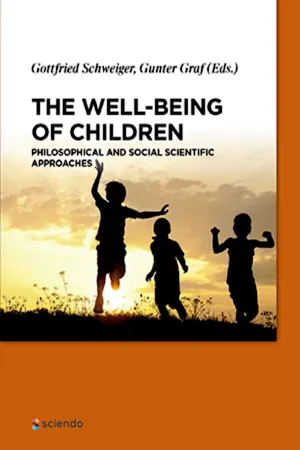
This volume explores the questions related to the theory, practice, and policy of the well-being and well-becoming of children. It does so in a truly interdisciplinary way with a focus on the social sciences and philosophy, giving therefore justice to the growing insight that studying and promoting the well-being of children has a strong ethical component. It is dependent on the questions of good life, its conditions and cannot be separated from the concept of social justice and moral entitlements of children and their families. In this book, philosophers and social scientists, in close dialogue, shed light on some of the most challenging matters involved.
eBook - ePub
The Well-Being of Children
Philosophical and Social Scientific Approaches
- 176 pages
- English
- ePUB (mobile friendly)
- Available on iOS & Android
eBook - ePub
The Well-Being of Children
Philosophical and Social Scientific Approaches
About this book
Information
Topic
PhilosophySubtopic
HistoriographySection I: Theories and Concepts of Children’s Well-Being
1 Conceptions of Childhood, Agency and the Well-Being of Children1
1.1 Introduction
Historical, ethnological and social scientific research shows that different societies possess diverse conceptions of childhood. They differ in their assessment of when it begins, ends, how it should be divided and which dimensions are relevant when demarcating it from adulthood. Therefore, the often held conviction that childhood and the way we deal with children is a simple and natural fact of the way human beings develop has been seriously challenged – childhood and the social norms we associate with it are contingent and indeed the notion of the “social construction of childhood” has become widespread in the social scientific literature, particular in the influential field called “sociology of childhood”. However, the importance and normative implications of these insights are still unclear and there is considerable disagreement among theoreticians about what the strong social component in any conception of childhood means for the evaluation of the well-being of children and, from a moral point of view, the way children are treated in modern western societies. While some argue that the focus on protection and the emphasis of children’s vulnerability as key components of the way a good childhood is conceived in many contemporary states constitutes clear moral progress, others are sceptical and defend the view that children are one of the last oppressed groups in need of liberation. In this contribution, some aspects of these different approaches will be discussed, particularly focusing on the role of children’s agency for their well-being. In the first section I engage with key texts of the aforementioned sociology of childhood and the related social constructivist thesis of childhood. It will be shown that children are indeed social agents influencing their own lives and those of the persons in their environment in many ways and that power relations are an important category in considering the relationship between children and adults. In the second section, however, it will be argued that a strict interpretation of some of the typical claims sociologists of childhood make yield to radical and untenable consequences that must be refuted. Children are not small adults, a view that is usually also defended in the sociology of childhood, and they should not, with few exceptions, have an adult-like right to authority over their own circumstances. The way (most) children perform their agency is importantly different from the agency of mature adults, something that should be seen as relevant from a moral point of view. In the third, concluding section, it will be indicated that a more modest interpretation of the mentioned sociological view of childhood adds important dimensions to the discussion regarding the moral status of children, which are often overlooked in theories of political and social philosophy. Particularly if philosophers want to engage with pressing problems of the real world, contribute to the improvement of children’s lives and help develop a comprehensive concept of the well-being of children, there are clear merits and helpful insights provided by a child-centred perspective as defended in the sociology of childhood.
1.2 The Social Construction of Childhood
Thinking about children in the context of political philosophy is often characterized by some basic and commonsensical assumptions about children (see Cohen 1980, Archard 2004, Sen 2007). It is taken for granted, for example, that children are vulnerable beings progressing with adult help through stages needed to turn them into mature and autonomous adults. They are contrasted, as a group, with adults and described as weaker, less knowledgeable and incompetent, all characteristics that lead to their inability to make good decisions. As a consequence of these assessments it is generally stated that protection and guidance are important concepts for doing justice to the special status of children, and of course it is adults who have to provide the relevant support. In any case, children’s decisions and actions are always seen as suspicious from a prudent point of view. Due to their lack of development, knowledge and stability of character, there is always the chance that they may do the wrong things for the wrong reasons and therefore adult supervision is morally justified and even required. In an important sense the adult point of view is thus privileged over the child’s perspective, assuming also that main aspects of the well-being of children should not be judged and defined by children themselves but by adult members of society. Children just seem to know too little about life and the world they live in to give their opinions too much weight. This does not mean, however, that children should, according to this view, never be consulted or included in decision-making processes, particularly in the private sphere or educational settings, since they have to practice their abilities and become familiarized with situations of choice and responsibilities. But their freedom and right to participation is a limited one: their choices are respected as long as they conform to certain standards, which are defined by adults. In other cases, they are regulated, modified or cancelled. But of course, such interferences are considered to be in the best interest of the child and therefore justified from a moral point of view since they secure the child’s well-being and development of autonomy in the long run.
In this context it is interesting to note that there is little discussion in political philosophy about the concept of childhood itself and the aforementioned commonsensical assumptions made. In many cases, it is treated as a self-explaining, almost natural category in no need of particular explanation, and if insights are cited, they come from developmental psychology in a Piagetian and Kohlbergian tradition supporting the thesis that children should be best conceptualized via a process of becoming, with adulthood as the normative benchmark (Rawls 1971, Noggle 2002). This is in sharp contrast to other, increasingly popular and highly influential approaches dedicated to the study of children. Particularly in so-called “childhood studies” – and the related field of the “sociology of childhood” – a multidisciplinary focus can be found, combining mainly anthropological, sociological, historical and judicial knowledge about children (Jenks 1982, Mayall 2002, James/Prout 2005). There, one of the main fields of critical inquiry concerns the concept of childhood, its social dimension and the problematic features of many commonsensical assumptions about children. And since many concepts and claims of these research efforts have been very influential both in academia (not so much in philosophy, though) and in policy making at various levels, it is worth asking the question how this discipline conceives children, their agency and well-being and what philosophy could learn from these insights. In particular, there are three important points of the sociology of childhood that are of direct relevance for philosophical thinking about children: the social constructivist thesis of childhood, power structures regulating children’s lives and the emphasis on children’s agency (understood both in a social and a moral sense). In the following I will briefly present these broad issues and try to outline what is central to them. Since there have been many publications in this area over the last three decades, my presentation of the central theses is rather general and cannot discuss them in depth. However, it gives a fair account of them as they are currently discussed in the literature.
Firstly, it should be noted that childhood is, according to many researchers in the sociology of childhood, and to use a phrase frequently found in the literature, “socially constructed” (Wyness 1999). This formulation emphasizes that the norms and values associated with the early years of human life vary strongly between different cultures as social scientific, ethnological and historical research clearly shows. Childhood, therefore, is understood as a culturally variable, interpretive frame for understanding a certain life period (James & Prout 2005, 3). And while no specific norms and values connected to this institution seem to be of universal validity (or so it is argued), as far as we know, all known societies have some understanding of childhood as a structural component. Similar to the distinction between sex and gender as introduced by feminist theory, the social construction thesis of childhood seeks to draw attention to the social and normative content of the concept and show that biological facts cannot adequately explain the way social roles are organized in a given society. In the case of children, this means that biological immaturity and childhood are two different things. To capture a central idea behind the motivation of the social constructivist thesis, David Archard introduced the helpful distinction between the concept of childhood and conceptions of childhood (Archard 2004, 27). While the concept of childhood only requires that children are distinguished from adults in respect of some unspecified set of attributes, in a conception of childhood these attributes are specified. “In simple terms, to have a concept of ‘childhood’ is to recognize that children differ interestingly from adults; to have a conception of childhood is to have a view of what those interesting differences are” (Archard 2004, 27). And since there are theoretically and practically many ways these specifications can be made, a variety of sometimes contradictory conceptions of childhoods can be found – both around the globe and throughout history. They differ in their assessment of when it begins, ends, how it should be divided and which dimensions are relevant when demarcating it from adulthood (Qvortrup 2005). This finding about the strong social component in any conception of childhood is generally connected by sociologists of childhood to the further thesis that the way children are seen and treated in a given society is changeable. Social relationships are not fixed by biological, psychological and social laws but can be reconstituted on a different basis – or reconstructed as it is often called – through various forms of social and political struggle. And just as women took many years to overcome unjustified oppression that was based on alleged biological “facts”, children are considered to be in need of liberation and equal recognition. This constitutes an ongoing development that still has far to go, even if children’s participation and involvement in different social and political processes is on the agenda of many institutions and there are many projects which try to give children a voice (Lansdown and UNICEF Innocenti Research Centre 2001; Percy-Smith and Thomas 2010; Biggeri, Ballet, and Comim 2011).
A second and closely related theme discussed in the sociology of childhood concerns the social status of children as a group, and again, many authors draw on insights from feminism and gender studies and apply them to the case of children (Mayall 2002, Alanen 2005). Authors such as Berry Mayall characterize children as “a minority social group, whose wrongs need righting” (Mayall 2002, 9) and claim that the marginalization of children is often justified in a very similar way as it has happened in the case of women, only that generation has replaced gender as the axis of distinction in an unequal power relationship. Fragility, vulnerability, a lack of strength and inferiority in knowledge and working skills are in both cases categories justifying these groups’ dependency on another, dominant one. The idea that children are best described as a minority group is further sustained by the observation that children hardly have the opportunities to organize themselves on an aggregate, societal and political level (Qvortrup 1990, 84). Even if there have been changes in the last 30 years, in most cases, children’s interests are still represented and defended not by themselves but by adults speaking for them. Particularly in school, one of the most important institutions in a child’s life, unequal power relations are obvious - not just between a specific class and its teachers but more generally in that the institution as a whole sets standards of normality and development that cannot be questioned by the pupils (Mayall 1994, 3). Empirical investigations also show that children “see themselves as a group vis-à-vis the adult group, and as a group whose rights are both neglected and rejected” (Mayall, 2002, 21). This is a relationship ...
Table of contents
- Cover
- Half-Title
- Titlepage
- Copyright
- Contents
- Acknowledgments
- Preface
- List of Contributors
- Gunter Graf & Gottfried Schweiger
- Section I: Theories and Concepts of Children’s Well-Being
- Section II: Children Well-Being and Well-Becoming
- List of Figures
- List of Tables
- Index
- Back Cover
Trusted by 375,005 students
Access to over 1.5 million titles for a fair monthly price.
Study more efficiently using our study tools.
Frequently asked questions
Yes, you can cancel anytime from the Subscription tab in your account settings on the Perlego website. Your subscription will stay active until the end of your current billing period. Learn how to cancel your subscription
No, books cannot be downloaded as external files, such as PDFs, for use outside of Perlego. However, you can download books within the Perlego app for offline reading on mobile or tablet. Learn how to download books offline
Perlego offers two plans: Essential and Complete
- Essential is ideal for learners and professionals who enjoy exploring a wide range of subjects. Access the Essential Library with 800,000+ trusted titles and best-sellers across business, personal growth, and the humanities. Includes unlimited reading time and Standard Read Aloud voice.
- Complete: Perfect for advanced learners and researchers needing full, unrestricted access. Unlock 1.5M+ books across hundreds of subjects, including academic and specialized titles. The Complete Plan also includes advanced features like Premium Read Aloud and Research Assistant.
We are an online textbook subscription service, where you can get access to an entire online library for less than the price of a single book per month. With over 1.5 million books across 990+ topics, we’ve got you covered! Learn about our mission
Look out for the read-aloud symbol on your next book to see if you can listen to it. The read-aloud tool reads text aloud for you, highlighting the text as it is being read. You can pause it, speed it up and slow it down. Learn more about Read Aloud
Yes! You can use the Perlego app on both iOS and Android devices to read anytime, anywhere — even offline. Perfect for commutes or when you’re on the go.
Please note we cannot support devices running on iOS 13 and Android 7 or earlier. Learn more about using the app
Please note we cannot support devices running on iOS 13 and Android 7 or earlier. Learn more about using the app
Yes, you can access The Well-Being of Children by Gottfried Schweiger, Gunter Graf, Gottfried Schweiger,Gunter Graf in PDF and/or ePUB format, as well as other popular books in Philosophy & Historiography. We have over 1.5 million books available in our catalogue for you to explore.