Peacebuilding, Power, and Politics in Africa is a critical reflection on peacebuilding efforts in Africa. The authors expose the tensions and contradictions in different clusters of peacebuilding activities, including peace negotiations; statebuilding; security sector governance; and disarmament, demobilization, and reintegration. Essays also address the institutional framework for peacebuilding in Africa and the ideological underpinnings of key institutions, including the African Union, NEPAD, the African Development Bank, the Pan-African Ministers Conference for Public and Civil Service, the UN Peacebuilding Commission, the World Bank, and the International Criminal Court. The volume includes on-the-ground case study chapters on Sudan, the Great Lakes Region of Africa, Sierra Leone and Liberia, the Niger Delta, Southern Africa, and Somalia, analyzing how peacebuilding operates in particular African contexts.
The authors adopt a variety of approaches, but they share a conviction that peacebuilding in Africa is not a script that is authored solely in Western capitals and in the corridors of the United Nations. Rather, the writers in this volume focus on the interaction between local and global ideas and practices in the reconstitution of authority and livelihoods after conflict. The book systematically showcases the tensions that occur within and between the many actors involved in the peacebuilding industry, as well as their intended beneficiaries. It looks at the multiple ways in which peacebuilding ideas and initiatives are reinforced, questioned, reappropriated, and redesigned by different African actors.
A joint project between the Centre for Conflict Resolution in Cape Town, South Africa, and the Centre of African Studies at the University of Cambridge.
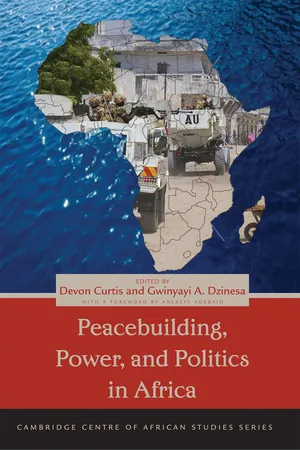
eBook - ePub
Peacebuilding, Power, and Politics in Africa
- English
- ePUB (mobile friendly)
- Available on iOS & Android
eBook - ePub
Peacebuilding, Power, and Politics in Africa
About this book
Information
PART ONE
Peacebuilding: Themes and Debates
ONE
Peace as an Incentive for War
DAVID KEEN
THIS CHAPTER LOOKS AT THE INCENTIVES FOR FURTHER VIOLENCE that may be established by peace agreements. It does not aim for a comprehensive discussion but rather seeks to highlight a key element of building peace that has been somewhat neglected both at the policy level and in academic discussions. This is risk of “incentivizing” further violence through the very act of peacemaking.
The question of how “inclusive” or “exclusive” a peace agreement should be is a difficult and critical one. A considerable measure of inclusion of the main armed groups—both at the negotiating table and in government—would appear to be necessary. Why else would they agree to lay down their arms? The case of Liberia is instructive here. In the four years prior to the 1996 Abuja II peace agreement, as Adekeye Adebajo has shown,1 the Economic Community of West African States (ECOWAS), through its Cease-Fire Monitoring Group (ECOMOG), made a serious attempt to marginalize Liberian warlords and support a civilian government in Monrovia. Yet peace agreements in this period simply did not stick, as powerful warlords refused to disarm and clung to their profitable economic activities. By 1996, subregional mediators exhibited a new determination to bring warlords into political power in Monrovia. Distasteful as this “warlords’ peace” was, it had the significant advantage that the agreement could actually be implemented; in this new climate, both demobilization and elections became possible.2
The constraints imposed by warring parties may be severe; but going too far in the direction of including and appeasing war leaders may damage equity, deepen impunity, and store up trouble for the future. There are grave dangers in excluding civil society and politicians not linked to armed groups. A key problem is the signal sent out: in particular, it may sometimes be difficult to discern the exact difference between rewarding people for giving up violence and rewarding people for taking it up.
Armed groups have proliferated in many conflicts, and there may be many political interests who might potentially turn to arms if their grievances are not met. To what extent should a peace process embrace a proliferation of armed groups? Is it possible that a peace process could itself encourage such proliferation?
Incentive-based approaches to peacemaking tend to focus on the violent (who constitute the immediate problem) while often ignoring those who have not (or not yet) been drawn into participation in violent processes. By contrast, those emphasizing a need for justice and an “end to impunity”—including human rights organizations—tend to focus on the importance of signals, notably to those who might one day contemplate violence. However, the advocates of both positions often “talk past” each other.
Incentivizing Violence: Three Mechanisms
There are three key incentive problems when it comes to peacemaking. The first key danger is that a peace process may exclude major armed groups taking part in a war, who will therefore have little incentive to abide by the peace. An extreme example was the 1997 Khartoum Peace Agreement in Sudan, an agreement that actually excluded the main rebel organization, the Sudan People’s Liberation Army (SPLA), and predictably did not bring the war to an end. Also in Sudan, the May 2006 Darfur Peace Agreement was not accepted by two of the three rebel factions, and the Khartoum government then set about attacking and intimidating the nonsignatories, in alliance with the one faction (under Minni Minawi) that had signed the agreement. The exclusion of the Arab militias—often referred to as Janjaweed—from the Darfur peace process has also caused significant risks.
A second problem is that even when the main armed groups are represented, the underlying causes of violence are likely to remain unaddressed. In particular, where large sections of civil society are excluded, this will tend to prolong or even exacerbate the grievances of ordinary citizens. What forms of corruption are being institutionalized in a particular peace process? Economic initiatives may help cement a peace agreement between armed factions, perhaps by providing the right mix of incentives and disincentives, but a key danger is that deep fissures in the society may simply be “papered over.” In practice, armed actors who have been able to use violence to secure control of production, trade, and emergency aid in wartime may be able to carve out for themselves a degree of control over production, trade, and development and reconstruction aid after a peace settlement.3 By consolidating exploitation and corruption, an exclusive peace agreement may store up problems for the future.4 When civilians fall victim to an exclusionary peace agreement that institutionalizes corruption, this may sometimes be an extension of collaborative warfare that targeted and exploited civilians.5
The dangers of consolidating corruption and exploitation were illustrated in the case of Liberia. What looks to some people like realism and pragmatism may look to others like appeasement. After the 1995–96 Abuja II peace process had brought a number of warlords (most notably Charles Taylor) into the political settlement, Taylor, who was subsequently elected president in 1997, proved unwilling to engage in substantial reform of the security services while promoting widespread corrupt practices and harassing civil society and the press.6 In Sierra Leone, the controversial appointment of Revolutionary United Front (RUF) leader Foday Sankoh as vice president and head of a new mineral resources commission (under the 1999 Lomé Peace Agreement) was profoundly offensive to many Sierra Leoneans: it looked even more distasteful when the RUF returned to war in 2000.7 The 2003 peace agreement in the Democratic Republic of the Congo (DRC), while in many ways a step forward, was also seen by many as a kind of “warlords’ peace” that entrenched the exploitation of economic resources by various military commanders, often with foreign backing, who were given a degree of power within the state apparatus and a degree of political legitimacy.8
An earlier and revealing example of a political fix that “papered over” important societal grievances came at the end of Sudan’s first civil war. The 1972 Addis Ababa Peace Agreement, which ended Sudan’s first civil war, included important concessions to the southern rebels, such as incorporation into the national army, but it did not produce the kind of accountable political system that was capable of remedying the extreme underdevelopment of the south or the marginalization of significant groups within the north. In effect, a military government entered into alliance with former rebels at the expense of rival political forces within the north. When President Jaafar Nimeiri and his successors courted some of the discontented elements in the north (especially the western part of northern Sudan) during the 1980s, the south was left without protection. In these circumstances, the limited economic rehabilitation in the south after the first civil war served merely to regenerate resources, notably cattle, that could be raided by disgruntled northern pastoralists allied to the government.
Twenty-three years after the Addis Ababa agreement, Sudan’s 2005 Comprehensive Peace Agreement (CPA), which ended Sudan’s second civil war, also carried the seeds of major problems in relation to opposition groups in the north. The agreement excluded the opposition National Democratic Alliance, and the CPA allocated only 14 percent of positions in the national and state executive and legislative branches to the northern opposition, compared to 52 percent to the National Congress Party and 28 percent to the Sudan People’s Liberation Movement (SPLM).9 As in 1972, peace meant an alliance with the southern rebels but also an exclusion of many elements of northern, and even southern, civil society. Opponents of the current regime have included those Muslims who hoped, wrongly as it turned out, that common religion could be a basis for common citizenship; with southern secession, many in the north also fear that they will now have no option but to become part of an Islamic state.10 Key grievances in the north have included, first, years of neglect by the government and, second, the loss of access to land by both smallholders and pastoralists as a result of the expansion of Sudan’s large semimechanized farms.11 Leben Moro has presented the north-south peace in Sudan as a rather exclusive business, even in terms of the south. This is manifest, for example, in the difficulty that many displaced people have experienced in returning to oil-rich areas that the government in Khartoum, which came to include the SPLM/A, was interested in exploiting.12
Away from Africa, many similar concerns have attached themselves to peace agreements. In Cambodia in the 1990s, the institutionalization of corruption in a peace process helped deprive the treasury of revenue, and this was subsequently a source of some instability.13 In Tajikistan following the 1992–97 civil war, a considerable degree of stability has been brought about by a peace process that effectively “bought off” a range of warring factions, not least with the benefits of a privatization program. However, the entrenchment of corruption and of oligopolistic markets has raised concerns about the long-term sustainability of this peace.14 In the former Yugoslavia, the 1995 Dayton Peace Agreement can be seen as rewarding local elites who had already rewarded themselves through violent accumulation in wartime.15
In Afghanistan, as Antonio Giustozzi has highlighted, warlords have tried to use peace agreements to become “respectable” and to consolidate their ill-gotten gains; indeed, this impulse may even help to explain why elements of peace became possible.16 Some analysts suggest that during negotiations over the composition of an interim government starting in November 2001 in Bonn, the United States, in concert with senior United Nations (UN) officials, actually strengthened the morale of, and support for, Afghan warlords (some of them described as “paper tigers”) at a moment when they could have been weakened.17 It appears that concerns beyond “human security” were influential, including the need to “incentivize” and then reward allies in the Northern Alliance in the context of the “war on terror” and the US-led war against the Taliban. One of the longer-term problems that resulted was that powerful warlords were able to withhold a great deal of customs revenue from the center, making reconstruction and restoring some kind of central authority more difficult. As Ahmed Rashid wrote in 2007: “The lack of developmental activities in the south [of Afghanistan] has resulted in part from [President Hamid] Karzai’s failure to purge corrupt or drug-trafficking officials from powerful positions. This has fuelled disillusionment among Pashtuns, the dominant ethnic group in southern and eastern Afghanistan, many of whom are now offering to fight or at least offer sanctuary to the Taliban.”18
A third problem is that peace agreements may actually reward violent behavior, sending potentially damaging signals perhaps internationally as well as nationally about the utility of violence. These signals may be acted upon by a variety of (excluded) groups within a country that is ...
Table of contents
- Cover
- Title
- Copyright
- Contents
- Foreword
- Acknowledgments
- Abbreviations
- Introduction: The Contested Politics of Peacebuilding in Africa
- Part I: Peacebuilding: Themes and Debates
- Part II: Institutions and Ideologies
- Part III: Case Studies
- Bibliography
- Contributors
- Index
Trusted by 375,005 students
Access to over 1.5 million titles for a fair monthly price.
Study more efficiently using our study tools.
Frequently asked questions
Yes, you can cancel anytime from the Subscription tab in your account settings on the Perlego website. Your subscription will stay active until the end of your current billing period. Learn how to cancel your subscription
No, books cannot be downloaded as external files, such as PDFs, for use outside of Perlego. However, you can download books within the Perlego app for offline reading on mobile or tablet. Learn how to download books offline
Perlego offers two plans: Essential and Complete
- Essential is ideal for learners and professionals who enjoy exploring a wide range of subjects. Access the Essential Library with 800,000+ trusted titles and best-sellers across business, personal growth, and the humanities. Includes unlimited reading time and Standard Read Aloud voice.
- Complete: Perfect for advanced learners and researchers needing full, unrestricted access. Unlock 1.5M+ books across hundreds of subjects, including academic and specialized titles. The Complete Plan also includes advanced features like Premium Read Aloud and Research Assistant.
We are an online textbook subscription service, where you can get access to an entire online library for less than the price of a single book per month. With over 1.5 million books across 990+ topics, we’ve got you covered! Learn about our mission
Look out for the read-aloud symbol on your next book to see if you can listen to it. The read-aloud tool reads text aloud for you, highlighting the text as it is being read. You can pause it, speed it up and slow it down. Learn more about Read Aloud
Yes! You can use the Perlego app on both iOS and Android devices to read anytime, anywhere — even offline. Perfect for commutes or when you’re on the go.
Please note we cannot support devices running on iOS 13 and Android 7 or earlier. Learn more about using the app
Please note we cannot support devices running on iOS 13 and Android 7 or earlier. Learn more about using the app
Yes, you can access Peacebuilding, Power, and Politics in Africa by Devon Curtis, Gwinyayi A. Dzinesa, Devon Curtis,Gwinyayi A. Dzinesa in PDF and/or ePUB format, as well as other popular books in Politique et relations internationales & Politique africaine. We have over 1.5 million books available in our catalogue for you to explore.