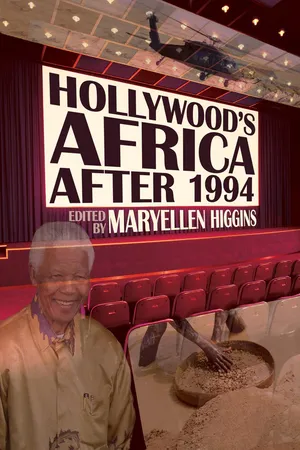
Hollywood’s Africa after 1994
Edited by MaryEllen Higgins
Ohio University Press • Athens
Ohio University Press, Athens, Ohio 45701
ohioswallow.com
© 2012 by Ohio University Press
All rights reserved
To obtain permission to quote, reprint, or otherwise reproduce or distribute material from Ohio University Press publications, please contact our rights and permissions department at (740) 593-1154 or (740) 593-4536 (fax).
Cover art: Background photo, courtesy istockphoto.com; top: UH-60 Blackhawk,
courtesy Suzanne M. Jenkins, USAF; bottom left: Nelson Mandela in Johannesburg, Gauteng, on 13 May 1998, courtesy South Africa The Good News; bottom right: A miner in Kono District, Sierra Leone, searches his pan for diamonds, courtesy USAID Guinea.
Cover design by Beth Pratt
Printed in the United States of America
Ohio University Press books are printed on acid-free paper ƒ ™
20 19 18 17 16 15 14 13 12 5 4 3 2 1
Library of Congress Cataloging-in-Publication Data
Hollywood’s Africa after 1994 / edited by MaryEllen Higgins.
p. cm.
Includes bibliographical references and index.
ISBN 978-0-8214-2015-7 (pb : alk. paper) — ISBN 978-0-8214-4433-7 (electronic)
1. Africa—In motion pictures. 2. Human rights in motion pictures. 3. Imperialism in motion pictures. 4. Culture conflict in motion pictures. 5. Motion pictures—United States—History—21st century. I. Higgins, MaryEllen, 1967–
PN1995.9.A43H65 2012
791.43'651—dc23
2012032543
Contents
Hollywood’s Africa after 1994 i
Contents vi
Introduction 2
African Blood, Hollywood’s Diamonds? 2
Chapter 1 The Cited and the Uncited 16
Chapter 2 The Troubled Terrain of Human Rights Films 36
Chapter 3 Hollywood’s Representations of Human Rights 55
Chapter 4 Hollywood’s Cowboy Humanitarianism in Black Hawk Down and Tears of the Sun 69
Chapter 5 Again, the Darkness 84
Chapter 6 Ambiguities and Paradoxes 97
Chapter 7 Minstrelsy and Mythic Appetites 111
Chapter 8 “An Image of Africa” 126
Chapter 9 Plus Ça Change, Plus C’est la Même Chose 144
Chapter 10 New Jack African Cinema 158
Chapter 11 “It Is a Very Rough Game, Almost as Rough
as Politics” 179
Chapter 12 “Every Brother Ain’t a Brother” 195
Chapter 13 Coaxing the Beast Out of the Cage 209
Chapter 14 Situating Agency in Blood Diamond and Ezra 224
Chapter 15 Bye Bye Hollywood 242
Contributors 263
index 267
Introduction
African Blood, Hollywood’s Diamonds?
Hollywood’s Africa after 1994
maryellen higgins
At the conclusion of Edward Zwick’s Blood Diamond, Ambassador Walker lectures an audience about the complicity of Westerners in the human crises fueled by conflict diamonds in Sierra Leone. The target audience for Walker’s speech is not the actors playing attendees at the staged meeting in Kimberley, South Africa, of course, but rather the spectators watching the film. Walker announces:
Solomon Vandy, a humble Mende fisherman, approaches the podium. But before he utters his first word, the film ends, and the screen goes dark. In the film’s postscript, viewers are urged to insist that their diamonds are conflict free. Ironically, Solomon’s voice remains ignored as the film credits roll.
What are the messages conveyed in this moment? Does the severing of Solomon’s speech suggest that there is not yet an African (or “Third World”) perspective—that there are no grassroots African authorities, no African humanitarians who can take the microphone and offer a new perspective? Or does Zwick implicate Hollywood itself, so that the framing of Solomon’s silence reads as a running commentary on Hollywood’s perpetual denial of African agency? Are we expected to fill in the blankness of Solomon’s voice, rendering him an everlasting mute victim, unable to achieve liberation without our assistance?
We might also look at this scene in the context of another Hollywood blockbuster: King Solomon’s Mines, based on H. Rider Haggard’s best-selling 1885 novel, which has been adapted for movie and television screens on at least six occasions. King Solomon’s Mines epitomizes the imperial rationale: white adventurers arrive in Africa to locate hidden treasures that belonged to a biblical king, but also to save friendly, noble Africans from evil, monstrous tyrants. In 2006, Blood Diamond re-presents an African character named Solomon who reveals the location of a precious diamond in exchange for white protection against murderous African militants. In Zwick’s reframing of the colonial narrative, Solomon is not an ancient king but a Mende fisherman, and diamonds are viewed not as glamorous jewels for the taking, but as catalysts for bloody conflicts linked to human rights abuses in Sierra Leone’s civil war. Zwick transmits a new cast of characters onto the African scene: greedy European corporate magnates, shady international arms dealers, and human rights advocates in the Kimberley Process initiative.
In recent films set in Africa starring Hollywood celebrities, human rights issues have become a major thrust. A close inspection of some of the most interesting new “Africa films” reveals a mixing of human rights concerns with familiar figures from what V. Y. Mudimbe describes as the “colonial library” (1994, 17), figures that have been revived and cleverly revised in a new century. The legendary David Livingstone, a nineteenth-century Scottish missionary doctor, is resuscitated cinematically in 2006 through the figure of Nicholas Garrigan, a Scottish doctor who loses his way during a mission to Uganda in Kevin Macdonald’s thriller, The Last King of Scotland. There is a twist here, too. Previous Hollywood films tended to glorify Livingstone’s “civilizing mission” in Africa: the tagline of Henry King and Otto Brower’s 1939 Stanley and Livingstone reads, “The most heroic exploit the world has known! Into the perilous wilderness of unknown Africa . . . Heat . . . fever . . . cannibals . . . jungle . . . nothing could stop him!” In contrast, the Scottish protagonist in The Last King of Scotland befriends the tyrannical Ugandan president Idi Amin Dada, provides information that leads to the execution of Amin’s opponents, and fails to save anyone. Dr. Livingstone’s “three C’s”—commerce, Christianity, and civilization—are replaced by Dr. Garrigan’s covetousness, corruption, and complicity.
This collection questions whether recent cinematic depictions of Africa adapt colonial fictions in order to subvert them, or whether they serve, ultimately, to reproduce colonialist ideologies. Crafted and reinforced by European and North American missionaries, travel writers, and filmmakers, colonial narratives consistently referenced Africa as a dangerous or exotic territory, as the pinnacle of horror and savagery, and as the recipient of the West’s benevolent, heroic humanitarianism. The argument here is not that all of the films examined in the volume fall neatly under the rubric of Hollywood cinema; instead, our focus is on the fate of what Kenneth Cameron calls the “complex of received ideas” about Africa that Hollywood has perpetuated (12). The chapters that follow examine big-budget, celebrity-studded films produced and distributed by major Hollywood studios but also independent films and transnational films that engage with Hollywood’s “Africa” archives. When recent films set in Africa revisit narratives of empire, are they recycled reinforcements of an imperial enterprise, nostalgic renderings of the past, revisionist engagements, creative attempts at atonement, anti-imperialist subversions, distractions, a blend?
The collection sets out not just to trace what remains of the colonial legacy in Hollywood, but to contemplate what has changed in Hollywood’s updated projections of Africa. How do we read twenty-first-century projections of human rights issues—child soldiers, genocide, the exploitation of the poor by multinational corporations, dictatorial rule, truth and reconciliation—within the contexts of celebrity humanitarianism, “new” military humanitarianism, and Western support for regime change in Africa and beyond? Do the emphases on human rights in the films offer a poignant expression of our shared humanity, do they echo the inequities of former colonial “civilizing missions,” or do human rights violations operate as yet another mine of grisly images for Hollywood’s dramatic storytelling? Does the continent serve as a stage for redemption and reconstituted intervention during a time when American and British military operations abroad have received intense global scrutiny?
The year 1994 was selected as a starting point for several reasons. The Rwandan genocide of 1994 pricked the consciousness of human rights advocates worldwide, and Hollywood celebrities responded. Human rights activists have looked to film as a medium to circulate images and interpretations of human rights violations in Africa, and to motivate viewers to participate in human rights campaigns. The DVD version of Annie Sundberg and Ricki Stern’s The Devil Came on Horseback (2007), a documentary about US marine captain Brian Steidle’s travels through Darfur, promises that for every copy sold, a dollar is donated to Save Darfur. Terry George’s Hotel Rwanda (2004) would not be released until a decade after the Rwandan genocide, yet the prominent media presence of Hotel Rwanda’s leading actor, Don Cheadle, in the Save Darfur movement underscores the role of Western filmmaking and Western celebrities in the process of “raising awareness” about African conflicts—what Heike Härting describes as the development of a Western “humanitarianist consciousness” (2008, 63). On the DVD version of Hotel Rwanda, Don Cheadle speaks about the heroism of the nonfictional Paul Rusesabagina, whose character he plays in the feature film. Immediately after, Cheadle urges viewers to take action for victims in Darfur. The Save Darfur movement saw film as a vehicle to prompt agitation against oppression in Africa, yet what kind of activism is generated when the exposition of the Darfurian context is based not on historical or political knowledge, as Mahmood Mamdani observes, but on the Rwanda analogy? Several contributors to this volume perceive that films about human rights violations in Rwanda, Darfur, and Sierra Leone base their pleas on analogies, disturbing images, and sentimental narrators; the assumed humanitarian gaze is dictated by the camera’s frame in a move that privileges what Mamdani calls “evidence of the eyes” over...