Explores liturgical practice as formative for how three Victorian women poets imagined the world and their place in it and, consequently, for how they developed their creative and critical religious poetics.
This new study rethinks several assumptions in the field: that Victorian women's faith commitments tended to limit creativity; that the contours of church experiences matter little for understanding religious poetry; and that gender is more significant than liturgy in shaping women's religious poetry.
Exploring the import of bodily experience for spiritual, emotional, and cognitive forms of knowing, Karen Dieleman explains and clarifies the deep orientations of different strands of nineteenth-century Christianity, such as Congregationalism's high regard for verbal proclamation, Anglicanism's and Anglo-Catholicism's valuation of manifestation, and revivalist Roman Catholicism's recuperation of an affective aesthetic. Looking specifically at Elizabeth Barrett Browning, Christina Rossetti, and Adelaide Procter as astute participants in their chosen strands of Christianity, Dieleman reveals the subtle textures of these women's religious poetry: the different voices, genres, and aesthetics they create in response to their worship experiences. Part recuperation, part reinterpretation, Dieleman's readings highlight each poet's innovative religious poetics.
Dieleman devotes two chapters to each of the three poets: the first chapter in each pair delineates the poet's denominational practices and commitments; the second reads the corresponding poetry. Religious Imaginaries has appeal for scholars of Victorian literary criticism and scholars of Victorian religion, supporting its theoretical paradigm by digging deeply into primary sources associated with the actual churches in which the poets worshipped, detailing not only the liturgical practices but also the architectural environments that influenced the worshipper's formation. By going far beyond descriptions of various doctrinal positions, this research significantly deepens our critical understanding of Victorian Christianity and the culture it influenced.
eBook - ePub
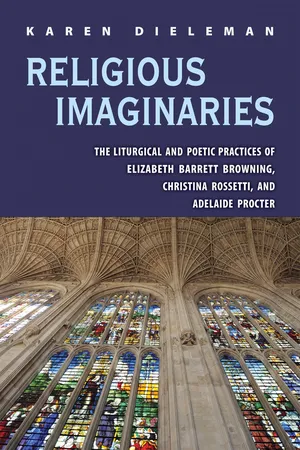
Religious Imaginaries
The Liturgical and Poetic Practices of Elizabeth Barrett Browning, Christina Rossetti, and Adelaide Procter
- English
- ePUB (mobile friendly)
- Available on iOS & Android
eBook - ePub
Religious Imaginaries
The Liturgical and Poetic Practices of Elizabeth Barrett Browning, Christina Rossetti, and Adelaide Procter
About this book
Information
Topic
LittératureCHAPTER ONE
TRUTH AND LOVE
ANCHORED IN THE WORD
Elizabeth Barrett Browning’s Religious Imaginary
Because Barrett Browning’s connection to Congregationalism in her adult life has been under-recognized to date, this chapter necessarily begins with remapping the poet’s postmarriage religious commitments. Though somewhat preliminary to the main argument of the chapter, the opening pages resituate Barrett Browning within—or at least close to—a church group that has mistakenly been judged in its midcentury character by the theology and practice of an earlier time. The mistake matters for literary studies because it has marred our perception of the importance of religion to arguably the most important woman poet of the period. Certain of Barrett Browning’s remarks have led to suppositions that the poet distanced herself from her earlier commitment to Congregationalism; consequently, while critics have rightly ascribed innovation and independence to her, some have also underplayed or denied an ongoing religious context that actually reveals her innovation and independence more forcefully. In aligning the mature poet and her remarks more closely with Congregationalism and its affiliates than others have done, I do not mean to limit Barrett Browning as a religious thinker and writer; in fact, I see the clarifications I offer on Barrett Browning’s theology vis-à-vis Congregationalist teaching as somewhat ancillary to my main focus, which is on religious practice. Nevertheless, religious practice, to be rightly understood, must be situated within its denominational context. I hope in doing so to advance our knowledge of Barrett Browning’s creativity, originality, and skill as a writer of religious poetry, by exploring in detail the religious imaginary that stands behind her creative work, an imaginary developed within and by the poet’s chosen church affiliations.
Once the grounds for seeing Barrett Browning as linked with Congregationalist and like-minded churches throughout her life have been established, the chapter proceeds with its main purpose, which is to explicate the enabling as well as the challenging dimensions of the Congregationalist ethos broadly, and its liturgy specifically, for the formation of a woman adherent’s religious imaginary and poetic voice. In Congregationalism, the verbal dimensions of worship took precedence over visual, meditative, or ceremonial possibilities, because they best illustrated—and, in reciprocal motion, formed—the deepest postures of Congregationalism: its valuation of Scripture as the highest authority and of intellectual and spiritual independence as necessary for every believer and congregation. Sermons and hymns thus figure importantly in Congregationalist worship, because they create and reinforce Word/ word centrality and dialogic-democratic temperament. From these modes, I believe, Barrett Browning shaped her religious-poetic experiments. She first pursued the emotive and generic opportunities offered by the relatively new religious-literary field of hymn writing. Later she turned to expansive poetic forms such as the dramatic lyric, lyrical drama, and epic-narrative hybrid. These forms, while emulating the sermon in scope and interpretive work, also permit more substantial dialogue among speakers than does the lyrical voice of the hymn. Moreover, the Congregationalist grassroots concept of the preacher played an important role in Barrett Browning’s thinking about the (woman) poet. With it, she modified the prevailing Romantic paradigm of the poet as an authoritative, prophetic figure. Yet even while she employed these liturgical models and figures, Barrett Browning also experimented with them, remaining alert to a larger cultural context that challenged some of the denomination’s practices. The most significant dimensions of Barrett Browning’s poetic development arise, I argue, when the hymn and sermon become spaces where religious thought and language confront both a Victorian ideology of gender that distinguished between men’s and women’s modes of being and of expressing themselves, and a Victorian homiletic theory that called (male) preachers to infuse their sermonic expositions with a more feeling (that is, “feminine”) language. Congregationalism did not escape these issues. Attentive as it was to hymn and sermon—that is, to word-oriented practices—it had to consider what kind of speaker and what kind of language best served the goals of religion. As a woman participating in such language-laden practices, Barrett Browning, too, considered the point: If an intellectually sophisticated language expresses religious truth best, then how might a woman poet write in an age when gender theory assigns the intellectual primarily to men? If an emotive or passionate language expresses religious truth best, how might a woman poet committed to serious, scriptural interpretation—as is the preacher—produce work that moves beyond the sentimentalism expected of her as a woman? Word-orientation, independence, dialogism, style: these matters frame my study of Barrett Browning, with the present chapter exploring her religious imaginary as generated within (and sometimes against) the Congregationalist liturgy, particularly hymn and sermon; and the next chapter reading mainly her religious poetry as creatively and critically arising from this imaginary.
Barrett Browning, Congregationalism, and the Free Church of Scotland
Barrett’s early and well-known association with Congregationalism needs only a brief recounting here.1 The poet’s diary and early correspondence tell of Barrett’s regular participation (excepting periods of illness) in Congregationalist gatherings such as the Hope End schoolhouse-chapel, Sidmouth Marsh Independent Chapel, and London Paddington Chapel.2 By contrast, Barrett Browning’s postmarriage correspondence does not name any Congregationalist chapels among her places of worship. This absence—especially when coupled with such remarks as “There is nobody in the world with a stronger will & aspiration to escape from sectarianism in any sort of sense” (BC, 8:76); “[I am] a believer in a Universal Christianity” (BC, 9:120); and “I could pray anywhere & with all sorts of worshippers, from the Sistine chapel to Mr. Fox’s [Unitarian chapel]” (BC, 11:10)—has led critics to conclude that the poet moved toward heterodoxy or outright disavowal of organized religion. Simon Avery, for example, states that during her years in Italy, Barrett Browning increasingly “took up the firm dissenting stand of staying at home to read and interpret the gospels by herself.”3 However, although illness certainly kept Barrett Browning at home much of the time, she remained invested in communal worship throughout her life. In her thirties, she affirmed to William Merry that a “rational person” could, without being called a “controversialist,” “class himself or herself with the particular class of Christians which appears to approach nearest his or her view of Scriptural truth” (BC, 8:47); continuing the conversation in her next letter, of early 1844, she identified the “class of Christians” she chose as her own: “I am not a Baptist—but a Congregational Christian,—in the holding of my private opinions” (BC, 8:150). When she and Robert discovered during their courtship that their religious ideas resonated well together, she wrote to him, “You go quickest there, where your sympathies are least ruffled & disturbed—& I like, beyond comparison best, the simplicity of the dissenters.” She then qualified her remark about being able to pray anywhere, even in Fox’s Unitarian chapel, with the statement, “I would prefer as a matter of custom, to pray in one of these chapels, where the minister is simple-minded & not controversial,—certainly wd. prefer it. Not exactly in the Socinian chapels, nor yet in Mr. Fox’s—not by preference” (BC, 13:154). These statements in themselves caution against any quick conclusion as to Barrett’s rejection of Congregationalism or, more broadly, of organized religion. More substantially, though, other evidence points to a sustained—though not uncritical—relationship with the denomination.
To uncover that evidence requires a brief foray into church history. W. B. Selbie’s study of Congregationalism reveals that the denomination, rooted in sixteenth-century England, formed also in Scotland, Ireland, Wales, America, Canada, Australia, and other outreaches of the British Empire, but not in Europe.4 That is to say, Barrett Browning never had the opportunity in Europe to affiliate herself in public worship with Congregationalists so-named. But her sense of fellowship with Congregationalism continued, though it necessarily appeared in a different guise, primarily as an affiliation with the Free Church of Scotland. The Free Church of Scotland began in 1843 when it broke from the (Scottish) Established Church over the question of legislative authority.5 In resisting the increasingly heavy-handed practice of patronage appointment of ministers and the civil courts’ enforcement of that practice, the Free Church declared its own principles to be those of “non-intrusion and spiritual independence”; further, whereas members of the Established Scottish Church could declare, “What makes the church of Scotland, but the law [of the land]?” the Free Church emphatically stated, “God is her Author, Christ is her King, and the Bible is her law.”6 In these declarations, the Free Church of Scotland endeared itself to Congregationalists, who appreciated the convictions that led to independent establishment. Though their views on the sacrament of the Lord’s Supper differed somewhat—a point to which I will return—Congregationalists and adherents of the Free Church concurred on most theological and liturgical points. In fact, in Scotland many Congregationalists were absorbed into this newly established Free Church,7 while in London they quickly became acquainted with these like-minded believers when the majority of churches in the London “Scots Kirk” Presbytery decided, also in 1843, “to sever connection with the Church of Scotland” and become “Free.”8 These Free Churches existed in good harmony with Congregationalist churches, often in near proximity.9 Barrett seems early to have recognized the affiliations between the two groups. When she desired to attend church a few weeks before her marriage, but not amid the crowds of worshippers at her Congregationalist Paddington Chapel, she went with Arabella to what she called the “Scotch church” in her neighborhood (BC, 13:284); as the guest preacher of the day later noted, this church was “the chapel of Mr. Chalmers (Free Church),” not the Established Scottish Church (BC, 13:286n7).
A London Congregationalist relocating to Europe would mostly likely, then, have sought the Free Church of Scotland as an alternative place of worship. Because of the work of its Continental Committee, the Free Church of Scotland had a presence in several important European cities in the nineteenth century.10 Barrett Browning repeatedly referred to it in her letters to Arabella. As before, she called it the “Scotch church” and frequently expressed either a longing for or a satisfaction at finding this church in her neighborhood. At Pisa, she wished “the Scotch church at Leghorn were here.”11 In Paris, where no Scotch church had been established, she attended the Reformed churches, which she referred to, not insignificantly, as “the French independents” (LA, 1:407, 436, 485; 2:182, 239). True, she also expressed appreciation for the pastor of the Paris church associated with the Newman Street churches of London (later named the Catholic Apostolic Church and led by Edward Irving), but she based her regard on private encounters with him and made a point of saying she had never been to Mr. Carré’s church (LA, 1:483–85). Upon arriving in Florence, she and Robert first chose rooms that had the “advantage” of having “the French protestant church close by” (LA, 1:178), but when, two years later, a Scotch church was established there, they began attending its services instead (LA, 1:323, 347, 524). The minister in this church, Robert Maxwell Hanna, had been ordained at Girthon and Anwoth, Scotland, in 1844, in a congregation that had “gone out” of the Establishment the year before; he arrived in Florence in 1850 to serve the Free Church of Scotland there,12 and he was highly regarded by both Brownings (LA, 1:323). In Rome, the Brownings attended St. Peter’s on Christmas Day, a visit often taken as evidence of their ecumenicalism; but Barrett Browning’s account of the experience reads more like a tourist’s report than a worship participant’s: “It was warm enough to admit of my going out to St Peters to hear the grand mass. It was very fine, the spectacle (two Kings present besides pope & cardinals) & the music most affecting” (LA, 2:199). Moreover, she wrote to Arabella that their usual practice was to “attend the Presbyterian worship in a private room of the American embassy” (LA, 2:52). Once again, this small gathering was the Scotch church. During the last years of her life, when no longer able to attend church herself, Barrett Browning, having allowed her son, Pen, to visit numerous Roman Catholic churches with his nurse in his early years, decided that, now that he was older, he should go with Robert to the Scotch church (LA, 2:269). Finally, whenever Barrett Browning returned to London to visit, she continued to attend the Congregationalist services at Paddington Chapel (LA, 2:172). Her worship pattern in Europe suggests it was not sisterly affection alone that caused her to join Arabella at these services.
Given this information, Barrett Browning scholarship needs to reexamine the assumption that the poet rejected her early religious affiliation later in life. To be sure, this reading derives from many of Barrett Browning’s own remarks. The poet declared Scripture to be indefinite about “any doctrine of particular election” (Diary, 122–23), the sacraments to be merely memorial signs and not instruments of grace (BC, 7:211), Isaac Watts’s hymns used in Congregationalist chapels to be not all in good taste (LA, 2:104), the impulse to sectarianism to be detestable (LA, 2:117), and the scriptural phrases about hell to be simply symbolic.13 When these remarks are set within the wider context of nineteenth-century Congregationalism, though, they produce a different effect than when read in isolation. Histories of nineteenth-century Congregationalism reveal that the denomination’s theology shifted over time, its parameters gradually widening. Gerald Parsons states of midcentury Congregationalists, “In practice the majority had quietly replaced the old ‘high Calvinist’ doctrine that only the elect would be saved by a more moderate, effectively Arminian, belief in the possibility of salvation for all.” Significantly, Parsons emphasizes the exploratory aspects of the Congregationalist approach to doctrine: “Nonconformists (and especially Congregationalists and Unitarians) explored various liberal and critical versions of theology.” He then specifies what three well-known Congregationalist ministers were teaching from their pulpits: “As early as the 1840s Thomas Binney was rejecting belief in eternal torment, and in 1846 Edward White expounded the view that immortality was found only in Christ and that the ungodly would not suffer eternal punishment but would be destroyed. . . . Others, among them Baldwin Brown, pressed further and advocated universalism and the eventual salvation of all.”14 These doctrinal shifts and contests with regard to salvation and the nature of hell were accompanied by changing attitudes to the sacraments and hymn singing. The midcentury Congregationalist minister R. W. Dale observed that, with regard to the sacraments, “the overwhelming majority” of Congregationalist ministers had given over the view that the benefit to the participant is brought to the sacrament by Christ in favor of the view that the efficacy of the sacrament is determined by the degree of faith the participant brings to it.15 About the denomination’s hymns, J. Briggs writes that a new tolerance crept into the hymns over the course of the century, a worry about claiming uniqueness.16 Congregationalist historian Albert Peel points out with regard to sectarianism that many Congregationalists resisted being formed into even a loose association among themselves lest they appear as an independent church rather than independent congregations.17 Now to reread Barrett Browning’s midlife declarations is to see just how well these expressions fall in line with the theological positions then being taken up by major Congregationalist figures in England. The poet’s divergence from some points of historic Protestant theology, in other words, is mid-nineteenth-century Congregationalism’s divergence. Although the Free Church of Scotland did not manifest these shifted theological positions (though at least one critic has described Thomas Chalmers—the leading figure in the Scottish Disruption of 1843—as “soft on Calvinism”18), Barrett Browning clearly maintained her Congregationalist sensibility while worshipping in the Scotch church. Though she told a friend in 1854 sh...
Table of contents
- Cover
- Half title
- Title
- Copyright
- Contents
- Acknowledgments
- Abbreviations
- Introduction
- 1 Truth and Love Anchored in the Word
- 2 “Truth in Relation, Perceived in Emotion”
- 3 “The Beloved Anglican Church of My Baptism”
- 4 Manifestation, Aesthetics, and Community in
- 5 “The One Divine Influence at Work in the World”
- 6 Religious-Poetic Strategies in Adelaide Procter’s Lyrics,
- Conclusion
- Notes
- Bibliography
- Index
Trusted by 375,005 students
Access to over 1.5 million titles for a fair monthly price.
Study more efficiently using our study tools.
Frequently asked questions
Yes, you can cancel anytime from the Subscription tab in your account settings on the Perlego website. Your subscription will stay active until the end of your current billing period. Learn how to cancel your subscription
No, books cannot be downloaded as external files, such as PDFs, for use outside of Perlego. However, you can download books within the Perlego app for offline reading on mobile or tablet. Learn how to download books offline
Perlego offers two plans: Essential and Complete
- Essential is ideal for learners and professionals who enjoy exploring a wide range of subjects. Access the Essential Library with 800,000+ trusted titles and best-sellers across business, personal growth, and the humanities. Includes unlimited reading time and Standard Read Aloud voice.
- Complete: Perfect for advanced learners and researchers needing full, unrestricted access. Unlock 1.5M+ books across hundreds of subjects, including academic and specialized titles. The Complete Plan also includes advanced features like Premium Read Aloud and Research Assistant.
We are an online textbook subscription service, where you can get access to an entire online library for less than the price of a single book per month. With over 1.5 million books across 990+ topics, we’ve got you covered! Learn about our mission
Look out for the read-aloud symbol on your next book to see if you can listen to it. The read-aloud tool reads text aloud for you, highlighting the text as it is being read. You can pause it, speed it up and slow it down. Learn more about Read Aloud
Yes! You can use the Perlego app on both iOS and Android devices to read anytime, anywhere — even offline. Perfect for commutes or when you’re on the go.
Please note we cannot support devices running on iOS 13 and Android 7 or earlier. Learn more about using the app
Please note we cannot support devices running on iOS 13 and Android 7 or earlier. Learn more about using the app
Yes, you can access Religious Imaginaries by Karen Dieleman in PDF and/or ePUB format, as well as other popular books in Littérature & Histoire moderne de la Grande-Bretagne. We have over 1.5 million books available in our catalogue for you to explore.