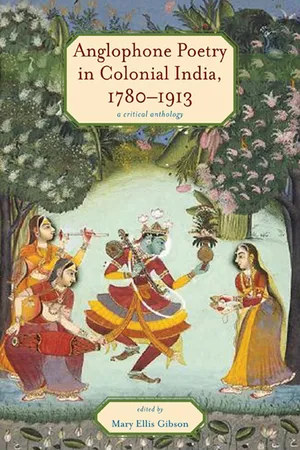
Anglophone Poetry in Colonial India, 1780–1913: A Critical Anthology makes accessible for the first time the entire range of poems written in English on the subcontinent from their beginnings in 1780 to the watershed moment in 1913 when Rabindranath Tagore won the Nobel Prize in Literature.Mary Ellis Gibson establishes accurate texts for such well-known poets as Toru Dutt and the early nineteenth-century poet Kasiprasad Ghosh. The anthology brings together poets who were in fact colleagues, competitors, and influences on each other. The historical scope of the anthology, beginning with the famous Orientalist Sir William Jones and the anonymous "Anna Maria" and ending with Indian poets publishing in fin-de-siècle London, will enable teachers and students to understand what brought Kipling early fame and why at the same time Tagore's Gitanjali became a global phenomenon. Anglophone Poetry in Colonial India, 1780–1913 puts all parties to the poetic conversation back together and makes their work accessible to American audiences.With accurate and reliable texts, detailed notes on vocabulary, historical and cultural references, and biographical introductions to more than thirty poets, this collection significantly reshapes the understanding of English language literary culture in India. It allows scholars to experience the diversity of poetic forms created in this period and to understand the complex religious, cultural, political, and gendered divides that shaped them.
- 360 pages
- English
- ePUB (mobile friendly)
- Available on iOS & Android
eBook - ePub
About this book
Trusted by 375,005 students
Access to over 1.5 million titles for a fair monthly price.
Study more efficiently using our study tools.
Information
Subtopic
19th Century HistoryIndex
LiteratureAPPENDIX
Comic and Satiric Poets of the Long Nineteenth Century

Quiz
Referring to The Grand Master; or, Adventures of Qui Hi in Hindostan: A Hudibrastic Poem in Eight Cantos by Quiz, the 1862 printing of the Bookseller’s Catalogue declares, “The intention of this work was to hold up to opprobrium the Marquis of Hastings, who was Governor-General of India, and also Commander-in-Chief, from Oct. 1813 to Jan. 1823. It was probably written by W.H. Ireland.” The author is now more widely believed to have been William Combe, a British satirical poet (1741–June 19, 1823). This attribution may also be flawed, for Combe appears to have never lived in India, and the poem attributed to him has a fluent command of Indian argot. Combe, however, did work in partnership with Thomas Rowlandson, a British caricaturist, on most of his books, and Rowlandson was clearly responsible for the highly amusing illustrations that accompanied The Grand Master. Qui hi, translated as “Is anybody there?” was the common term for servant and was used by Indians to mockingly refer to the British.
Sources
[William Combe,] The Grand Master; or, Adventures of Qui Hi in Hindostan: A Hudibrastic Poem in Eight Cantos by Quiz (London: Thomas Tegg, 1816). See also Willis and Sotheran, A Catalogue of Upwards of Fifty Thousand Volumes of Ancient and Modern Books: English and Foreign, in All Classes of Literature and the Fine Arts Including Rare and Curious Books (London: Willis and Sotheran, 1862).

from The Grand Master
Now, with ambitious hopes elated,
Our youth has been initiated
To all his honors, in a word,
Assumes the gorget, sash and sword,
5
Whether adorn’d with cat1 or lion,
Or plain G.R. we can’t rely on;
Our information only goes
To shew the colour of his cloths;
’Twas red, of course, this information,
10
Convinces you he serv’d the nation,
Whether a company or king,
The muse will not pretend to sing:
The reader may, if he’s inclin’d,
Make him serve which he has a mind,
15
And he’s at liberty to guess,
Of what description was his dress;
’Tis certain that his facings bore
The designation of his corps;
But whether black, or white or blue,
20
Is nothing now to me or you;
Or whether a mistake2 he made
By accident, and for them paid;
For sometimes it may be aver’d,
That subs pay only with their word.
25
(If an apology’s of use)
Necessity has some excuse,
For sad experience often shews
That poverty can truth oppose,
And subalterns, like others, find
30
Justice is rightly painted blind.
Dame fortune frequently bestows
On vice her wealth, on merit blows;
For, after many “a hair bread’th scape,”
Troubles and wants in evr’y shape,
35
He sees, with an indignant frown,
His airy castles tumbling down;
All his fair claims are soon forgot–
Mendacity must be his lot:
He scorns to act an abject part,
40
And droops beneath a broken heart.
Too well the Indian subs. can feel
The truth of what I here reveal;
How often, with a doleful face,
They pay for breakfast with their lace:3
45
They find the tenure of a sword,
Can scarcely bread and cheese afford,
While, ’tis a fact, tho’ strange to tell,
Riches attend the paltry quill.4
Civilian luxury attends
50
The powerful interest of friends,
While merit’s claim is scarcely heard,
Neglect its whole and sole reward:
But now the chearful smile of peace,
Has lighten’d every Briton’s face;
55
Now that John Bull with beef and beer,
Treats as a friend poor old Monsieur,
Nor casts a surly look from Dover,
Defying Monsieur to come over,
But lands him from the very boat,
60
Where he had vow’d to cut his throat;
With Boney’s fate John’s anger ends,
And Boney’s foes and now his friends.
Russians and Prussians, Swedes, and Poles,
Among his friends he now enrolls,
65
And Giles, with open mouth and hat off,
Takes every one for Marshal Platoff;
And this John Bull at once forgets,
Twenty years taxes, war, and debts.
Now with ...
Table of contents
- Cover
- Title
- Copyright
- Dedication
- Contents
- Acknowledgments
- A Note on Names
- Abbreviations
- Introduction
- Sir William Jones
- Sir John Horsford
- Anna Maria
- Lady Maria Nugent
- John Leyden
- James Atkinson
- Reginald Heber
- George Anderson Vetch
- Horace Hayman Wilson
- John Lawson
- Thomas Medwin
- Emma Roberts
- James Ross Hutchinson
- Henry Meredith Parker
- David Lester Richardson
- Honoria Marshall Lawrence
- Kasiprasad Ghosh
- Henry Louis Vivian Derozio
- Henry Page
- Sir John William Kaye
- E.L.
- Michael Madhusudan Dutt
- Shoshee Chunder Dutt
- Govin Chunder Dutt and The Dutt Family Album
- Mary Seyers Carshore
- Sir Edwin Arnold
- Greece Chunder Dutt
- Mary Eliza Leslie
- Sir Alfred Comyn Lyall
- Aru Dutt
- Toru Dutt
- John Renton Denning
- Rabindranath Tagore
- Laurence Hope [Adela Cory Nicolson]
- Rudyard Kipling
- Manmohan Ghose
- Joseph Furtado
- Aurobindo Ghose
- Sarojini Naidu
- Appendix: Comic and Satiric Poets of the Long Nineteenth Century
- Index of Authors
- Index of Titles
Frequently asked questions
Yes, you can cancel anytime from the Subscription tab in your account settings on the Perlego website. Your subscription will stay active until the end of your current billing period. Learn how to cancel your subscription
No, books cannot be downloaded as external files, such as PDFs, for use outside of Perlego. However, you can download books within the Perlego app for offline reading on mobile or tablet. Learn how to download books offline
Perlego offers two plans: Essential and Complete
- Essential is ideal for learners and professionals who enjoy exploring a wide range of subjects. Access the Essential Library with 800,000+ trusted titles and best-sellers across business, personal growth, and the humanities. Includes unlimited reading time and Standard Read Aloud voice.
- Complete: Perfect for advanced learners and researchers needing full, unrestricted access. Unlock 1.5M+ books across hundreds of subjects, including academic and specialized titles. The Complete Plan also includes advanced features like Premium Read Aloud and Research Assistant.
We are an online textbook subscription service, where you can get access to an entire online library for less than the price of a single book per month. With over 1.5 million books across 990+ topics, we’ve got you covered! Learn about our mission
Look out for the read-aloud symbol on your next book to see if you can listen to it. The read-aloud tool reads text aloud for you, highlighting the text as it is being read. You can pause it, speed it up and slow it down. Learn more about Read Aloud
Yes! You can use the Perlego app on both iOS and Android devices to read anytime, anywhere — even offline. Perfect for commutes or when you’re on the go.
Please note we cannot support devices running on iOS 13 and Android 7 or earlier. Learn more about using the app
Please note we cannot support devices running on iOS 13 and Android 7 or earlier. Learn more about using the app
Yes, you can access Anglophone Poetry in Colonial India, 1780–1913 by Mary Ellis Gibson in PDF and/or ePUB format, as well as other popular books in Literature & 19th Century History. We have over 1.5 million books available in our catalogue for you to explore.