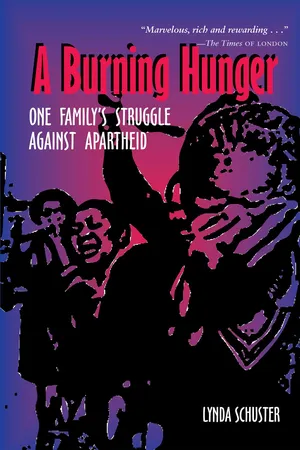
If the Mandelas were the generals in the fight for black liberation, the Mashininis were the foot soldiers. Theirs is a story of exile, imprisonment, torture, and loss, but also of dignity, courage, and strength in the face of appalling adversity. Originally published in Great Britain to critical acclaim, A Burning Hunger: One Family's Struggle Against Apartheid tells a deeply moving human story and is one of the seminal books about the struggle against apartheid. This family, Joseph and Nomkhitha Mashinini and their thirteen children, became immersed in almost every facet of the liberation struggle—from guerrilla warfare to urban insurrection. Although Joseph and Nomkhitha were peaceful citizens who had never been involved in politics, five of their sons became leaders in the antiapartheid movement. When the students of Soweto rose up in 1976 to protest a new rule making Afrikaans the language of instruction, they were led by charismatic young Tsietsi Mashinini. Scores of students were shot down and hundreds were injured. Tsietsi's actions on that day set in motion a chain of events that would forever change South Africa, define his family, and transform their lives. A Burning Hunger shows the human catastrophe that plagued generations of black Africans in the powerful story of one religious and law-abiding Soweto family. Basing her narrative on extensive research and interviews, Lynda Schuster richly portrays this remarkable family and in so doing reveals black South Africa during a time of momentous change.
- 472 pages
- English
- ePUB (mobile friendly)
- Available on iOS & Android
eBook - ePub
About this book
Information
Subtopic
African HistoryIndex
HistoryCHAPTER ONE
Nomkhitha and Joseph
The story of the Mashinini family begins more than 500 miles south of Johannesburg in the Transkei: the place of Nomkhitha’s birth. It is a world apart. Even before the apartheid government went through the charade of erecting a border marker, the boundary between white South Africa – with its paved roads, electric street lights, freshly watered lawns – and this black area was inescapable.
Here the dreamy, desolate landscape stretches for miles. There are few cars and little movement, save the occasional goat balanced on tiptoe to nibble at the thorny bushes. The distant mountains are ragged outcroppings of boulders, lightly smeared with green vegetation and topped with purple-blue shadows. Whitewashed huts dot the undulating hillsides.
For all its poverty of development, though, the Transkei is rich in political tradition. The first white missionaries settled here among the Xhosa people in the 1800s. Their arrival had a profound effect: the Xhosas – who lived in what used to be one of South Africa’s largest territorial divisions and numbered more than three million – were among the first blacks to be exposed to Western education. The Transkei became renowned for its missionary schools; the country’s first black university, Fort Hare, was established here. That so many black political thinkers and activists – Nelson Mandela among them – subsequently emerged from the region is hardly coincidental.
It was to these dual tendencies – education and politics – that Nomkhitha was born. Her mother, Olive Nonthuthuzlo, came from St Marks, a village dominated by its Anglican church. She was one in a long line of teachers – a not-unremarkable feat for women of that era. Her five sisters and one brother also had teaching certificates. Olive had been a quiet, serious girl with a beautiful singing voice and a penchant for netball; her great passion, though, was reading. Teaching suited her studious nature.
When the time came for Olive to marry, her father, a prosperous sheep farmer who had built St Marks’ first sizeable house, wanted an educated man for his daughter. Daniel Boto seemed an ideal match. Of royal blood, Daniel was a praise singer at the chief’s court, an interpreter in the local magistrate’s court (he spoke several languages), a respected politician, a successful farmer and a poet. This would be the widower’s second marriage. Daniel had fifteen children from his first marriage, the oldest of whom was Olive’s age.
On her wedding day, Olive left her parents’ home for Daniel’s village several miles away. Hers was a ‘white’ wedding, so called because Olive’s father could afford to buy a white gown. After the ceremony in St Marks’ church and a feast at her father’s house, Daniel hoisted Olive – still wearing the prized frock – into a covered wagon drawn by a team of oxen. White flags adorned the lead animal to show that this was a wedding party. Lest anyone miss the message, the bridegroom’s best men, astride horses bedecked in beads and white flags, preceded the wagon as a kind of honour guard. They rode at a breakneck speed, now doubling back around the wagon, now racing forward, trilling: ‘Li, li, li, li, hallelujah! Umtshato! It’s a wedding!’ Daniel moved the procession steadily forward. His wagon was loaded down with wooden trunks containing bed linen, towels, blankets, crockery and a bedroom set – all gifts provided by Olive’s family; a new bride was not supposed to ask her mother-in-law for anything.
The wagon came to rest in Bengu, a speck of a settlement. It sits at the end of a rock-strewn road that snakes for miles through the mountains from the white town of Lady Frere. A forlorn, wind-whipped place, Bengu has sweeping vistas of the land as it rolls gently towards the Great Kei river. Most of its inhabitants lived in shacks. Their floors were cold stone caked with dirt; they cooked on coal stoves that filled the tiny dwellings with acrid smoke; their meagre possessions were usually covered with a thick coating of flies.
Daniel’s house, as befitted his position, was Bengu’s grandest. Built of brown stone, it boasted three spacious rooms and several outhouses. He also owned a large tract of land. It was a rare thing for an African to own land; most blacks were tenant farmers, paying an annual rent to the government or to a white landlord. But Daniel had inherited part of the property from his father, with the rest bequeathed to him by the chief. He grew maize and wheat; in the orchard were peaches, apples, apricots and pomegranates. Daniel also raised goats, pigs, sheep, horses, cows, geese and shaggy-feathered chickens.
In this house, Olive gave birth to Virginia Nomkhitha – her name means ‘attractive’ in Xhosa – on 9 May 1935. A son, Mark, followed a couple of years later. The two children would soon become inseparable companions; by the time they started school, their half-siblings had all grown and moved to nearby villages. And so they did everything together: homework, play, household chores. (Neither was required to help in the fields or kraals, where the cattle were kept; hired hands did that work.) Their contrasting personalities complemented one another. Like Olive, Mark had a calm, gentle manner; Nomkhitha, on the other hand, emulated Daniel’s exuberance.
Theirs was an unconventional family for the times. Olive had to be away for most of the week; her teaching job in a village near Lady Frere was too distant for her to travel there and back every day. She would leave on Sunday night, riding her horse the fifteen miles to the school, and return on Friday. Much of the child rearing fell to Daniel. He came to favour Nomkhitha and Mark over his other children, but he still brought them up in strict African fashion.
Daniel woke before sunrise every morning to start a fire, then roused Nomkhitha and Mark with a hymn. They joined in the singing; the children knelt while their father prayed. Afterwards, Daniel shooed them outdoors to begin their chores. Bucket in hand, Nomkhitha and Mark had to fetch water from the river that meandered past the village. It was only a ten-minute walk to the riverbank, but the pail, once filled, felt unbearably heavy to a small, sleepy child. And the air could be achingly cold, especially in winter. Upon returning to the house, Nomkhitha and Mark had to sweep their room and dust the chairs. Only then would Daniel give them their breakfast of porridge, bread and tea.
On weekdays, Nomkhitha and Mark walked to school. Unlike many of their classmates, they had shoes, but they went barefoot when it rained to preserve them. After school finished in the early afternoon, Nomkhitha and Mark raced home to more chores. There was water to draw again, and laundry to be carried to the riverbank for washing. The children pounded the clothes on large rocks to get them clean and spread them across the tall grass; while waiting for the laundry to dry in the sun, Nomkhitha and Mark played. It was the best part of the day. They held running races, climbed the huge, overhanging trees, swam if the weather was warm. To dry off, Mark taught Nomkhitha different dance steps. He loved to sing too, although he hadn’t inherited Olive’s mellifluous voice; but he was a stunning dancer.
The children had to finish their homework by eight o’clock every evening. That was when they and Daniel (and Olive, when she was present) gathered in one room to pray. Then Daniel would read to Mark and Nomkhitha and regale them with stories of his travels or with intsomi, traditional Xhosa folktales that usually incorporated some sort of moral lesson.
Sundays were given over to church. Nomkhitha and Mark would jump the stone fence that separated their father’s property from the Methodist church next door; both liked attending the services, especially Mark, who was a server. Otherwise, Bengu offered little in the way of diversion. No one had a radio. Mail arrived weekly; newspapers came once a month, delivered by horse-drawn carriage. (The villagers learned of the outbreak of the Second World War only when white sugar suddenly disappeared from the shops and other foodstuffs became scarce.) The most valued entertainment was a visitor. The appearance of a traveller generated much excitement and extreme gestures of hospitality: water would be boiled, tea brewed, precious stores of biscuits brought out. And neighbours would crowd into the hot, dark room where the visitor was staying, eager for news of the outside.
Once a month, Daniel, Olive, Nomkhitha and Mark made the journey to Lady Frere. It was not a grand place: one dusty street filled with small shops and a scattering of churches. Still, it was a town; here you could buy things, catch up on gossip, feel a vitality and movement missing in Bengu. Nomkhitha and her family made a day of it. Dressed in their Sunday finery, they wandered from shop to shop, lingering over a bolt of fine cloth, admiring a stylish hat, exchanging pleasantries with a shopkeeper. (Olive, clearly an educated, Christian woman, was always treated courteously by the white shopkeepers.) When they had seen all that the town had to offer, Olive and Daniel purchased their stores of wheat, sorghum, mealie meal (ground corn) for the month, gathered up the children and began the long ride home.
Impelled by his religion and his position in the community, Daniel believed in sharing his wealth. If a man in the village died, Daniel slaughtered a cow to contribute to the ceremonies; for a child’s funeral, he gave a sheep. Every June, when little grew in the southern hemisphere winter and people were in the throes of what was called ‘the hungry season’, Daniel prepared a feast. He roasted a cow, brewed quantities of sorghum beer, and invited people from miles around. Many of the guests were ‘red people’, traditional Xhosas whose appellation came from the ochre clay they smeared on their bodies and faces. To Nomkhitha, the women were especially spectacular. They wore shawls folded in a square on their heads, skirts of animal skin, a piece of cloth tied around their breasts, and a sheepskin pouch in which to keep their inqawe, a wooden pipe, and tobacco. To complete their maquillage, some scraped out the sticky black ash from the inqawe with a twig and applied it to their lips or dotted it on their cheeks.
Although these festivities impressed Nomkhitha as a child, she was most taken with the rites of ancestor worship. African Christianity is overlaid with vestigial tribal rites; chief among them is belief in the ancestors. Daniel taught Nomkhitha to respect her forebears. They are your interlocutors with God, he explained, the link between the living and the Lord. They can intercede on your behalf. If you leave the house, for instance, you must say: I’m going out now, please protect me. If you talk to your ancestors, they will understand. But you must honour them. After hearing your prayers, they expect to be offered a pinch of snuff, a calabash of beer. These were lessons Nomkhitha would take with her into adulthood.
Daniel adhered strictly to the ways of the ancestors. He bought tombstones for deceased relatives and unveiled them with ceremony; if someone were not buried properly, he believed, one’s children could be visited by the restless soul. Daniel led his family on annual pilgrimages to the cemetery. It was a dry, solitary spot, littered with saguaros and thorn bushes; from here, Bengu could barely be discerned in the distance. The graves of Nomkhitha’s family dated back to the 1800s and were marked with simple stones, painted white, with names chiselled crudely on them. Daniel would pull out the weeds that had sprung up around the headstones. He also tested the stones to be sure they were firmly implanted; cattle liked to rub against them and often loosened or even knocked them down. To communicate with their ancestors, Daniel, Olive and the children would each spit on a small stone and gingerly place it near a headstone. Then they would pray.
These rituals gave definition to Nomkhitha’s life. But her identity, her sense of self, came from Daniel’s position as a praise singer – imbongi – and adviser at the chief’s court. Part socio-political commentator, part oral historian, the imbongi composed poems about past and present events. Only the most gifted poets became praise singers. Speaking in Xhosa, an extravagant, metaphorical language of clicks and pops, they combined acute political intuition with wit and eloquence. (Many would later trace Tsietsi’s oratorical skill when he led the 1976 Soweto uprising to his grandfather.) The imbongi commanded respect not only for his talents, but also because of his relationship to the chief. He was among the latter’s most trusted counsellors; the praise singer could, if he deemed it necessary, publicly criticize the chief in the poems he recited. Thus the imbongi acted as a kind of social conscience for the community.
Daniel was imbongi to Chief Valelo Mhlontlo, who ruled over an area that corresponded roughly to the provincial district of Glen Grey. A chief is born to his position: Mhlontlo was a lesser member of the royal house of the Thembu tribe, the most prominent in the Transkei. (Nelson Mandela’s father was a counsellor to the Thembu royal family.) Daniel, as the imbongi, preceded the chief in his travels through the Glen Grey region. Tall and handsome, wearing a leopard-skin headdress, English riding boots and britches (of which he was very proud), Daniel cut a striking figure as he galloped on his horse across the countryside, singing the chief’s praises and announcing his arrival.
The court was conducted at the Great Place, as the royal residence was called. It stood on a high hill and commanded a stunning view of Bengu’s tiny, pastel-coloured huts splayed out below. The chief’s house was, of course, the best in the district: a long, low whitewashed dwelling, adorned with a tin roof and a veranda. Those were the living quarters; the cooking was done in a nearby mud-and-wattle hut. A set of yellow, thatch-roofed rondavels, guest huts for visiting counsellors and dignitaries, completed the compound. There was also a small cemetery not far from the main house. Here the chiefs were buried, facing downhill towards their people; their wives occupied plots behind them.
The court sessions were held next to the stone kraal. The chief, wrapped in a wool blanket, sat in front; his dozen or so counsellors, elderly men chosen for their wisdom and integrity, flanked him. In an atmosphere of great solemnity, they heard all manner of cases: marital breakdowns, property disputes, disagreements about dowries. These they weighed and dissected and examined from every angle. The chief and his aides attempted to settle matters themselves so that the disputants would not have to go before the government’s magistrate – a costly and often bewildering experience.
The Great Place was also the venue for traditional ceremonies and concerts. Nomkhitha attended many such grand occasions as a child; the chief’s compound seemed to her a live thing then, an amorphous moving mass of colour and sound. She particularly admired the dancers: their swathes of pastel-coloured cloth, their intricate necklaces and collars strung with beads; their long, swirling skirts fashioned from cow hides; the knobkerries they brandished with great shouts; their bare feet, adorned with ankle bracelets, that pounded the dusty earth with a frenzied rhythm. The dances evoked ancient Xhosa tales of birth and death, love and war.
Thus Nomkhitha passed her childhood: immersed in her heritage, secure in her privileged status. The racist rules of the white world barely touched her. Later, in adulthood, Nomkhitha would liken the certainties of that time to the architecture of her village. Houses there were always placed in the same manner: first the main hut, then the secondary huts, all in a row. Nomkhitha loved the exactness of it, the reliability. The world was as it should be.
Nomkhitha carried these beliefs with her when, at the age of thirteen, she left Bengu for boarding school. She attended a black, all-girls institution in Mt Arthur, near Lady Frere, which was run by the Methodist Church. Because of the distance from Bengu, Nomkhitha returned only during the December and June holidays. She was not homesick; Olive stuffed an enormous suitcase full of clothes and bedding and mementos that Nomkhitha dragged onto the bus to Mt Arthur. And the family visited her on their monthly outings to Lady Frere.
The Methodists were strict schoolmasters. The girls woke at five o’clock every morning, washed, dressed in their uniforms, ate breakfast, then attended classes until two o’clock in the afternoon; afterwards, they had several hours of homework. Nomkhitha flourished under the regimen. She studied biology, geography, history, arithmetic and English; for sport, she played tennis. Her vivacity and self-assurance attracted a large circle of friends.
For the first couple of years at school, the trajectory of Nomkhitha’s life remained unaltered. She decided she would study nursing after finishing at Mt Arthur. There were only two professions open to blacks at that time: teaching and nursing. Although Olive had imbued her with a fierce desire for education, Nomkhitha rejected her mother’s career; she was, in fact, alone among her friends in opting to become a nurse. To Nomkhitha, nursing seemed glamorous. The medical studies, smart uniform, the contribution to the community – they all captured her imagination in a way teaching never did. Nomkhitha firmly believed, with the certainty that described her childhood, that she would study nursing and return to Bengu to practise her profession for the rest of her life.
By Nomkhitha’s third year at Mt Arthur, however, everything had changed. Daniel was getting too old to farm, his chief means of income; he started selling off cattle to pay for her school fees. That source would soon be depleted. Daniel was not satisfied with Nomkhitha being half-educated, as he put it, so he devised a plan to send her to live with her Aunt Letitia, Olive’s sister, in Johannesburg. Letitia had promised to help Nomkhitha get into nursing school and to find a way to support her.
Nomkhitha was thrilled. Her best friend at Mt Arthur came from Johannesburg and had regaled her with tales of eGoli, as it was known, the City of Gold. Young people from the countryside dreamed of going to South Africa’s biggest city. Nomkhitha was seventeen years old on the night that she and Olive boarded the train for Johannesburg; too excited to sleep, she could only imagine the life that lay before her.
If Nomkhitha’s childhood seemed golden, Joseph’s, by contrast, was bleak. He grew up feeling the full brunt of the poverty and cruelty inflicted on blacks. As a youth, his father, Hendrik Mashinini, had moved to South Africa from neighbouring Swaziland. A tall, muscular man with a stern countenance, Hendrik worked as a contract labourer, moving from farm to farm as the seasonal employment finished. He and his wife Sara were living in Orange Free State province in 1932 when their fourth and penultimate child, a son, was born. Sara named him Ramothibe – shepherd – in her native Sotho. And because she was a devout Christian, she also gave him a biblical name, Joseph, in English. (He would use this name with everyone except his immediate family.)
A couple of years later, Hendrik moved his family to a farm near Vereeniging, about twenty-five miles from Johannesburg. Sara’s sister lived there with her husband and eight children; she had told Sara that a job was available. Hendrik disliked the vicissitudes of agricultural work, but neither he nor Sara had much education, and being a hired hand was about the best position he could hope to secure. Once again, Hendrik had to build a home for his family. This time, it consisted of a series of squat, stifling rooms made from mud. The doors were wooden boards; big stones held the tin roofs in place. The tiny structures form...
Table of contents
- Cover
- Epigraph
- Title Page
- Copyright Page
- Dedication
- Contents
- Illustrations
- Map of South Africa
- Map of Africa
- Prologue
- Chapter One: Nomkhitha and Joseph
- Chapter Two: Joseph, Nomkhitha and the Children
- Chapter Three: June 16
- Chapter Four: The Children
- Chapter Five: Tsietsi
- Chapter Six: Mpho and Nomkhitha
- Chapter Seven: Rocks
- Chapter Eight: Dee
- Chapter Nine: Tsietsi
- Chapter Ten: Mpho
- Chapter Eleven: Dee
- Chapter Twelve: Tsietsi
- Chapter Thirteen: Rocks
- Chapter Fourteen: Mpho
- Chapter Fifteen: Tshepiso
- Chapter Sixteen: Dee
- Chapter Seventeen: Tsietsi
- Chapter Eighteen: Rocks
- Chapter Nineteen: Mpho
- Chapter Twenty: Tshepiso
- Chapter Twenty-One: Dee
- Chapter Twenty-Two: Tsietsi
- Epilogue
- Acknowledgments
- Sources
- Bibliography
- Notes
- Index
Trusted by 375,005 students
Access to over 1.5 million titles for a fair monthly price.
Study more efficiently using our study tools.
Frequently asked questions
Yes, you can cancel anytime from the Subscription tab in your account settings on the Perlego website. Your subscription will stay active until the end of your current billing period. Learn how to cancel your subscription
No, books cannot be downloaded as external files, such as PDFs, for use outside of Perlego. However, you can download books within the Perlego app for offline reading on mobile or tablet. Learn how to download books offline
We are an online textbook subscription service, where you can get access to an entire online library for less than the price of a single book per month. With over 1.5 million books across 990+ topics, we’ve got you covered! Learn about our mission
Look out for the read-aloud symbol on your next book to see if you can listen to it. The read-aloud tool reads text aloud for you, highlighting the text as it is being read. You can pause it, speed it up and slow it down. Learn more about Read Aloud
Yes! You can use the Perlego app on both iOS and Android devices to read anytime, anywhere — even offline. Perfect for commutes or when you’re on the go.
Please note we cannot support devices running on iOS 13 and Android 7 or earlier. Learn more about using the app
Please note we cannot support devices running on iOS 13 and Android 7 or earlier. Learn more about using the app
Yes, you can access A Burning Hunger by Lynda Schuster in PDF and/or ePUB format, as well as other popular books in History & African History. We have over 1.5 million books available in our catalogue for you to explore.