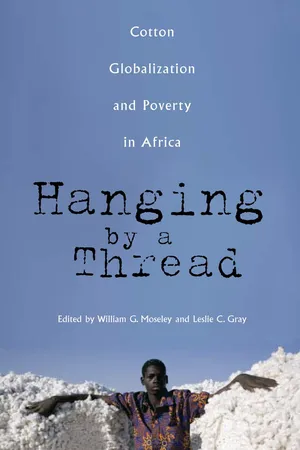
The textile industry was one of the first manufacturing activities to become organized globally, as mechanized production in Europe used cotton from the various colonies. Africa, the least developed of the world's major regions, is now increasingly engaged in the production of this crop for the global market, and debates about the pros and cons of this trend have intensified. Hanging by a Thread: Cotton, Globalization, and Poverty in Africa illuminates the connections between Africa and the global economy. The editors offer a compelling set of linked studies that detail one aspect of the globalization process in Africa, the cotton commodity chain. From global policy debates, to impacts on the natural environment, to the economic and social implications of this process, Hanging by a Thread explores cotton production in the postcolonial period from different disciplinary perspectives and in a range of national contexts. This approach makes the globalization process palpable by detailing how changes at the macroeconomic level play out on the ground in the world's poorest region. Hanging by a Thread offers new insights on the region in a global context and provides a critical perspective on current and future development policy for Africa. Contributors: Thomas J. Bassett, Jim Bingen, Duncan Boughton, Brian M. Dowd, Marnus Gouse, Leslie C. Gray, Dolores Koenig, Scott M. Lacy, William G. Moseley, Colin Poulton, Bhavani Shankar, Corinne Siaens, Colin Thirtle, David Tschirley, and Quentin Wodon.
eBook - ePub
Hanging by a Thread
Cotton, Globalization, and Poverty in Africa
- 312 pages
- English
- ePUB (mobile friendly)
- Available on iOS & Android
eBook - ePub
About this book
Trusted by 375,005 students
Access to over 1.5 million titles for a fair monthly price.
Study more efficiently using our study tools.
Information
Subtopic
Human GeographyIndex
Social SciencesPart I
Global Cotton, Local Crises
1

Producing Poverty
Power Relations and Price Formation in the Cotton
Commodity Chains of West Africa
“If I export a kilogram of raw cotton I am paid US$1.20. If you make
yarn, you get three times that. If you weave, the value goes up six times
and if you make the garment the value goes up ten times,” Museveni
said, complaining that unfair tariff barriers make Africa a continent of
“donor” nations that give jobs and income to the industrial west.
yarn, you get three times that. If you weave, the value goes up six times
and if you make the garment the value goes up ten times,” Museveni
said, complaining that unfair tariff barriers make Africa a continent of
“donor” nations that give jobs and income to the industrial west.
—Ugandan president Yoweri Museveni
Ann and I will carry out this equivocal [sic] message to the world,
markets must be open. The United States will not tolerate favoritism
and unfair subsidies. We want to compete, and we want our farmers
to compete on level ground.
markets must be open. The United States will not tolerate favoritism
and unfair subsidies. We want to compete, and we want our farmers
to compete on level ground.
—U.S. president George W. Bush
THE 2003 WORLD TRADE ORGANIZATION (WTO) meetings held in Cancun, Mexico, collapsed because cotton growers of the global South insisted on a level playing field in agricultural trade. Led by the trade ministers of Brazil, Benin, Burkina Faso, Mali, and Chad, a group of twenty countries declined to take up the North’s agenda until progress was made in implementing the Doha Declaration. Penned at the end of the 2001 WTO ministerial conference held in Doha, Qatar, the declaration committed the North “to correct and prevent restrictions and distortions in world agricultural markets . . . with a view to phasing out, all forms of export subsidies; and substantial reductions in trade distorting support” (WTO 2001). Yet the United States and European Union continue to give billions of dollars in subsidies to their cotton growers, ginners, and exporters, leading to overproduction, dumping, and depressed world market prices. The cotton subsidy issue was again center stage at the 2005 WTO Hong Kong meetings (Bradsher 2005; Ricard 2005). But despite the exhortations of African cotton growers, little progress was made in settling this dispute.1 Some observers of farm subsidies have argued that if all cotton subsidies were eliminated, world prices would increase by 11 cents (Oxfam 2003; FAO 2004). Even if that came to pass,2 major questions remain about the distribution of this eleven-cent cotton bonus. Would it trickle down to African cotton growers or end up in the pockets of other actors in the cotton commodity chain?
Cotton Broils
Cotton cultivation is central to the farming systems and rural economies of West Africa. With few cash-earning alternatives, cotton is often the only source of agricultural credit and is pivotal to reducing poverty and improving livelihoods for hundreds of thousands of rural and urban households (Pfeifer 2005). Income from cotton sales pays for health and education expenses and determines whether a metal or thatch roof covers the home. When cotton incomes are low, sick children are not taken to health clinics because their parents cannot afford to buy medicines. Low incomes also force parents to take children out of school because they cannot afford to pay for school fees and supplies. Cotton is also a major source of foreign-exchange earnings for West African governments, ranging from a fifth of Mali’s exports to more than a third of Burkina Faso’s. This dependence of cotton growers and governments on world markets makes them vulnerable to declining prices and unfavorable exchange rates since, cotton is traded in dollars.
Cotton growers in the United States depend more on government subsidies than on world market prices. In most years, U.S. farmers are unable to produce cotton at a cost that is below the world market price. Between 1997 and 2004 world market prices for cotton averaged 54 cents per pound.3 The average cost of production (ex-gin) in the United States fluctuates around 70 cents per pound (Estur 2005). In the absence of subsidies, U.S. cotton is not profitable. U.S. cotton growers would have lost $827 per acre every year since 1997 without government subsidies that amounted to between $2 and $3 billion annually (UNDP 2005). The 2002 Farm Act assures that U.S. cotton growers are compensated for their high production costs no matter what the market price. The number and variety of income support programs (direct payments, countercyclical payments, marketing loans) encourages farmers to sustain production levels despite falling world market prices (Wescott, Young, and Price 2002). Cotton-ginning companies and exporters reap their own subsidies through the Step 2 and export credit programs. In fact, all the major actors in the U.S. cotton industry, from growers and ginners to warehouse operators, domestic mill owners, and international traders, receive some government payment in what one observer calls the “most ‘vertically integrated’ program of any commodity” (Thompson 2005, 11). The proponents of these programs, notably the industry’s lobbying arm, the National Cotton Council, argue that these subsidies are “essential tools of the U.S. [cotton] industry” (National Cotton Council 2005, 9–10).4 By dumping price-depressing surpluses onto the world market, U.S. cotton growers and exporters prevent West African cotton growers from reaping the widely touted rewards of free trade. To understand the relationship between world prices and producer prices in West Africa, we need to understand how prices are formed in the cotton commodity chain.
The Global Commodity Chain Approach
The global commodity chain (GCC) is an analytical tool for uncovering price formation at different stages of the production and marketing processes. By dividing the chain into its constituent activities, we can see where profits are made and how they are distributed among various actors. The regulation and coordination of a GCC, also known as chain governance, is strong when a particular firm or institution has significant influence on price formation. Chain governance is very strong in West Africa where parastatal cotton companies have historically regulated cotton production through input supply-credit schemes and monopsonistic control over seed cotton markets. One of the World Bank’s objectives in restructuring West Africa’s cotton sectors is to modify chain governance by giving market forces as well as cotton growers more power in price formation (see below).
The GCC approach derives from world systems theory and the political economy of development/underdevelopment studies of the 1970s and 1980s. It is distinguished from the global value chain approach by its focus on the political-economic dimensions, history, and power relations that shape the input/output structure, geography, and governance structures of GCCs (Bair 2005; Gereffi and Korzeniewicz 1994). GCC analysis is closely allied to the commodity-based filière approach, derived from French colonial agricultural development policy (Raikes, Jensen, and Ponte 2000). While GCC is tending toward developing a coherent theoretical framework (Bair 2005; Gereffi, Humphrey, and Sturgeon 2005), the filière approach is more of a mesolevel analytical tool used by policymakers for restructuring production systems and institutional frameworks in the name of development. Until recently the filière approach restricted itself to the national scale, since producer prices were set and trade controlled by state institutions such as government marketing boards. In the context of economic restructuring driven by the neoliberal polices of international financial institutions like the World Bank, the filière approach is increasingly concerned with issues of price formation and trade issues that transcend the national scale (Raikes, Jensen, and Ponte 2000, 404). A good example of the filière’s expanded scope is the series of studies conducted by the Centre International de Recherche en Agriculture pour le Développement (CIRAD) from 2001 to 2003 of the cotton commodity chains of a half dozen West African countries (Fok and Taze 2003). Table 1.1 illustrates this multiscale scope of the filière approach.
Table 1.1. Cotton commodity chain, Côte d’Ivoire

Forging the West African Cotton Commodity Chain
The historical development of the West African cotton commodity chain is key to our understanding of its current configuration, in which parastatal cotton companies play key governance roles (Bassett 2001). We can date the emergence of these firms to the waning years of French colonial rule in West Africa, when the French Company for the Development of Textile Fibers (CFDT) and the Institute for Research on Cotton and Textile Fibers (IRCT) developed a high-yielding cotton package consisting of seeds, fertilizers, and insecticides. The Allen cotton program, named after the G. hirsutum variety that was the centerpiece of this package in Côte d’Ivoire, involved important innovations in the production and marketing of cotton. For example, before the Allen program, seed cotton could be purchased by any trader. The Mandé-speaking Jula outcompeted French traders by offering higher prices for seed cotton. French traders gained the upper hand when the CFDT signed a cotton development contract with the independent Ivorian government in 1962. Arguing that it needed to control seed cotton varieties and agricultural inputs to prospective cotton growers, the CFDT succeeded in becoming the exclusive buyer of cotton in the country (Bassett 2001, 103–6). The CFDT’s monopsony allowed the company to give credit to cotton growers for the purchase of fertilizers and pesticides at the beginning of the growing season and to recuperate these loans at the time of harvest, when producers sold their crop to the company. This input supply-credit scheme, which tied producers to cotton companies in an informal system of contract farming, became the hallmark of the cotton commodity chain in West Africa until the end of the twentieth century.
Parastatal control over cotton markets and input supply enabled cotton companies to erect a vertically integrated commodity chain. Their activities included cotton varietal research and development, input delivery, extension services, village-level marketing, transportation, ginning, and selling cotton fiber on world markets. The CFDT’s marketing arm, the Compagnie Cotonnière (COPACO), served as the commission agent for three new national cotton companies: CIDT (Côte d’Ivoire), CMDT (Mali), and Sofitex (Burkina Faso).5 In conjunction with government marketing boards or stabilization funds, these cotton companies exercised considerable power in setting agricultural input and seed cotton prices. The constituent parts of this buyer-driven commodity chain are diagrammed in figure 1.1.
The commodity chain segments shown in figure 1.1 trace the major activities involved in the production of seed cotton, its ginning, and its delivery to ports. The closure of the chain at ports reflects the export-oriented nature of cotton production in West Africa. Ninety-nine percent of Mali and Burkina Faso’s cotton is exported onto the world market. For Côte d’Ivoire, 15 percent of the cotton crop enters domestic textile mills; 85 percent is exported.
This system of strong single-firm governance of all aspects of the commodity chain became the target of World Bank structural adjustment reforms during the mid-1990s and early 2000s throughout West Africa. The bank requires governments to break up parastatal cotton companies by selling off groups of gins to private investors. To make the sale attractive, the governments delimited cotton-growing zones in which investors would have the right to buy seed cotton from “their producers.” The zonal model of partial privatization that characterizes the World Bank’s liberalization scheme was first pioneered in Côte d’Ivoire (Bassett 2003, 246–50). In Burkina Faso the parastatal cotton company Sofitex saw its national monopoly partially reduced in 2004 when it sold three of its gins to two different companies: Faso Coton and SOCOMA (Société Cotonnière de Gourma). The shareholders of Faso Coton are the Swiss cotton-trading firm Paul Reinhart (29 percent), International Promotion Services (21 percent), the Burkinabé transportation company SOBA (20 percent), the fertilizer company Amerfert (formerly Agridis) (20 percent), and the Burkinabé cotton growers’ union (UNPCB) (10 percent). The major shareholders of SOCOMA are Dagris (ex-CFDT) (55 percent) and UNPCB (20 percent). The remaining shares are held by private Burkinabé investors. Despite the reform, Sofitex continues to dominate the cotton economy. The area it controls accounted for 82 percent of national cotton production in 2004/5. SOCOMA and Faso Coton’s zones produced 11 percent and 7 percent of Burkina’s cotton that year.

FIG. 1.1. The cotton commodity chain: farm inputs to FOB.
Like Côte d’Ivoire, Burkina’s privatization scheme retains the vertically integrated form of the former parastatal. Rather than a national monopoly, there are now three regional monopolies. Each cotton company has a clearly delimited zone of intervention and control (fig. 1.2). Cotton growers obtain inputs from the company that controls their area and to which they are obliged to sell their seed cotton. Panterritorial pricing facilitates this process. The zoning model is primarily designed to manage the key input-supply credit and reimbursement relationship that links producers to specific cotton companies. If this link is broken (e.g., when produce...
Table of contents
- Cover
- Half title
- Title
- Copyright
- Contents
- Preface and Acknowledgments
- Contributors
- Introduction Cotton, Globalization, and Poverty in Africa
- Part I Global Cotton, Local Crises
- Part II Organizing Cotton: National-Level Reforms and Rural Livelihoods
- Part III Alternate Futures: Genetically Engineered and Organic Cotton
- Index
Frequently asked questions
Yes, you can cancel anytime from the Subscription tab in your account settings on the Perlego website. Your subscription will stay active until the end of your current billing period. Learn how to cancel your subscription
No, books cannot be downloaded as external files, such as PDFs, for use outside of Perlego. However, you can download books within the Perlego app for offline reading on mobile or tablet. Learn how to download books offline
Perlego offers two plans: Essential and Complete
- Essential is ideal for learners and professionals who enjoy exploring a wide range of subjects. Access the Essential Library with 800,000+ trusted titles and best-sellers across business, personal growth, and the humanities. Includes unlimited reading time and Standard Read Aloud voice.
- Complete: Perfect for advanced learners and researchers needing full, unrestricted access. Unlock 1.5M+ books across hundreds of subjects, including academic and specialized titles. The Complete Plan also includes advanced features like Premium Read Aloud and Research Assistant.
We are an online textbook subscription service, where you can get access to an entire online library for less than the price of a single book per month. With over 1.5 million books across 990+ topics, we’ve got you covered! Learn about our mission
Look out for the read-aloud symbol on your next book to see if you can listen to it. The read-aloud tool reads text aloud for you, highlighting the text as it is being read. You can pause it, speed it up and slow it down. Learn more about Read Aloud
Yes! You can use the Perlego app on both iOS and Android devices to read anytime, anywhere — even offline. Perfect for commutes or when you’re on the go.
Please note we cannot support devices running on iOS 13 and Android 7 or earlier. Learn more about using the app
Please note we cannot support devices running on iOS 13 and Android 7 or earlier. Learn more about using the app
Yes, you can access Hanging by a Thread by William G. Moseley, Leslie C. Gray in PDF and/or ePUB format, as well as other popular books in Social Sciences & Human Geography. We have over 1.5 million books available in our catalogue for you to explore.