![]()
1
Polonia Restituta
The Catholic Church and the Revival of Poland
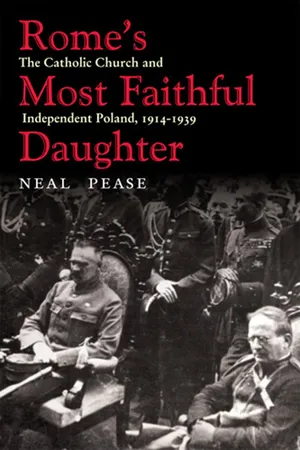
THE FORMAL RESUMPTION OF POLISH STATEHOOD in modern times began in church. On February 9, 1919, not quite three months after its inception, the government of the fledgling Second Polish Republic marked the convocation of its first parliament, or Sejm, inWarsaw with an inaugural Roman Catholic high mass, reviving the custom of the bygone commonwealth of Poland-Lithuania before its partition and subjection to foreign rule for a century and a quarter. In its form and dramatis personae, this ceremony vividly asserted the prominence of the Roman confession in national life and tradition, as well as its intimate association with the temporal power. At the hour of eleven that Sunday morning, Chief of State Józef Piłsudski entered the crowded nave of St. John Cathedral, thus sparing himself the sight of the incongruous nineteenth-century facade that defaced the Gothic antiquity of this oldest church of the capital. He began a procession down the aisle toward the altar, followed in turn by the prime minister, Ignacy Jan Paderewski, and his cabinet; the papal emissary to the country, Monsignor Achille Ratti, who would become pope himself three years later almost to the day; the assembled Catholic hierarchs of restored Poland; and finally the celebrant, the archbishop of Warsaw, Aleksander Kakowski. The solemnities reached their emotional peak when the lawmakers heard a patriotic sermon from one of their own, the Armenian-rite archbishop of Lwów Józef Teodorowicz, the most senior of thirty-two deputies who wore the collar, one-twelfth of the membership of the body. A noted homilist of the hellfire school and never a man given to understatement, to put it delicately, Teodorowicz reminded his audience of their duty to God and country with characteristic vehemence, his words laden with gravity and drama. On this momentous occasion, the speaker surpassed even his own impressive standards of fiery rhetoric, and sympathetic listeners afterwards described the prelate’s oratory as magnificent, divinely inspired. Even some political foes paid grudging tribute to his eloquence, barbed with not altogether complimentary comparisons with Piotr Skarga, the legendary Jesuit royal preacher who had harangued a previous Sejm in the heyday of Poland-Lithuania. As a final flourish, at the close of his exhortation Teodorowicz administered to the legislators their oaths of office in unison. When the liturgy ended, the congregation sang the national hymn “Boże coś Polskę”—“God, protector of Poland”—and then the freshly minted deputies emptied out of the cathedral to walk the length of Krakowskie Przedmieście and New World streets, amid cheering throngs, to the parliament building off of Three Crosses Square. There, later in the day, the primate of Poland, Archbishop Edmund Dalbor of Gniezno-Poznań, consecrated the chamber in the presence of the same collection of ranking worldly dignitaries.1
In its symbolic union of church and state, this set piece of official pageantry neatly echoed the litany of historical axioms that commentators habitually cited—and cite to this day, for that matter—to prove the indomitable Catholicity of the Poles throughout the ages and the natural affinity of Catholicism with Polish patriotism: the conventional dating of the origins of Poland from its baptism in 966, the status of the Catholic primate as interrex in Poland-Lithuania, the miracles of the icon of the Black Madonna of Częstochowa, the veneration of the Blessed Virgin as perpetual queen and patroness of Poland, the reputation of the old republic as the easternmost rampart of western Christendom against Turk, Tatar, and schismatic. Indeed, the famous Roman religiosity of Poland was the main thing—in not a few cases, practically the only thing—that many foreigners knew of the country or its people, and so they tended not to subject the time-honored legend of Polonia semper fidelis to rigorous examination. In reporting his initial impression from Warsaw to his superiors at the Vatican Secretariat of State, even the scholarly and matter-of-fact Monsignor Ratti intoned the truism “Dire polacco è dire cattolico”—to say Polish is to say Catholic—and plainly meant it, and only closer acquaintance with the subtleties of his new assignment would teach him not to accept the formula at face value.2 Small wonder, then, that observers more distant assumed the truth of the stereotype and took for granted the Catholic nature of the Second Republic and its readiness to serve the aims of the Church at home and abroad, whether they welcomed or rued the prospect. In the same year 1919, for instance, a French Catholic journalist rejoiced at the revival of Poland as “a political miracle,” stressing that in that land of fabled piety “the interests of Church and State not only coincide, but are actually dependent upon each other.”3 Surveying the perils facing Europe in the wake of a ruinous world war, others called on the newly emancipated Poles to take up once more their historic mission as guardians of religion and civilization. Still three years from full reception into the Church, but already Roman at heart, the English literary eminence G. K. Chesterton warned—accurately, after a fashion, if twenty years too soon—that “a flood threatens the West from the meeting of two streams, the revenge of Germany and the anarchy of Russia” and concluded that Europe had “only one possible dyke against such a flood, which is . . . the might and majesty of Poland,” the “Christian and chivalric shield” of the Occident.4 On the other hand, Polish diplomats arriving in Rome encountered brusque greetings from the government of Italy, which suspected them of being little more than agents of its papal rival across the Tiber. While concerned above all with the unresolved Roman question, Italian officials might have spoken for disapproving liberals and anticlericals everywhere when they complained to the Poles that “you are papists, the only ones in Europe nowadays; on you the Vatican pins all its hopes; you are to be a branch of the church-state and a base for the reborn temporal power of the papacy.”5 “The new born Polish republic,” an American newspaper correspondent told his readers in 1932, not reporting news so much as reinforcing an adage, “is Rome’s most faithful daughter.”6
Proclamations of this sort, celebratory and alarmist alike, proceeded from a common impression of Poland as a Catholic monolith and ultramontane bastion, the idea symbolically expressed and reinforced in the parliamentary mass in St. John’s Cathedral. Yet closer scrutiny of the participants in that ritual might have suggested a more guarded estimate of the influence of Catholicism in the councils of state in the Second Republic. Prime Minister Paderewski was rumored to be a Freemason, an affiliation forbidden by the Church. Chief of State Piłsudski, acclaimed by millions as the hero of the struggle for independence and destined to become the dominant figure of interwar Polish history, was at best a wandering and idiosyncratic Catholic openly despised by more than a few of the prelates in attendance that morning, and his retinue of cronies and devoted associates—the main pool of recruitment for high governmental position in the years to come—was notorious as a hotbed of unbelief and Freemasonry. For his part, within two years Achille Ratti would be hounded from his nunciature in Poland amid a din of furious protests and cries for a rupture of Polish relations with the Holy See; subsequently, as occupant of the throne of St. Peter under the name of Pius XI for the better part of the Second Republic’s free existence, he saw his cherished projects for a historic expansion of Catholicism eastward into the territories of the former Russian empire bitterly opposed and frustrated by the very government in Warsaw that many regarded as the cat’s-paw of the Vatican. To judge from the tenor of their sermons and public statements, the Catholic bishops and clergy of the country saw no grounds for confidence in the future of their Church, but instead saw it as embattled and under siege, even in Poland, beset by inner frailties and vulnerable to powerful foes, including scores of the very men who filled the pews of the cathedral that day. Most of the political parties represented in that first parliament could have been described fairly as anticlerical by instinct or heritage, even without the presence of deputies from the regions largely neither Polish nor Catholic that would be joined to the Second Republic only after prolonged and frequently military dispute. Once the dust settled and boundaries became more or less fixed, if not universally accepted, roughly three-quarters of Poland’s population of twenty-seven million professed themselves Catholics—a lesser percentage than in neighboring Lithuania or Czechoslovakia, and far fewer in number than in Germany, the birthplace of the Reformation and the Kulturkampf—and of those, some three million were Ukrainian Eastern-rite Catholics estranged from their nominal Polish coreligionists by barriers of mutual suspicion and national rivalries. One might well have wondered if this was the same country so often glibly described by supposedly knowledgeable contemporaries as a modern version of the confessional state, republican in form but Catholic in essence.7
In many ways, it was not: the pluralist, polyglot Poland of reality differed from the Poland of pious myth, but the confusion between the two sprang precisely from the fact that the myth held enough truth in it to persuade beholders that it was so. Outsiders were especially prone to this simplifying tendency. Most Poles knew better, but by the same token a great many of them believed that the myth could and should be made so, and thought and acted accordingly, while a great many others feared that attempts might be made to make it so and resolved to take care that it should not, and still others cared little one way or the other but gave the myth lip service to suit their purposes. The potent legend of “Poland ever faithful,” then, operated simultaneously as illusion, as ideal to be approached and possibly realized, as threatening prospect to be averted, and as handy polemical weapon. Owing to the conflicting reactions it inevitably evoked, the vision of a Catholic Poland could not serve as the unifying principle of the Second Republic, as widely assumed; on the contrary, perhaps no other theme held such power to polarize the country or set its various peoples and constituencies at odds.
Even so, the reflexive predisposition to equate Poland with the Roman church was not a mistaken judgment, but merely one that meant less in political terms than met the eye. It often proceeded from, or led to, an exaggerated appraisal of the collaboration of throne and altar throughout the history of Poland as well as a lack of understanding that, in fact, Catholicism occupied a somewhat ambiguous place in Polish political culture. True, the vast majority of Poles proclaimed themselves Catholics of the Latin rite, and the link between Catholicism and Polish identity was manifestly real, hallowed by time, accentuated by adjacency to peoples of other creeds, and starkly defined by the recent dominion of Protestant and Orthodox sovereigns over most of the Polish lands. Adherence to the Roman faith resoundingly supported the Polish ethos, then, and in Poland Catholicism bore no taint of association with foreign rule or of conflict with patriotic ideals, as in the Czech lands or in Hungary. However, these facts had exerted less influence on the behavior or inclinations of the former Polish Respublica than might have been expected, and less still on the creators of its interwar reincarnation. To put it mildly, old Poland had scarcely qualified as a crusader or inquisitorial realm, a Spain of the east. Indeed, its tradition had been to approach religion in moderate and latitudinarian fashion. More often than not, the commonwealth preferred to apply a cautious pragmatism in managing its multiconfessional populace, and Poland-Lithuania’s lack of zeal in enforcing religious uniformity had earned it occasional reproaches as a paradise for heretics and Jews. In other words, Catholicism acted as a salient indicator of Polish identity, but not as an element of great political significance or priority in statecraft. The pattern held during the era of partition, when the Church and its representatives played at most a secondary role in the struggle for independence, and the Polish political and intellectual elites that would later emerge into leadership of the interwar republic came to cultivate attitudes of indifference or outright hostility to Catholicism as a dubious force in national affairs.8
So as Poland entered a new phase of statehood in 1918, its Church occupied a formidable but awkward and undefined position in the country, looming as an imposing presence but by no means an uncontested or irresistible civic colossus. In truth, perhaps no other institution could lay so plausible a claim to the right and duty to speak for Poles on matters of governmental as well as private conduct; certainly the Church thought so, and did not shrink from attempting to exercise that prerogative. Too much a fixture in national life to be content with less than a commanding voice in public concerns and official recognition of its moral authority, and far too big to be ignored or underestimated as a political factor even by its most determined antagonists, it nevertheless fell short of the ability to translate its will into law or policy by persuading or overawing the combination of factions and constituencies that regarded the Church as an agent of clericalism, reaction, and bigotry and saw the shadow of black dictatorship lurking behind its every move. Nor did the dispute over the proper role of Polish Catholicism confine itself within the boundaries of the republic, for the Church of Poland did not exist as an isolated or fully autonomous entity, after all, but as an integral part of an avowedly universal religious body with sweeping worldly—and, literally, otherworldly—interests and aspirations. The popes of the day and their ministers in the Roman Curia considered the twentieth century a time of both frightful dangers and extraordinary opportunities, requiring prudence and daring alike, and the course on which they chose to steer the bark of Peter and its implications for Poland brought them into repeated disagreement with not only the secular rulers of that country, but also with the leaders of the Polish Church and the faithful. Such questions resisted easy solution because sooner or later debates over the proper place of the Church within Poland, and of Poland within the Catholic world, became emotive arguments over the fundamental character of the Second Republic and contrasting visions of Polish history. The argument went on unabated and unresolved right up to the day in October 1939 when Pope Pius XII called on Catholics around the world to mourn the martyrdom of Poland by invasion and conquest yet once more.
The argument had begun in earnest roughly a century earlier, during the decades of tripartite Russian, German, and Austrian sway over the lands of the once and future Poland. The conditions of captivity produced the paradoxical dual result of transforming the Church into a far more visible and powerful symbol of Polish identity, on the one hand, while on the other steadily alienating it from those elements within society who saw themselves as the true keepers of the national flame and formed the vanguard of the independence movement. Although during this time a “Polish Church” existed in none but the sentimental sense, having been apportioned among the ecclesiastical jurisdictions of the partitioners, the bond of Catholicity helped to maintain an indelible consciousness of nationhood that transcended the boundary lines of the moment. Apart from the example of the Habsburg Empire, where a common religion contributed to generally milder and more tolerable terms of confinement for Poles in Austrian Galicia, Catholicism and the Church also functioned as an obvious focus of Polish differentiation from their foreign masters and a national rallying point of solidarity and refuge. Especially during the latter half of the century, official anti-Catholic campaigns in Protestant Germany and Orthodox Russia had magnified the burdens of Poles in those domains. For all the famous rigor of Bismarck’s Kulturkampf, the repression of the Church in the Russian zone typically surpassed it in harshness by far, magnified by reprisal against ecclesiastical sympathy or support for the Polish rebellions of 1830–31 and 1863–64. Hundreds of Polish clergy, and even some hierarchs, suffered execution, banishment, or katorga (penal servitude) at the hands of Petersburg for real or suspected transgressions of this sort. By 1870, all but one Catholic bishopric in Russian Poland stood vacant, and the archbishop of Warsaw was consigned to an internal exile that would last twenty years. Even so unoffending a holy man as Fr. Honorat Koźmiński, the founder of twenty-six religious congregations, spent much of his life confined to a monastery at Russian behest. In such circumstances, the natural struggles of the Polish Church to withstand these assaults and shelter its faithful from religious persecution inevitably strengthened the tie between the Roman confession and Polishness. The apparent merging of faith and ethnicity that occurred in these times gave rise to the doctrine of polak-katolik—the conviction that to be Polish was to be Catholic, and, just as important, not to be Catholic was not to be genuinely Polish—a formula that would leave a deep and enduring impression on the mentality of subsequent generations of Poles. In short, the patriotic devout would not have hesitated to accord their Church much credit for having kept alive the Polish spirit throughout the ordeal of statelessness: Catholicism had sustained Poles in adversity and enabled them to preserve their cultural integrity, while the Church had shared and helped to shoulder the misfortunes of its flock and acted as a comforting and uniquely authentic Polish institution, an irreplaceable example and moral guide to the nation under siege.
All the same, the Church in the Polish lands found itself in an uncomfortably equivocal position, as suggested in the aphorism t...