![]()
1
Mwalimu Nyerere
A Study in Leadership
In January 2006 a delegation from the Vatican held a mass in the Tanzanian village of Butiama to begin investigating the life of Julius Kambarage Nyerere for beatification.1 This is usually the first step toward sainthood. But it is an unusual honor for a socialist dictator.
Neither saint nor tyrant, Nyerere was a politician who kept his integrity and vision in a harsh and changing world. He taught high school upon graduating from college in 1943, and for the rest of his life he was happiest to be called Mwalimu, the Swahili word for “teacher.” He became the first prime minister of independent Tanganyika in 1961, its first president in 1962, and brokered a merger with Zanzibar to become Tanzania in 1964. Prior to the presidency he headed a mass movement that skillfully brought Tanganyika to independence without violence. He was an advocate for democracy, but by reasoning that each country built its own style of democracy, he built a one-party state that regularly violated democratic values.
Nyerere pursued ambitious and not always successful policies aimed at building a peaceful and prosperous nation out of an ethnically diverse colonial territory populated mostly by illiterate peasant farmers. His Arusha Declaration in 1967 envisioned a clean government dedicated to economic growth on the basis of his theory of African socialism, or Ujamaa. Although his government gave military support to movements fighting white-minority governments, only the war with Idi Amin’s Uganda in 1978 mobilized the Tanzanian army and population at large. From his retirement in 1985 to his death in 1999, he used his prestige to urge for ethical political choices at home and abroad. Everyone who met him regarded him as a brilliant intellectual, but some of his policies seem disastrously misguided to us today.
As we are apt to do with historical figures, we lay claim to Julius Nyerere as a symbol of our aspirations and our nightmares; of our heroes and our villains. Yet a full-length, researched biography has not yet been written. In this sketch of his life, I seek to claim him instead as a symbol of leadership and its perils. There will be much debate before a scholarly, let alone popular, consensus is formed around these events. My hope is that this portrait can serve as a case study of an African country confronting the challenges of independence, as seen through the life of one of the era’s most creative and thoughtful politicians.
Nyerere laid out an intellectual and political project and then took deliberate steps to organize people in pursuit of that project. He saw decolonization as an opportunity to build a new society: “The Africa that we must create . . . cannot be an Africa which is simply free from foreign domination. It must be an Africa which the outside world will look at and say: ‘Here is a continent which has truly free human beings. . . . That is the continent of hope for the human race.’”2
His life and leadership encompassed the contradictions of his age, and those contradictions beguile us long after his death. While the Vatican may eventually find its own grounds for honoring Nyerere, such veneration is highly politicized and robs history of its human reality, where lessons might be learned from both success and failure. With a stubborn streak that easily blocked common sense, he was far from perfect. But by the same token, those who count Nyerere as a villain pursuing a “systematic campaign to deny [Muslims] basic rights,” as Aboud Jumbe resentfully put it, only set him up as a scapegoat for more complex social trends.3
Few leaders so assiduously cultivated an inclusive political establishment or so vehemently denounced the prejudices of their own societies. Nyerere made sure his government and his closest associates reflected a cross-section of Tanzania’s diverse society—Muslim, Christian, Hindu, and animist; African, Indian, Arab, and European—inclusive of all the countless ethnic groups of its broad territory. While those who suffered from his economic policies and political repression may cast him in the role of a Third World strongman, any honest account must also acknowledge his humility, his restraint, and his real commitment to a better life for the people of his country.
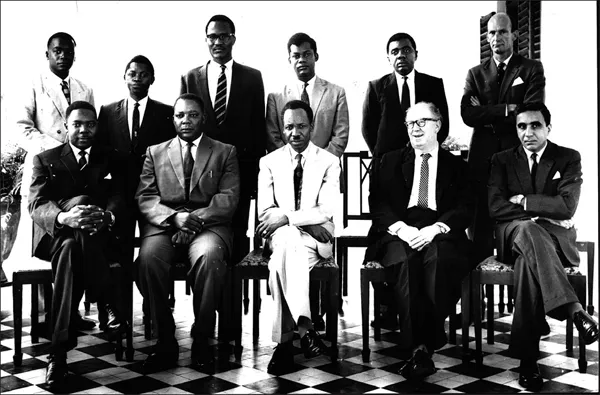
Figure 1.1 The independence cabinet, 1961. Rear, from left: Minister of Local Government Job Lusinde; Minister without Portfolio Rashidi Kawawa; Minister of Commerce and Industry Nsilo Swai; Minister of Education Oscar Kambona; Minister of Lands, Forests, and Wildlife Tewa Saidi Tewa; Cabinet Secretary Charles Meek. Front, from left: Minister of Agriculture Paul Bomani; Minister of Legal Affairs Abdallah Fundikira; Prime Minister Julius Nyerere; Minister of Finance Ernest Vasey; Minister of Communications, Power, and Works Amir Jamal. Not pictured: Minister of Home Affairs George Kahama and Minister of Health and Labour Derek Bryceson. © Tanzania Information Services/MAELEZO.
Late in life he offered lessons on leadership as the country prepared for its first multiparty presidential elections since independence. “A president of our country is chosen based on the constitution of Tanzania. And, upon being chosen, the person is sworn in: if a Christian, upon the Bible; if a Muslim, upon the Koran. We have not yet chosen a candidate who doesn’t believe in God, but when we do, we’ll find some way to swear the chap in!”4 He insisted that
a President must be able to lead the country. He is not there simply to execute popular demands if he recognises or believes that the consequences could be disastrous for the people or for the independence of the country. Yet he is responsible to the People; he needs their confidence and support. . . . [The President] needs to be a person of complete honesty and integrity, capable, strong, firm, and with clear principles which he can explain and defend.5
This was not mere rhetoric. This was the standard to which he held himself. “A President’s decisions are almost always difficult—easier ones can be made by his Ministers or Officials. And failure to decide is itself a decision: quite frequently refusing (or being unable) to make a decision is worse than making the one which time will prove to have been wrong! For the absence of any decision leads to confusion and opens the door to exploitation by crooks.” Nyerere had a scholar’s mind, but did not have the luxury to wrestle with ideas in the abstract. A politician’s ideas affect people’s lives. “To plan means to choose,” is the way Nyerere described the challenge of governance at the height of his presidency, and after his retirement he noted that he did not always make perfect choices.6
Whether in the fight to wrest a colony away from the clutches of an imperial power or the fight to guide the direction of an independent country, politics entails the competition for power. Political systems are designed to manage and contain the conflict inherent in this struggle. But systems fail, and politics can easily turn violent. Newly established political systems are especially prone to violence where there is little consensus over rules and norms, where there is little respect for the rights of those who don’t wield power, where there is little faith that those out of office will ever peacefully come into office. Peaceful politics requires compromise, tolerance, and benevolence.
Nyerere engaged in this competition for power in order to establish a peaceful political system. He trusted his vision and considered his leadership essential to establishing such a system. His tools were his ability with words and his management of political institutions. He knew that success would entail a system that could function without him and he made it his goal to step down from power of his own accord. Establishing such a system during his time in office, however, required power, and power is difficult for anyone to manage. By the 1970s, Nyerere was overseeing a creeping police state, administered by officials whose habits even he could not fully control.
His peers, the presidents and prime ministers of the newly independent countries of Africa, faced the same challenge. All of them sought power. All of them had visions, some more selfish than others. All of them faced challenges and opposition. In basic ways, Nyerere was like his peers. Most of them were only a generation removed from a village society of hand tools and family authorities. They were among the first from their colonized peoples to receive a European education. They saw their task as one of combining the best of their African cultural roots with those aspects of the colonizer’s culture that could benefit African society.7
Given the life-changing difficulty of this task, the competition and temptations of power and global political realities, leadership in postcolonial Africa was a perilous responsibility. Leaders held on to power by intimidating, often eliminating, those who would question them, by controlling the distribution of the nation’s wealth, and by setting segments of society in conflict with each other. A number of his peers were overthrown, sent into exile, or assassinated. Nyerere survived to step down of his own accord and live out his life as an active citizen of his home country. Such an accomplishment in the context of postcolonial Africa was never a saintly one.
Historical and Political Context
In the 1800s, as Britain led the effort to end the Atlantic slave trade, trade in slaves across the Indian Ocean grew and extended across East Africa. Where the Atlantic slave trade had been dominated and justified by Christian capitalists, the Indian Ocean slave trade was dominated by Muslim traders with roots in Africa and the Middle East. From the mid-1800s, increasingly aggressive strategies to capture slaves and ivory brought violence and disruption to farming societies, among whom the benefits of trade had traditionally outweighed costs of conflict. Seeking protection, villagers submitted to warlords like Tippu Tip, the slave trader and clove planter whose political influence stretched from Zanzibar to the Congo River, or warrior kings like the Hehe leaders in Iringa, Muyigumba and his son Mkwawa, who built up standing armies with taxes levied on conquered peoples.
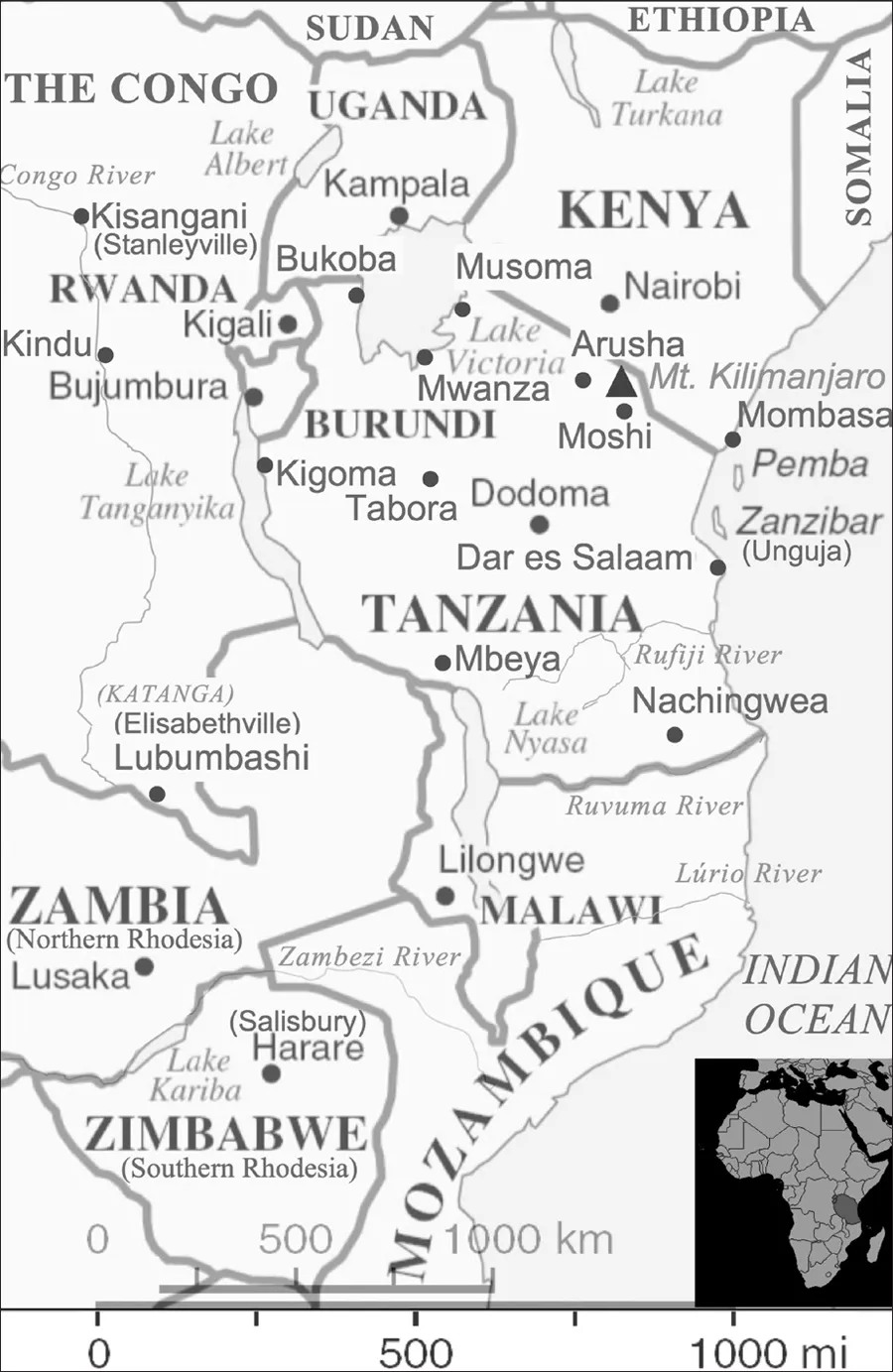
Map 1.1 East Africa. Adapted from United Nations Department of Peacekeeping Operations. © United Nations.
The interior was a diverse place harboring both hierarchical and decentralized societies as well as scores of distinct languages and cultural traditions. In political and economic terms, the export of slaves—as well as ivory, decorative woods, and cloves—meant that the coast and the interior became linked more intimately than they had been in the past. Not only did Islamic culture spread inland, but also the coastal Swahili language, with its heavy load of Arabic vocabulary superimposed on an African grammar.8
Toward the end of the century, European countries entered a heated global competition for colonies, and the antislavery cause gave them a convenient justification for seeking influence in Africa. In East Africa, a missionary named David Livingstone witnessed the devastation caused by the slave trade and advocated the antislavery movement’s concept of “commerce, Christianity, and civilization” as a means to its end. He was the first of many missionaries who followed the paths of Muslim caravan traders to establish Christian communities throughout the region.9 The early missionaries met with little success at first. Following in their path, however, were businessmen and soldiers who colonized Africa for European settlement and the production of raw materials in high demand because of industrialization in Europe.
By the mid-1900s, a generation had grown up under colonial rule in Africa. Some had witnessed aspects of the devastating European wars, others became familiar with European practices of business and governance, and a precious few gained a European education. In East Africa, the British had welcomed immigration from India because the immigrants could help administer colonial rule and expand commercial trade across the territory. European rule became a familiar presence, bringing significant benefits and a host of new problems. People resented the racial hierarchy that came with it, which set aside innumerable privileges for Europeans, offered Indian immigrants favorable advantages, and generally treated Africans as children. This prejudice was part and parcel of the paternalist justification for colonial rule.10
The independence and bloody partition of India in 1947 was a sign that the era of European colonialism was coming to an end, and inaugurated a global movement to end colonial rule. European powers found that their colonies were not very profitable, and colonial residents found ways to demand a greater voice in colonial administration.11 In Africa, a nominally independent kingdom in Egypt was overthrown by a group of military officers in 1952, and the new government under Gamal Abdel Nasser carved out a secular socialist compromise with a heavily Muslim population. Sudan negotiated its i...