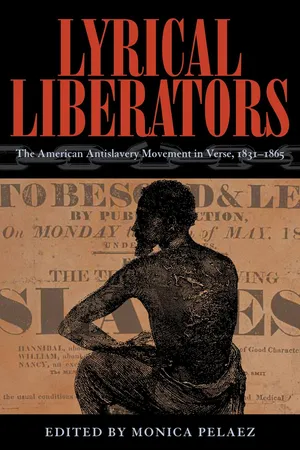
Lyrical Liberators
eBook - ePub

Lyrical Liberators

The American Antislavery Movement in Verse, 1831–1865

  1. 400 pages
  2. English
  3. ePUB (mobile friendly)
  4. Available on iOS & Android
eBook - ePub

Lyrical Liberators

The American Antislavery Movement in Verse, 1831–1865

About this book

Before Black Lives Matter and Hamilton, there were abolitionist poets, who put pen to paper during an era when speaking out against slavery could mean risking your life. Indeed, William Lloyd Garrison was dragged through the streets by a Boston mob before a planned lecture, and publisher Elijah P. Lovejoy was fatally shot while defending his press from rioters. Since poetry formed a part of the cultural, political, and emotional lives of readers, it held remarkable persuasive power. Yet antislavery poems have been less studied than the activist editorials and novels of the time.

In Lyrical Liberators, Monica Pelaez draws on unprecedented archival research to recover these poems from the periodicals—Garrison's Liberator, Frederick Douglass's North Star, and six others—in which they originally appeared. The poems are arranged by theme over thirteen chapters, a number that represents the amendment that finally abolished slavery in 1865. The book collects and annotates works by critically acclaimed writers, commercially successful scribes, and minority voices including those of African Americans and women.

There is no other book like this. Sweeping in scope and passionate in its execution, Lyrical Liberators is indispensable for scholars and teachers of American literature and history, and stands as a testimony to the power of a free press in the face of injustice.

Frequently asked questions

Yes, you can cancel anytime from the Subscription tab in your account settings on the Perlego website. Your subscription will stay active until the end of your current billing period. Learn how to cancel your subscription.
At the moment all of our mobile-responsive ePub books are available to download via the app. Most of our PDFs are also available to download and we're working on making the final remaining ones downloadable now. Learn more here.
Perlego offers two plans: Essential and Complete
  • Essential is ideal for learners and professionals who enjoy exploring a wide range of subjects. Access the Essential Library with 800,000+ trusted titles and best-sellers across business, personal growth, and the humanities. Includes unlimited reading time and Standard Read Aloud voice.
  • Complete: Perfect for advanced learners and researchers needing full, unrestricted access. Unlock 1.4M+ books across hundreds of subjects, including academic and specialized titles. The Complete Plan also includes advanced features like Premium Read Aloud and Research Assistant.
Both plans are available with monthly, semester, or annual billing cycles.
We are an online textbook subscription service, where you can get access to an entire online library for less than the price of a single book per month. With over 1 million books across 1000+ topics, we’ve got you covered! Learn more here.
Look out for the read-aloud symbol on your next book to see if you can listen to it. The read-aloud tool reads text aloud for you, highlighting the text as it is being read. You can pause it, speed it up and slow it down. Learn more here.
Yes! You can use the Perlego app on both iOS or Android devices to read anytime, anywhere — even offline. Perfect for commutes or when you’re on the go.
Please note we cannot support devices running on iOS 13 and Android 7 or earlier. Learn more about using the app.
Yes, you can access Lyrical Liberators by Monica Pelaez in PDF and/or ePUB format, as well as other popular books in Literature & North American Literary Criticism. We have over one million books available in our catalogue for you to explore.
1
CALLS FOR ACTION
POEMS THAT OVERTLY state their intent to rouse support for the cause are among the most persuasive and compelling in the abolitionist corpus. They demonstrate the vehement commitment of their authors, at times to such a radical extent that it becomes clear why their opponents frequently referred to them as “fanatics.” The imperative tone that characterizes these poems conveys the strong sense of urgency and persistence their authors felt the need to express in the face of heavy opposition. Also apparent is a deep confidence in the potential influence of poetry, which, as the author of “An Appeal to Poets” asserts, can extend even further than the law in its ability to expose truth and plead for justice on behalf of those who are unable to speak for themselves. The influence that literature could have is corroborated by the sonnet “Reading ‘Uncle Tom,’” whose author composed it after reading Harriet Beecher Stowe’s seminal 1852 novel Uncle Tom’s Cabin, which he claims increased his empathy for slaves as well as his commitment to the cause of justice. It is precisely this sort of outcome that poets hoped to elicit in readers by persuading them to commit to what this poem calls “the task through sympathy to grow more wise,” which would then presumably compel them to support abolition. That literature could indeed be persuasive was recognized as early as 1836, when the American Anti-Slavery Society’s publishing agent, R. G. Williams, observed that “the press has probably made seven-eighths of all the abolitionists in the country.”1
These calls for action commonly rely on the tactic of suggesting that a failure to get involved is in itself tantamount to a form of slavery. For instance, the well-known Boston minister John Pierpont accuses all Americans of being slaves and challenges them to prove they are not in “The Tocsin,” a title which in this case means “the alarm.”2 The poem sounds a virtual alarm that is intended to “Wake!” readers out of their complacency. As the editorial note preceding it makes clear, it was reprinted in the Herald of Freedom four years after its original publication as a commentary on recent attempts to suppress antislavery activities. The note acknowledges the assassination of abolitionist publisher Elijah P. Lovejoy in November 1837 (see chapter 2); the rioters whose opposition to the Second Anti-Slavery Convention of American Women scheduled to be held in Philadelphia in May 1838 led to the destruction of the Pennsylvania Anti-Slavery Society’s headquarters at Pennsylvania Hall (see plate 1); and the riot that disrupted an August 1842 convention in Nantucket following an inflammatory speech in which Stephen Symonds Foster denounced the clergy as a “brotherhood of thieves” who were colluding with businessmen and politicians to preserve slavery.3 Pierpont’s jeremiad targets this supposed brotherhood, as well as the press, for their failure to oppose slavery. He insists that while such voices may be constrained, poetic expression like his cannot be suppressed, defiantly calling on anyone who has been silenced and is therefore “at Slavery’s beck” to “Prove that ye are not Slavery’s slaves!” The popular poet James Russell Lowell, a member of the so-called Fireside Poets, makes a similar point in his “Stanzas on Freedom,” one of three poems by him included in this chapter. Lowell suggests that readers are mistaken in believing they are free while slavery continues to exist unless they are themselves contributing to the cause of universal freedom, whether it is popular or not. This message is reiterated in the provocatively titled poem “Who Is the Slave?,” which claims that the true slaves are those who fail to speak out against slavery, and motivates those who persist in doing so not to falter in their efforts.
Prior to the Civil War, poets adopted a variety of approaches to capture their readers’ attention. James Stillman memorably portrays slavery as a disease, or “plague spot,” that is spreading across the body of the nation, and wonders whether anyone will rise to the task of amputating the infected limbs so as to prevent the life-threatening ailment from spreading any further. In his poem, Liberator editor William Lloyd Garrison expresses empathy for the suffering of slaves who have been deprived of the freedom that is essential to happiness. His speaker asserts that if he were in their shoes, and had to face the pain of being separated from his wife and children, he, too, would rather flee from such conditions. These sentiments serve as a vehicle for Garrison’s immediatist insistence on abolishing an institution that he suggests binds all Americans in slavery, regardless of their race.
Several other authors assert their commitment to the cause as a means of rallying support. Lowell’s poem written at the antislavery convention held in Boston in 1844 insists that abolitionists will either “perish or be heard” in their continued attempts to speak out against oppression. The speaker of the anonymous “Song of the Agitators” relies on an insistent trochaic meter to bolster his defiant response to the plea that activists “cease to agitate,” declaring that they will stop doing so only once all men are recognized as equals. And in her poem “Onward!” the prolific black writer Frances Ellen Watkins Harper takes a somewhat different angle to urge anyone who sympathizes with the injuries inflicted on her race to pursue some concrete action, echoing Stillman’s approach by asking readers to “Come and staunch the wounds that ...

Table of contents

  1. Cover
  2. Title Page
  3. Copyright
  4. Dedication
  5. Epigraph
  6. Contents
  7. List of Illustrations
  8. Acknowledgments
  9. Introduction
  10. 1. Calls for Action
  11. 2. The Murder of Elijah P. Lovejoy
  12. 3. Fugitive Slaves
  13. 4. The Assault on Senator Charles Sumner
  14. 5. John Brown and the Raid on Harpers Ferry
  15. 6. Slaves and Death
  16. 7. Slave Mothers
  17. 8. The South
  18. 9. Equality
  19. 10. Freedom
  20. 11. Atonement
  21. 12. Wartime
  22. 13. Emancipation, the Proclamation, and the Thirteenth Amendment
  23. Notes
  24. Works Cited
  25. General Index
  26. Index of Poem Titles
  27. Index of Poets