This book is available to read until 23rd December, 2025
- 212 pages
- English
- ePUB (mobile friendly)
- Available on iOS & Android
eBook - ePub
Available until 23 Dec |Learn more
About this book
The result of five years of practice-based creative research focused on Nicole Garneau's UPRISING project, Performing Revolutionary presents a number of methods for the creation of politically charged interactive public events in the style of a how-to guide. UPRISING, a series of public demonstrations in eight locations in the United States and five in Europe, involved thousands of voluntary participants who came together to create radical change through performance art. Bringing together accounts by participants, writers, theorists, artists and activists, as well as photographs and critical essays, Performing Revolutionary offers a fresh perspective on the challenges of moving from critique to action.
Frequently asked questions
Yes, you can cancel anytime from the Subscription tab in your account settings on the Perlego website. Your subscription will stay active until the end of your current billing period. Learn how to cancel your subscription.
At the moment all of our mobile-responsive ePub books are available to download via the app. Most of our PDFs are also available to download and we're working on making the final remaining ones downloadable now. Learn more here.
Perlego offers two plans: Essential and Complete
- Essential is ideal for learners and professionals who enjoy exploring a wide range of subjects. Access the Essential Library with 800,000+ trusted titles and best-sellers across business, personal growth, and the humanities. Includes unlimited reading time and Standard Read Aloud voice.
- Complete: Perfect for advanced learners and researchers needing full, unrestricted access. Unlock 1.4M+ books across hundreds of subjects, including academic and specialized titles. The Complete Plan also includes advanced features like Premium Read Aloud and Research Assistant.
We are an online textbook subscription service, where you can get access to an entire online library for less than the price of a single book per month. With over 1 million books across 1000+ topics, we’ve got you covered! Learn more here.
Look out for the read-aloud symbol on your next book to see if you can listen to it. The read-aloud tool reads text aloud for you, highlighting the text as it is being read. You can pause it, speed it up and slow it down. Learn more here.
Yes! You can use the Perlego app on both iOS or Android devices to read anytime, anywhere — even offline. Perfect for commutes or when you’re on the go.
Please note we cannot support devices running on iOS 13 and Android 7 or earlier. Learn more about using the app.
Please note we cannot support devices running on iOS 13 and Android 7 or earlier. Learn more about using the app.
Yes, you can access Performing Revolutionary by Nicole Garneau, Anne Cushwa in PDF and/or ePUB format, as well as other popular books in Art & Art General. We have over one million books available in our catalogue for you to explore.
Information

REVOLUTIONARY PRACTICE #1
Times when people and planet are in desperate peril call for nothing less than totally audacious propositions. Embrace something you doubt can ever be accomplished in your lifetime, and then commit your time and energy to it. Choose to be ‘powerless criminals in a time of criminal power,’ like radical peace activist Father Daniel Berrigan ( Democracy Now! 2016). Allow that overture to structure your efforts in ways that are symbolically meaningful to you. The United States announced the start of its war against Iraq in March of 2003, and then-President Barack Obama announced its official end in December 2011, but the war continues as of writing this in 2017. We are now in a dangerous normalization of this perpetual state. Cultural critic Henry Giroux explains that ‘war has become a mode of sovereignty and rule, eroding the distinction between war and peace. Increasingly fed by a moral and political hysteria, warlike values produce and endorse shared fears as the primary register of social relations’ (Giroux 2013).
Count the weeks, days, months, years, or hours we have been at war. Quantify that violence, and match it with generous and compassionate actions that you hope might counteract ‘shared fears’ as the only way humans have to relate to each other. UPRISINGs happened once a month from 2008 to 2012. We are nowhere near restoring a balance between weeks of war and acts of love. As Chris Hedges stated in an anti-war rally at the White House gates in 2010, ‘the more futile, the more useless, the more irrelevant and incomprehensible an act of rebellion is, the vaster and more potent hope becomes. Any act of rebellion, any physical defiance of those who make war, of those who perpetuate corporate greed and are responsible for state crimes, anything that seeks to draw the good to the good, nourishes our souls and holds out the possibility that we can touch and transform the souls of others’ (Hedges 2010). The struggle continues.

26 January 2008, 1:00pm | Intersection of Milwaukee, Ashland, and Division in Chicago
Participants: Uncle Bear, Nicole Garneau, Britt Lower, David Ortega, and Bill Van Berschot
Photos: Ruth Robbins | Video: Zac Whittenburg
UPRISING #1 marked 240 weeks of the United States’ war against Iraq by offering 240 acts of love to audience and strangers gathered on the Chicago plaza known as the Polish Triangle. I was anxious about who was going to show up in heavy January snow. Uncle Bear and Ruth had volunteered to help me make the UPRISING, and while we rode our second bus en route to the Polish Triangle, most of the people who had volunteered to perform in UPRISING #1 called to say they were running late or not able to make it. Uncle Bear announced an intention to be miserable for the entire day due to relationship drama. Eventually, we gathered intrepid volunteer performers at La Pasadita restaurant on Ashland for nachos and instructions. I handed out white turtlenecks and jars of fresh beet juice and explained my plan.
I was excited that there were eight audience members who came to watch, because the blizzard had driven away all of the people that normally spend time on the benches of the Polish Triangle. Blowing snow had even discouraged pigeons from hanging around. We emerged from the Division Blue Line subway stairs holding hands in solidarity and walked across the plaza. We stood on the benches surrounding the trees. Performers told stories about a time when they felt like what they were doing was good for humanity: a moment of being filled with love for the world. We poured jars of beet juice on closed mouths and down the front of white shirts. In order to create 240 acts of love, we divided 240 by five performers. Each of us blew 48 kisses to the audience, each other, passing cars, people at the bus stop, and to the world we are trying to cherish.
We made a point of having an intentional target for each of our 240 kisses, so I had the experience of genuinely sending love to people in the performance, in the audience, and on the street. Cars on Milwaukee Avenue slowed and rolled down passenger side windows to see what was going on, and we blew them kisses. A couple of guys walked through the Triangle, suddenly realized they were in the midst of something, and blew a bunch of kisses right back at us, laughing the whole time.
For the first UPRISING, I remember the amazing sensation of gulping down that glass of beet juice as it splashed down my chest after speaking of the power of love in my work and in my life. Then the fullness in my heart as I blew the kisses out into the world.
– Uncle Bear (Participant, UPRISING #1)
I got tingles when you were all blowing kisses to the world and the crazy [beet] juice was dripping down to the snow.
– Bryn Magnus (Audience, UPRISING #1)
It doesn’t surprise me that you have walked off the stage and out into the streets. How exciting to perform NOT in a traditional theatre setting. It takes courage to do what you do. I felt empowered.
– David Ortega (Participant, UPRISING #1)
31 January 2008, after the first UPRISING event, I wrote to Nicole Garneau to say, ‘I’m way into what you do and how you’re doing it, and the fact that you’re so dedicated to it happening outside the relatively safe and/but kind of loaded arena of traditional performance venues […] It does my brain good to be reminded of how simple (and few) the elements of performance are.’ I continued to follow the UPRISING project through its four years, attending in person when I could. When I couldn’t, photo-postcards sent by mail kept me engaged with and aware of how UPRISING was progressing, evolving and growing. The number of people UPRISING involved as it continued – in terms of participants, audiences and communities – is impressive. I’m heartened and inspired knowing there’s a diaspora, so to speak, of UPRISING witnesses all over the Chicago area as well as on both coasts, in Kentucky, Russia and beyond.
– Zac Whittenburg (Videographer, UPRISING #1)
Interjection: Love Letter to Beets
When I was a kid, I thought that beets were sweet and sour slices in a jar that my mother put on her salads, but that no one else in the family even considered eating. It was not until I lived in Russia in the early 1990s that I understood that beets were fist-sized root vegetables that are delicious boiled and shredded for salads, or cooked in a soup called borscht. Somewhere around 2000, I bought a vegetable juicer and discovered the joys of beet juice for nutrition and artmaking.
Beets entered my artwork in 2001, when I filled a glass funnel with beet juice, hung it from the ceiling, and did dive rolls on a crib mattress under the drip. They have made many appearances in my work ever since. I have shredded them into my lap while wearing white pants; fed the audience that freshly shredded beet; scrubbed the streets with whole boiled beets; painted the sidewalk with beet juice graffiti; squeezed beet juice from a sea sponge on my body while singing in white lingerie; prayed over glass bottles of beet juice that hung around my neck, and then convinced strangers to let me put a few drops on their tongues; laid on the sidewalk choking through songs and stories while beet juice was poured down my throat from above; made beet juice handprints with white gloves; scratched fragments of community stories into apple slices and soaked them in beet juice before serving them back to the people; filled up my mouth with beet juice and then dribbled it out over peoples’ hearts and cupped hands; and distributed them in raw slices that were held daintily during a performance in an immaculate white apartment.
When I work with beets, they take on many different meanings. Beets and beet juice keep demanding my attention, hoping to appear in performances and visual art works. Audiences have rich interpretations of the crimson splatters they make. Beets and beet juice can be a reference to blood – both the bleeding caused by injury and bleeding not caused by injury. Beets are a source of sugar that comes from the earth. They have a wonderful smell. Many natural health blogs recommend beets for liver cleansing to purge anger from the body. Flower essence practitioners New Millennium Essences (2011) note that beetroot flower is often used in the treatment of post-traumatic stress disorder from war, affecting both combatants and civilians – sometimes even trauma that persists over generations.
For the UPRISINGs, I made the beet juice myself or bought it freshly made right before the performance. It was wholesome and delicious. Beet juice stains are not necessarily permanent. After many UPRISINGs, I gathered a garbage bag full of beet-stained clothing and laundered them myself. My method: a vigorous cold water rinse in the tub, then a regular wash with soap plus a little bit of bleach.
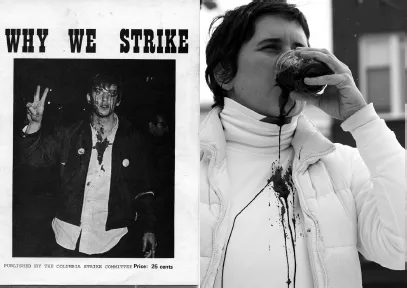
Figure 4: Pamphlet by Students for a Democratic Society (SDS), and Nicole Garneau in UPRISING #1. Photo by Ruth Robbins.

REVOLUTIONARY PRACTICE #2
Creating and re-creating literal and metaphoric expressions of truth telling draws a direct lineage from the feminist notion that the personal is political. Finding our voices and communicating the truth of our lives is a revolutionary skill worth practicing. We must dig inside ourselves for what we know, and defend our own truths. Your refusal to believe the lies of your oppressors and your actions of resistance are profound gestures of self-love. The act of inviting the truths of others honors their stories, even if we never hear them. In an op-ed inspired by Richard Martinez’ words about the murder of his son Christopher, who was killed in a mass shooting at the University of California-Santa Barbara, Adam Gopnik says, ‘Clear speech takes courage. Every time we tell the truth about a subject that attracts a lot of lies, we advance the sanity of the nation’ (Gopnik 2014). Novelist Anne Michaels reminds us, ‘there are many degrees of solidarity. We must learn the value of each other’s words, what they cost’ (2009: 211).
I am inspired by a photo of a pamphlet published in 1968 by the Students for a Democratic Society (SDS), entitled Why We Strike (Columbia Strike Committee 1968). On the cover is a student holding up a peace sign, bleeding down the front of their shirt. Transforming that image is a way of imagining our mouths as revolutionary tools. How are voices punished and silenced? Tell hard truths and bleed from the mouth.

7 February 2008, 8:30pm | DePaul University Quad, Chicago
Participants: First-year students in Dr Laila Farah’s Chicago Women’s Theatre course: Billy, Katie, Lauren, Kaitie, Krystal, Nichole, Theo, Katy, Samantha, Stephanie, Kyle, Jordan, Jenna, Margaret, and Vassaly
Photos: Nicole Garneau
A week before my visit to Dr Laila Farah’s Chicago Women’s Theatre course, there was a conference organized by the DePaul Academic Freedom Committee. The organization’s efforts were inspired by DePaul University’s 2007 decision to deny tenure to Dr Norman Finkelstein and Dr Mehrene Larudee, in spite of the fact that both scholars were well respected and recommended for tenure by their colleagues and departments. Finkelstein’s work had been very critical of the Israeli government’s treatment of Palestinians, and Dr Larudee had supported Finkelstein during his tenure battle (Busch 2008). The conference placed these cases in a larger context of threats to academic freedom on university campuses in the United States. None of the first-year students in Dr Farah’s class were aware of this controversy. For UPRISING #2 at DePaul University that same month, I asked students to research student rebellions of 1968 as preparation for my visit. I also requested that someone bring a dance we could all learn.
The students and I met each other for the first time at 6:00pm, and two hours later we were out performing on the frozen quad of DePaul’s Lincoln Park campus. In the classroom, we talked about the feminist principle ‘the personal is political’ and student revolutionary movements of 1968. It was really difficult, in such a short time, to help students have anything approaching a genuine understanding of the student rebellions of 1968. They had trouble imagining the utter seriousness of that moment. It was very hard for them to grasp, given their current context, the idea of a protest or demonstration meaning anything or changing anything. They got hung up on details about whether students were doing drugs or pissing in the president’s office. But I still believed drawing a 40-year line between students of 1968 and 2008 was important.
To activate themselves as creators of the work, I had students write their own radical truths. We designated volunteers for such performance roles as ‘telling your truth out loud,’ and ‘getting beet juice poured over your head.’ We dressed in white, dealt with one student’s pre-performance emotional breakdown, and walked out to the snowy quad. Performers silently mouthed their stories while they danced an abstracted Macarena, or someone poured beet juice over their heads. It was moving to watch people telling their radical truths without voices, just earnestly mouthing the words. It had the effect of putting them in the space of that truth telling, and letting that read on their faces, but they did not have to share anything they did not want to.
It sounded kind of stupid when we just talked about it, but when it was actually performed it seemed very moving. With the performance happening at night, and the peace of the winter snow, you could really feel the passion Nicole meant to portray through her piece.
I was so skeptical about the whole idea of performing on the streets when we had to watch the videos of the wild and crazy things Nicole does on the streets of Chicago in order to get her message across. I remember talking to people in the class about how weird ...
Table of contents
- Cover Page
- Copyright
- Title Page
- Dedication
- Acknowledgements
- Introduction
- UPRISING: Encounters with Revolutionary Unity and Beauty (An Appreciation) Anne Cushwa
- Balance Weeks of War with Acts of Love. Turn That into a Working Methodology / #1
- Interjection: Love Letter to Beets
- Invite Radical Truth Telling / #2
- Call for Volunteers. Build a Temporary Ensemble / #3
- Claim the Title Activist / #4
- Engage the People / #5
- Say the Word Revolution / #6
- Liberate Our Sexual Encounters / #7
- Reflections on UPRISING #7 Sheelah Murthy, Samantha Miller, Coman Poon, Jane Fresne
- Occupy Public Spaces Without Permission / #8
- Interjection: Remember That Cops Are Human Beings
- Support Radicals of Color / #9
- Honor Revolutionaries and Revolutionary History / #10
- Feminist Art Activism and UPRISING Anne Cushwa
- Envision the World in Which We Want to Live / #11
- Sing Movement Songs / #12
- Make Space for Children / #13
- Let Love Help Make the Art / #14
- Stop Caring about Whether or Not It Is Corny / #15
- Teach! / #16
- Ask Questions. Listen Compassionately / #17
- Interjection: All the Questions
- Respect the Earth and the Beets That Grow in Her / #18
- Produce Beautiful Images / #19
- Create Our Own Meaningful Ceremonies (And Then Get Called Out for Cultural Appropriation) / #20
- Do Not Add More Events to the Calendar / #21
- Violate Norms of Time and Space. Participate Virtually / #22
- Give Thanks / #23
- Bring the Shadow to Light / #24
- Sing on Revolution Square / #25
- Sweeten the Deal with Cookies / #26
- Speak Bravely in Spite of Obstacles / #27
- Give Back to the Grass Roots / #28
- Share Queer History in Queer Spaces / #29
- Put It on a Flag and Send It Out on the Wind / #30
- Be Active in Service of Struggle / #31
- Reflection on UPRISING #31 Anne Cushwa
- Remember the Guidance of Elders / #32
- Enact the Kinds of Relationships We Want with Other People / #33
- Revolutionize Gender / #34
- Keep It Silent and Unobtrusive / #35
- Facilitate Rituals of Release / #36
- Make the Road by Walking / #37
- Personalize the Revolution / #38
- Reflection on UPRISING #38 Nicole Coffineau
- Sew It by Hand / #39
- Re-Enact Revolutionary History / #40
- Understand That We Will Never Fit in One Box / #41
- Construct Metaphors of Community Repair / #42
- Recharge Hearts While Protesting Torture / #43
- Use Your Body to Remember Murdered Bodies / #44
- Name Your Gifts to the World / #45
- When a Youth-Led, Liberatory, Anti-Capitalist Revolutionary Movement Starts, Join Immediately / #46
- Leave a Trace / #47
- Tap into Parties as Sites of Resistance / #48
- Be the Touch You Want to Feel: Prefiguring Intimacy in a Time of Deformed Social Relations Daniel Tucker
- Serve Hot Tea to Cold Strangers / #49
- Recall Moments When You Believed the World Might Actually Change for the Better / #50
- Offer Feathers and Poems to the Wind / #51
- Speak Aloud the Places Where Our Clothes Were Made / #52
- Tend the Graves of Feminist Revolutionaries / #53
- Be a Party Trick / #54
- Find a Shaded Spot and Listen to Stories of Economic Crisis / #55
- Attempt Impossible Tasks / #56
- Share Life’s Glories: Bread and Roses / #57
- Dematerialize Performance / #58
- Choose Honesty and Sincerity as Aesthetic and Revolutionary Strategies. Avoid Art Jargon. Speak Plainly / #59
- Release Material Burdens. Clean Up after Ourselves / #60
- Appendix: Where I’m From
- Notes on Contributors
- Bibliography
- Index