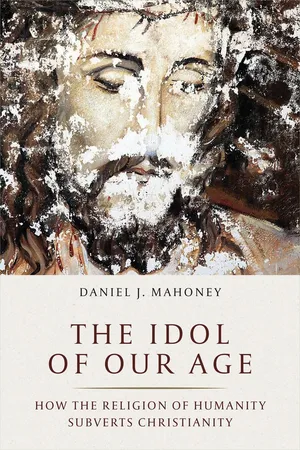
This book is a learned essay at the intersection of politics, philosophy, and religion. It is first and foremost a diagnosis and critique of the secular religion of our time, humanitarianism, or the "religion of humanity." It argues that the humanitarian impulse to regard modern man as the measure of all things has begun to corrupt Christianity itself, reducing it to an inordinate concern for "social justice," radical political change, and an increasingly fanatical egalitarianism. Christianity thus loses its transcendental reference points at the same time that it undermines balanced political judgment. Humanitarians, secular or religious, confuse peace with pacifism, equitable social arrangements with socialism, and moral judgment with utopianism and sentimentality. Mahoney's book follows pope emeritus Benedict XVI in affirming that Christianity is in no way reducible to a "humanitarian moral message." In a pungent if respectful analysis, it demonstrates that Pope Francis has increasingly confused the Gospel with left-wing humanitarianism and egalitarianism that owes little to classical or Christian wisdom. It takes its bearings from a series of thinkers (Orestes Brownson, Aurel Kolnai, Vladimir Soloviev, and Aleksandr Solzhenitsyn) who have been instructive critics of the "religion of humanity." These thinkers were men of peace who rejected ideological pacifism and never confused Christianity with unthinking sentimentality. The book ends by affirming the power of reason, informed by revealed faith, to provide a humanizing alternative to utopian illusions and nihilistic despair. The book is introduced by the distinguished political philosopher Pierre Manent.
- 224 pages
- English
- ePUB (mobile friendly)
- Available on iOS & Android
eBook - ePub
About this book
Information
Topic
Theology & ReligionSubtopic
Religion, Politics & StateCHAPTER ONE

The Humanitarian Subversion of Christianity and Authentic Political Life
The great danger of contemporary humanitarianism is of habituating peoples to despise political reflection, even politics itself and its concrete conditions of existence, as if the affirmation of humanity was sufficient in itself.
Each epoch knows some temptations. The revolutionary temptation persisted for a long time in the West. Today, we experience the humanitarian temptation, which appears more sympathetic. But, in a certain manner, these two temptations are in continuity, and belong to the very same project: to abolish the political existence of men which separates human beings into nations and classes.
— PIERRE MANENT (2000)
The distinguished French Catholic political thinker Pierre Manent perfectly describes the humanitarian temptation that afflicts the Western world today. Even as we insist that human beings live in closed cultures, utterly sufficient unto themselves, our elites blindly announce the unification of a “humanity” which is escaping national loyalties and national identification. Unbeknownst to ourselves, we are adherents of nineteenth-century French philosopher and sociologist Auguste Comte’s “religion of humanity.” Comte was the “prophet” of the movement of humankind from a theological and military order to a scientific and industrial one, and of the dawn of a great “Occidental Republic” that would culminate in the comprehensive unity of the human race. He was the theorist of “democratic pantheism” par excellence since, in the future that he imagined and announced, there would be no more separation between either God and man or peoples and nations. Manent, following his teacher Raymond Aron, calls Comte “the sociologist of human and social unity.” In this understanding, Humanity becomes its own paramount theme. The movement toward a unified humanity is “irresistible,” but it must be “institutionalized and organized” through “the organization and institution of the religion of humanity.” As Manent shows, Comte makes explicit the implicit faith of the late modern world.
Like Comte, Manent suggests, our intellectual elites “can only see human unity.” The philosophical idea of humanity, which first came to light in the eighteenth century in French and German enlightenment thought, is now accompanied by what can only be described as “religious enthusiasm.” What Montesquieu, Voltaire, and Kant announced as a humanizing “Idea” to soften and regulate the mores of modern peoples, we treat as a “self-evident truth.” All who question it are met with “sacred indignation.” Nations were seemingly discredited by the two world wars of the twentieth century, and, as a result, Europe, Comte’s avant-garde of humanity, sees unity where it only incompletely exists. Human beings still live in political communities, plural nations, and regimes, which are the only homes we have for common action, for true political life. These communities “mediate” and “concretize” our sense of the universal but are met by our contemporaries with what Manent calls “vigilant hostility.” We increasingly despise mediation and the political expression of our humanity. In truth, human beings experience common humanity only in the meeting of diverse human and spiritual affirmations and propositions that arise from the concrete human communities in which we live. We see and feel these communities every day. But our intellectuals and opinion-makers are prisoners of the “invisible” unity of the human race that only true believers can see. The humanitarian temptation takes the form of an intolerant and indignant “religion of humanity,” which excoriates all those who do “not see humanity as an immediate reality,” as a self-evident truth. In multiple ways, Auguste Comte remains the secret ruler of souls.
FROM POSITIVISM TO THE RELIGION OF HUMANITY
Auguste Comte was a theoretician of positivism before becoming the founder of the “religion of humanity.” His atheism is more thoroughgoing than what usually goes by the name. He faulted most soi-disant atheists for still trying to answer metaphysical questions. “The true positive spirit” was aggressively anti-theological and anti-metaphysical. It regarded questions about the “why” of existence as utterly futile. True science was concerned with “the study of the invariable laws of phenomena,” not with causes, whether “proximate or primary.” It had no interest in explaining the formation of the universe or the origin of animal and human life. These were “metaphysical” concerns that would be left behind by the positivist spirit. The eminent twentieth-century political philosopher Eric Voegelin has noted the incipient totalitarianism lurking behind Comte’s rendering of the great human questions as futile and useless. In the spirit of ideology, Comte simply announces that these questions can no longer be asked in the great Occidental Republic of which he is the prophet and forerunner. He imposes on reason a crippling self-limitation that prevents it from engaging in properly philosophical reflection. In this way, too, Comte remains a ruler of souls and is one of the sources of the flaccid positivism that dismisses out of hand those questions about truth and meaning that are at the core of our dignity as thinking animals.
In his chapter on the “Religion of Humanity” at the end of part I of his System of Positive Polity, Comte announces the superiority of the morality of positive science to the morality of revealed religion, since it has substituted “the love of Humanity for the love of God.” Adverse to all forms of theology and metaphysics, and excluding “all personal considerations,” the new morality puts “Social Feeling” above self-love. “Humanity,” understood as the very best in human beings, becomes the Grand-Être to be worshipped by limited and fallible men. Comte has forgotten that what is highest in man finds its ultimate source in what is higher than man. Without deference to the Beings, Forms, and Limits that inform and elevate the human will, man risks becoming a monster to himself, enslaved by his own self-deification. Comte admirably recognized that people should defer to what is best, most meritorious, in human beings. But as Aurel Kolnai has well noted, nobility also entails “the subordination of everything human to what is above man.” Men are not gods, and that affirmation is the beginning of all wisdom, secular and religious. Voegelin strikingly captures what is so disturbing in Comte’s innovation: his is an “inter-mundane eschatology … a divination of word-immanent entities” that is the enemy of all transcendent reality. Nothing humane or truly spiritual can arise from such an “apocalypse of man.” It is built on the most demonic of foundations—what Voegelin so suggestively calls in Science, Politics, and Gnosticism “the murder of God.”
PSEUDO-CHRISTIAN ASSONANCES
Readers of Comte cannot help but be struck by what Voegelin calls the “Christian assonances” in his writings, the repeated appeals to “charity,” “love,” “spirituality,” and “faith.” But Voegelin rightly adds that we should not be deceived by this appeal to “religious” categories. The famous motto of the Comtean movement appeals to “Love,” its “principle,” to “Order,” its “basis,” and to “Progress,” its “end.” Comte aimed to bring Feeling, Reason, and Activity together in a perfect synthesis, one that would wholly supersede the old religion and any conception of God. Like all partisans of the end of History, he aimed for a “perfect harmony” where evil and sin would have no place. He would reconcile the aspirations of the French Revolution with the requirements of order, thus establishing a “restoration” on revolutionary foundations. Comte found spirituality in the harmonizing work of women, represented by that great love of his life, Clotilde de Vaux (1845 was the transformative year of their encounter), who taught him the existential primacy of the affective over the rational part of the soul. But love, for which he invented the term “altruism,” was completely divorced from the amor Dei. As Voegelin pointed out, the soul was no longer directed to any transcendental reality. As Voegelin also astutely observed, Comte cannot fathom the existence of “evil spirits.” He is blind to the depths of the soul. His account of a completely mundane “spiritual order” is thus deformed by a naïve faith that believes history will simply leave evil behind in the new, positive age. Comte’s is the most superficial of anthropologies, since it is ignorant of the drama of good and evil in the human soul.
As Voegelin also observes, Comte spiritualizes utilitarianism in ways that are manifestly dangerous and illiberal. He speaks “with the authority of spirit,” even though he has no place for the human soul or an order of things of which it is a part. His spiritual order embodies an “order of moral worth,” a meritocracy within a technocratic industrial order. Woman, the proletariat, and the priests of the religion of humanity will temper and transfigure the hierarchies that constitute industrial society. All of this sounds harmless enough. But Comte was no mere technocrat or benign reformer. He proclaimed himself the “high priest” of Humanity, the exalted servant of the Grand-Être, and announced with great fanfare that the “siècle exceptionel,” the new Occidental Republic dedicated to the religion of humanity, would be inaugurated in 1855. He drew up The Catechism of Positive Religion in the early 1850s and even concocted a Calendrier that would, as Voegelin puts it, pay tribute to the “great men who belong to the Préparation Humaine that leads up to the positive age.” The religious founders, from Zoroaster and St. Paul to Mohammed, were given their places—save one, Jesus Christ. He who is truly God and truly Man, the God-man whose very existence refutes the illusions of pantheism and its perverse spiritualization of the immanent, shall not be mentioned or honored in the new, final age inaugurated by Comte. Comte takes the place of Christ, just as “the love of Humanity,” the jealous Grand-Être, takes the place of “love of God.” In this sense, Comte has divinized his own existence, making himself the herald of a new Humanity worshipping itself. Comte’s existence, and Comte’s alone, truly has universal significance as the harbinger of human self-deification.
A THIS-WORLDLY ESCHATOLOGY
Today, many join John Stuart Mill and Émile Littré in praising Comte’s positivism, his dogmatic and unreasonable hostility to metaphysical speculation and inquiry, while decrying his decision to transform positivism into a religion. But at least Comte saw the need to buttress human unity with an enhanced emphasis on “social feeling,” “altruism,” and a “spiritual order” that transcended the requirements of technique. The problem is the resort to what Voegelin calls “an inter-mundane eschatology” that is inseparable from a philosophy of history that confuses prophetism for reality. And yet, without the fanfare or the accompanying catechism and calendar, many of our contemporaries remain wedded to a religious emphasis on human unity that thoughtlessly and resolutely leaves the old nations and the old religion behind. As Manent suggests, we smile at Comte, the High Priest of Humanity, even as we adhere to many of his secular “religious” presuppositions.
ADIEU TO POLITICS
If Voegelin is the most helpful guide to understanding the not always obvious eschatological dimensions of Comte’s project, the great French political thinker Raymond Aron provides crucial guidance for understanding Comte’s desire to abolish the political realm of human existence in its entirety. As Aron points out, Comte assumed that the positivist era, the age of science, industrial society, and a religion of human unity, would leave war behind once and for all. Europeans were the avant-garde of humanity, paving the way for the abolition of war and the full reconciliation of the human race. As Aron comments in Main Currents of Sociological Thought, history failed Auguste Comte in the years leading up to 1945.
But with the end of the Cold War, Europeans have proceeded as if they are indeed the harbingers of a post-political humanity that will leave borders and sovereignty behind. As Manent has argued in Seeing Things Politically, they can adhere to this quasi-Comtean religion of humanity largely because they continue to rely on the United States for their military protection. In the 1970s, in Aron’s masterwork on Clausewitz, Aron himself called the “farewell to arms” “the great illusion” captivating the European mind and soul. He was convinced that Comte, like Marx, had woefully underestimated the political, imperial, and tragic dimensions of human history. “History as usual” would persist even in the age of science and technique, since human beings cannot escape being political animals. To believe otherwise was to give in to a hope supported only by faith. Comte may not have been wrong that Napoléon misjudged his age by hurling France into the conquest of Europe and by restoring a military regime in place of representative institutions. But the same Comte hated “representative and liberal institutions” and applauded Louis Napoléon’s coup d’état in December 1851. Comte denounced British-style parliamentary institutions as the “metaphysical” instruments of windbags and had next to no concern for political liberty. He even wrote the Russian tsar a letter in the introduction to volume II of his System of Positive Polity offering to instruct him in the lessons of positive philosophy. Comte’s concern for the “fundamental reorganization of European society” and the establishment of a unified human race was unsullied by any concern for political liberty or self-government.
Do contemporary adherents of the religion of humanity show much more respect for the self-government of nations and peoples? They, too, seem to treat political liberty as a metaphysical concern belonging to another moment in human history. In this connection, everyone observes the “democratic deficit” in the European project, but nothing is done about it. Elites affirm the “irresistible” character of “globalization” and the necessary erosion of civic life at the national level (is there a dirtier word today than “nationalism,” which is almost always arbitrarily confused with humane national loyalty?). Like Comte’s original positivism and its accompanying religion of humanity, contemporary partisans of human unity are all too happy to say goodbye to both politics and the Christian religion. Depoliticization and de-Christianization are two great preconditions of the movement toward a unified humanity, now freed from all need for political or religious mediation and concretization. Comte thus hovers in the background not as a prophet of a new age, of a new historical dispensation, but as the half-deluded theorist of a secular religion that remains the temptation of our age. The humanitarian lie is in important respects less horrifying than the totalitarian one, but it is rooted in the same contempt for the political nature of man and the same ignorance of the human soul. The illusions of humanitarianism remind us of the protean character of the ideological lie under conditions of modernity. At its center is a willful denial of the political and spiritual nature of man in any substantial sense of the terms.
CHRISTIANITY AND THE RELIGION OF HUMANITY
Humanitarianism, the softer, regnant version of the religion of humanity, is thus wholly at odds with the Christian proposition and the risks subverting it in the name of an inter-mundane eschatology. Woefully ignorant of sin and of the tragic dimensions of the human condition, it reduces religion to a project of this-worldly amelioration. Free-floating compassion substitutes for charity, and a humanity conscious of its unity (and utter self-sufficiency) puts itself in the place of the visible and invisible Church. Christians ought to be the most sensitive to what is at stake in this new and aggressive secular religion, but today they increasingly redefine the contents of the faith in broadly humanitarian terms. Christianity is shorn of any recognizable transcendental dimension and becomes an instrument for promoting egalitarian social justice, usually in the name of an ideological conception of the poor (clearly, Pope Francis increasingly fits into this category). One cannot help but ask if Christianity is inherently vulnerable to humanitarian appropriation, as Nietzsche suggested with hostile intent. Pierre Manent, with no hostile intent, has argued that the religion of humanity would never “have attained its empire over our souls if it did not appear as the extension and the consequence, perhaps the effectual truth, of Christianity, of the religion of the neighbor.” Manent suggests that “the feeling of the same,” the vague but powerful sentiment of a common humanity on the way to full realization in a unified human race, appears to many in the modern democratic world as “the truly human form, the final form of Christian charity.”
But this reduction of charity, the greatest theological virtue, to compassion and fellow-feeling ignores the fact that genuine love of one’s neighbor is only possible because one discerns in him or her “the image of God.” Every unique and irreplaceable person reflects in some way the goodness and grandeur of God, and not his or her own self-sufficiency. Manent suggests that authentic love frees us from the double slavery to the self and the other because it elevates the soul to a higher spiritual plane, one marked by the ineffable grace and goodness of God. The Good Samaritan does not love the wounded man on the side of the road because he somehow espouses the “democratic religion of the same.” He is not a humanitarian, but one who is properly sensitive to the image of God in each and every human being, however marked we all are by sin. The modern world has trouble understanding St. Mother Teresa of Calcutta because it can only interpret her good works within the closed horizons of humanitarianism. Mother Teresa, however, told Malcolm Muggeridge in the late 1960s that her love for the poorest of the poor was motivated by her desire to do “something beautiful for God.” The paradox of Christian charity is that by escaping from the closed circle of self and other, we are able to truly appreciate the dignity of every human being. Christians welcome good works such as the admirable efforts of Doctors Without Borders. But Christian humanism does not reduce charity to a means of this-worldly transformation. The life of the soul as illustrated by Mother Teresa has “specifically Christian dimensions not found within humanitarianism.”
I have concentrated on the insights of Pierre Manent in no small part because he is that rare contemporary who appreciates the defects of humanitarianism on political, philosophical, and theological grounds. He grasps the whole picture, so to speak. He is also that rare Christian who appreciates that Christians, too, are political animals, and not first and foremost “citizens of the world.” Once an indispensable category of Aristotelian and Thomistic thought, the “common good” is increasingly identified by popes and other Christians in positions of authority with a nonexistent “world governing authority” (this unfortunate locution can be found in papal social encyclicals dating back to the 1960s). It is fair to say that Catholic thought has been infected by a humanitarian virus that forgets the wisdom of subsidiarity (the need to diffuse political and social power) and the fact that humanity is for many a self-conscious substitute for the Church as the “bearer and instrument of charity” for a humankind “wounded and divided by sin,” to cite Manent again. Nor do the most influential teachers of the faithful fully appreciate that the “contemporary religion of humanity excludes and rejects the Christian religio...
Table of contents
- Cover
- Title Page
- Copyright
- Dedication
- Contents
- Foreword
- Introduction: The Secular Religion of Our Age
- Chapter One: The Humanitarian Subversion of Christianity and Authentic Political Life
- Chapter Two: Orestes Brownson: From the Religion of Humanity to Catholicism and Constitutional Republicanism
- Chapter Three: Soloviev on the Antichrist or the Humanitarian Falsification of the Good
- Chapter Four: The Humanitarian Ethos
- Chapter Five: Solzhenitsyn’s Red Wheel: A Tough-Minded and Humane Christian Vision
- Chapter Six: Pope Francis’s Humanitarian Version of Catholic Social Teaching
- Chapter Seven: Jürgen Habermas and the Postpolitical Temptation
- Chapter Eight: Reason, Conscience, and the Return to Truth
- Appendix: The Humanitarian versus the Religious Attitude
- Selected Bibliography
- Index
Trusted by 375,005 students
Access to over 1.5 million titles for a fair monthly price.
Study more efficiently using our study tools.
Frequently asked questions
Yes, you can cancel anytime from the Subscription tab in your account settings on the Perlego website. Your subscription will stay active until the end of your current billing period. Learn how to cancel your subscription
No, books cannot be downloaded as external files, such as PDFs, for use outside of Perlego. However, you can download books within the Perlego app for offline reading on mobile or tablet. Learn how to download books offline
Perlego offers two plans: Essential and Complete
- Essential is ideal for learners and professionals who enjoy exploring a wide range of subjects. Access the Essential Library with 800,000+ trusted titles and best-sellers across business, personal growth, and the humanities. Includes unlimited reading time and Standard Read Aloud voice.
- Complete: Perfect for advanced learners and researchers needing full, unrestricted access. Unlock 1.5M+ books across hundreds of subjects, including academic and specialized titles. The Complete Plan also includes advanced features like Premium Read Aloud and Research Assistant.
We are an online textbook subscription service, where you can get access to an entire online library for less than the price of a single book per month. With over 1.5 million books across 990+ topics, we’ve got you covered! Learn about our mission
Look out for the read-aloud symbol on your next book to see if you can listen to it. The read-aloud tool reads text aloud for you, highlighting the text as it is being read. You can pause it, speed it up and slow it down. Learn more about Read Aloud
Yes! You can use the Perlego app on both iOS and Android devices to read anytime, anywhere — even offline. Perfect for commutes or when you’re on the go.
Please note we cannot support devices running on iOS 13 and Android 7 or earlier. Learn more about using the app
Please note we cannot support devices running on iOS 13 and Android 7 or earlier. Learn more about using the app
Yes, you can access The Idol of Our Age by Daniel J. Mahoney in PDF and/or ePUB format, as well as other popular books in Theology & Religion & Religion, Politics & State. We have over 1.5 million books available in our catalogue for you to explore.