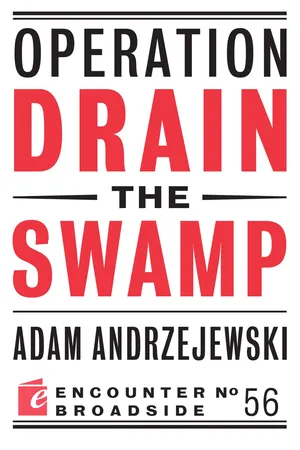
President Donald J. Trump said he wants to "drain the swamp." But is it a swamp or an ocean? It's about time the American people had some hard facts regarding the federal bureaucracy.In Operation Drain The Swamp, we expose all of it. We showcase who receives how much, where they work, and what they do. Most importantly, we reveal how much these bureaucrats cost the American taxpayer.During the 2016 presidential election, the supporters of Donald Trump on the right – and even those supporting Bernie Sanders on the left – felt that the "system was rigged" for insiders. Now, we highlight the facts and stories to prove it. In Operation Drain The Swamp, we offer a step-by-step guide to civil service reforms.
- 24 pages
- English
- ePUB (mobile friendly)
- Available on iOS & Android
eBook - ePub
Operation Drain the Swamp
About this book
Information
INTRODUCTION
MANY AMERICANS LIKELY know the Reverend Minister Louis Farrakhan founded the Nation of Islam. But do they know he’s also a farmer? Farrakhan received more than $317,000 in federal farm subsidies and commodities loans at his home address in Hyde Park, Chicago during a sixteen-year period.
The subsidies were granted to a charity called the Three Year Economic Saving Program, which then, allegedly, distributed the funds to a 1,500-acre farm based in Georgia called “Muhammad Farms.” The trouble is, the Three Year Economic Saving Program might not be a real charity — in 2014, the Cincinnati office of the Internal Revenue Service didn’t have a record of it. The Illinois Secretary of State listed the Saving Program as “not in good standing.” What’s more, the Illinois Attorney General’s office, which oversees the state’s 501(c)(3) charities, in 2014, had no record of a charity registered with that name. And yet government checks flowed to Farrakhan, not in Georgia, of course, but at his home address in Chicago.
This is but one sadly typical illustration of the reach and perfidy of what has become popularly known as “the swamp.”
“The swamp” is not just how we refer to Washington when the party we despise controls the levers of government. Nor is it merely a snarky designation for that generally disliked Mid-Atlantic wasteland known as the D.C. Beltway zone (despite the myth, Washington was not founded atop a drained swamp).
In America today, “the swamp” is a real thing: a permanent government within our government that will outlast this administration and the next one and the one after that. It has a massive architecture that can be measured. It is composed of tens of thousands of individuals — many of whom operate well outside the confines of Washington, D.C. And it is not just government employees. It is also the thousands of lobbyists working to keep pet projects funded, the thousands of rent-seeking private citizens who practice their own form of income redistribution by gobbling up tax dollars through federal subsidies, and the thousands of private-sector employees hired as independent contractors to do work the American people never asked for.
The administrative state’s costly interventions into the daily lives of American citizens far outweigh its purported benefits.
The larger the swamp grows, the more it entangles and imperils our everyday lives.
Americans are rightly suspicious. They know unfairness when they see it. But few Americans are aware just how far the tentacles of the swamp have spread, and just how tight a grip the swamp has on their everyday lives. While the idea of draining the swamp may seem to be a new one, it has a storied American history — which makes it all the more shocking that it has never been accomplished.
Indeed, Americans have loathed the swamp since long before President Donald Trump targeted it in his successful 2016 campaign. In fact, the slogan “drain the swamp” has a long and, surprisingly, bipartisan history. In 1983, Ronald Reagan pledged to drain the swamp, saying to constituents: “sometimes it is difficult to remember that you didn’t send us to Washington to feed the alligators, you sent us to drain the swamp.” Unfortunately, the alligators were still being fed by the time Senate Minority Leader Nancy Pelosi made the same promise in 2007, pledging to “break the link between lobbyists and legislation.”
But just what is the swamp, and where did it come from? In technical terms, “the swamp” is perhaps best described as America’s administrative state: a broad, unelected federal bureaucracy conceived by Progressives and willed into existence with the New Deal reforms. The administrative state technically falls under the purview of the executive branch, but today’s administrative agencies function autonomously with little to no oversight or accountability to the presidency — or the American people.
The Left views the administrative state as a professional technocrat class that competently manages various federal programs for the benefit of the public. In the Left’s view, the people, unable to help themselves, must be constantly taken care of by the federal government.
The Right argues that our elected officials have delegated far too much power to these agencies, that they operate with less-than-scientific efficiency, and that the administrative state’s costly interventions into the daily lives of American citizens far outweigh its purported benefits.
OpenTheBooks fact checked the promises from both sides and conducted a full-scale investigation to reveal the size, scope, and effectiveness of this federal bureaucracy. We audited all publicly disclosed government salaries and bonuses for the 2016 fiscal year. We learned what exactly it is they do, where they work, and how much they make.
We literally mapped the swamp. And the results were deeply alarming.
The current state of America’s bureaucracy is unconscionably expensive. In 2016, there were 1.97 million civil service employees in the executive agencies (plus the U.S. Post Office), at a total cash cost of $136 billion. Federal bureaucrats are paid 1.1 million dollars every minute, $65.6 million every hour, and over half a billion dollars per day — and that’s just cash compensation. This, by the way, is not counting the Department of Defense and our active military — one of the few expenditures that most Americans actually agree is essential to the security and wellbeing of our nation.
Many American workers spend their entire careers trying to earn six figures — indeed only 8 percent of Americans make $100,000 a year. In the swamp, however, six figures can be the norm. We found that $100,000 represents a kind of “minimum wage” for federal employees. There are 78 agencies where the average salary is $100,000 or more. Around 25 percent of federal employees make six figures — three times the percentage of private-sector workers. And the number of highly compensated federal employees is only growing. Between fiscal years 2010 and 2016, the number of federal employees making $200,000 or more increased by 165 percent. Our analysis showed that more than 406,000 federal employees earned six-figure incomes in 2016, while 30,000 rank-and-file federal employees received more than $190,823, out-earning each of the 50 state governors.
Federal bureaucrats are paid 1.1 million dollars every minute, $65.6 million every hour, and over half a billion dollars per day—and that’s just cash compensation.
It is not just big salaries that make these federal employees so pricey — taxpayers also pay for lucrative perks like weeks of paid time off, performance bonuses, and padded retirement pensions. On average, federal employees receive 10 federal holidays, 13 sick days, and 20 vacation days per year. Compare that to the average 10 days of paid-time-off that private sector American workers receive. These benefits, which far exceed those offered in the private sector, cost taxpayers $22.6 billion annually.
On top of overly generous vacation time, the federal government pays out $1.5 billion in big bonuses every year. In 2016, there were more than 330,000 disclosed federal bonuses, but the largest bonus in the federal government ($141,525) didn’t go to a doctor researching a cure for cancer or a rocket scientist helping us to reestablish dominance in space. Instead, it went to an HR Manager who’s in charge of payroll at a small federal agency in San Francisco, California, called Presidio Trust. In fact, Presidio Trust — a needless agency about which we’ll learn more later — awarded 3 of the 4 biggest bonuses in 2016.
All told, the federal workforce contains 579 job titles ranging from “Book Binding” to “Zoology.” The scope for malfeasance is vast. But even legitimate jobs are sources of major waste. There are more than 35,000 lawyers in the administrative state. Yet just one-third of those lawyers work at the Department of Justice. The majority of these taxpayer-funded attorneys are dispersed across 90 agencies defending regulations rather than fighting crime and criminals. If the average American’s life feels more burdened by regulation than ever before, there’s a good reason for that. The army of lawyers in the employ of the federal government assures that no aspect of American life is untouched by the swamp’s appendages.
Should the federal government reassess its payroll priorities? Is it necessary to maintain such an expansive and costly bureaucracy? Does a large and widespread federal workforce facilitate good government? The answers, after our study, are clear. Select case studies of governmental overreach in specific departments will make this even more apparent.
THE EPA: MURKY WATERS
Elizabeth Southerland — who until August 2017 was the director of science and technology in the Environmental Protection Agency’s Office of Water — might be the most famous EPA employee not named Scott Pruitt. In 2017, she made headlines for resigning from the EPA in protest over the way the Trump administration, under new director Pruitt, was “seriously weakening the EPA’s mission by vigorously pursuing an industry deregulation approach and defunding implementation of environmental programs.” Her public resignation, which decried “major budget cuts” that were not yet law, was lauded by the media as an example of a principled government employee standing up for her beliefs.
What the reporting failed to mention was that Southerland was one of the EPA’s — and the federal government’s — highest paid employees. In 2016, she earned a salary of $185,100, plus a bonus of $64,155, meaning her total government income exceeded Vice President Joe Biden’s by nearly $20,000. Furthermore, Southerland’s principled stand was anything but. In fact, she was eligible for a government pension, which allowed her to have her cake and eat it too. Rather than be thankful to the American people for the years of over-pay she received, Southerland rudely waltzed out the door with a cushy pension, too. Southerland is the true representation of the administrative state: exceedingly well-paid, entrenched, and infatuated with her singular ability to conduct the business of government.
This mentality is widespread throughout the administrative state. The EPA is a particular source of harmful bloat. Not only do its employees take home typically large salaries, they enjoy perks beyond any reasonable measure. Over a nine-year period, the agency spent $92 million on furniture alone. But while expensive office chairs are offensive enough, they don’t touch the average American in the way some EPA programs do. Consider just one example of EPA overreach: the EPA has spent over $715 million on its “Criminal Enforcement Division.” This staggering budget includes 200 special agents, armed with guns, ammunition, and military-grade equipment. It is hard to imagine why these agents would need such equipment, and harder still to fathom how it could cost so much.
The army of lawyers in the employ of the federal government assures that no aspect of American life is untouched by the swamp’s appendages.
All this would be easier to swallow if the EPA were not such a meddlesome organization. Take the case of John Duarte, a fourth-generation farmer who oversees 450 acres of a family farm in Northern California. In 2012, Duarte was accused by the EPA and Army Corps of Engineers of damaging wetland features on his property. The bill from the government in fines and restoration fees totaled $30 million. Duarte’s crime? Tilling his own land. The EPA alleged that he had violated the Clean Water Act, which regulates tributaries that flow into larger bodies of water. Duarte’s bad fortune — that wetlands on his property flowed into a larger body — resulted in the federal government requiring a permit before Duarte could cultivate land he had owned for decades. Such a permitting process can take years and includes conducting studies at the owner’s expense. When Duarte failed to meet the EPA’s unreasonable standards, he was targeted with an outrageous fine. Rather than litigate the injustice, he chose the sensible option of settling with the government for $1.1 million.
While the EPA was targeting family farmers like Duarte, the agency simultaneously employed 168 economists with salaries totaling $18.9 million to study “the application of the principles of economics to the study of how environmental and natural resources are developed and managed.” If the EPA were more efficient, perhaps it wouldn’t need to fine small-scale farmers tens of millions of dollars to fund itself.
THE VA: ANYTHING BUT CARE
In 2014, a courageous whistleblower named Dr. Sam Foote brought national attention to a “cook the books” wait-time bonus scandal at the Phoenix Veterans Affairs facility. At that facility alone, up to 40 veterans died while waiting to see a doctor and up to 1,300 veterans had to wait up to six months for an appointment — the average wait-time was 115 days.
And while veterans were waiting to see a doctor, the official books showed no wait-times at all. Though it started in Phoenix, the scandal spread nationwide, revealing similar issues at VA facilities across the country. During a ten-year period, more than 1,000 veterans died waiting to see a doctor, and many calls to the VA’s suicide hotline were answered by an automated voicemail service. While even one veteran’s needless death is an outrage, the VA’s behavior during the scandal makes the situation even more appalling.
While veterans were suffering at the hands of a broken bureaucratic machine, the VA doled out tens of thousands of undeserved performance bonuses: $150 million per year. At the peak of the scandal, the U.S. House of Representatives voted 426–0 to end the practice of VA bonuses through 2016, but the Senate never took up the legislation. Yet during and after the worst scandal in Veterans Affairs history, the VA continued doling out bonuses. What’s worse? Nearly half the bonuses in 2014 went to the same employees as the previous year, effectively rewarding its staff for the gratuitous deaths of thousands of American veterans. In 2016, the VA disclosed only $22 million worth of bonuses to 38,292 employees and continued to hide its ‘performance bonuses.’
If veterans are dying because there are not enough doctors to see them, the logical solution would be for the VA to hire more doctors. It is not that the VA isn’t hiring any doctors — it is that they are hiring so many other employees in non-medical roles. From 2015 to 2016, the VA made 20,711 new hires; but just 2,091 were doctors, continuing the historical 10:1 doctor to non-doctor employee hiring ratio at the agency. In 2016, the VA had 372,614 total employees but just 8 percent of these were medical doctors, dental officers, optometrists, or podiatrists.
Even as the VA claims to be improving, treatment is still subpar for thousands of veterans. This year, the VA Secretary David Shulkin admitted that more than 90,000 disability claims would take more than 125 days to process. And over 500,000 veterans still wait longer than 30 days to even see a doctor. Why, then, does the VA continue to hire so many nonessential employees?
In 2016, the VA employed 3,498 police officers at a total cost of $172 million. All names and locations of these officers, however, were redacted. When asked about corresponding crime statistics, the VA was unable to provide any information on the number of crimes or incidents. Bear in mind that, as of 1996, the VA employed no police officers with arrest and firearm authority at all.
Today’s officers not only draw large salaries, they’re equipped with expensive and unnecessary equipment. In 2015, almost $2 million was spent on riot helmets, shields, body armor, a cannon system, tactical gear, and other equipment for crowd control. The average physician at the VA makes around $205,000 a year, meaning the VA could employ 840 doctors instead of 3,498 police officers. These doctors would help fulfill President Lincoln’s promise to “care for him who shall have borne the battle.” How, exactly, does an army of VA police officers help do that?
It is not just police officers that drive unnecessary costs at the VA. The VAs retains a large staff of none...
Table of contents
- Cover
- Table of Contents
- Introduction
- Acknowledgements
- Copyright
Trusted by 375,005 students
Access to over 1.5 million titles for a fair monthly price.
Study more efficiently using our study tools.
Frequently asked questions
Yes, you can cancel anytime from the Subscription tab in your account settings on the Perlego website. Your subscription will stay active until the end of your current billing period. Learn how to cancel your subscription
No, books cannot be downloaded as external files, such as PDFs, for use outside of Perlego. However, you can download books within the Perlego app for offline reading on mobile or tablet. Learn how to download books offline
We are an online textbook subscription service, where you can get access to an entire online library for less than the price of a single book per month. With over 1.5 million books across 990+ topics, we’ve got you covered! Learn about our mission
Look out for the read-aloud symbol on your next book to see if you can listen to it. The read-aloud tool reads text aloud for you, highlighting the text as it is being read. You can pause it, speed it up and slow it down. Learn more about Read Aloud
Yes! You can use the Perlego app on both iOS and Android devices to read anytime, anywhere — even offline. Perfect for commutes or when you’re on the go.
Please note we cannot support devices running on iOS 13 and Android 7 or earlier. Learn more about using the app
Please note we cannot support devices running on iOS 13 and Android 7 or earlier. Learn more about using the app
Yes, you can access Operation Drain the Swamp by Adam Andrzejewski in PDF and/or ePUB format, as well as other popular books in Politics & International Relations & American Government. We have over 1.5 million books available in our catalogue for you to explore.