The current frenzy over global warming has galvanized the public and cost taxpayers billons of dollars in federal expenditures for climate research. It has spawned Hollywood blockbusters and inspired major political movements. It has given a higher calling to celebrities and built a lucrative industry for scores of eager scientists. In short, ending climate change has become a national crusade.And yet, despite this dominant and sprawling campaign, the facts behind global warming remain as confounding as ever.In Climate Confusion, distinguished climatologist Dr. Roy Spencer observes that our obsession with global warming has only clouded the issue. Forsaking blindingly technical statistics and doomsday scenarios, Dr. Spencer explains in simple terms how the climate system really works, why man’s role in global warming is more myth than science, and how the global warming hype has corrupted Washington and the scientific community.The reasons, Spencer explains, are numerous: biases in governmental funding of scientific research, our misconceptions about science and basic economics, even our religious beliefs and worldviews. From Al Gore to Leonardo DiCaprio, the climate change industry has given a platform to leading figures from all walks of life, as pandering politicians, demagogues and biased scientists forge a self-interested movement whose proposed policy initiatives could ultimately devastate the economies of those developing countries they purport to aid.
eBook - ePub
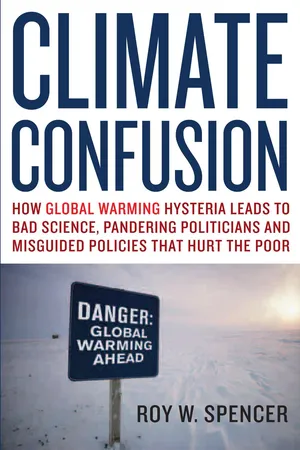
Climate Confusion
How Global Warming Hysteria Leads to Bad Science, Pandering Politicians and Misguided Policies That Hurt the Poor
- 190 pages
- English
- ePUB (mobile friendly)
- Available on iOS & Android
eBook - ePub
Climate Confusion
How Global Warming Hysteria Leads to Bad Science, Pandering Politicians and Misguided Policies That Hurt the Poor
About this book
Information
Topic
Sciences biologiquesSubtopic
Science environnementale
Run for your life! Run for your life! The ice age is coming!!
Chapter 1: Global Warming Hysteria
It was a dark and stormy night; the rain fell in torrents—except at occasional intervals, when it was checked by a violent gust of wind which swept up the streets (for it is in London that our scene lies), rattling along the house-tops, and fiercely agitating the scanty flame of the lamps that struggled against the darkness. Had Jack known that such meteorological chaos, long predicted by climate experts and his favorite movie stars, would have ensued after his purchase of that petrol-guzzling behemoth, he would not so quickly have given in to the siren calls of the TV commercials that had relentlessly nagged him into buying his Hummer—an acquisition that would trouble his heavy heart, a good heart, right up to this very moment.
IN CASE YOU have not noticed, all natural disasters are now caused by global warming. Tsunamis, hurricanes, tornadoes, heat waves, and snowstorms are all being blamed on mankind’s use of fossil fuels. The latest flood and drought were both caused by global warming. Al Gore’s movie and book An Inconvenient Truth make it sound like chunks of glaciers breaking off and falling into the ocean, arctic sea ice melting, and major hurricanes striking the United States never happened before global warming . . . and if we would just stop the warming, these things wouldn’t happen ever again. Even the Alaskan Inuit’s “traditional” way of life is now threatened by warmer temperatures in the Arctic. It seems their snowmobiles are falling through the ice more frequently these days.
Apparently, global warming theory is so powerful and flexible that it can explain everything, from failed crops, to flooded homes, to shrinking polar bear populations, and, as recently reported, even shrinking polar bear testicles. Warmer winters? Evidence of global warming. Colder winters? Also evidence of global warming. The theory of manmade global warming has been elevated to a physical law, proven beyond any doubt, and it supposedly now gives us a unified way to explain any change we see in nature.
But no matter whether manmade global warming is a serious problem, an overblown fear, or even nonexistent, it does provide a source of some excitement and entertainment in our lives. Let’s look at some of the ways in which we have been entertaining ourselves with global warming.
RECORD WEATHER EVENTS
It appears to be part of human nature to blame severe weather events on something done by mankind, whether it is global warming, or the Russians’ weather control machine that a South Dakota TV weatherman blamed the 2005 hurricanes on. But one of the features of extreme weather events that most people don’t understand is that abnormal weather is . . . well . . . normal.
Let’s take record high or low temperatures as an example. For a weather observation site that has existed for one hundred years (and there aren’t many of those), daily record high temperatures should, on average, occur three or four times a year. The first year the station existed, every day experienced a record. This is because the high temperature was higher (and lower, too) than it was ever measured before on that date . . . which was never. Then, in the second year, one-half of the days would have record high temperatures, while all the others would be record low temperatures. Only in the third year would it even be possible for a temperature not to set a new record every day.
You get the idea. It is normal, even expected, to have record weather occurrences on occasion. Yet we seem surprised when they happen. They also tend to occur in clusters. Some regions will have record temperatures for days in a row. One hundred or more cities and towns might set records on a given day during a heat wave. And while you might have been led to believe that the all-time record high temperatures in the United States were set in the last ten years or so, the truth is that the decade with the largest number of all-time state record high temperatures was the 1930s.
And what happened in previous centuries? Was the weather back then really that different from today? No one really knows for sure. If it was different, that wasn’t because of humans. While there is some anecdotal evidence about grapes growing in England, or the Thames River freezing over completely in winter in centuries past, these events might well have had no connection to global warmth or cold. The Earth is a pretty big place, and since three-quarters of it is ocean, it still remains a little difficult to measure what is happening everywhere.
One thing we do know is that, historically, warm weather has been better for humans than cold weather. Around 1000 A.D ., warm climate conditions called the Medieval Warm Period, or Medieval Optimum, existed. Humanity prospered during this time, presumably because they weren’t buried under a mile-thick layer of ice like they were during the “Less-Than-Optimum Ice Age.” Note that climatologists call that warm period the “Medieval Optimum,” not the “Medieval Global Warming Disaster.”
Then there was the widespread fear back in the 1970s that the slight cooling trend we had been experiencing since the warm 1940s was the start of the new Ice Age. People instinctively knew that cold was bad (unless you operate a ski resort). But now warmer is also bad. Apparently, the exact temperature we were at in 1980 was the temperature we are supposed to be at. It is perfect, undefiled, and natural. Never mind that “perfect” for many of us ranges from below 0° Fahrenheit in the winter to 90° Fahrenheit in the summer. Those, presumably, are the temperatures ordained by Mother Nature, and we shouldn’t even think about touching the thermostat.
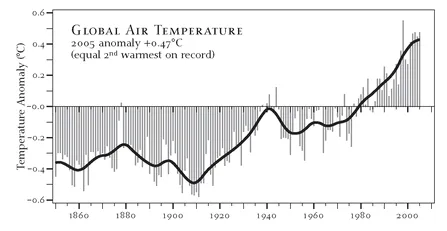
As the following chart of global temperatures between 1850 and 2005 shows, however, globally averaged temperatures can change substantially for entirely natural reasons. Most of the warming up until 1940 could not have been caused by mankind simply because we had not emitted very much in the way of greenhouse gases before that time.
And when it comes to actually knowing what global temperatures were before about 1850, we simply do not have the measurements available to say much of anything of scientific value.
Nevertheless, some scientists won’t let a little problem like a lack of measurements stop them. A number of scientists, apparently frustrated historians, have created a discipline called “paleoclimatology.” This is where scientists look at tree rings or ice core layers and magically divine the historical temperature record.
While normal people would call such an interpretation questionable, the researchers prefer to call it science. With just a few key assumptions (which are then immediately forgotten), these paleoclimatologists can tell us what the weather was like during past centuries or millennia. Since they do not have to deal with the inconvenience of actual temperature measurements to verify their methods, their results are often treated as gospel. There’s an old joke in science that if you want perfect measurements, take them only once. Then there’s no disagreement.
I personally do not put much faith in paleoclimate studies. Since scientists can’t even agree on the accuracy of actual thermometer-measured temperatures over the last hundred years, I find claims that we can discern ancient temperatures based upon the tree-ring spacing of a Bristlecone Pine growing at 9,000 feet elevation in a remote corner of Colorado to be a little dubious.
A National Academy of Sciences review panel in 2006 addressed an ongoing flap about whether the Earth is warmer now than anytime in the last 1,000 years. The infamous “hockey stick” curve of global temperatures published by paleoclimatologists in 1998 made a huge splash because it downplayed the warmth of the Medieval Warm Period, thus elevating the late twentieth-century warmth to record status. Without explicitly scolding the hockey stick inventors for using questionable statistical techniques to make their warmest-in-a-thousand-years claim, the NAS panel finally agreed that about all one could say with considerable confidence is that the Earth is warmer now than anytime in the last 400 years.
The media exclaimed, “Oh, no! We are warmer now than anytime in the last 400 years!,” apparently not realizing that this was a pretty big downgrade from their previously reported exclamation, “Oh, no! We are warmer now than anytime in the last 1,000 years!” Since 350 of those 400 years were during the “Little Ice Age,” I would call our current warmth pretty good news.
Yet, even though our present period of warmth might be more beneficial than harmful, most journalists can’t ever bring themselves to report anything in a positive light. What a depressing job.
Another human tendency that influences our perception of global warming is the belief that, if we happen to be experiencing a drought, the whole world must be drought-stricken. If this is the warmest year our town or city has ever recorded, then the whole world must be sweltering. Any unusual local weather event is given global significance. Maybe you have heard of “weather patterns”? Well, they really do exist, and they influence relatively small portions of the Earth. Of course, we scientists don’t call them “weather patterns,” because that sounds too unprofessional. We call them “regional climate anomalies,” a more technical term which shows how intelligent we are.
Even the United States, as big as it is, represents only a little over 2 percent of the surface area of the Earth. I once computed the correlation between United States temperatures and globally averaged temperatures from the satellite data analyses that John Christy and I originally developed and continue to maintain. (Satellites, by the way, provide our only way of measuring the whole globe.) The resulting correlation was just about zero. No relationship. Even averaged over the entire United States, heat waves or cold snaps were unrelated to globally averaged conditions.
And that was for the whole United States, not just a little burg like Podunk, Michigan (which, by the way, is a real town). When one region is experiencing unusually hot weather, it is almost always accompanied by another area, typically a thousand miles or so away, that is having unusually cold weather. For instance, in the United States, if the east coast is having a heat wave, you can usually count on California being unseasonably cool, and vice versa. It doesn’t have any global significance. Well, okay, it does have a little over 2 percent global significance.
So when Al Gore gave a global warming speech in January 2004 on one of the coldest days ever in New York City, one could have been tempted to attribute global significance to the event, rather than just irony. But that cold day really didn’t mean that the whole Earth is getting colder. Nevertheless, you can bet that when Earth Day occurs during a heat wave in New York City, the event speakers will tie that to global warming.
Another issue that colors how we view extreme weather events is that we tend to put current weather into the context of our own, rather short, lifetimes. If we never experienced something before, we are tempted to conclude that it never happened before at all. And even within our lifetimes, our memory of past events that really did occur is often not very good. The best example of this is the Great Alien Invasion of 1984. Absolutely no one that I ask about this historic event can even recall it happening. A brilliant illustration of my point: the public has a short memory.
And how many “storms of the century” did we have in the 1980s and 1990s? As I recall, by 2001 or so, we had already experienced what was called the “Storm of the 21st Century.” Apparently, someone entered NASA’s secret weather time machine, and checked out what will happen over the next ninety-nine years. Um . . . forget I told you about the time machine, you aren’t supposed to know about it. Oh, never mind, you’ll forget about it anyway.
For something blatantly ridiculous, let’s look at a non-weather event that some people nevertheless connected to the weather. The mega-tsunami of December 26, 2004 in Indonesia certainly was unprecedented in recent human memory. Unbelievably (or maybe predictably), a few experts and politicians actually blamed the tsunami on global warming.
Well, tsunami waves are triggered by earthquakes under the bottom of the sea. The earthquakes, in turn, are caused by the tectonic plates that make up the Earth’s crust slowly grinding against each other. Given the enormous forces deep in the Earth involved in earthquake formation, any change in the concentration of a minor atmospheric constituent like carbon dioxide would go totally unnoticed by the Earth’s crust.
The Earth’s crust and mantle simply don’t care whether the atmospheric carbon dioxide concentration is 250 parts per million (sometime in the distant past) or 500 parts per million (predicted for late in this century). It probably doesn’t even care whether there is an atmosphere or not. I tried to invent a more absurd reason than global warming for the cause of the Indonesian tsunami, but I couldn’t think of one. Yet since the supposed connection to global warming was reported in the news, many people will believe it.
While most experts didn’t blame the tsunami on global warming, it was at least suggested that the tsunami showed how vulnerable we are to global warming. But this historic tsunami event should make us fear global warming less, not more. The tsunami puts global warming into proper perspective for us. Coastal residents have been told that global warming will cause sea levels to rise by several inches in the coming decades. Then along came a tsunami, growing to as much as twenty feet tall in a matter of seconds, making a possible gradual sea level rise of a few inches all but superfluous, lost in the noise, irrelevant.
The difference in magnitudes between these two extremes is astounding. A gradual sea level rise can be adapted to. Seawalls and levees can be built up; the next crop of new buildings can be on slightly higher foundations. But an earthquake under the sea floor is totally unpredictable. The only way to avoid tsunamis is to not live so close to sea level. Like that is going to happen.
The inescapable reality is that people who live in coastal regions are at risk of natural disasters visiting them from the ocean, just as those who live in earthquake zones are at risk, and those who live where tornadoes occur. There a...
Table of contents
- Title Page
- Preface
- Prologue
- Chapter 1: Global Warming Hysteria
- Chapter 2: Science Isn’t Truth
- Chapter 3: How Weather Works
- Chapter 4: How Global Warming (Allegedly) Works
- Chapter 5: The Scientists’ Faith, the Environmentalists’ Religion
- Chapter 6: It’s Economics, Stupid
- Chapter 7: The Politics of Climate Change
- Chapter 8: Dumb Global Warming Solutions
- Chapter 9: Less Dumb Global Warming Solutions
- Chapter 10: Summary
- Epilogue
- ILLUSTRATION CREDITS
- Index
- A NOTE ON THE TYPE
- Copyright Page
Trusted by 375,005 students
Access to over 1.5 million titles for a fair monthly price.
Study more efficiently using our study tools.
Frequently asked questions
Yes, you can cancel anytime from the Subscription tab in your account settings on the Perlego website. Your subscription will stay active until the end of your current billing period. Learn how to cancel your subscription
No, books cannot be downloaded as external files, such as PDFs, for use outside of Perlego. However, you can download books within the Perlego app for offline reading on mobile or tablet. Learn how to download books offline
Perlego offers two plans: Essential and Complete
- Essential is ideal for learners and professionals who enjoy exploring a wide range of subjects. Access the Essential Library with 800,000+ trusted titles and best-sellers across business, personal growth, and the humanities. Includes unlimited reading time and Standard Read Aloud voice.
- Complete: Perfect for advanced learners and researchers needing full, unrestricted access. Unlock 1.5M+ books across hundreds of subjects, including academic and specialized titles. The Complete Plan also includes advanced features like Premium Read Aloud and Research Assistant.
We are an online textbook subscription service, where you can get access to an entire online library for less than the price of a single book per month. With over 1.5 million books across 990+ topics, we’ve got you covered! Learn about our mission
Look out for the read-aloud symbol on your next book to see if you can listen to it. The read-aloud tool reads text aloud for you, highlighting the text as it is being read. You can pause it, speed it up and slow it down. Learn more about Read Aloud
Yes! You can use the Perlego app on both iOS and Android devices to read anytime, anywhere — even offline. Perfect for commutes or when you’re on the go.
Please note we cannot support devices running on iOS 13 and Android 7 or earlier. Learn more about using the app
Please note we cannot support devices running on iOS 13 and Android 7 or earlier. Learn more about using the app
Yes, you can access Climate Confusion by Roy W. Spencer in PDF and/or ePUB format, as well as other popular books in Sciences biologiques & Science environnementale. We have over 1.5 million books available in our catalogue for you to explore.