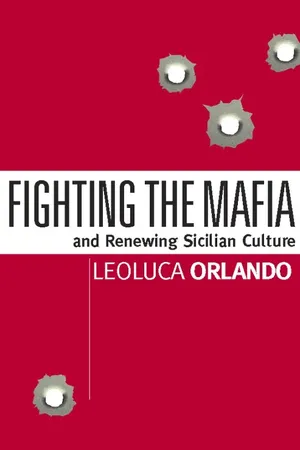
Growing up in an aristocratic family that seems almost to have stepped out of the pages of The Leopard, Leoluca Orlando entered law and politics in the late 1970s as one of the young idealists identified with the Catholic Church who were challenging the Mafia's control of Sicilian life. At about the same moment, life in Sicily was becoming more perilous. As if the "old" Mafia had not been bad enough, a new and particularly vicious Mafia sect based in the town of Corleone was murdering its way to power. Fueled by profits from the international heroin trade, this mafia gansteristica made Sicily into an Italian Lebanon and filled the international press with pictures of bloody bodies—those of Mafia rivals as well as police and government law enforcement officials.One of the figures most prominently identified with Italy's offensive against the Mafia, Orlando has endured repeated assassination attempts and even today travels with a bodyguard. Fighting the Mafia is his dramatic tale of witness and survival, of his effort to expose Mafia infiltration into the highest levels of Italian life and politics, and of the movements he helped to build—in schools and churches and at the ballot box—to recapture Sicilian culture and inspire a renaissance of democracy.
- 212 pages
- English
- ePUB (mobile friendly)
- Available on iOS & Android
eBook - ePub
Fighting the Mafia & Renewing Sicilian Culture
About this book
Information
CHAPTER 1
After long treating the concept as taboo, linguists now speculate endlessly about the origins of the word “Mafia.” Some say it comes from Mahias, Arabic for “bold” or “braggart.” Others say that its root is Muafirr, the name of a Saracen tribe that once controlled Palermo. Less plausibly, it has been suggested that the word comes from M’fie, the name of the caves that served as hiding places for those Saracens and later for Sicilians who retreated there in fear when Garibaldi landed in 1861.
The theory that has always seemed most reasonable to me holds that “Mafia” is a corruption of the Arabic Mu (“strength”) plus Afah (“to protect”). Yet what I find most intriguing about this word is not the exotic etymologies reaching far back into Sicilian history, but the fact that during the years of my youth, “Mafia” was almost never said. I was aware that it existed—both the word and the reality it stood for—but I apprehended it the same way that one catches a faint aroma on the wind, something familiar yet not quite identifiable.
The spectral presence of the Mafia in Sicilian life has always made me think of the comment by the Danish philosopher Sören Kierkegaard that part of our human dilemma is to be condemned to live our lives forward and understand them backward. We Sicilians have lived for generations with the Mafia, while rigorously excluding it not only from our conversation but even from our thought. Only relatively recently have we begun to understand backward the impact that “the Octopus”—a metaphor for Cosa Nostra first used by a judge and soon after a common term—has had on our history and culture.
Yet Sicily is the logical place for a phenomenon such as the Mafia to have arisen. We are a people who never really ruled our own territory. We were always a colony, and, even worse, a colony passed from one ruler to another. If these rulers had been harsh and repressive, they would at least have created a strong centralized government; but this was not the case. Sicily was always a place to be exploited more than governed. Until the nineteenth century, aristocratic families controlled Sicilian life more or less independently of whatever conqueror happened to be ruling at any given time. These barons cared about their own property and prerogatives, but not much else. Their ethos is beautifully portrayed in Giuseppe di Lampedusa’s The Leopard, where Fabrizio, the Prince, sleepwalks through life, disconnected from his country, his fate, and even his own ancestral holdings.
Eventually this aristocracy would collapse and disappear, but without leaving a middle class to fill the vacuum it left behind. Instead, as the barons moved to Rome, Vienna, Paris and other more cosmopolitan areas, the administration of their lands fell to middlemen called gabelloti. These administrators squeezed the share-croppers to pay the high rents demanded by absentee landowners, and controlled the brigands who roamed the countryside. Backed by a network of family, friends, and clients—the only groups able to provide social stability in the absence of an institutional order—these gabelloti became Sicily’s New Men, archetypes of the capimafia of the future. (Lampedusa’s Don Cologero is such a man avant la lettre.) The violent men they hired to enforce their power would become the Mafiosi of Sicily’s future.
Unlike its equivalent in the United States, which was based on family (Gambino, Bonanno and the like), the Sicilian Mafia was rooted in the land and organized around a place—Corleone, Prizzi, and other communities. Eventually the Mafia groupings in these places would build a bridge from the village to the developing urban centers such as Palermo. The Sicilian Cosa Nostra was always more intrinsic to the structure of society than its American cousins. It developed because the state itself was atrophied and defective in Sicily, and the people, conquered repeatedly by outsiders, never expected to receive justice from “the system.” They looked to the charismatic uomini di rispetto to fulfill the functions that bureaucratic governments served everywhere else in Europe. If your daughter was raped, you looked to such a “man of respect” for redress rather than to a distant and foreign police force.
The Mafia networks of the nineteenth century gradually took on the functions of the state: collecting taxes, providing a hierarchy of leadership, and raising little armies to enforce its “laws.” Political and economic life adjusted to these arrangements and accepted them as reality. Later on, when legitimate government tried to assert its authority, it would first have to redefine this reality as “criminal.” This was a monumental task. It is the subject of this book.
The Mafia created an autonomous social order in Sicily, but it could not have succeeded as well as it did, had it not also created a myth: that its members were Men of Honor comprising an honorable society that not only made the social order work, but made it work according to principle. Mario Puzo, author of The Godfather, got this aspect of the Mafia mentality exactly right: those who chose this path believed that while they might be called upon to perform tasks others might shrink from in serving their family and friends, they were nonetheless superior to the corrupt and hypocritical world surrounding them.

A sign of how deeply—and swiftly—the Mafia had penetrated Sicilian life came in 1893 when a man named Emanuele Notarbartolo, director general of the Bank of Sicily and former mayor of Palermo, tried to overturn corrupt deals made by one of his directors, a politician named Raffaele Palizzolo, who had links to the Mafia. Notarbartolo bravely protested these criminal activities to ministers in Rome. Before the issue could be brought to trial, he was stabbed twenty-six times by an assassin on a train, becoming the first of many “excellent cadavers” in Sicily’s future.
The entrenchment of the Mafia, complete by the 1920s, made this organization a public enemy for Mussolini. Upon coming to power, the Fascists saw the Mafia for what it was even then: una associazione per delinquere, in the words of Cesare Mori, “an association for criminal purposes.” Mori, who became known as the “Iron Prefect” after Mussolini sent him to Sicily to bring the Mafia to heel, famously swept into the centers of Mafia power and bluntly laid out his intentions to the townspeople: “My name is Mori and I shall have people killed. Delinquency must disappear just as the dust disappears on the wind of the sirocco.”
A measure of the cleansing power of his sirocco could be seen in the fact that in 1928, the year that Mori took control, there were only 26 murders in Sicily compared to 278 the year before. But most of the “men of honor” he rounded up, killed, imprisoned or sentenced to hard labor were at the level of the picciotti, or soldiers. The bosses went into hiding or slipped away to the United States, Marseilles, or even Tunis, pretending to be heroic figures of resistance. And when, in 1929, Mori began to investigate the connections between the Mafia and some high-level figures of the Fascist regime, a telegram from Rome informed him that he had been pensioned off. He was thus the first to understand what others would see later on: it was far easier to deal with the Mafia militarily than to root the organization out of Sicilian politics and culture.
After the Allied invasion of 1943, the Fascists fled to the mainland as the Allies advanced on Palermo. American soldiers saw chaos: criminals escaping from jails, peasants occupying land, people settling private feuds with murder and arson, and everyone stealing anything that could be carried. General George Patton said of the Palermitans: “These people are crazy!” Such a view made any structure of influence appealing. While it is a myth that the Allies used American mobsters like “Lucky” Luciano to inspire an anti-Fascist Mafia underground in Sicily, it is true that some Americans naively failed to exclude the Mafia from the postwar social order. In fact, in one letter to the secretary of state, the American consul wrote: “I have the honor to report that on November 18, 1944, General Giuseppe Castallaro, together with Maffia leaders including Calogero Vizzini, conferred with Virgilio Nasi, head of the well known Nasi family of Trapani and asked him to take part in the leadership of a Maffia-backed movement for Sicilian autonomy.”
The United States dropped the idea of Sicilian separatism once the Germans were driven out of Italy, but didn’t shed its naiveté about the Mafia. After 1945, with the long-delayed issues of land redistribution and union organizing finally coming to the fore in Sicily, a force that could counterbalance the Left was vitally important. Thus the Mafia was not only tolerated, but eased into an alliance with the Christian Democratic Party, which would fight the Communists in the political arena, collecting Mafia votes and sometimes using the Mafia as its military wing. This devil’s pact—which resulted in the murder of dozens of Communists and Socialists over the next few years and in the delivery of votes that kept the Christian Democrats in power in Italy—would haunt Sicily for a generation.

At the time of my birth, August 1, 1947, these facts of the Mafia were not known, let alone written; the time for looking backward at its history had not yet arrived in Sicily. My parents were uneasy as they watched the Mafia use the crises of the postwar world as a cover to enter our country’s political and cultural bloodstream. Yet they had more immediate concerns, notably their fear that the pneumonia which had killed their firstborn son, Carmelo, a few days after his birth in 1941 would now take me, too.
Penicillin was still an exotic substance in Sicily at the time of my infancy. But through my mother’s family connections and my father’s prestige as the most prominent civil lawyer in Sicily, they managed to get the precious medicine—in this case from the Vatican pharmacy—and I recovered. Yet instead of diminishing, their fears about my health became an obsession that burst into near-hysteria a few years later when it was discovered during a routine physical exam that my heart was on the wrong side of my chest. This discovery was made by a radiologist who, upon seeing an x-ray, first furiously berated his assistant for having printed the film incorrectly, only to realize after further examination that not only was the image accurate, but all of my organs were reversed. Since then I have always worn a gold medallion around my neck inscribed with the Latin words Situs viscerum inversus—and I’m sure some would say that I have pursued my political life in reverse order, too.
I had two older sisters, but I was given my dead brother’s role of firstborn son, a treasured position in a Sicilian family that requires a loving diminutive, however old the boy is. I was “Luchetto,” especially when my parents were exhorting me to do those things they hoped would ensure my survival. “Luchetto, put your coat on, otherwise you’ll catch cold and be seriously ill!” or “Luchetto, be careful, you’ll hurt yourself!” or “Luchetto, don’t do that, remember that you’re very fragile!” In time I would have two younger brothers and two more sisters, but in some peculiar way I would always be the baby of the family as well as the “firstborn.”
Not surprisingly, I grew up with the conviction that death was anxious to claim me, and that I therefore had to live as well as I could in the brief time I had been allotted. It is probably also why later on, during the years when the Mafia had decided to kill me, I found myself not particularly afraid; after all, I had been condemned since birth. I feared the pain, but death itself had been my companion for years.
The rhythms of a Sicily that was almost gone when I was a boy and has now vanished forever were still part of my growing up. The first twenty days of our summer holidays, for instance, were always spent at Imbriaca, one of several vast agricultural properties belonging to my father in an area near Corleone, about forty miles from Palermo. Named after the Sicilian word for “drunk,” Imbriaca bordered on one of the many properties owned by my mother’s family. It was called Margi, which derives from the word “soaked.” This area, with its breathtakingly beautiful valleys, woods and towering cliffs, has little rainfall but is very rich in underground waters, and thus all the aqueous names.
The properties of Imbriaca and Margi are separated by a stream, crossed by a small bridge which we children jokingly called the Ponte dei Sospiri, “the Bridge of Sighs,” a reference to the romantic landmark all lovers visiting Venice feel obliged to pass under in a gondola. This bridge at Imbriaca was where my father, Salvatore Orlando, would meet my mother, Eleonora, youngest daughter of the aristocratic Cammarata family and many years his junior, when they were courting; so we imagined the romance of their trysts.
Theirs was a love match but also, by Sicilian standards, something of a mismatch as well. The Orlandos were landed gentry, and my father, whose family came from the charming town of Prizzi (in whose central square the wedding scene in The Godfather Part II, which supposedly takes place in Corleone, was actually shot), became a civil lawyer, just as his own father and grandfather had been. The Orlandos were part of that Catholic rural bourgeoisie whose strong moral principles became even more rigid in my father’s case through study of the law in Heidelberg. His morality was matched only by his piety. My father always paid his taxes fully and punctually, while others in his social class scornfully evaded them. He was seen as foolish for complying with the letter of the law, but for him the letter was the law in microcosm.
My mother descends on one side from the Marquises of Arezzo—of the oldest mid-Italian aristocracy—and on the other from the Cammaratas, Barons of Corleone. In fact, the Cammarata family palazzo in Corleone, which dominates the small central square of the town, is now the seat of municipal government. The Sicilian heritage of the Arezzos was literary in origin, beginning when one of them wrote a biography of Charles V, Holy Roman Emperor and King of Spain, Naples and Sicily. Charles was so pleased with this work that he showered money, titles and Sicilian land on the writer, and so the Arezzos joined the country’s nobility.
The fact that my mother had technically married beneath her class sometimes worked its way into her conversation. It was her only strength against my formidable father, and she used it with elegance and innuendo, often in the form of a melancholy observation that for reasons not entirely clear to her, she did not frequent as often as before the high society salons of Palermo where she belonged by birth. In truth, it was because of my father’s moral rigor, not the stigma of his bourgeois background, that both had chosen to shun this environment. Apart from close family members, I cannot recall a single friend of my mother’s or father’s frequently visiting our home. We were far more likely to entertain a worker or foreman from one of our country estates than non-family members of Palermo’s high society.
All this struck me as quite odd when I was growing up. Eventually I realized that it was my father’s way of keeping us from possibly being tainted by people casually associated (as so many upper-class Sicilians have been) with the Mafia. Later on, after the war against the Mafia had been fought and won, one of the wealthiest and best-bred individuals in Palermo, a man who had not offered any help when the fight was taking place, came up to me and said, “I want to thank you for what you’ve done. We offered them our fingers and they took our hands. You’ve given us our hands—our freedom—back again.”

There was no running water in our country house at Imbriaca, and as a five-year-old my great joy was to sit astride a mule led by one of the peasants who worked for our family, and go to fetch water from the spring. The water was put into enormous clay jars, attached to stout hooks on either side of the mule’s saddle, and brought back to the house, where it remained sweet and ice cold. Imbriaca had no electricity; illumination came from oil lamps, giving a dim, romantic light to our quiet evenings together. It was not until the 1960s that my father finally had a generator installed, but it made such an unholy racket at night that we switched it off and continued to go to bed with our oil lamps.
After the mule came a small Sardinian donkey. It was a present from my father and belonged to me alone. It took the place of horses, which I was rarely allowed to ride because, as the movie Gone with the Wind showed, they can cause one to fall and die. My parents continued to fret about their precious Luchetto’s mortality, even though in fact I was as healthy as my brothers and sisters. At the slightest sign of illness, Doctor Michele Navarra—referred to as my pediatrician, although he was actually the only available doctor in Corleone—was immediately summoned to thump my chest and give them reassurances.
The word “Mafia” being forbidden in our house, it was not until several years later that I learned that Dr....
Table of contents
- Title Page
- Prologue
- CHAPTER 1
- CHAPTER 2
- CHAPTER 3
- CHAPTER 4
- CHAPTER 5
- CHAPTER 6
- CHAPTER 7
- CHAPTER 8
- CHAPTER 9
- CHAPTER 10
- CHAPTER 11
- CHAPTER 12
- CHAPTER 13
- Acknowledgements
- Index
- Copyright Page
Trusted by 375,005 students
Access to over 1.5 million titles for a fair monthly price.
Study more efficiently using our study tools.
Frequently asked questions
Yes, you can cancel anytime from the Subscription tab in your account settings on the Perlego website. Your subscription will stay active until the end of your current billing period. Learn how to cancel your subscription
No, books cannot be downloaded as external files, such as PDFs, for use outside of Perlego. However, you can download books within the Perlego app for offline reading on mobile or tablet. Learn how to download books offline
Perlego offers two plans: Essential and Complete
- Essential is ideal for learners and professionals who enjoy exploring a wide range of subjects. Access the Essential Library with 800,000+ trusted titles and best-sellers across business, personal growth, and the humanities. Includes unlimited reading time and Standard Read Aloud voice.
- Complete: Perfect for advanced learners and researchers needing full, unrestricted access. Unlock 1.5M+ books across hundreds of subjects, including academic and specialized titles. The Complete Plan also includes advanced features like Premium Read Aloud and Research Assistant.
We are an online textbook subscription service, where you can get access to an entire online library for less than the price of a single book per month. With over 1.5 million books across 990+ topics, we’ve got you covered! Learn about our mission
Look out for the read-aloud symbol on your next book to see if you can listen to it. The read-aloud tool reads text aloud for you, highlighting the text as it is being read. You can pause it, speed it up and slow it down. Learn more about Read Aloud
Yes! You can use the Perlego app on both iOS and Android devices to read anytime, anywhere — even offline. Perfect for commutes or when you’re on the go.
Please note we cannot support devices running on iOS 13 and Android 7 or earlier. Learn more about using the app
Please note we cannot support devices running on iOS 13 and Android 7 or earlier. Learn more about using the app
Yes, you can access Fighting the Mafia & Renewing Sicilian Culture by Leoluca Orlando in PDF and/or ePUB format, as well as other popular books in Politics & International Relations & Political Biographies. We have over 1.5 million books available in our catalogue for you to explore.