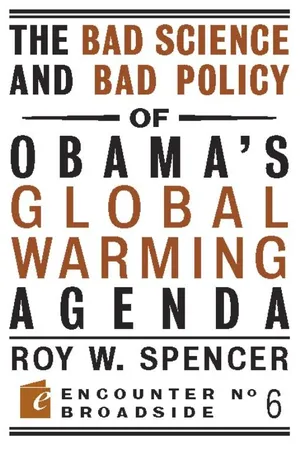
As the U.N. moves closer to a new global warming treaty, it is time to examine the calls for reductions in greenhouse gas emissions. The health and welfare of humanity has benefited from access to fossil fuels, and any drastic move to limit that access must have extraordinary evidence to support it.While alternative energy technologies will increasingly be relied upon in the face of dwindling fossil fuel supplies, leading climate researcher Dr. Roy W. Spencer argues that the free market is the best mechanism for solving the problem. In addition, Dr. Spencer addresses the new science that suggests that our modern fears of anthropogenic global warming might well be unfounded, because the climate system itself might be responsible for causing what is now known as "climate change.”
- 48 pages
- English
- ePUB (mobile friendly)
- Available on iOS & Android
eBook - ePub
The Bad Science and Bad Policy of Obama? s Global Warming Agenda
About this book
Information
IN MID -NOVEMBER 2009, hundreds of e-mails from the U.K.’s Climatic Research Unit at the University of East Anglia involving some of the leading names in global warming research were made public, probably by a whistle-blower. The resulting scandal - dubbed “Climategate” by critics - was a public-relations disaster for the global warming industry. It seriously shook public confidence, not only in the scientists involved in the research but also in the lobbyists and politicians pushing for radical action to address a problem that might be more manufactured than real. The leaked e-mails revealed disturbing plans to either destroy or hide temperature data, manipulate the data to hide an observed decrease in temperature, and discussions of how to block the publications of global warming skeptics.
This behavior certainly does not help the United Nations’ efforts to coordinate a new international global warming treaty to replace the Kyoto Protocol, which runs out in 2012. The primary goal of a U.N. meeting in Copenhagen in early December 2009 was to forge a new agreement for much larger reductions in greenhouse gas emissions than were targeted by the Kyoto treaty. While it looks unlikely at this writing that those legally binding targets will be agreed to in 2009, it is only a matter of time before another push for treaty negotiations and signing is made.
What follows is a brief overview of the science, economics and politics of anthropogenic global warming, with an emphasis on what is not being reported by the mainstream media. Given the multi-trillion dollar costs involved in greatly reducing greenhouse gas emissions, it is critical that the public understands what is at stake if we agree to legally binding limits, and just how poor the science is that is being used to justify these reductions.
THE PUTATIVE REASONS FOR REDUCING GREENHOUSE GAS EMISSIONS
The ostensible goal of any mechanism like the Kyoto Protocol is to reduce our consumption of carbon-based fuels: primarily coal, petroleum and natural gas. Burning of these fuels produces carbon dioxide, a so-called greenhouse gas. Greenhouse components in the atmosphere reduce the rate at which the Earth cools to outer space through infrared (IR) radiation. The most important greenhouse components are water vapor and clouds, with carbon dioxide representing a small - but not negligible - fraction of the Earth’s total greenhouse effect.
The Earth’s natural greenhouse effect acts somewhat like a lid on a pot of water that has been warmed on the stove. The lid reduces the rate at which heat is lost to the pot’s surroundings and keeps the water warmer than if the lid were not there. Similarly, the greenhouse effect is a “radiative lid” that keeps the atmosphere warmer in the face of solar heating than if those greenhouse components of the atmosphere were not there.
It can be calculated theoretically that our addition of more CO₂ to the atmosphere has made the Earth’s natural greenhouse lid about 1 percent more efficient at reducing energy loss to outer space, compared with preindustrial times. The expected result is a warming tendency, but the actual amount of warming is much more uncertain than you have probably been led to believe. While it is theoretically possible for more carbon dioxide to result in a future climate catastrophe, it is also possible that the amount of warming will be barely measurable in comparison to natural climate variability. The question is just how “sensitive” the climate system is, an issue I will return to later.
The most immediate and effective way to reduce greenhouse gas emissions would simply be to cease all economic activity, all commerce, in the world.
But for now, let us assume that global warming is caused entirely by humanity’s use of fossil fuels, and that people and the biosphere are at great risk. How migh...
Table of contents
- Title Page
- .
- Copyright Page
Trusted by 375,005 students
Access to over 1.5 million titles for a fair monthly price.
Study more efficiently using our study tools.
Frequently asked questions
Yes, you can cancel anytime from the Subscription tab in your account settings on the Perlego website. Your subscription will stay active until the end of your current billing period. Learn how to cancel your subscription
No, books cannot be downloaded as external files, such as PDFs, for use outside of Perlego. However, you can download books within the Perlego app for offline reading on mobile or tablet. Learn how to download books offline
Perlego offers two plans: Essential and Complete
- Essential is ideal for learners and professionals who enjoy exploring a wide range of subjects. Access the Essential Library with 800,000+ trusted titles and best-sellers across business, personal growth, and the humanities. Includes unlimited reading time and Standard Read Aloud voice.
- Complete: Perfect for advanced learners and researchers needing full, unrestricted access. Unlock 1.5M+ books across hundreds of subjects, including academic and specialized titles. The Complete Plan also includes advanced features like Premium Read Aloud and Research Assistant.
We are an online textbook subscription service, where you can get access to an entire online library for less than the price of a single book per month. With over 1.5 million books across 990+ topics, we’ve got you covered! Learn about our mission
Look out for the read-aloud symbol on your next book to see if you can listen to it. The read-aloud tool reads text aloud for you, highlighting the text as it is being read. You can pause it, speed it up and slow it down. Learn more about Read Aloud
Yes! You can use the Perlego app on both iOS and Android devices to read anytime, anywhere — even offline. Perfect for commutes or when you’re on the go.
Please note we cannot support devices running on iOS 13 and Android 7 or earlier. Learn more about using the app
Please note we cannot support devices running on iOS 13 and Android 7 or earlier. Learn more about using the app
Yes, you can access The Bad Science and Bad Policy of Obama? s Global Warming Agenda by Roy W. Spencer in PDF and/or ePUB format, as well as other popular books in Politics & International Relations & Environment & Energy Policy. We have over 1.5 million books available in our catalogue for you to explore.