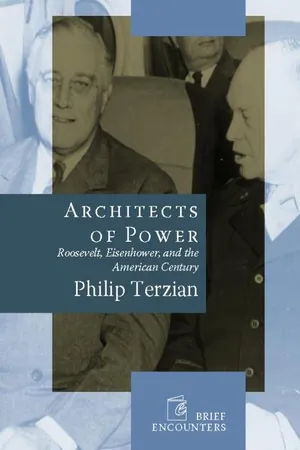
The United States is not a preternaturally inward-looking nation, and isolation is not the natural disposition of Americans. The real question is not whether Americans are prone to isolation or engagement, but how their engagement with the world has evolved, how events have made the United States a superpower, and how these developments have been guided by political leadership. Indeed, the great debates on foreign affairs in American history have not been about whether to have debates on foreign affairs; they have been between the competing visions of American influence in the world.In Architects of Power, Philip Terzian examines two public figures in the twentieth century who personify, in their lives, careers, and philosophies, the rise of the United States of America to global leadership: Franklin D. Roosevelt and Dwight D. Eisenhower. Terzian reveals how both men recognized and acted on the global threats of their time and questions whether America can rise to the same challenges today. Without this clear window into the stricken world that Roosevelt inhabited and Eisenhower understood, we are unlikely to recognize the perils and challenges of the world we have inherited.
- 112 pages
- English
- ePUB (mobile friendly)
- Available on iOS & Android
eBook - ePub
About this book
Information
1
The Hyde Park Roosevelt
In the dim distant past [my ancestors] may have been
Jews or Catholics or Protestants - What I am more
interested in is whether they were good citizens and
believers in God - I hope they were both.
Jews or Catholics or Protestants - What I am more
interested in is whether they were good citizens and
believers in God - I hope they were both.
Franklin D. Roosevelt, 1935
THE GREAT American presidents are submerged in mythology, and Franklin Roosevelt is no exception. In understanding his character and seeking to assess his tenure in the White House, his experience with infantile paralysis is often considered paramount. According to this version, prior to the onset of polio at the age of thirty-nine, FDR was a feckless, attenuated youth, a frivolous socialite who skimmed across the surface of life, content with a gentleman’s C at Harvard and happy to accept the preferments that seemed to come effortlessly his way. After he contracted polio, Roosevelt came to understand disappointment, discovered new depths of meaning in his life, and developed a consuming empathy for those less fortunate than he. Suffering and physical impairment were the central emotional events of his life, dividing his past self from the mature man who rescued his country from the Depression and led America during the Second World War.
That is the mythology—and like most myths, it is grounded in a handful of facts deployed to concoct a particular narrative. In Roosevelt’s case it is especially distorted and misleading. Roosevelt was not a notably reflective man, and what self-analysis he may have undertaken in his lifetime he kept to himself; but he would have laughed at the notion that polio was anything other than an arbitrary disaster that afflicted him and tested, but did not shape, the man that he was. In most respects, FDR was the same person after 1921 than he had been before, and the elusive character and “deeply forested interior” had taken shape long before he became paraplegic. It is to Roosevelt’s credit that his crippling disease did not scuttle his ambition but only diverted him from the path that he had undertaken in his youth. Polio, it may be assumed, hardened and disciplined his will, but it was a greater physical than emotional impediment. The astonishing fact that Roosevelt never discussed the implications of his affliction with anyone—including members of his own family—and never revealed the emotional toll of polio in any straightforward sense only conveys the depth of his ambition and reserve. The pursuit of the presidency, we may be assured, requires such personal resources, which FDR enjoyed in abundance.
He was, in fact, a familiar figure in American political history: a product of the upper-middle or upper classes for whom politics was a social inheritance and a natural inclination. In his centennial-year study of FDR, the journalist Joseph Alsop went to considerable lengths to explain that Roosevelt was not an aristocrat in the usual sense of the term, since the United States harbors no such social distinctions; but this merely serves to reveal the aristocrat that Roosevelt manifestly was. If, like a democratic American, he chose to explain himself in other ways, and went to some lengths to deplore such implications—in the manner of Alsop, for instance—he succeeded only in demonstrating the extent to which he was, by any measure, aristocratic in upbringing, manner, and outlook. Of course, “aristocracy” in this sense has less to do with superficial qualities than with natural presumptions, codes of conduct, and habits of being. Roosevelt was ostentatiously aware of his family background and of his relative status in the landed gentry of the Hudson River Valley and the early American republic. His immediate forebears were not only moneyed and prominent in civic, commercial, and social life but imitated the lives of the English rural gentry. His father James was a self-conscious and self-described country gentleman, the master of a minor estate who divided his existence between genteel business ventures and rural pursuits as well as the solemn duties of the local squirearchy. Like the Henry James inventions they resemble, the Roosevelts even migrated to Europe in season and participated in the New York-Boston matrimonial sweepstakes. Members of the Reformed church from their days in the Dutch ascendancy of seventeenth-century New York, they had become Episcopalians by the middle of the nineteenth century. Sufficiently conscious of their aboriginal status to avoid nouveau riche Newport, they migrated in the summertime to an island off the coast of Canada, safe from the contagion of post-Civil War wealth. When a Vanderbilt constructed an enormous mansion adjacent to the Roosevelt place, James Roosevelt refused their invitation to dine: malice disguised as gentility.
Yet there may be found in James Roosevelt’s Victorian hauteur an element of uncertainty as well. He was, despite appearances, prone to gambling on the occasional business venture, as he sought to increase the family endowment. He also commended his older son James, Jr.—who, in contrast to his half-brother Franklin, really was feckless by nature—to appointive political and diplomatic offices, with mixed results but for reasons we can easily guess. And while Franklin was tutored at home until a certain age, James Roosevelt ultimately sent him to Groton—a new school founded outside Boston by the Reverend Endicott Peabody, an American-born (but Cambridge-educated) Episcopal clergyman—that was expressly devoted to the cultivation of a ruling class. We may disagree about the qualities and defects of such institutions, or the very existence of a governing class in a democratic society; but the fact is that James Roosevelt took these notions seriously and imparted them to his younger, and ultimately more consequential, son. It is also clear that the Peabody ethos took root in Franklin Roosevelt.
We know this for two reasons. First, there is the evidence that Roosevelt was not a success at Groton in the sense by which such qualities are measured in schoolboy terms. He was too slight to succeed as an athlete—his cousin Alice Roosevelt Longworth always derided the Hyde Park Roosevelt preference for sailing in contrast to the Oyster Bay Roosevelt habit of rowing—and, partly due to his solitary upbringing and delayed arrival at Groton, did not get on so well with his fellow students. He was hardly a pariah—not in the sense that his first cousin James Roosevelt, who seems to have been mentally disturbed, was a social outcast—but he was preternaturally accustomed to the company of older people and, in the words of one alumnus (the son of an FDR classmate), was altogether “too eager to please” his young contemporaries who, then as now, put a certain value on reserve. The qualities that served Roosevelt the politician well were not designed to endear him to late Victorian adolescent specimens of his class. By contrast, Roosevelt was an academic success, a better-than-average student who substituted managing the baseball team for playing and who wrote letters home full of artificial cheer and enthusiasm for his school. Roosevelt was an eager supplicant to the head-master and his wife, who trained the boys in the Anglican faith; and no matter what his private feelings may have been about Endicott Peabody, Roosevelt never failed to pay public fealty to his old schoolmaster, enlisting him for service at his wedding ceremony and savoring the pleasure of summoning Peabody three times to officiate at his presidential inaugurations.
The second reason for crediting Peabody’s influence on Roosevelt’s life is somewhat less obvious. We may assume that Roosevelt took Peabody’s admonitions about public service to heart because he entered politics (becoming the first—and thus far, the only—Groton alumnus to be elected president). But it is difficult to discern what, exactly, impelled Roosevelt to enter politics, especially since he was constitutionally indisposed to explain himself in such ways. One theory, which seems the least likely, is that his unhappiness at Groton—accentuated by his later failure to be elected to the exclusive Porcellian Club at Harvard—impelled him to take gradual vengeance on his classmates: first, by bucking the tide as a Democrat, and second, by surpassing their achievements in business or the law by serving as chief magistrate of the United States. This theory would make more sense if we did not know that James Roosevelt was already a Democrat, and that FDR was not the sort of youth to defy his father’s direction in such matters. Moreover, Roosevelt seems to have settled on politics very early in his career as a lawyer in New York—seems, indeed, to have mapped out a route to the White House, as described to a fellow junior member in the firm of Carter, Ledyard, and Milburn, that bore a striking resemblance to the path of his distant cousin, Theodore. It is true that elective politics was an unusual career choice for one of his time and station, and that the great majority of his contemporaries at Groton and Harvard and other citadels of the Protestant ascendancy were far more likely to enter business or finance or even one of the professions, or perhaps the church; but Roosevelt never felt obliged to enlarge what was, by any measure, a comfortable family fortune, and he was manifestly bored by the law. So Peabody’s call to public service, combined with the example of his presidential cousin, led inexorably to politics.
The example of Theodore Roosevelt cannot be understated in Franklin Roosevelt’s biography. The famous rivalry between the two branches of the family was a fact in FDR’s adulthood: Franklin was a Democrat in a predominantly Republican clan; he was an active rival of Theodore’s eldest son for supremacy in New York politics; and several Oyster Bay cousins were publicly derisive, even hostile, in their treatment of their Hyde Park relation after he entered the White House. Yet it is easy to ascribe too much to these facts and to ignore the tribal rites of the class to which both branches of the family belonged. That is to say, political differences did not necessarily translate into personal hostility, and in the Roosevelt family, at least, blood usually transcended political ideology. Even Theodore’s elder daughter Alice Roosevelt Longworth, whose fame in later life was largely sustained by well-publicized remarks at her cousin’s expense, was a frequent guest at the White House in Roosevelt’s second term, and FDR remained on friendly, not to say affectionate, terms with innumerable streams from the main branch of the Oyster Bay Roosevelts—not least through his marriage to Theodore’s niece. In this, as in most aspects of FDR’s life, we may discern a dual impetus: he was certainly compelled by his upbringing to be conciliatory, even magisterial. But it must have given him pleasure to remind his cousins of his political triumphs, sometimes at their expense, and he surely reveled in his status as the sun around which the other Roosevelts revolved.
This impulse derived from the senior member of his family in national life. Theodore Roosevelt, declared his fifth cousin, was “the greatest man I ever knew,” and for once we may be certain that FDR spoke with absolute sincerity: Roosevelt was not a hero-worshiper by instinct and tended to be jealous of contemporaries. But it is not difficult to imagine the effect that the hero of San Juan Hill and the boy-governor of New York must have had on his distant, impressionable cousin when Theodore Roosevelt visited Groton to talk to the boys. Franklin was beginning his sophomore year at Harvard when Theodore became president—by accident, to be sure, but at the early age of 42 and, at the juncture of the twentieth century, seemingly by historical design. Whatever qualities Franklin discerned in his cousin Eleanor—the daughter of Theodore’s late, unlamented brother Elliott, and a late-blooming swan—her connection to her uncle the president must have been paramount in FDR’s mind. Roosevelt was doubtless attracted to the young Eleanor for her own sake, and it is certainly plausible that these two lonely products of privilege found some emotional refuge in each other; but the Roosevelt were dynasts as much as democrats, and Eleanor’s status must surely have separated her from the other young women of a certain station in New York. Roosevelt was already calculating his acquisition of power, made all the more precise by his seeming casualness and lack of ambition, and this was a shrewd marriage that would immediately usher him into the White House. Eleanor was given away by her uncle at their wedding; there was a famous scene at the reception where the president’s dynamic presence drew the company away, leaving the newlyweds abandoned in an adjacent room. Abandoned, perhaps, but from the groom’s point of view happily so, considering the dividends.
dp n="24" folio="15" ?
2
President-in-Waiting
GRENVILLE CLARK, who shared quarters with FDR when they were both apprentice lawyers in Manhattan, testified that Roosevelt once explained to him the trajectory of his political ambitions: he intended to be elected to the New York state legislature, then secure an appointment as assistant secretary of the Navy and serve as governor of New York before attempting the presidency.
This is a remarkable anecdote, for two reasons. First, it reveals an overweening ambition in Roosevelt at a time in his life when no one, including members of his family, discerned anything remotely resembling professional, much less political, ambition in the amiable young man his cousins called “the Feather Duster.” Second, FDR’s plan is an exact parallel to Theodore’s curriculum vitae, down to the Harvard degree. Assuming that Roosevelt actually said such a thing—and Clark, a public-spirited pillar of the Bar later in life, was not the inventive sort—it also reveals a particular clairvoyance. In 1907 or thereabouts Roosevelt might well have contemplated a candidacy for the New York state legislature in the near future—he was, in fact, elected to the state Senate three years later—but he could hardly have known, especially in that political epoch, that a Democratic administration would have put a sub-Cabinet post within his reach so soon. Yet if Roosevelt was thinking in dynastic terms, it was not an unreasonable notion: Theodore had been 39 years old when he was appointed assistant secretary of the Navy in the McKinley administration; Franklin might well have calculated that a similar opportunity would afford itself when he reached the same age, in 1921.
As we know now, the chronology was accelerated: FDR was appointed assistant secretary of the Navy at the age of 31, and except for a feint at a U.S. Senate seat two years later, he kept a length or two ahead of Theodore Roosevelt during the following decade. Theodore had been McKinley’s running mate at the age of 41, but FDR was the Democratic vice-presidential candidate at 38, the same age Theodore was when he had been appointed assistant secretary of the Navy. Thereafter, as we also know, disaster intervened: Roosevelt was struck down by infantile paralysis the following year, and his political future—indeed, the course of his life—became suddenly and unexpectedly ambiguous.
Because FDR was, ultimately, only momentarily deflected from his object, despite his paraplegic status and uncertain health, we know that the one ingredient that motivated Franklin Roosevelt—ambition—was wedded to the particular trait he shared with Theodore Roosevelt—confidence. We may even say that FDR’s ambition, in political terms at least, exceeded his distant cousin’s. FDR was aware that the device that had propelled Theodore ahead of his class was his resignation from the Navy Department in 1898 and his organization of an irregular cavalry regiment in the war against Spain. After San Juan Hill, it is impossible to speculate where politics might have led Theodore Roosevelt had he been content to remain in political office. But no such opportunity presented itself to FDR: although Theodore persistently admonished his niece’s husband to resign from the Navy Department after the United States entered the war against Germany, Franklin could not resist the entreaties of the Secretary of the Navy, Josephus Daniels, to remain in place, nor did he choose to appeal Woodrow Wilson’s re - fusal to allow senior federal officials to enter military service. Either his sense of obligation to his political master, in his time, was greater than Theodore Roosevelt’s in his, or Franklin’s primary loyalty was to his political ambition.
Whereas Theodore felt obliged, both to himself and to his sense of public duty, to serve in the Army, Franklin Roosevelt could never quite conceive the circumstances that would propel him into the uniformed Navy. A cynical observer might assume that, while Theodore’s service was conspicuous in the war against Spain, FDR was in no position to lead a well-publicized cavalry charge or otherwise attract public attention. In any event, it made no difference. Roosevelt remained assistant secretary and made the most of his fortunate circumstances; and within two months of the end of the First World War, Theodore Roosevelt was dead and his distant cousin’s famous surname no longer stood in the way of Franklin’s nomination as the 1920 Democratic vice-presidential candidate. Roosevelt knew that the 1920 campaign would be an exercise in futility—fought, as it was, on the dead issue of the League of Nations and freighted, as it was also, by Wilson’s unpopularity—but it was a personal opportunity. He was transformed from a secondary figure in the Wilson administration into a national political figure, and no one was likely to blame him for the outcome of a race between Governor Cox and Senator Harding, both of Ohio.
Polio might or might not have decisively affected Roosevelt’s character—I believe it did not—but it inarguably complicated his political schedule. Of course, he could hardly have anticipated this; nor could he have conceived that what appeared to be a catastrophe—paralysis, withdrawal from active political life, a prolonged struggle to gain some measure of personal equilibrium—would be, in the long run, to his advantage. But this outcome was less about good fortune than it was a testament to the combination of ambition and confidence in Roosevelt’s makeup. At a time when the members of his family were inclined to see him retire from public life and take up his father’s mantle as local squire—collecting his books, stamps, and naval prints, refurbishing the Roosevelt place at Hyde Park, assuming the mantle of civic dignitary—Roosevelt seems never to have lost sight of his objective. It is generally understood that his mother and wife battled over Roosevelt’s prospects, and that Eleanor prevailed when Franklin was persuaded not to retreat to Hyde Park. That is the public version of events, and there may be an element of truth in it. But it’s more likely that the struggle between Sara and Eleanor Roosevelt was only incidentally about Franklin: it is far more plausible that Eleanor, who had long resented her domineering mother-in-law, did not wish to fall inexorably into the Hyde Park orbit, and that promoting Franklin’s political career was a suitable device to prevent this. Whether this was motivated by disdain for Sara Roosevelt, faith in FDR’s prospects for advancement, or resentment at her husband’s recent infidelity, we cannot say: the Roosevelts did not live in an age when such matters were discussed in the open, especially not in that particular family. But the upshot is that, for both personal and professional reasons, Roosevelt’s ambition prevailed—even if, in medical terms, it taxed his diminished resources and shortened his life.
What was the source of this ambition? We can never know, because FDR, despite his lifelong habit of correspondence and love of talk, was an especially self-protective, even secretive man whose interior life was entirely concealed from others, including—perhaps especially—his closest relations. The devices by which he compensated for this are all too evident: like most men possessed by presidential ambition, Roosevelt had hundreds of acquaintances but no close friends. He wrote thousands of letters that are little more than cheerful, sometimes anodyne, chatter, and his love for the spoken wo...
Table of contents
- Title Page
- Dedication
- Apology
- 1 - The Hyde Park Roosevelt
- 2 - President-in-Waiting
- 3 - “War is a contagion”
- 4 - “Doctor Win-the-War”
- 5 - The Roosevelt Peace
- 6 - “I am from Abilene”
- 7 - The Education of a General
- 8 - Soldier of Democracy
- 9 - The Monarch of the Glen
- 10 - Eisenhower’s Planet
- Epilogue
- BIBLIOGRAPHY
- INDEX
- Copyright Page
Trusted by 375,005 students
Access to over 1.5 million titles for a fair monthly price.
Study more efficiently using our study tools.
Frequently asked questions
Yes, you can cancel anytime from the Subscription tab in your account settings on the Perlego website. Your subscription will stay active until the end of your current billing period. Learn how to cancel your subscription
No, books cannot be downloaded as external files, such as PDFs, for use outside of Perlego. However, you can download books within the Perlego app for offline reading on mobile or tablet. Learn how to download books offline
Perlego offers two plans: Essential and Complete
- Essential is ideal for learners and professionals who enjoy exploring a wide range of subjects. Access the Essential Library with 800,000+ trusted titles and best-sellers across business, personal growth, and the humanities. Includes unlimited reading time and Standard Read Aloud voice.
- Complete: Perfect for advanced learners and researchers needing full, unrestricted access. Unlock 1.5M+ books across hundreds of subjects, including academic and specialized titles. The Complete Plan also includes advanced features like Premium Read Aloud and Research Assistant.
We are an online textbook subscription service, where you can get access to an entire online library for less than the price of a single book per month. With over 1.5 million books across 990+ topics, we’ve got you covered! Learn about our mission
Look out for the read-aloud symbol on your next book to see if you can listen to it. The read-aloud tool reads text aloud for you, highlighting the text as it is being read. You can pause it, speed it up and slow it down. Learn more about Read Aloud
Yes! You can use the Perlego app on both iOS and Android devices to read anytime, anywhere — even offline. Perfect for commutes or when you’re on the go.
Please note we cannot support devices running on iOS 13 and Android 7 or earlier. Learn more about using the app
Please note we cannot support devices running on iOS 13 and Android 7 or earlier. Learn more about using the app
Yes, you can access Architects of Power by Philip Terzian in PDF and/or ePUB format, as well as other popular books in Politics & International Relations & Political Biographies. We have over 1.5 million books available in our catalogue for you to explore.