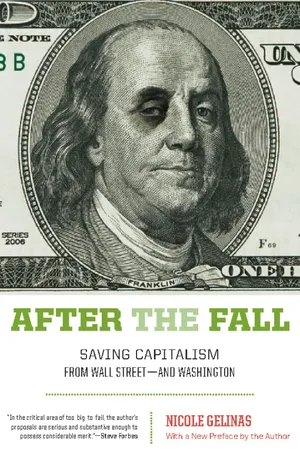
Robust financial markets support capitalism, they don't imperil it. But in 2008, Washington policymakers were compelled to replace private risk-takers in the financial system with government capital so that money and credit flows wouldn't stop, precipitating a depression.Washington's actions weren't the start of government distortions in the financial industry, Nicole Gelinas writes, but the natural result of 25 years' worth of such distortions.In the early eighties, modern finance began to escape reasonable regulations, including the most important regulation of all, that of the marketplace. The government gradually adopted a "too big to fail" policy for the largest or most complex financial companies, saving lenders to failing firms from losses. As a result, these companies became impervious to the vital market discipline that the threat of loss provides.Adding to the problem, Wall Street created financial instruments that escaped other reasonable limits, including gentle constraints on speculative borrowing and requirements for the disclosure of important facts.The financial industry eventually posed an untenable risk to the economy -- a risk that culminated in the trillions of dollars' worth of government bailouts and guarantees that Washington scrambled starting in late 2008.Even as banks and markets seem to heal, lenders to financial companies continue to understand that the government would protect them in the future if necessary. This implicit guarantee harms economic growth, because it forces good companies to compete against bad.History and recent events make clear what Washington must do.First, policymakers must reintroduce market discipline to the financial world. They can do so by re-creating a credible, consistent way in which big financial companies can fail, with lenders taking their warranted losses. Second, policymakers can reapply prudent financial regulations so that markets, and the economy, can better withstand inevitable excesses of optimism and pessimism. Sensible regulations have worked well in the past and can work well again.As Gelinas explains in this richly detailed book, adequate regulation of financial firms and markets is a prerequisite for free-market capitalism -- not a barrier to it.
- 256 pages
- English
- ePUB (mobile friendly)
- Available on iOS & Android
eBook - ePub
About this book
Information

CHAPTER 1
THE RISK OF FREEDOM
I have no cash or securities to put up and I feel sure that my speculative stocks are going higher in the future. If you do not share my enthusiasm I shall be very pleased to sign a temporary waiver on any dividends, profits, etc., that may accrue on my Radio and Woolworth shares as far ahead as you like—25 years if necessary—to meet your requirements. I feel sure that both of these companies will pay immense dividends in the next quarter of the century.
—investment client to broker, summer 19281
—editorial, New York Times, November 2, 1933
IN THE 1920S, MANY COMPANIES FOUND AN EASY WAY to make a decent profit on spare cash: invest it in “brokers’ loans,” through which financial firms lent people money to buy stocks. An investor could borrow $80, buy stocks worth $100, and, when the stock value soared to $200, sell enough to repay the $80 plus interest and have a tidy profit left over. This practice—called borrowing on margin—is dangerous because stocks can go down as well as up, while borrowers must repay the amount borrowed.
dp n="25" folio="12" ?While such danger seems clear today, almost everyone back then missed it. To the few naysayers at a 1926 New York State Bankers’ Association conference, the New York Stock Exchange’s public-relations man gave this reassurance: “It is a fair statement that the increasing popularity enjoyed by security collateral loans is due to the growing recognition that no safer investment exists. There is not a single instance of a loss suffered by lenders within the memory of those engaged in the handling of this type of loan.”2 The Wall Street Journal dismissed the worry that stocks would fall, editorializing that any stock-market collapse would be limited “by the very volume ... represented on the New York Stock Exchange and by the normal increase in [stock prices] as a result of the economic progress of the country.”3 The paper further noted that lenders themselves adequately controlled borrowing, often requiring 25 percent cash down payments that turned stock lending into “very safe and sane gambling” (although not all firms were this conservative).4
Brokers’ loans didn’t cause the Depression. But they were a symptom of the casual exuberance that did help cause it. The twenties proved that it isn’t so much people’s willingness to take crazy risks that imperils economies, but our inability (or refusal) to recognize risk where it exists. The gravest peril comes when everyone becomes willing to bet everything on the idea that the future will be just as purportedly riskless as the present—and exponentially more profitable, too.
In the twenties, ever-rising stock prices were the most potent evidence of an exuberant view of the future and of the financial world’s reasoning that the increase in asset values didn’t represent a risk. Between 1923 and late 1929, the Dow Jones Industrial Average, the best-known measure of stock values, nearly quadrupled. 5 Wall Street insiders, echoing the Journal’s argument, said that the stratospheric rise tracked progress in the nation’s real economy. A “major cause of securities speculation ... consists in the very rapid changes occurring in American industry and trade,” said E. H. H. Simmons, the New York Stock Exchange chief, in May 1929.6
dp n="26" folio="13" ?For a while, such optimism had been healthy, and finance had worked the way it was supposed to. The first time the Dow doubled—from 1923 to 1927—the index’s increase measured the profit growth that came with industrial and technological progress and accounted for a reasonable expectation that such profits would continue to grow. Through risk-taking in pursuit of profits, the financial world fueled the real economy. Investors used financial resources to create a more productive future. Investors large and small shared in the gains.
Eventually, though, speculative fever outran what the real economy could support. From early 1928, it took less than two years for the Dow nearly to double once again, though the economy hadn’t doubled its prowess in so short a time. Dazzled investors looked into the future and saw decades upon decades of unending profit growth—and they included all that future growth in the stock price. The same went for land and other investments. Markets’ ability to reflect information about future profits now testifies to their efficiency. In a bubble, however, markets can price systemic distortions into asset prices far too efficiently.
With no regulations to limit such behavior, investors large and small borrowed and lent liberally against that confidence. Such aggressive borrowing signals investor certainty about future growth, profits, and asset values. Certainty about the future had helped total debt grow by a rapid 25 percent since 1920, after decades of slower growth, to nearly twice as high as the value of everything that the nation could produce in one year, a level that it wouldn’t reach again in boom times until the 1980s.7 Banks lent money for everything from land purchases in Florida to corporate expansion in the nation’s industrial centers to municipal projects in postwar Europe.
People saw no risk. Lenders didn’t worry about the extent of borrowing against stock values, for example, because if they needed the loan repaid, they knew that the borrowers could sell their shares instantly on the always-liquid stock market and pay the money back. The Wall Street Journal noted that “the speculation in stocks can be liquidated in a few hours or days with no damage as concerns the country.”8 The same confidence that any asset could always fetch a higher price at a painless sale buoyed other investments.
Decades later, in the mid-2000s, investors would see the same illusion of liquidity in the market for securities made up of bundles of individual mortgages. Just as in the twenties, few remembered that liquidity exists only when there are buyers as well as sellers, and that buyers disappear in a panic. Few asked, then or now: What if asset values were rising only because there was so much easily borrowed money available to push them up? And what would happen to asset prices if the borrowed money supporting them vanished?
In the twenties, without an external force to stop it, the market eventually trapped itself in a speculative circle. Rising asset prices, supported by debt, justified even higher prices, and even more debt. Banks became even more complacent in limiting how much money they would lend against stock. They lent money, for example, to huge “investment pools” whose managers invested the funds in more securities. The banks lending the money often were not independent of these securities-speculation vehicles. At Chase National Bank, the bank’s securities affiliate operated half a dozen of these pools, some of which speculated in hundreds of thousands of shares of Chase’s own stock.9 The banks even lent money to their own executives so that they could bet on rising stocks, too—often the stock of their own employers. These activities created a circular risk to the banks and to the economy. If the banks ran into trouble, they would have to pull back their lending to such pools, thus pulling the support out from under their own stock prices and the stock market in general, taking even more losses on the pools and on their other stock investments and pulling back lending even more severely, harming the economy and causing stock prices to fall further.
To understand how confident executives and their bankers were, remember Samuel Insull, chief executive of Chicago’s Commonwealth Edison Company, the high-flying utility. Edison was a solid company with strong profits based on breakthroughs that literally powered the economy. Insull was able to use financiers’ and the public’s expectations of permanent future growth to erect a rickety tower of stock securities on top of bond securities, bond securities on top of stock securities. “Holding” companies borrowed tremendous amounts to control the “operating” companies that actually delivered the power.
Insull’s complicated corporate structure was based on a simple premise: it was fine not only to spend all of tomorrow’s profits today but to borrow liberally against those future profits, because the next day’s profits would be even higher. Insull borrowed so extensively that he “only had to invest slightly more than $50 million to control a $500 million company,” wrote John F. Wasik in The Merchant of Power; as the mania grew, he needed only $27 million to support the same amount, borrowing nearly $18 for every $1 he had in hand. Profits had to rise stratospherically every year to support expectations of this kind. It would take only a slight weakening of corporate profits for the entire structure to collapse. But the financial world wasn’t worried. “Since banks were tripping over themselves to lend him money in the 1920s, he had easy access to capital,” Wasik observed.10
Companies like Edison did not have to disclose their business practices and the possible threats to their business and financial models clearly and regularly to investors. Firms often put positive spins on the reports they did issue, with optimism untempered even by cursory warnings about the bad things that could happen. In 1915, Edison reported “all of 12 lines” on the state of its financial assets and liabilities, Wasik wrote. In 1931, even as scrutiny had grown in a plummeting market, the company’s seven-page annual report “did not mention that [a related company] was purchasing Commonwealth Edison’s stock in the open market, the impact of the Depression on the company, the relationship of [parent companies] to Commonwealth Edison nor much significant detail at all about anything.... Considering what had happened to the economy ..., the report is laughable in its lack of detail.”11
dp n="29" folio="16" ?Pre-Depression America trusted the financial market to protect itself from disaster. “Speculation may be able to correct itself a great deal better than it can be controlled by official action,” the Wall Street Journal opined in mid-October 1929. “If the stock market is left alone, it will liquidate itself in due course and do so safely.”12
So great was the belief in the financial market’s ability to regulate itself that Robert Owen of Oklahoma, a progressive senator who favored more government involvement in many areas of life, couldn’t conceive of imposing limits on markets. Regulating brokers’ loans and other aspects of the securities market was “a task much too intricate for government and could not be accomplished except by ... the destruction of individual liberty. The remedy would be worse than the disease,” Owen said in April 1929.13 Even small bank depositors were on their own, with housewives expected to police their own banks for signs of reckless investment and withdraw funds at the first sign of irresponsibility. But nobody seemed to mind. The market had made geniuses out of the 16 million small investors who turned to stocks and corporate bonds after their successful experience in buying war bonds at the government’s urging a decade earlier.14
The government had only two modest means for discouraging excessive speculation. The first was the young Federal Reserve, the nation’s central bank, created little more than a decade earlier. The Fed could help control speculation with one blunt tool: setting the interest rate at which it lent to banks. If the Fed thought that money was too “tight”—that a scarcity of money was squelching economic growth—it could slash the interest rate. If it deemed money too “loose”—when too much money chasing the same amount of goods and services around threatened to increase inflation or to feed speculation—it could raise interest rates, making it more expensive to borrow.
The Fed had to be perfect because other regulations did not exist to cushion the financial markets and the economy from its mistakes. But the central bank had an impossible job. First, it couldn’t target speculators by hiking interest rates only for certain lending practices. It had to raise rates for everyone, affecting the entire economy, giving it little room for error in raising rates too high and hurting growth.15 Second, the Fed was the steward of much of the world’s monetary policy, not just America’s. Since the end of the World War a decade earlier, the U.S., as an export powerhouse, had amassed huge stores of the world’s gold, just as China, an export powerhouse eight decades later, would amass huge stores of the world’s dollars.
This global imbalance was just as important in the twenties as it would be eight decades later. Because of the gold standard of the time, governments couldn’t create money without backing it in part with the precious metal, so as other nations relinquished their gold to America, they also sacrificed their ability to mint money. If America’s central bank made a mistake in setting interest rates on the outsize share of the world’s money that it controlled, the mistake would hurt not only the nation’s economy but the world’s.16
The Fed’s powers seemed theoretical, anyway, in the face of a far stronger market. In June 1928, the Fed finally raised rates, but the market didn’t care. In an article titled “Loss of Credit Control,” the Wall Street Journal reported that “corporations and private and foreign lenders ... are finding a way to make their ... loans through channels outside the banks.”17 The market didn’t need the Fed; it could create credit on its own. As asset values continued to rise, lenders felt increasingly comfortable lending money against those assets, creating more credit no matter what the Fed did.
The government’s other tool against speculative excess was to prosecute stock fraud—and it’s an enduring myth that the government did nothing on this front. More than three years before the crash, President Hoover’s Treasury secretary, Andrew Mellon, worried that average Americans were proving no match for the immoral actors plaguing the markets. “Each year,” Mellon wrote, “a very appreciable amount of capital is being lost so that it would seem to be the duty of the federal government to provide adequate legal machinery for protecting the public.” He suggested that the nation’s “Attorney General be authorized to investigate [suspect] securities and ... issue a summary order forbidding their further sale under heavy penalties.”18
No legislation came of Mellon’s idea, but the government did what it could under common-law provisions. In October 1929 alone, it announced that it had investigated twenty-two securities houses for fraud, closing ten. Penalties were severe: one “bucketshopper”—slang for stock swindler—got a five-year federal sentence on October 19, just in time to miss the crash.19 Reviewing one federal antifraud push, the Wall Street Journal declared that “with the indictment of 20 persons in the past week or two by the federal grand jury, the drive being conducted ... on promoters of spurious securities entered its major phase.... [I]ts effect has been far-reaching.”20
State and private efforts to combat fraud were even more aggressive. In 1925, New York State, the stock-fraud capital and a pioneer in prosecuting such crimes, estimated that stock fraud cost victims $500 million annually.21 The state stepped up its efforts to prosecute hucksters, using its unique power, the 1921 Martin Act, which directed the state attorney general to investigate securities crimes and empowered him to close down bucket shops and other suspicious operations. Other states—California, New Jersey, and Pennsylvania among them—specifically targeted stock-fraud scandals, with front-page prosecutions that put swindlers on notice.22
The New York Stock Exchange worried abo...
Table of contents
- Praise
- Title Page
- Preface
- Introduction
- CHAPTER 1 - THE RISK OF FREEDOM
- CHAPTER 2 - THE BLESSING OF THE FREE MARKETS
- CHAPTER 3 - TOO BIG TO FAIL
- CHAPTER 4 - HOLLOWED OUT
- CHAPTER 5 - A RISK-FREE WORLD
- CHAPTER 6 - THE LAST MILEPOSTS
- CHAPTER 7 - SAFE AS HOUSES
- CHAPTER 8 - CREDIT CRUNCH, ECONOMIC CALAMITY
- CHAPTER 9 - DESTROYING THE SYSTEM IN ORDER TO SAVE IT
- CHAPTER 10 - FREE MARKETS: OUR CHOICE
- BIBLIOGRAPHY
- Acknowledgements
- NOTES
- INDEX
- Copyright Page
Trusted by 375,005 students
Access to over 1.5 million titles for a fair monthly price.
Study more efficiently using our study tools.
Frequently asked questions
Yes, you can cancel anytime from the Subscription tab in your account settings on the Perlego website. Your subscription will stay active until the end of your current billing period. Learn how to cancel your subscription
No, books cannot be downloaded as external files, such as PDFs, for use outside of Perlego. However, you can download books within the Perlego app for offline reading on mobile or tablet. Learn how to download books offline
Perlego offers two plans: Essential and Complete
- Essential is ideal for learners and professionals who enjoy exploring a wide range of subjects. Access the Essential Library with 800,000+ trusted titles and best-sellers across business, personal growth, and the humanities. Includes unlimited reading time and Standard Read Aloud voice.
- Complete: Perfect for advanced learners and researchers needing full, unrestricted access. Unlock 1.5M+ books across hundreds of subjects, including academic and specialized titles. The Complete Plan also includes advanced features like Premium Read Aloud and Research Assistant.
We are an online textbook subscription service, where you can get access to an entire online library for less than the price of a single book per month. With over 1.5 million books across 990+ topics, we’ve got you covered! Learn about our mission
Look out for the read-aloud symbol on your next book to see if you can listen to it. The read-aloud tool reads text aloud for you, highlighting the text as it is being read. You can pause it, speed it up and slow it down. Learn more about Read Aloud
Yes! You can use the Perlego app on both iOS and Android devices to read anytime, anywhere — even offline. Perfect for commutes or when you’re on the go.
Please note we cannot support devices running on iOS 13 and Android 7 or earlier. Learn more about using the app
Please note we cannot support devices running on iOS 13 and Android 7 or earlier. Learn more about using the app
Yes, you can access After the Fall by Nicole Gelinas in PDF and/or ePUB format, as well as other popular books in Economics & Political Economy. We have over 1.5 million books available in our catalogue for you to explore.