The discipline of economics is not what it used to be. Over the last few decades, economists have begun a revolutionary reorientation in how we look at the world, and this has major implications for politics, policy, and our everyday lives. For years, conventional economists told us an incomplete story that leaned on the comfortable precision of mathematical abstraction and ignored the complexity of the real world with all of its uncertainties, unknowns, and ongoing evolution.What economists left out of the story were the positive forces of creativity, innovation, and advancing technology that propel economies forward. Economists did not describe the dynamic process that leads to new pharmaceuticals, cell phones, Web-based information services—forces that fundamentally alter how we live our daily lives.Economists also left out the negative forces that can hold economies back: bad governance, counterproductive social practices, and patterns of taking wealth instead of creating it. They took for granted secure property rights, honest public servants, and the willingness of individuals to experiment and adapt to novelty.From Poverty to Prosperity is not Tipping Point or Freakonomics. Those books offer a smorgasbord of fascinating findings in economics and sociology, but the findings are only loosely related. From Poverty to Prosperity on the other hand, tells a big picture story about the huge differences in the standard of living across time and across borders. It is a story that draws on research from the world's most important economists and eschews the conventional wisdom for a new, more inclusive, vision of the world and how it works.
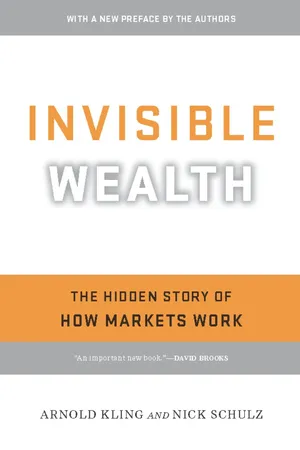
- 336 pages
- English
- ePUB (mobile friendly)
- Available on iOS & Android
eBook - ePub
About this book
Information
Topic
EconomiaSubtopic
Teoria economica Chapter 1:
AN INTRODUCTION TO ECONOMICS 2.0
ECONOMICS IS NOT what it used to be. Over the last few decades, economists have begun a significant reorientation in how they look at the world. This shift rests on a large and growing body of research that we will explore with you in this book. And it has significant implications for politics, policy, and how we view the world around us.
To understand this change in orientation, consider one of the most basic notions in first-year economics, an economy’s so-called “factors of production.” We used to teach that there are three factors of production: land, labor, and capital. We described an economy consisting of amber waves of grain, routine unskilled work, and belching, clanking machines inside of giant factories.
But most people today do not live in that economy. Instead, we work in quiet offices situated on land whose value has nothing to do with its agricultural fecundity, doing tasks that are highly specialized and differentiated.
For years, the story economists told to describe the world around us was incomplete. What we had left out of the story were the positive forces of creativity, innovation, and advancing technology that propel economies forward. We did not describe the dynamic process that leads to new pharmaceuticals, cell phones, Web-based information services, computerized logistical systems that fill stores with inexpensive merchandise, and financial innovations that give more people access to credit.
We also left out the negative forces that can hold economies back: bad governance, counterproductive social practices, and patterns of taking wealth instead of creating it. We took for granted secure property rights, honest public servants, and the willingness of individuals to experiment and adapt to novelty.
This book presents the main ideas of what we call Economics 2.0. Economists have developed these ideas in order to explain the enormous differences in quality of life over history and across countries.
Economics 2.0 says that these differences reflect intangible assets and invisible liabilities. The intangible assets are knowledge bases. This category includes formal scientific findings, such as the quantum mechanics and chemistry that help engineers design integrated circuits. It also includes less formal learning from experience, such as the know-how that enables general contractors to put up housing developments on schedule and within budget.
Invisible liabilities, on the other hand, are institutional and cultural impediments to innovation and productivity. These range from the structure and conduct of government to the attitudes and customs of ordinary citizens.
Economics 2.0 offers a completely fresh perspective on the role of markets in society, one that will become clear over the course of this book. Traditionally, the debate over markets has been between the “Chicago school” and the “Harvard – MIT school.” The Chicago school says, “Markets usually work. That is why we need markets.” The Harvard – MIT school says, “Markets often fail. That is why we need government.”
Economics 2.0 says, “Markets often fail. That is why we need markets.”
dp n="18" folio="3" ?What do we mean by this? Economics 2.0 says that overcoming market failure requires innovation. Innovation is best delivered by markets. It is rarely delivered by government. Hence, the paradoxical conclusion is that markets are often the best solution to market failure.
Economics 1.0, whether at Chicago or Harvard, looks at the market as a mechanism for allocating a given amount of resources. Most importantly, the market is said to operate with a fixed, known set of production technologies. The debate between Chicago and Harvard centers on whether or not the government can out-guess the private sector in coming up with the best possible allocation.
In Economics 2.0, the market is a mechanism for stimulating and filtering innovation. Entrepreneurs are at the heart of the economy, pumping innovation through the system. Large bureaucracies, on the other hand, whether they belong to corporations or government, are more like cholesterol – inhibiting the circulation of new products and new methods.
If what you are looking to read is the next Tipping Point or Freakonomics, don’t look here. Those books offer a smorgasbord of fascinating findings in economics and sociology. Each is a collection of interesting stories that are only loosely connected with one another.
Instead, this book tells one big story. It is a story that we have assembled out of a number of overlapping strands of research, undertaken by many economists who have received little or no attention in the media. A major goal in writing this book is to introduce these economists and their ideas to a broader audience.
A central figure in this story is Douglass North, who is practically unknown outside of the economics profession. Even among academic economists, North is little recognized, in spite of having been awarded a Nobel Prize. North’s main area of research is economic history, a field that was overlooked by Economics 1.0. Many other economists you will meet in this book focus on economic development, another field which, like economic history, has been neglected by mainstream economics. Conventional economists prefer the comfortable precision of mathematical abstraction to the messy complexity of the real world, with all of its uncertainties, unknowns, and ongoing evolution.
Antecedents of Economics 2.0 can be found in the work of a group of economists known as the Austrian school. Joseph Schumpeter emphasized the importance of entrepreneurs, innovation, and what he called “creative destruction.” Friedrich Hayek emphasized the roles of cultural norms, institutions, and “spontaneous order.” However, the focus of this book will be on the ideas of living economists, and we leave it to curious readers to explore the intellectual genealogy themselves.
ECONOMICS 1.0 VS. ECONOMICS 2.0
Economics 1.0 is about scarcity. To understand what we mean by that, consider that textbooks define economics as the study of the allocation of scarce resources among competing ends. So if a society wants to produce more guns, then it will have less labor, land, and equipment with which to produce butter. When first-year students are given a quiz on the opening textbook chapter that asks them to state the economic problem, their answer is supposed to revolve around scarcity, often phrased as “unlimited wants but limited resources.”
Economics 2.0 is about abundance, which arises from technical progress. Maybe there is no free lunch, as the saying goes; but we do not have to work nearly as hard to put food on the table as we used to. Just two hundred years ago, over half of all Americans worked in agriculture. Today, the figure is less than two percent. Sixty years ago, a social studies teacher looking for a movie that would motivate students to sympathize with the plight of the unfortunate in America might have chosen “The Grapes of Wrath.” Today, it would be “Supersize Me.”
Conventional economics is focused on how we can allocate resources efficiently. In this view, the story is that markets facilitate trade and thereby foster efficiency but do little else. With painstaking graphs and numerical examples, the professor shows that both sides of trade benefit from the exchange, whether trade takes place within a national border or across it. These calculations explain why it is better to outsource your ironing to a laundry than to do it yourself. Economics 1.0 explains that trade is based on comparative advantage.
Economics 2.0 says, yes, it is more efficient to send your shirts to a laundry than to iron them yourself. But have you heard of permanent press? Thanks to technical progress, many shirts today do not need to be ironed at all. Perhaps in another decade or two they will not need to be washed. Given the likely progress of nanotechnology, there is a good chance that shirts manufactured in 2020 will be “permanent clean.” That’s Economics 2.0.
THE SOFTWARE LAYER
Another way to think about Economics 2.0 is that it emphasizes the importance of the “software layer” of the economy. The economy can be understood as consisting of hardware and software, like a computer. Yet the software layer is glossed over in economics textbooks, which attempt to describe the production and allocation of goods and services in terms of the use of tangible inputs – things you can see and feel, like factory conveyor belts, machine tools, and individual workers.
But building a car takes more than just the machines and workers that you see sitting inside a factory. It also takes research, design, contracts, specifications, quality-control systems, and worker training – all of which are components of what we call the software layer. Moreover, when consumers come to a dealer to buy a car, both parties operate under a set of expectations and rules about negotiating, financing, and post-purchase obligations. These expectations and rules are also part of the software layer.
How important is the software layer? Over the past fifty years, many economists, including those you will meet in this book, have come to believe that the software layer explains most of the significant differences in economic performance over history and across countries.
To grasp the magnitude of these differences, consider for a moment what it would be like if you were forced to live like a typical American of one hundred years ago. Think of how many goods and services that you rely on today that could not have been found a century earlier. Call this the “Hundred-Year Gap.” We can also go back in history and consider the Hundred-Year Gap between, say, A. D. 1000 and A. D. 1100. (That gap is much smaller than the most recent Hundred-Year Gap.)
Alternatively, imagine if you were forced to live like a typical citizen of an underdeveloped nation today. Call this the “Development Gap.” For example, in Africa the average income is less than $2,000 a year per person, while in the United States it is more than $30,000. Even in rapidly growing countries, such as India, hundreds of millions of people lack many things Americans take for granted, such as reliable electricity and safe drinking water.
The Hundred-Year Gap and the Development Gap have never been as large as they are today. The Development Gap, in particular, is one of the most pressing economic issues of our time. Increasingly, we have come to recognize that much of what accounts for the Development Gap is to be found in the software layer.
The Hundred-Year Gap and the Development Gap reflect intangible assets and invisible liabilities. We may think of the intangible assets as recipes or algorithms. These recipes for satisfying human wants are far more sophisticated and efficient than the recipes that humans possessed one hundred years ago.
The invisible liabilities are social arrangements and political institutions. Societies are held back by government corruption, resistance to innovation, and the habit of rewarding those who expropriate wealth more highly than those who create it. Institutions are to the economy what an operating system is to a computer. A clumsy or buggy institutional environment will hinder economic performance.
The magnitudes of these intangible assets and invisible liabilities are staggering. A study published by the World Bank estimates that the average citizen in many advanced industrial countries has over $400,000 in intangible net worth. Meanwhile, the intangible net worth of people living in the poorest, most ill-governed nations of the world is actually negative. Their social and political institutions are like software that has so many bugs and viruses that you would be more productive without any computer at all.
There is another key difference between the hardware and software layers of the economy. The hardware layer obeys the laws of scarcity. The labor, machinery, and factory space in an automobile plant are scarce, in that they cannot at the same time be used to make frozen food or television sets. Moreover, when you double the amount of hardware used in production, you typically get less than double the level of output, which is the phenomenon known as diminishing returns.
If only hardware mattered, rich countries would face limits to growth and progress would decelerate. The standard of living would be improving fastest in the poorest countries, where small incremental gains in hardware would have the largest impact relative to a low base.
The software layer, by contrast, does not obey the laws of scarcity. As a result, we can (and do) observe growth accelerating in developed countries while some underdeveloped economies stagnate or even decline.
Only looking at the hardware layer, economists typically take progress for granted as something that just happens. Yet this raises the question of why the benefits of progress are so much greater in some countries than in others. Consider that we can profitably employ an immigrant in construction in the United States at a wage far higher than what that person could earn in his home country. Our building methods are not exactly nuclear secrets. Nor are the low-cost techniques of our retailers, our utilities, or our banks. How is it that so much of the world lags behind?
Economists used to try to explain underdevelopment in terms of hardware. Poor countries lacked the necessary tangible “stuff” needed to grow, such as steel mills and power plants. Today, we increasingly focus on the software layer, particularly government function and social norms. It turns out that where property rights are weak and government expropriation is unchecked, as in Zimbabwe or North Korea, prosperity is elusive. On the other hand, countries that are relatively poor in resources can nonetheless achieve a high level of affluence. The examples of Hong Kong, Singapore, and Israel demonstrate that with a constructive software layer, economic success does not require a natural resource base.
Rather than taking technological innovation as given, Economics 2.0 looks at the process by which innovation arises and spreads. Often, innovation is the result of the unplanned trial-and-error learning that takes place among new enterprises, rather than the organized research and development efforts of large organizations.
The hardware-driven story of textbook economics can be told without the entrepreneur. In contrast, entrepreneurs are the main characters in the story that we tell about the software layer. Entrepreneurs push innovation past the resistance of skeptics and entrenched interests.
We recognize that in order to function, modern markets need a robust operating system, consisting of rules, customs, norms, standards, and protocols. It is true that government provides part of this operating system in the form of laws and regulations, but the private sector also supplies much of the operating system that enables markets to function well.
In providing its segment of the economic operating system, government has the advantage of economies of scale: it can offer definitive, universal solutions. The provision of meat inspections and bank deposit insurance and regulation are examples of practices where the United States government has developed effective systems on which all of us rely.
However, the institutional software needs of markets are evolving. Improving an operating system requires innovation, and innovation is best delivered by trial-and-error experimentation and competition, which largely takes place in markets. Governments are not known for extensive trial-and-error experimentation (indeed, there are often good reasons for government not to engage in such experimentation). Hence, our paradoxical conclusion is that markets are often the solution to market failure.
Douglass North speaks of the adaptive efficiency of the economy. This is an important concept for understanding how Economics 2.0 differs from what came before it. The standard theory of public goods and private goods looks at how to allocate existing resources. Instead, we ask how well the software layer is suited to creating new wealth and raising the standard of living. Some economies are far better at generating wealth and rising living standards; these economies are said to have adaptive efficiency and not just allocative efficiency. They are more dynamic than their static counterparts.
dp n="25" folio="10" ?North describes what he does as “the New Institutional Economics,” emphasizing the role of institutions. Indeed, it is difficult to overstate how important institutions are to modern economies. But our scope is somewhat broader than institutional economics. We want to include the role of ideas and innovation in driving economic growth. We like to use Paul Romer’s term “recipes” to point up the knowledge component of the economy.
Moreover, the term “institutions” as used by North differs somewhat from the term as it is employed in ordinary discourse. In standard usage, an institution is often a discrete social organization, such as a religious institution or an institution of higher learning. That is not really what North is referring to when he speaks of institutions.
A better term for North’s concept might be “protocols.” In ordinary speech, the term protocol is used to refer to unwritten customs for behavior among ambassadors (“diplomatic protocol”), written agreements (“the Geneva protocol”), formats for exchanging information between computers (“the Internet protocols”), and recommended procedures for medical treatment (“protocol for administering beta blockers”). All of these usages of the term “protocol” are relevant here.
We think that the term “operating system” provides a good metaphor for the sorts of institutions or protocols we have in mind. The concept of an operating system captures the fundamental importance of basic economic institutions. Just as your ability to use clever computer applications, such as email and spreadsheets, depends on having a working operating system, an economy’s ability to use the latest innovations depends on having well-established property rights and the rule of law.
In short, we will describe the software layer as consisting of recipes and an operating system. We use “recipes” to refer to innovation, ideas, know-how, science, and technology. We use “the operating system” to refer to customs, rules, norms, laws, regulations, and methods of intermediation.
One important form of intermediation is financial int...
Table of contents
- Praise
- Title Page
- Dedication
- Acknowledgments
- Preface
- Chapter 1: - AN INTRODUCTION TO ECONOMICS 2.0
- Chapter 2: - ECONOMICS 2.0 IN PRACTICE
- Interview with - ROBERT FOGEL
- Interview with - ROBERT SOLOW
- Chapter 3: - FROM THE MEADOW TO THE FOOD COURT
- Interview with - PAUL ROMER
- Interview with - JOEL MOKYR
- Chapter 4: - BUGS IN THE SOFTWARE LAYER
- Interview with - DOUGLASS NORTH
- Interview with - WILLIAM EASTERLY
- Chapter 5: - THE HEART THAT PUMPS INNOVATION
- Interview with - EDMUND PHELPS
- Interview with - AMAR BHIDE
- Chapter 6: - FINANCIAL INTERMEDIATION
- Chapter 7: - ADAPTIVE EFFICIENCY AND THE ROLE OF GOVERNMENT
- Interview with - WILLIAM LEWIS
- Chapter 8: - CHALLENGES FOR THE FUTURE
- Interview with - WILLIAM BAUMOL
- NOTES
- INDEX
- Copyright Page
Trusted by 375,005 students
Access to over 1.5 million titles for a fair monthly price.
Study more efficiently using our study tools.
Frequently asked questions
Yes, you can cancel anytime from the Subscription tab in your account settings on the Perlego website. Your subscription will stay active until the end of your current billing period. Learn how to cancel your subscription
No, books cannot be downloaded as external files, such as PDFs, for use outside of Perlego. However, you can download books within the Perlego app for offline reading on mobile or tablet. Learn how to download books offline
Perlego offers two plans: Essential and Complete
- Essential is ideal for learners and professionals who enjoy exploring a wide range of subjects. Access the Essential Library with 800,000+ trusted titles and best-sellers across business, personal growth, and the humanities. Includes unlimited reading time and Standard Read Aloud voice.
- Complete: Perfect for advanced learners and researchers needing full, unrestricted access. Unlock 1.5M+ books across hundreds of subjects, including academic and specialized titles. The Complete Plan also includes advanced features like Premium Read Aloud and Research Assistant.
We are an online textbook subscription service, where you can get access to an entire online library for less than the price of a single book per month. With over 1.5 million books across 990+ topics, we’ve got you covered! Learn about our mission
Look out for the read-aloud symbol on your next book to see if you can listen to it. The read-aloud tool reads text aloud for you, highlighting the text as it is being read. You can pause it, speed it up and slow it down. Learn more about Read Aloud
Yes! You can use the Perlego app on both iOS and Android devices to read anytime, anywhere — even offline. Perfect for commutes or when you’re on the go.
Please note we cannot support devices running on iOS 13 and Android 7 or earlier. Learn more about using the app
Please note we cannot support devices running on iOS 13 and Android 7 or earlier. Learn more about using the app
Yes, you can access Invisible Wealth by Arnold Kling, Nick Schulz in PDF and/or ePUB format, as well as other popular books in Economia & Teoria economica. We have over 1.5 million books available in our catalogue for you to explore.