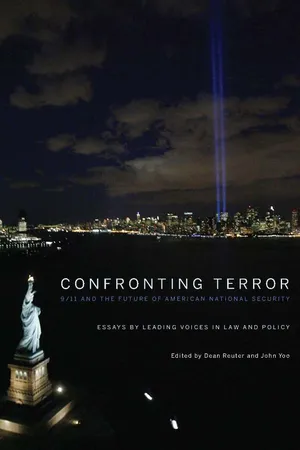
After the September 11, 2001 attacks the United States went to war. With thousands of Americans killed, billions of dollars in damage, and aggressive military and security measures in response, we are still living with the war a decade later. A change of presidential administration has not dulled controversy over the most fundamental objectives, strategies and tactics of the war, or whether it is even a war. This book clears the air over the meaning of 9/11, and sets the stage for a reasoned, clear, and considered discussion of the future with a collection of essays commemorating the 10th anniversary of the attacks. The contributors include supporters and critics of the war on terrorism, policymakers and commentators, insiders and outsiders, and some of the leading voices inside and outside government.
eBook - ePub
Confronting Terror
9/11 and the Future of American National Security
- 320 pages
- English
- ePUB (mobile friendly)
- Available on iOS & Android
eBook - ePub
About this book
Information
ENDNOTES
INTRODUCTION
1 Abraham Lincoln, President of the United States, Annual Message to Congress, Dec. 1, 1862, in Abraham Lincoln: Speeches and Writings 1859–1865, ed. Don E. Fehrenbacher (Library of America, 1989), 415.
9/11 IN ITS HISTORICAL CONTEXT
1 George Washington, Farewell Address to the People of the United States, Sept. 17, 1796, in Felix Gilbert, To the Farewell Address: Ideas of Early American Foreign Policy (Princeton University Press, 1961), 144–45.
2 John Quincy Adams and American Continental Empire: Letters, Speeches, and Papers, ed. Walter LaFeber (Quadrangle, 1965), 45.
3 Quoted in Henry Kissinger, Diplomacy (Simon & Schuster, 1994), 39.
dp n="315" folio="306" ?4 A. J. P. Taylor, The Origins of the Second World War (Touchstone, 1961), 185.
5 Nicholas Spykman, America’s Strategy in World Politics: The United States and the Balance of Power (Harcourt, Brace & Co., 1942), at 447; Arnold Wolfers, “‘National Security’ as an Ambiguous Symbol,” Political Science Quarterly 67 (1952), reprinted in Discord and Collaboration: Essays on International Politics, ed. Arnold Wolfers (Johns Hopkins, 1962), 150–51, n. 6.
6 Spykman, America’s Strategy in World Politics, 447.
7 Quoted in Fred Kaplan, The Wizards of Armageddon (Simon & Schuster, 1983), 22.
WAR V. CRIME
1 See, e.g., Foreign Intelligence Surveillance Act of 1978, § 102, 92 Stat. 1783 (1978) (current version at 50 U.S.C. § 1802 (2010); § 106 (current version at 50 U.S.C. § 1806); Exec. Order No. 12,33 3, 46 Fed. Reg. 59,441, 59,949 (Dec. 4, 1981); Exec. Order No. 12,036, 43 Fed. Reg. 3,674, § 2–202 (Jan. 24, 1978).
2 Use of Army and Air Force as Posse Comitatus, 18 U.S.C. § 1385 (2010) (formerly Posse Comitatus Act, Law of June 18, 1878, ch. 263, § 15, 20 Stat. 152); Insurrection Act, 10 U.S.C. § 331 (2010).
3 National Commission on Terrorist Attacks Upon the United States, The 9/11 Commission Report (2004), at 78–80; In re Sealed Case, 310 F.3d 717, 730 (FISA Ct. Rev. 2002). See USA Patriot Act of 2001, § 203(b), 18 U.S.C. § 2517 (2010).
4 See, 9/11 Commission Report.
5 Compare Ex Parte Milligan, 71 U.S. 2, 128–129 (1866) (permitting United States citizen to be held as a prisoner of war does not forfeit constitutional protections) with Ex Parte Quirin, 317 U.S. 1, 44 (1942) (denying United States citizen held as enemy combatant right to jury trial).
6 See Press Release, U.S. Department of Justice, “United States Charges 50 Leaders of Narco-Terrorist FARC in Columbia with Supplying More Than Half of the World’s Cocaine,” March 22, 2006, http://www.justice.gov/usao/nys/pressreleases/March06/farcindictmentpr.pdf.
7 See, e.g., Ex Parte Quirin, 317 U.S. 1, 44 (1942).
8 Boumediene v. Bush, 553 U.S. 723, 723–24 (2008) (describing background of military commissions and Military Commissions Act, 28 U.S.C. § 2 241 (2006)); Rasul v. Bush, 542 U.S. 466, 470–71 (2004) (describing detention of foreign terrorist combatants prior to Military Commissions Act).
9 Hamdi v. Rumsfeld, 542 U.S. 507 (2004).
10 United States v. Lindh, 212 F. Supp. 2d 541 (E.D. Va. 2002).
11 United States v. Padilla¸ No. 04-cr-60001, 2007 WL 2349148 (S.D. Fla. Aug. 16, 2007) (jury verdict finding Padilla guilty); United States v. Al-Marri, No. 09-cr-10030, 2009 WL 6498890 (C.D. Ill. October 20, 2009) (plea agreement and sentencing memorandum).
A UNIFIED DEFENSE AGAINST TERRORISTS
1 Less controversially, our Presidents have also twice reorganized the White House, first creating a Homeland Security Council (HSC) to operate parallel to the National Security Council (NSC), and then, under President Obama, disbanding the HSC and merging its functions into a separate directorate of the NSC. As we note with respect to the DHS and the IC, every reorganization saps energy from the institution that is being reorganized. Fortunately, the White House reorganizations were achieved with greater alacrity and less controversy than attended the other reorganizations—at least in part because the President was able to act unilaterally when it comes to White House organization, thereby avoiding much of the politicization of the other efforts we discuss.
2 Homeland Security Act of 2002, Pub. L. 107–296, 116 Stat. 2135 (2002).
3 National Security Act of 1947, Law of July 26, 1947, ch. 343, § 2, 61 Stat. 496 (1947) (codified at 50 U.S.C. § 401 et seq.).
4 Intelligence Reform and Terrorism Prevention Act of 2004, Pub. L. 108–458, 118 Stat. 3638 (2004).
5 IRTPA § 102(a) (codified at 50 U.S.C. § 403(1)).
6 Intelligence Reform and Terrorism Prevention Act of 2004, Pub. L. 108–458, § 1013, 118 Stat. 3638 (2004).
7 Authorization for Use of Military Force Against Terrorists, Pub. L. 107–40, 115 Stat. 224 (2001).
8 To cite but one example, it should trouble every American that the executive’s decision to target a known al-Qaeda affiliate, Anwar al-Aulaqi, has become the subject of litigation simply because he prosecutes the war from his home in Yemen rather than on the traditional battlefield. Nobody should welcome the prospect of a federal district court judge micromanaging the launch of a kinetic attack. Al-Aulaqi v. Obama, 727 F. Supp. 2d 1 (2010).
9 Katz v. United States, 389 U.S. 347 (1967).
10 Now codified at 18 U.S.C. §§ 2510–22.
11 Piracy, after all, was one of the domains of responsibility explicitly given to Congress in the Constitution. U.S. Const. art. I, § 8, cl. 10.
12 Portions of this section are based upon an earlier work, see Paul Rosenzweig, “Civil Liberties and the Response to Terrorism,” Duquesne Law Review 42 (2004), 663–723.
13 See Uniting and Strengthening America by Providing Appropriate Tools Required to Intercept and Obstruct Terrorism Act of 2001 (USA Patriot Act), Pub. L. 107–56, 115 Stat. 272 (2001).
dp n="317" folio="308" ?14 See generally John Yoo, The Powers of War and Peace: The Constitution and Foreign Affairs after 9/11(University of Chicago Press, 2005).
15 Letter from Thomas Jefferson to E. Carrington, May 27, 1788, reprinted in The Founders’ Almanac, ed. Matthew Spalding (Heritage Foundation, 2002), 157.
16 John Locke, Two Treatises of Government, ed. Peter Laslett (Cambridge University Press, 1988), 305–6.
REFORMING THE INTELLIGENCE COMMUNITY
1. Karl Rove, Courage and Consequence: My Life as a Conservative in the Fight (Threshold, 2010).
THE IMPERFECT RECONCILIATION OF LIBERTY AND SECURITY
1 Pub. L. No. 95–511, 92 Stat. 1783 (1978) (codified at 50 U.S.C. §§ 1801 et seq.).
2 FISA Amendments Act of 2008, Pub. L. No. 110–261, 122 Stat. 2436 (to be codified in scattered sections of 50 U.S.C.).
3 U.S. Const. amend. IV.
4 U.S. Const. amend. V.
5 U.S. Const. art. I, § 9, cl. 2.
6 Pub. L. No. 109–366, 120 Stat. 2600 (2006) (codified at 10 U.S.C. §§ 948 et seq.), invalidated in part by Boumediene v. Bush, 553 U.S. 723 (2008).
7 548 U.S. 557 (2006).
TORTURE AND DEMOCRATIC ACCOUNTABILITY
1 Although I am personally opposed to torture as a normative matter (see Alan M. Dershowitz, “Tortured Reasoning,” in Torture: A Collection, 2004), my views have been repeatedly distorted by commentators and bloggers alike. I feel no need to name names, but I entreat anyone inclined to summarize or summarily dismiss my views to peruse them first.
2 Quoted in Alan M. Dershowitz,...
Table of contents
- Title Page
- Dedication
- Introduction
- in memory of barbara k. olson
- the obama response to september 11
- 9/11 in its historical context
- war v. crime: breaking the chains of the old security paradigm
- a unified defense against terrorists
- reforming the intelligence community
- the imperfect reconciliation of liberty and security
- torture and democratic accountability: an oxymoron?
- nuremburg revisited and revised: the legitimation of torture in the united states
- stopping the terrorists
- confronting the animating ideology of the enemy
- Interrogation
- fear: the tail wagging the post-9/11 policy dog
- liberty, security, and the USA patriot act
- protection of our national security—revisited
- access to justice in the “war on terror”
- problematic post-9/11 judicial inactivism: immunizing executive branch overreaching
- the guantánamo mess
- our fighting faith, ten years later
- Conclusion
- AUTHOR BIOGRAPHIES
- Acknowledgments
- ENDNOTES
- Copyright Page
Trusted by 375,005 students
Access to over 1.5 million titles for a fair monthly price.
Study more efficiently using our study tools.
Frequently asked questions
Yes, you can cancel anytime from the Subscription tab in your account settings on the Perlego website. Your subscription will stay active until the end of your current billing period. Learn how to cancel your subscription
No, books cannot be downloaded as external files, such as PDFs, for use outside of Perlego. However, you can download books within the Perlego app for offline reading on mobile or tablet. Learn how to download books offline
Perlego offers two plans: Essential and Complete
- Essential is ideal for learners and professionals who enjoy exploring a wide range of subjects. Access the Essential Library with 800,000+ trusted titles and best-sellers across business, personal growth, and the humanities. Includes unlimited reading time and Standard Read Aloud voice.
- Complete: Perfect for advanced learners and researchers needing full, unrestricted access. Unlock 1.5M+ books across hundreds of subjects, including academic and specialized titles. The Complete Plan also includes advanced features like Premium Read Aloud and Research Assistant.
We are an online textbook subscription service, where you can get access to an entire online library for less than the price of a single book per month. With over 1.5 million books across 990+ topics, we’ve got you covered! Learn about our mission
Look out for the read-aloud symbol on your next book to see if you can listen to it. The read-aloud tool reads text aloud for you, highlighting the text as it is being read. You can pause it, speed it up and slow it down. Learn more about Read Aloud
Yes! You can use the Perlego app on both iOS and Android devices to read anytime, anywhere — even offline. Perfect for commutes or when you’re on the go.
Please note we cannot support devices running on iOS 13 and Android 7 or earlier. Learn more about using the app
Please note we cannot support devices running on iOS 13 and Android 7 or earlier. Learn more about using the app
Yes, you can access Confronting Terror by Dean Reuter, John Yoo in PDF and/or ePUB format, as well as other popular books in Politics & International Relations & Terrorism. We have over 1.5 million books available in our catalogue for you to explore.