The intellectual and political elite of the West is nowadays taking for granted that religion, in particular Christianity, is a cultural vestige, a primitive form of knowledge, a consolation for the poor minded, an obstacle to coexistence. In all influential environments, the widespread watchword is "We are all secular" or "We are all post-religious." As a consequence, we are told that states must be independent of religious creed, politics must take a neutral stance regarding religious values, and societies must hold together without any reference to religious bonds. Liberalism, which in some form or another is the prevailing view in the West, is considered to be "free-standing, " and the Western, liberal, open society is taken to be "self-sufficient."Not only is anti-Christian secularism wrong, it is also risky. It's wrong because the very ideas on which liberal societies are based and in terms of which they can be justified—the concept of the dignity of the human person, the moral priority of the individual, the view that man is a "crooked timber" inclined to prevarication, the limited confidence in the power of the state to render him virtuous—are typical Christian or, more precisely, Judeo-Christian ideas. Take them away and the open society will collapse. Anti-Christian secularism is risky because it jeopardizes the identity of the West, leaves it with no self-conscience, and deprives people of their sense of belonging. The Founding Fathers of America, as well as major intellectual European figures such as Locke, Kant, and Tocqueville, knew how much our civilization depends on Christianity. Today, American and European culture is shaking the pillars of that civilization.Written from a secular and liberal, but not anti-Christian, point of view, this book explains why the Christian culture is still the best antidote to the crisis and decline of the West. Pera proposes that we should call ourselves Christians if we want to maintain our liberal freedoms, to embark on such projects as the political unification of Europe as well as the special relationship between Europe and America, and to avoid the relativistic trend that affects our public ethics. "The challenges of our particular historical moment", as Pope Benedict XVI calls them in the Preface to the book, can be faced only if we stress the historical and conceptual link between Christianity and free society.
eBook - ePub
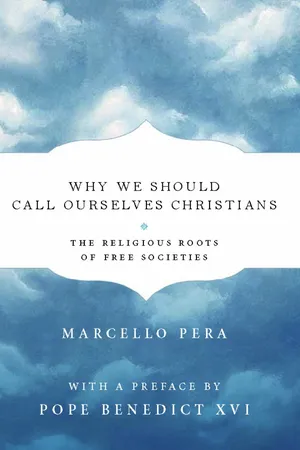
Why We Should Call Ourselves Christians
The Religious Roots of Free Societies
- 220 pages
- English
- ePUB (mobile friendly)
- Available on iOS & Android
eBook - ePub
About this book
Information
Topic
Theology & ReligionSubtopic
Religion, Politics & StateCHAPTER ONE
Liberalism, the Secular Equation, and the Question of Christianity
LIBERALISM AT THE CROSSROADS
The hardest question for liberals to answer nowadays is this: What is liberalism?
Whenever a widely accepted doctrine comes up against serious obstacles and must adapt itself to new challenges, the doctrine no longer resembles its original form. It becomes complex and composite, often eclectic. It may have spawned many different versions of itself. But as long as its core is protected, it will continue to be accepted by the competent community. That is the situation of liberalism today.
In terms of political culture, liberals and their kindred have become the governing class of the Western world almost without exception. They have triumphed over absolutism and totalitarianism. They have helped prevent democracy from becoming “the tyranny of the majority,” by obliging it to respect certain fundamental human rights and institutions. Liberal regimes are the most advanced in the world, offering greater well-being, opportunity, social mobility, and freedom. Though often beset by economic crises, liberal governments usually manage to overcome them without lowering their citizens’ standard of living. They are a beacon for other countries and a goal for refugees and immigrants. Yet this victory of liberal regimes is not in itself “liberal.” These regimes today are hybrids, especially insofar as liberalism progressively yields to democracy, in which law is produced through majority parliamentary vote concerning even those very rights that liberals regard as fundamental.
Liberal doctrine is also hybrid. There are so many divisions, differences, and fractures within it that we can hardly speak of it as a single doctrine. All its main tenets are subject to controversy. Is liberalism only a political doctrine whose range of action is limited to the organizing of the public sphere, or is it a “comprehensive” doctrine—philosophical, ethical, and metaphysical? When we speak of freedom, the pillar of liberalism, do we mean freedom from coercion, interference, restrictions, etc., or do we mean freedom to lead one’s own life in rational and moral autonomy? By “autonomy” do we mean the freedom to make choices according to our own plans, or also the possession of the resources and effective power to do so? Are liberty and private property, or liberty and capitalist economy conceptually related? Are they the same thing? Are they essential to each other, or can they be separated? Are liberty and social justice compatible? How far can a liberal regime tolerate the interference of politics in the state’s redistribution of resources? Is liberalism a universal theory, or does it hold good only for certain communities or for ones that have reached a certain stage of human development? Is liberalism blind to all differences among individuals and communities, or is it pluralistic, allowing for ethnic and group rights?
There are no clear-cut answers to any of these questions today, for there are different ways of being “liberal.” The upshot is that all current versions of liberalism include various concepts—such as tradition, nation, social justice, redistribution, public intervention—that originated with one or the other of two political families in perpetual competition with each other: conservatism and socialism. Because the elements of liberalism have sprung predominantly from the latter, however, the word “liberal” in American political language has become synonymous with the word “social-democratic” in European political language. Whenever we must add an adjective to the name of a doctrine in order to define it—such as “social” liberalism, “democratic” liberalism, “conservative” liberalism, “libertarian” liberalism, “national” liberalism, “multicultural” liberalism, or, vice versa, “liberal” socialism, “liberal” democracy, and the like—we know that the doctrine itself is imperiled. In the end, it must be reborn in a new guise, or else become obsolete.
Hybrid regimes built on irreconcilable political concepts and a hybrid doctrine composed of incompatible notions both signify the current crisis of liberalism. No one denies that this crisis exists, and the very proliferation of schools of thought, variants of doctrine, and research programs are enough to bring even the most obstinate liberal back to reality. But “crisis” does not mean “end” or “demise.” The vital core of liberalism remains powerfully resilient and attractive. This core is the idea of natural rights (also known as “human,” “fundamental,” “essential,” or “basic” rights): all human beings are free and equal by nature; their basic liberties exist prior to and independent of the state, and are noncoercible by the state.1 This idea has various corollaries. One is that every individual is free to pursue his own conception of the good. Another is that everyone enjoys freedom of conscience and religion.
The optimism for which liberals are renowned shines forth in these corollaries. How is it possible for free and equal persons to live together, faithful and loyal to the state, if everyone is authorized to live as he pleases, and is thus potentially in conflict with everyone else? We must presuppose that in order to guarantee social coexistence, liberal societies must be able to harmonize all their conceptions of the good (or maintain a minimum distance among them all) and to ensure maximum compatibility among religious faiths (or maintain a minimum of friction among them). Otherwise, the war of all against all would ensue—precisely that wild state of nature that liberals aspire to supersede—with lethal outcome for the whole of society.2
The great fathers of liberalism were well aware of this problem and were confident it could be solved. To this end, they invented “cosmopolitan law,” “federation of states,” and “perpetual peace,” just as their descendants have invented the United Nations, the International Court of Justice, and the Universal Declaration of Human Rights. But history has shaken even the most deep-seated convictions. In terms of doctrine, liberal presuppositions have been shaken by the discovery of the plurality of values, and even more so by the idea of the incommensurability of values, i.e. that there is no common measure with which all the forms of culture and civilization may be evaluated. In terms of policies, liberal regimes are endangered in modern societies, beleaguered by the re-emergence of strong nationalistic sentiments, by increased friction among various conceptions of the good, and by the spreading of multiculturalism, the idea that groups, classes, or categories may have special rights distinct from those of the majority or from those of humanity as a whole. It is no wonder that the old liberal belief in the moral and rational unity of mankind—the brotherhood of man—has fragmented to such an extent today that it has become a paradox, as expressed in the motto of the European Union, “Unity in Diversity.”
Religion, in particular, resists liberal optimism. Bouncing boldly back into the limelight, it poses questions of identity and belonging, and is at once the obstacle to the integration and coexistence of millions of immigrants, and the stimulus for the forming of new states. It has limited or bogged down legislation in the field of ethics, generated fundamentalism and created friction, violence, even terrorism. As a result, in the liberal West, the terms of the question have changed. Regarding the exercise and justification of liberal rights, our society has been transformed from a homogeneous one shaped by Christian values (as it was for centuries) into one marked by intense religious conflict.
To avoid or minimize this conflict, liberals have offered two remedies: to oppose religion outright, or to separate it from public life. These two very different solutions converge in the equation “liberal = secular.” In this view, secularity is viewed as a shield protecting the core of the liberal doctrine. If society is secular and the state is also secular, then, to cite an example of liberal optimism, religion cannot penetrate it, and thus religion poses no threat to social stability.
Although this idea is so widely held that it is treated as a sort of dogma, it has not yielded satisfactory results, especially in Europe. On the contrary, it has worsened the moral or ethical-civil crisis that Europe is now undergoing, just at the time when “giving Europe a soul” has become politically imperative in order to safeguard the great plan of a United Europe. Thus the second hardest question for liberals to answer nowadays is this: What is the relationship between liberalism and religion?—if indeed there is one—and more specifically, between liberalism and Christianity, which is the religious tradition of the founding fathers of liberalism and of the liberal Western countries? This is the crossroads where liberal doctrine stands today, and where its destiny will be played out. The answer to this question is vital. If there is indeed a non-extrinsic link between liberalism and Christianity, then liberalism may rely on a solid heritage of ethical and religious values as an anchor for the basic concepts of its own doctrine. If no such link exists, then liberalism is doomed to become the propagator of its own crisis.3
Standing at this crossroads, I take the first road. I reject the illiberal positions that have been the disastrous intellectual and political exercise of so many fascists, Nazis, and communists.4 I also reject the antiliberal positions held by many conservatives, even though I do believe that conservatism is right on one point often neglected by liberalism today: the need to defend the founding principles of our own tradition. Most specifically, I do not share the objection that the doctrine of liberalism is based on individualism, egoism, hedonism, or that it is unconcerned with virtue and the common good.5 I also reject that philosophy of history, deriving from Hegel and Heidegger, according to which modernity begins with the birth of individualism in the sixteenth century; proceeds through the scientific revolution in the seventeenth, the Enlightenment in the eighteenth, the birth of nationalism in the nineteenth; and ends in the twentieth with Auschwitz and the gulag, after which “only a god can save us.” Such an account of history has been put forward precisely by those antiliberals and anti-Christians who, after the tragedy to which they themselves lent a hand, now beat their breasts and continue to pray to the wrong divinity (“a god,” but never our God), or believe that to stop praying and to deprive religion of any meaning and value is the best remedy for our moral disease.
There are many objections to liberalism, and some of them are reasonable and well founded.6 My complaint is that liberalism has lost faith in its own founding principles and has severed the historical and conceptual ties that once linked it to Christianity. I am convinced that some ideas prevalent among liberals today—for example, that religion should not voice opinions, that it is irrelevant to public life, that it is an obstacle, or that it has become outmoded in the modern or postmodern world—are indefensible in theory and disastrous in practice, especially in Europe, where the crisis of liberalism is most keenly felt.7 This is the thesis I will be defending.
Before I proceed, I would like to make it clear that, given the theoretically and politically hybrid nature of my subject, I will be discussing liberalism, liberals, and liberal regimes from a philosophical and cultural rather than a strictly political point of view.8 In order to avoid interfering in tormented family quarrels, and to push aside the unsolvable purist controversies (“Who is an authentic liberal?” “What is real liberalism?”), whenever I must resort to other authors I will refer to those who have defined themselves as liberals or to those in whom the core of the liberal doctrine is visibly at work. The problem we are dealing with here, the relationship between liberalism and religion, will assist us, because it is on this ground that the similarities are most starkly drawn. For example, despite the differences for which liberal Americans are considered “left-wing” and liberal Europeans “right-wing,” the critical and negative perspective on religion they share places both on the same side, holding similar theoretical views on the issue and tending to favor similar political measures.
dp n="31" folio="20" ?The main theater of my inquiry in this chapter stretches from Europe out to the entire West. To set the stage, I will begin with the apostasy of Christianity that is widespread on the Old Continent and that is being cultivated today by liberal and secular culture. I will then address four points. First, I will present and argue against the equation “liberal = secular” as it is currently maintained by liberals. Second, I will survey the history of anticlericalism, of which this equation is a vestige. Third, I will turn to the fathers of liberalism to understand how they treated the problem and to seek inspiration from them. Fourth, I will address the main point: why liberals should call themselves Christians. Should call themselves, I say, not “can” or “can’t help but” call themselves.
THE APOSTASY OF CHRISTIANITY
To manage the tempestuous relations between ethnic groups, cultures, and religions within their societies, European governments have adopted typically liberal policies such as: generous legislation concerning immigration; facilitation in obtaining citizenship; the acceptance of foreign customs that are incompatible with our own; the censoring of the symbols of our own history; the refusal to see religion as a decisive factor in public life or even as an influence on social behavior and custom. In the area of ethics, commonly adopted liberal measures have included the proliferation of so-called “new rights,” the recognition of the most diverse and sometimes (at least with respect to our own tradition) perverse demands, and the permissive authorizing of medical research and therapeutic practices that touch the core of basic Christian values.
In implementing these measures, liberal governments and political forces use what seem to be the noblest and most generous words in the political vocabulary: “inclusion,” “recognition,” “welcoming,” “acceptance of minorities,” “dialogue,” “tolerance,” and “respect,” as well as “post-national constellation” and “postmodern society,” all referring to an ideal type of community without borders: one that is pluralistic and open, indulgent and permissive, bound together by “constitutional patriotism,” another expression dear to modern liberals.
The consequences of this mixture of humanitarianism, utilitarianism, subjectivism, and permissiveness have fallen short of expectations. Open-border policies have provoked social friction in some great European cities (including the suburbs of Paris). The welcoming of immigrants has produced noman’s-lands under special jurisdiction that is incompatible with national jurisdiction (in England) and episodes of ethnic and religious violence (in the Netherlands). Multiculturalism and assimilation, the European recipes for integration, have not put an end to incidents of religious conflict but only disguised them. In France, for example, an outcry over the hijab, the veil or headscarf worn by Muslim women, was treated as a debate concerning appropriate dress in public. In Italy, a recent controversy over the removal of crucifixes from schools and other public areas was resolved through recourse to legal technicalities: the supreme court refused to rule on the question when protests arose, claiming it was a matter for local administrations to decide. The idea of the post-national constellation bound together by constitutional patriotism has not stamped out the fires in the hotbeds of the new ethnic n...
Table of contents
- Title Page
- Foreword
- Introduction
- CHAPTER ONE - Liberalism, the Secular Equation, and the Question of Christianity
- CHAPTER TWO - Europe, Christianity, and the Question of Identity
- CHAPTER THREE - Relativism, Fundamentalism, and the Question of Morals
- NOTES
- BIBLIOGRAPHY
- INDEX
- Copyright Page
Trusted by 375,005 students
Access to over 1.5 million titles for a fair monthly price.
Study more efficiently using our study tools.
Frequently asked questions
Yes, you can cancel anytime from the Subscription tab in your account settings on the Perlego website. Your subscription will stay active until the end of your current billing period. Learn how to cancel your subscription
No, books cannot be downloaded as external files, such as PDFs, for use outside of Perlego. However, you can download books within the Perlego app for offline reading on mobile or tablet. Learn how to download books offline
Perlego offers two plans: Essential and Complete
- Essential is ideal for learners and professionals who enjoy exploring a wide range of subjects. Access the Essential Library with 800,000+ trusted titles and best-sellers across business, personal growth, and the humanities. Includes unlimited reading time and Standard Read Aloud voice.
- Complete: Perfect for advanced learners and researchers needing full, unrestricted access. Unlock 1.5M+ books across hundreds of subjects, including academic and specialized titles. The Complete Plan also includes advanced features like Premium Read Aloud and Research Assistant.
We are an online textbook subscription service, where you can get access to an entire online library for less than the price of a single book per month. With over 1.5 million books across 990+ topics, we’ve got you covered! Learn about our mission
Look out for the read-aloud symbol on your next book to see if you can listen to it. The read-aloud tool reads text aloud for you, highlighting the text as it is being read. You can pause it, speed it up and slow it down. Learn more about Read Aloud
Yes! You can use the Perlego app on both iOS and Android devices to read anytime, anywhere — even offline. Perfect for commutes or when you’re on the go.
Please note we cannot support devices running on iOS 13 and Android 7 or earlier. Learn more about using the app
Please note we cannot support devices running on iOS 13 and Android 7 or earlier. Learn more about using the app
Yes, you can access Why We Should Call Ourselves Christians by Marcello Pera in PDF and/or ePUB format, as well as other popular books in Theology & Religion & Religion, Politics & State. We have over 1.5 million books available in our catalogue for you to explore.