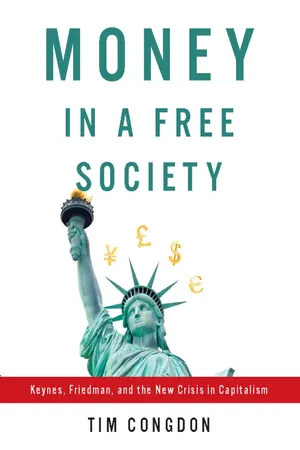
In the 15 years to mid-2007 the world economy enjoyed unparalleled stability (the so-called "Great Moderation"), with steady growth and low inflation. But the period since mid-2007 ("the Great Recession") has seen the worst macroeconomic turmoil since the 1930s. A dramatic plunge in trade, output and employment in late 2008 and 2009 has been followed by an unconvincing recovery. How is the lurch from stability to instability to be explained? What are the intellectual origins of the policy mistakes that led to the Great Recession? What theories motivated policies in the USA and other leading nations? Which ideas about economic policy have proved right? And which have been wrong?Money in a Free Society contains 18 provocative essays on these questions from Tim Congdon, an influential economic adviser to the Thatcher government in the UK and one of the world's leading monetary commentators. Congdon argues that academic economists and policy-makers have betrayed the intellectual legacy of both Keynes and Friedman.These two great economists believed – if in somewhat different ways – in the need for steady growth in the quantity of money. But Keynes has been misunderstood as advocating big rises in public spending and large budget deficits as the only way to defeat recession. That has led under President Obama to an unsustainable explosion in American public debt. Meanwhile the Fed has ignored extreme volatility in the rate of money growth, contrary to the central message of Friedman's analytical work. In his 1923 Tract on Monetary Reform Keynes said, "The Individualistic Capitalism of today, precisely because it entrusts saving to the individual investor and production to the individual employer, presumes a stable measuring-rod of value, and cannot be efficient--perhaps cannot survive--without one." In Money in a Free Society Congdon calls for a return to stable money growth and sound public finances, and argues that these remain the best answers to the problems facing modern capitalism.
- 486 pages
- English
- ePUB (mobile friendly)
- Available on iOS & Android
eBook - ePub
About this book
Information
PART ONE
DID HIS DISCIPLES BETRAY KEYNES?
dp n="34" folio="" ?dp n="35" folio="" ? PREFACE
KEYNES’S INTRODUCTION to economics came in the opening years of the twentieth century at Cambridge University, where the dominant figure was Alfred Marshall. Marshall’s most famous work was his Principles of Economics, which Keynes started to read in 1905, at the age of twenty-two. However, his first real enthusiasm was not for Marshall’s solid if rather dreary work, but rather for William Stanley Jevons’s Investigations in Currency and Finance. In a letter of July 8, 1905, to Lytton Strachey, Keynes described Jevons’s Investigations as a “most thrilling volume.”1 Like all his contemporaries, Jevons believed in the importance of money and banking to the workings of the economy as a whole. Not surprisingly, the economics books that Keynes read in his twenties were predominantly in the monetary area. In 1911 the United States’ foremost economist, Irving Fisher of Yale, brought out a big book called The Purchasing Power of Money. When Keynes reviewed it for The Economic Journal, he did not dispute Fisher’s main point. This was to affirm the validity of the quantity theory of money, in which changes in the price level were heavily influenced by changes in the quantity of money.
At the start of the twenty-first century, the quantity theory of money is usually bracketed with monetarism and placed at the conservative end of the political spectrum. As we shall see later (in essay 12), there are good reasons for this tendency. But a hundred years ago the ideological landscape was very different. The conservative position was to favor “sound money,” where money was “sound” if it either was a precious metal or had a definite, unbreakable link with a precious metal. When The Purchasing Power of Money was published, most of the leading nations had been on the gold standard for at least a generation. In Britain almost no one opposed the fixed link between the pound and gold, which had been maintained since 1821; £ 3 17s. 10½d. of sterling coin was taken to be fully convertible into an ounce of gold, in the same way that 1,760 yards made up a mile and 14 pounds were equivalent to a stone. One of Fisher’s key findings in his 1911 book was that the sharp increase in the availability of gold since the 1890s had been responsible for a major inflation in the United States.2 This helped to convince him to favor and advocate a different monetary regime, in which the focus would be the discretionary management of the currency in order to achieve price stability. Fisher’s position was radical and avant garde, even perhaps a little left of center.
Essay 3 suggests that Fisher’s argument had been anticipated more than a century earlier by Henry Thornton in his 1802 An Inquiry into the Nature and Effects of the Paper Credit of Great Britain. Both Thornton and Fisher saw that, because the price level of goods depended on the quantity of money relative to the quantity of goods, the state could try to achieve price stability by managing the quantity of money. In Thornton’s words, the Bank of England should allow “a slow and cautious extension” of the sum of paper money in circulation, “as the general trade of the kingdom enlarges itself”; or, as Fisher put it in 1911, the price level could be “kept almost absolutely stable” by “the issue of inconvertible paper money in quantities . . . proportioned to [the] increase of business.”3
The financial exigencies of the First World War caused Britain to leave the gold standard. A key public-policy issue in the early 1920 s became: Should the pound be restored to the gold standard at the price that had prevailed for almost a century until 1914? Unfortunately, a return to the gold standard at the pre-war parity would make British products uncompetitive in world markets. Keynes was therefore opposed to it. In a series of newspaper articles, brought together in his 1923 pamphlet, A Tract on Monetary Reform, he instead proposed “a managed currency” on Fisher’s lines. Essay 3 discusses the tensions between the exchange rate and the quantity of money as nominal “anchors” in the conduct of British monetary policy from 1700 to today. Ironically, in the late 1980s it was the so-called “Keynesians” who vilified a discretionary policy based on domestic monetary trends and wanted a fixed exchange system in the form of the European Exchange Rate Mechanism. Did they not see that – like the return to the gold standard in the 1920s – the ERM would leave British output and employment at the mercy of a foreign central bank, in this case the German Bundesbank? Did they not understand that, if they wanted to be loyal to their intellectual hero, they should have supported a policy based on domestic monetary conditions? Or had they perhaps read rather less of Keynes’s work than they liked to pretend?
Essays 1, 2, and 4 are also about continuities and discontinuities in economic thought, but they are more directly relevant to current policy perplexities in North America and elsewhere. Keynes continued through the 1920s to believe that monetary policy could have powerful effects on macroeconomic conditions. His 1930 two-volume Treatise on Money looked in some detail into how monetary-policy instruments might be deployed to affect employment, output, and the domestic price level. This may have shocked defenders of the external discipline imposed by the gold standard, but it had a neutral or even conservative message for social organization. The conduct of monetary policy by the central bank – or even by the central bank in cooperation with the government – needed neither extra public expenditure nor official powers to control investment and “plan” the economy. If monetary policy could stabilize an economy in which private property and market forces were dominant, there was – of course – no case for an upheaval in property relationships or state direction of employment and production.
But in the early 1930s Keynes pioneered a new approach to the determination of national income. Its core was that national income was a multiple of “autonomous demand,” which can be loosely equated with investment and government spending. His 1936 book, The General Theory of Employment, Interest, and Money, developed these ideas in more depth and implied that an increase in government spending could be used to generate an increase in output that would be severalfold (perhaps two or three times, perhaps five times) higher than itself.4 Fiscal policy was upgraded and monetary policy downgraded. Keynes conjectured that, in extreme conditions, additions to “the quantity of money” would not lead to a drop in “the rate of interest.” Yet, without a fall in the rate of interest, Keynes thought that extra money could not boost aggregate demand. One of Keynes’s Cambridge colleagues, Dennis Robertson, gave this vexed state of affairs the memorable sobriquet of “the liquidity trap.” While Keynes admitted that he had never seen a real-world “liquidity trap,” he wanted people to believe that its possible future appearance was a major flaw in free-market capitalism.
As noted in the introduction, in the late 1990s Paul Krugman made the challenging claim that Japan was in a real-world liquidity trap, and he used that claim to recommend that the Japanese government increase public spending and run a large budget deficit. In the Great Recession of 2008 – 2010, he repeated his claim and recommendation, but now in the context of the United States itself. Essay 4 argues that Krugman has misinterpreted Keynes. The phrases “the quantity of money” and “the rate of interest” are ambiguous, and Krugman in his newspaper articles and popular books has used them in a different way from Keynes in The General Theory. If “the quantity of money” is given Keynes’s meaning, then monetary policy contains a much larger toolkit than Krugman appreciates, and the scope of expansionary monetary operations has not been exhausted in either Japan or the United States. It follows that Krugman has not established a case for extra public spending and a large budget deficit in either country.
Krugman’s writings demonstrate one point beyond contradiction: that interest in Keynes remains lively and intense more than sixty years after his death in 1946. The General Theory continues to sell in significant numbers, despite being an extraordinarily difficult book to read. Essay 2 considers the relative merits of The General Theory and Keynes’s other writings, many of which not only are comprehensible to the non-economist, but are even a joy to read. That essay concludes that A Treatise on Money is in many ways superior to The General Theory . Remarkably, one of the earliest and most avid readers of A Treatise on Money was Milton Friedman, as a student at the University of Chicago in 1932.5
The first version of essay 1 was written in the 1970s, when inflation was the world’s principal economic problem. In both the U.S. and the U.K., the self-styled “Keynesians” of that era were articulate protagonists of direct intervention in the price mechanism by means of prices and incomes policies (or wage and price controls, as they are known in the U.S.). Essay 1 shows that Keynes himself always believed that control of the quantity of money was the correct method to combat inflation. In that sense he was a monetarist before it became fashionable. The larger lesson is to be suspicious of economists who invoke the name of Keynes as a debating point, particularly if they do not support what they say with a verifiable reference to his work. Too many people try to buttress their own flimsy intellectual positions by asserting that “Keynes said this” or “Keynes would have recommended that,” where Keynes’s views are claimed to be similar to theirs. Don’t trust them.
dp n="40" folio="8" ? ESSAY 1
WERE THE KEYNESIANS LOYAL FOLLOWERS OF KEYNES?
TRIBAL WARFARE is not the most attractive feature of contemporary economics, even if it is much the most exciting. But the vigor of debate occasionally makes it less careful and precise than it should be. Distinguished economists are misled by their own slogans and tend to assert glibly what they know should be argued cautiously. One particular vice is the habit of attaching a brand name to a school of thought, not with the intention of designating a common theme, but with that of heightening rhetorical impact. It is right to be suspicious of this tendency because it conveys a possibly spurious impression of unanimity, of a confederation of intellects, which can persuade non-participants in the debate by sheer force of numbers. But there can be a still more serious reason for distrust. When the confederation becomes known by a special name there is a danger that the name can give a distorted idea of the quality of its intellectual weaponry. The danger is greatest when the name used is that of a much revered warrior, now dead, who achieved a number of famous victories in his lifetime.
In economics, the revered warrior in all confrontations is still John Maynard Keynes. A quote from Keynes, no matter how slight and trivial, appears to silence opposition. It has the same force as an appendix of mathematical reasoning or a half-dozen learned articles. It can be a powerful blow in debate, and, indeed, it can sometimes serve as a substitute for thought. It is important, therefore, to examine carefully the credentials of any group that calls itself “Keynesian.” In the 1960 s and 1970 s the Keynesian label was attached to a body of economists in England, principally from Cambridge University, who held distinctive views on the problem of inflation control. (Keynesians were even more numerous in American universities, but the focus here is on the U.K. After all, Britain was Keynes’s home and the country in which he had the most direct influence.)
In choosing this label, the Keynesians had – or believed they had – a great advantage. It was then – and remains today – a commonplace that Keynes was worried above all by the depression of the 1930s and the attendant unemployment, and that his work on inflation was insubstantial and can be neglected. The Keynesians therefore had the freedom to propound their own views as those of Keynes. This freedom amounted to a license to counterfeit his intellectual coinage.1
In fact, it is not true that Keynes was uninterested in inflation. He had lived through the most rapid inflation of the twentieth century: that between 1914 and 1920, which ravaged the British financial system and devastated the currencies of most European countries. His writings on inflation are extensive. The post-war British Keynesians’ views on inflation can be compared with, and checked against, Keynes’s own position. It emerges that several leading strands in Keynesian thought cannot be said to have their origins in Keynes’s work. The claim of a close correspondence between the two was based on a myth – a myth that was carefully nurtured by a number of economists who collaborated with Keynes in the 1930s, but who outlived him and propagated an influential, but spurious, oral tradition. Tribes, even tribes of economists, need myths. They serve as both emotional support and a sort of shared intellectual cuisine. This particular myth must be exploded. A summary of the Keynesians’ position is of course needed to define the debate. The account here tries to do justice to Keynesian thought, despite the obvious and unavoidable danger that, if one highlights its central elements, its variety and subtlety may not be sufficiently acknowledged.
I.
The British Keynesians of the 1960s and 1970s saw the inflationary process as almost exclusively a question of “cost push.” A number of forces were identified as responsible for rising costs of production throughout the economy, and prices were seen as being raised in response to higher costs, in order to preserve profit markups. This cost – push process was contrasted with “excess demand” explanations of inflation, in which the causes were said to be too much demand for labor (which, then, raised wages and costs) and for goods (which enabled firms to raise prices without fearing loss of business). Of the forces driving up costs trade-union bargaining pressure (or “pushfulness”) was usually given priority, although rising import costs might also be mentioned. The Keynesians were ambivalent in their attitude to the union movement, because it was regarded as both the cause of a self-defeating jostling among different groups for a larger share of the national cake (which they deplored) and the agent of income redistribution in favor of the lower classes (which they applauded). Nevertheless, they made numerous criticisms of the trade unions, and some of them were scathing. At one extreme Lord Balogh – who served as an economic adviser to Harold Wilson, the prime minister from 1964 to 1970 – was outspoken and unhesitating in his condemnation. Others were more circumspect. In his contribution to a book titled Keynes: Aspects of the Man and His Work (based on the first Keynes seminar, which had been held at the University of Kent in 1972), Dr. Roger Opie – a don at New College, Oxford – attributed their behavior to the economic context in which they operated. It was, he said, the experience of past high employment which had let the unions taste power, while the combination of organized labor and oligopolized industry had given them the opportunity to exercise it without limit.2 Professor Joan Robinson recognized the conflict between the public aims of the labor movement as a whole and the private, self-interested objectives of the individual unions. In her view, although the vicious inflationary spiral caused by wage bargaining did “no good to the workers,” nevertheless it remained “the duty of each trade union individually to look after the interests of its own members individually.”3
Accompanying this hostility, open or disguised, to the trade unions was a set of beliefs about the operation of the labor market. Wages were deemed to be set not by demand and supply, but by bargaining and power. According to the Keynesians, workers did not move quickly and easily from industry to industry and from firm to firm in response to the incentives of better pay and prospects. The labor market was instead characterized by rigidities and imperfections, and wage determination took place in an environment of “countervailing power,” without respect for fairness or for social justice. (“Countervailing power” was a phrase coined by the American Keynesian, Professor John Kenneth Galbraith.) Moreover, the imperfections in the labor market were matched by imperfections in the production and supply of goods. Opie’s reference to “oligopolized industry” was typical. Occasionally even the retailers took their share of the blame. As Sir Roy Harrod put it, the distributors were “sometimes up to a little mischief.”
In short, the core of cost-push inflation was the conflict among managers, trade unionists,...
Table of contents
- Title Page
- Table of Figures
- List of Tables
- Foreword
- SUMMARY OF KEY MESSAGES
- Acknowledgments
- Introduction
- PART ONE - DID HIS DISCIPLES BETRAY KEYNES?
- PART TWO - IS “THE KEYNESIAN REVOLUTION” A FACTOID?
- PART THREE - DOES FISCAL POLICY WORK?
- PART FOUR - WAS THERE A “MONETARIST COUNTERREVOLUTION”?
- PART FIVE - HOW DOES THE ECONOMY WORK?
- NOTES
- INDEX
- Copyright Page
Trusted by 375,005 students
Access to over 1.5 million titles for a fair monthly price.
Study more efficiently using our study tools.
Frequently asked questions
Yes, you can cancel anytime from the Subscription tab in your account settings on the Perlego website. Your subscription will stay active until the end of your current billing period. Learn how to cancel your subscription
No, books cannot be downloaded as external files, such as PDFs, for use outside of Perlego. However, you can download books within the Perlego app for offline reading on mobile or tablet. Learn how to download books offline
Perlego offers two plans: Essential and Complete
- Essential is ideal for learners and professionals who enjoy exploring a wide range of subjects. Access the Essential Library with 800,000+ trusted titles and best-sellers across business, personal growth, and the humanities. Includes unlimited reading time and Standard Read Aloud voice.
- Complete: Perfect for advanced learners and researchers needing full, unrestricted access. Unlock 1.5M+ books across hundreds of subjects, including academic and specialized titles. The Complete Plan also includes advanced features like Premium Read Aloud and Research Assistant.
We are an online textbook subscription service, where you can get access to an entire online library for less than the price of a single book per month. With over 1.5 million books across 990+ topics, we’ve got you covered! Learn about our mission
Look out for the read-aloud symbol on your next book to see if you can listen to it. The read-aloud tool reads text aloud for you, highlighting the text as it is being read. You can pause it, speed it up and slow it down. Learn more about Read Aloud
Yes! You can use the Perlego app on both iOS and Android devices to read anytime, anywhere — even offline. Perfect for commutes or when you’re on the go.
Please note we cannot support devices running on iOS 13 and Android 7 or earlier. Learn more about using the app
Please note we cannot support devices running on iOS 13 and Android 7 or earlier. Learn more about using the app
Yes, you can access Money in a Free Society by Tim Congdon in PDF and/or ePUB format, as well as other popular books in Economics & Economic Theory. We have over 1.5 million books available in our catalogue for you to explore.