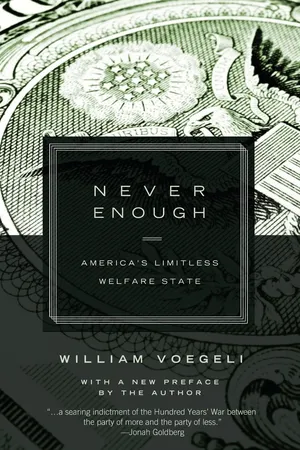
Since the beginning of the New Deal, American liberals have insisted that the government must do more—much more—to help the poor, to increase economic security, to promote social justice and solidarity, to reduce inequality, and to mitigate the harshness of capitalism. Nonetheless, liberals have never answered, or even acknowledged, the corresponding question: What would be the size and nature of a welfare state that was not contemptibly austere, that did not urgently need new programs, bigger budgets, and a broader mandate? Even though the federal government's outlays have doubled every eighteen years since 1940, liberal rhetoric is always addressed to a nation trapped in Groundhog Day, where every year is 1932, and none of the existing welfare state programs that spend tens of billions of dollars matter, or even exist. Never Enough explores the roots and consequences of liberals' aphasia about the welfare state's ultimate size. It assesses what liberalism's lack of a limiting principle says about the long-running argument between liberals and conservatives, and about the policy choices confronting America in a new century. Never Enough argues that the failure to speak clearly and candidly about the welfare state's limits has grave policy consequences. The worst result, however, is the way it has jeopardized the experiment in self-government by encouraging Americans to regard their government as a vehicle for exploiting their fellow-citizens, rather than as a compact for respecting one another's rights and safeguarding the opportunities of future generations.
- 360 pages
- English
- ePUB (mobile friendly)
- Available on iOS & Android
eBook - ePub
About this book
Information
CHAPTER ONE
AMERICA’S WELFARE STATE IN NUMBERS
MEASURING ITS GROWTH
dp n="55" folio="15" ?In 2004 the American Prospect staged an online “debate” over whether Pres. Clinton’s domestic policy had been sufficiently liberal. Ann Lewis defended the proposition that Clinton’s presidency had been “good for our country,” an argument the former communications director in the Clinton White House could have made under sedation. Disputing her claim was Max Sawicky, an economist at the Economic Policy Institute, a liberal think tank. His central accusation was that Clinton had failed to “rehabilitate the reputation of the welfare state by proposing well-founded expansions. This, I submit, is the mission of the Democratic Party; otherwise, it has little purpose.”1
Lewis responded with Clintonian triangulation, asserting that while government programs can be the best tools to promote social goals, “more government is not an end in itself.” In rebuttal, Sawicky called more government for the sake of more government a red herring. He insisted that abstract objections to expanding government were trivial compared to concrete realities that require a bigger welfare state, which “offers obvious solutions to fundamental problems.”
There are huge gaps in our social safety net, giving rise to major sources of economic insecurity for working people: displacement, ill health, workplace injury, destitution in old age, inability to finance long-term care, and an increasingly rapacious Wal-Mart-style labor market. There is no mystery about how to fill these gaps: with social insurance.2
If the expansion of the welfare state is the reason liberals get up and go to work in the morning, its contraction is the reason conservatives do. Ronald Reagan made this clear in his 1981 inaugural address: “In this present crisis, government is not the solution to our problem; government is the problem.... It is my intention to curb the size and influence of the Federal establishment and to demand recognition of the distinction between the powers granted to the Federal Government and those reserved to the States or to the people.”3 He made the point repeatedly during the course of his presidency. To pick just one example, Reagan told the American Bar Association in 1983, “It’s time to bury the myth that bigger government brings more opportunity and compassion.... In the name of fairness, let’s stop trying to plunder family budgets with higher taxes, and start controlling the real problem—Federal spending.”4
WHAT BIG GOVERNMENT ENCOMPASSES
It is worthwhile, before diving into the data, to make a distinction between the welfare state and the more encompassing idea of “Big Government.” As used in conservative rhetoric, Big Government is a catchall term that is usually disparaging but rarely precise. The term amalgamates three different but related efforts of modern government: 1) macro-economic regulation, to keep inflation low, employment high and economic growth steady; 2) micro-economic regulation of individual industries and companies; and 3) welfare state programs to promote individuals’ economic opportunities and security, and enhance the quality of their lives.
All three aspects of Big Government work to correct what liberals see as the defects of capitalism. The first two undertakings, economic policy and the regulatory state, work to modify capitalism’s processes. For the entire economy, the problem liberals perceive and set out to solve is that capitalism, left to its own devices, is susceptible (or even doomed) to debilitating boom-and-bust cycles. The workings of the market economy are more often self-aggravating than self-correcting. When bad economic trends engender worse ones, the government must step in to moderate the business cycle. As Franklin Roosevelt said in 1932, “We must build toward the time when a major depression cannot occur again; and if this means sacrificing the easy profits of infla-tionist booms, then let them go; and good riddance.”5
The regulatory state concerns itself with those capitalistic processes held to be unacceptably harsh, risky, unscrupulous, or to have harmful effects on third parties. The government establishes and enforces standards of conduct for participants in the market when it wants to remedy these problems. Examples of the resulting activities include the protections given to labor unions, regulations of pollutants, the government’s efforts to assure the safety of a wide range of consumer goods and services—cars, food, drugs, airline travel—and the transparency and integrity of financial transactions carried out by banks, brokers and insurance companies.
We should be careful not to make the line between regulating an entire economy and regulating components of it more distinct for the purposes of our analysis than it is in reality. Macro-economic regulations will have micro-economic consequences, and vice versa. The line is blurred in another sense: Leftist thought and rhetoric, going back to Marx, has come down on both sides of this question: Are macro-economic dislocations caused by the impersonal workings of the inner logic of the capitalistic system or the follies and depredations of capitalists? Much of the political energy of the New Deal was directed against “malefactors of wealth” and “economic royalists,” phrases meant to resonate with those who believed villains in top hats were the primary cause of the Depression. One New Dealer told the Senate in 1933, “We have reached a stage in the development of human affairs where it has become intolerable to have our primitive capitalistic system operated by selfish individualists engaged in ruthless competition.”6
As Alan Brinkley chronicles in The End of Reform, this belief “that something was wrong with capitalism and that government should find a way to repair it” was supplanted in the late 1930s and the decades to follow by “a set of liberal ideas essentially reconciled to the existing structure of the economy and committed to using the state to compensate for capitalism’s inevitable flaws.” This transformation owes, in part, to frustrations with the New Deal’s protracted failure to restore the standards of living Americans had enjoyed in the 1920s. The unexpected recession that began in 1937 was particularly dispiriting. Another cause was that the economic theories of John Maynard Keynes had few followers in the U.S. before 1938, either in economics departments or in government. Thereafter, however, the idea that government could abbreviate and moderate economic downturns by fiscal policies that stimulated aggregate demand was embraced enthusiastically by liberals in and out of Washington.7
This focus on extending the benefits of capitalism rather than correcting its evils proved to be more harmonious with the welfare state, which concerns itself with how capitalism works out rather than how it works. It attends to the results of capitalism by trying to make them conform more closely to some notion of “distributive justice.” If some people wind up with too much and others too little, the welfare state redistributes income through policies of taxation, transfer payments, and by providing or subsidizing certain goods and services. The intention is to secure more for those who have too little, as the sensibilities of the welfare state’s architects and advocates define a minimum level of decency.
Sometimes these advocates are also motivated by ideas about a maximum level of decency. According to James MacGregor Burns, FDR “astonished” Treasury officials in 1941 by “averring that he favored taxing all personal income above $100,000 a year at 99½ or 100 percent. ‘Why not?’ he asked. ‘None of us is ever going to make $100,000 a year. How many people report on that much income?’ But he did not press his confiscatory idea.” An income of $100,000 in 1941 would have had about the same purchasing power as $1,459,000 in 2009.8 Heavy taxation on those above the level of maximum decency may be simply a means to the end of helping the poor, or may additionally be an end in itself, curtailing and even punishing those deemed guilty of extravagance and greed.
The arguments between liberals and conservatives over the proper size and scope of government include disputes about economic policy, the regulatory state and the welfare state, often without distinguishing between them. While these arguments raise many related questions about the proper roles of government and markets, this book will concentrate on the welfare state, saying considerably less about government regulation of business, industries or the entire economy.
DEFINING AND MEASURING THE WELFARE STATE
Sawicky pronounces the growth rate of the welfare state under Clinton “pathetic,” but he arrives at that conclusion by using a measure—inflation-adjusted, discretionary federal spending on everything except national defense—that’s more rough than ready. This category, used by the Office of Management and Budget (OMB) in its historical tables accompanying each year’s federal budget, includes government endeavors no one thinks of as components of the welfare state, such as programs for international affairs, science, space and technology. At the same time, it excludes the social insurance programs Sawicky says are vital: Social Security, Medicare, Medicaid and food stamps, among others.9
A better yardstick can be fashioned to keep score of the Hundred Years’ War between the welfare state’s expanders and its reducers. OMB’s historical tables track annual federal outlays beginning in 1940, using enormous categories (“superfunctions”) composed of smaller but still vast “functions.” One of these superfunctions, Human Resources, is made up of the following six functions:
■ Education, Training, Employment and Social Services
■ Health (excluding Medicare, but including health care services, health research and training, and consu...
Table of contents
- Praise
- Title Page
- Dedication
- Foreword
- Preface
- Introduction
- CHAPTER ONE - AMERICA’S WELFARE STATE IN NUMBERS
- CHAPTER TWO - AMERICA’S WELFARE STATE IN THEORY
- CHAPTER THREE - LIBERALISM’S CONTINUING INABILITY TO MAKE SENSE
- CHAPTER FOUR - LIBERALISM’S CONTINUING INABILITY TO MAKE PAYROLL
- CHAPTER FIVE - CONSERVATISM’S CONTINUING INABILITY TO MAKE A DIFFERENCE
- CONCLUSION
- Acknowledgments
- NOTES
- INDEX
- Copyright Page
Trusted by 375,005 students
Access to over 1.5 million titles for a fair monthly price.
Study more efficiently using our study tools.
Frequently asked questions
Yes, you can cancel anytime from the Subscription tab in your account settings on the Perlego website. Your subscription will stay active until the end of your current billing period. Learn how to cancel your subscription
No, books cannot be downloaded as external files, such as PDFs, for use outside of Perlego. However, you can download books within the Perlego app for offline reading on mobile or tablet. Learn how to download books offline
Perlego offers two plans: Essential and Complete
- Essential is ideal for learners and professionals who enjoy exploring a wide range of subjects. Access the Essential Library with 800,000+ trusted titles and best-sellers across business, personal growth, and the humanities. Includes unlimited reading time and Standard Read Aloud voice.
- Complete: Perfect for advanced learners and researchers needing full, unrestricted access. Unlock 1.5M+ books across hundreds of subjects, including academic and specialized titles. The Complete Plan also includes advanced features like Premium Read Aloud and Research Assistant.
We are an online textbook subscription service, where you can get access to an entire online library for less than the price of a single book per month. With over 1.5 million books across 990+ topics, we’ve got you covered! Learn about our mission
Look out for the read-aloud symbol on your next book to see if you can listen to it. The read-aloud tool reads text aloud for you, highlighting the text as it is being read. You can pause it, speed it up and slow it down. Learn more about Read Aloud
Yes! You can use the Perlego app on both iOS and Android devices to read anytime, anywhere — even offline. Perfect for commutes or when you’re on the go.
Please note we cannot support devices running on iOS 13 and Android 7 or earlier. Learn more about using the app
Please note we cannot support devices running on iOS 13 and Android 7 or earlier. Learn more about using the app
Yes, you can access Never Enough by William Voegeli in PDF and/or ePUB format, as well as other popular books in Politics & International Relations & Social Policy. We have over 1.5 million books available in our catalogue for you to explore.