The 2012 election will be one of the hardest-fought in U.S. history. It is also likely to be one of the closest, a fact that brings concerns about voter fraud and bureaucratic incompetence in the conduct of elections front and center. If we don't take notice, we could see another debacle like the Bush-Gore Florida recount of 2000 in which courts and lawyers intervened in what should have involved only voters. Who's Counting? will focus attention on many problems of our election system, ranging from voter fraud to a slipshod system of vote counting that noted political scientist Walter Dean Burnham calls "the most careless of the developed world.” In an effort to clean up our election laws, reduce fraud and increase public confidence in the integrity of the voting system, many states ranging from Georgia to Wisconsin have passed laws requiring a photo ID be shown at the polls and curbing the rampant use of absentee ballots, a tool of choice by fraudsters. The response from Obama allies has been to belittle the need for such laws and attack them as akin to the second coming of a racist tide in American life. In the summer of 2011, both Bill Clinton and DNC chairman Debbie Wasserman Schultz preposterously claimed that such laws suppressed minority voters and represented a return to the era of Jim Crow.But voter fraud is a well-documented reality in American elections. Just this year, a sheriff and county clerk in West Virginia pleaded guilty to stuffing ballot boxes with fraudulent absentee ballots that changed the outcome of an election. In 2005, a state senate election in Tennessee was overturned because of voter fraud. The margin of victory? 13 votes. In 2008, the Minnesota senate race that provided the 60th vote needed to pass Obamacare was decided by a little over 300 votes. Almost 200 felons have already been convicted of voting illegally in that election and dozens of other prosecutions are still pending. Public confidence in the integrity of elections is at an all-time low. In the Cooperative Congressional Election Study of 2008, 62% of American voters thought that voter fraud was very common or somewhat common. Fear that elections are being stolen erodes the legitimacy of our government. That's why the vast majority of Americans support laws like Kansas's Secure and Fair Elections Act. A 2010 Rasmussen poll showed that 82% of Americans support photo ID laws.While Americans frequently demand observers and best practices in the elections of other countries, we are often blind to the need to scrutinize our own elections. We may pay the consequences in 2012 if a close election leads us into pitched partisan battles and court fights that will dwarf the Bush-Gore recount wars.
eBook - ePub
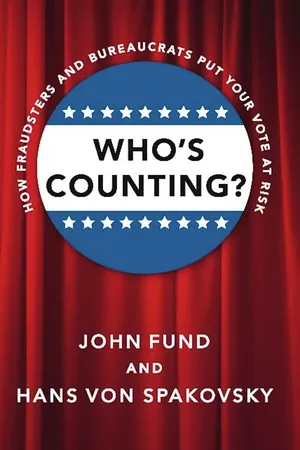
Who's Counting?
How Fraudsters and Bureaucrats Put Your Vote at Risk
- 304 pages
- English
- ePUB (mobile friendly)
- Available on iOS & Android
eBook - ePub
About this book
Information
CHAPTER ONE
A Crisis of Voting Confidence
WOULD OBAMACARE HAVE PASSED WITHOUT VOTER FRAUD?
Minnesota’s 2008 Senate race wasn’t just an ordinary election. Disputes over the razor-thin margin held the Senate seat vacant for eight months, until early July 2009. That was when Democrat Al Franken was declared the winner by 312 votes by Minnesota’s Supreme Court.
Franken’s seating gave the Democrats the critical 60 votes they needed to overcome Republican filibusters, and proved vital to the passage of ObamaCare. They quickly lost their 60-seat majority in January 2010, when Scott Brown won the Senate seat of the late Ted Kennedy in a special election. But in the preceding six months, Democrats rammed ObamaCare through the Senate, wrapping up the process with a late-night Christmas Eve vote in which they had no margin for error.
“ObamaCare doesn’t pass if the result of the Minnesota election is different,” says former Senator Norm Coleman, whom Franken defeated.1 Most observers agree with him that ObamaCare in its final form wouldn’t have passed without Senator Franken’s vote; the process by which he was seated is thus worth reexamining.
Minnesota Majority, a conservative watchdog group, has come up with compelling evidence that at least 1,099 ineligible felons voted illegally in the Franken v. Coleman contest. That’s more than three times the victory margin Franken eventually achieved through litigation.
Minnesota Majority compared criminal apprehension data to voter history files, and then examined court records to verify matches, convictions, and probation records. The group’s conclusions are bolstered by the fact that since 2009, courts in Minnesota have convicted 177 felons for voting illegally in the Senate race; another 66 felons are awaiting trial. The numbers aren’t greater because the standard for convicting someone of voter fraud in Minnesota is that they must have both been ineligible, and “knowingly” voted unlawfully.2
Rick Hodsdon, the assistant prosecutor in charge of voter fraud for the Washington County Attorney’s office, openly admits that a person can get off scot-free for voting illegally if he admits the crime and simply says he didn’t intend to vote. “That’s why some of our counties in Minnesota have received hundreds of referrals, and yet have prosecuted a relatively small number of cases.”
Of course, no one can be certain how the felon votes uncovered by Minnesota Majority were cast. “I am highly skeptical that felons voted for one candidate or another en masse,”3 says Sue Gaertner, the former Ramsey County Attorney who has convicted 27 felons for voting illegally. But there are clues to prove her wrong. In a 2003 study, sociologists Christopher Uggen and Jeff Manza found that an overwhelming majority of felons lean toward voting Democratic. They estimated that in 1992, Bill Clinton received 86 percent of votes cast by felons, and in 1996 a whopping 93 percent.4 Statistician John Lott’s own work in Washington State found that felons were 37 percent more likely to be registered Democrats even when accounting for race, gender, education level, religious habits, employment, age, and county of residence.
Indeed, in Minnesota, when Fox News went door-to-door to interview some of the felons who were convicted of voting illegally in 2008, nine of the 10 people interviewed said they had voted for Franken. When asked if she thought her vote helped Al Franken get into office, Sabrina Ruth Hall was blunt: “I don’t know, but I hope it did.”
Dan McGrath, the investigator who supervised Minnesota Majority’s work, is distressed that so few convictions have been obtained despite the data he compiled and sent to prosecutors. “First, felon voting is wrong for a reason. We don’t want gangsters and drug dealers electing county sheriffs and county attorneys and others ultimately in charge of the law.” With that as a given, he says, it’s “a shame we as private citizens had to compile the data ourselves before anything happened. I believe a far greater number of convictions could have been obtained if some prosecutors hadn’t slow-walked the process. And the statute of limitations has run out on election-related crimes from the 2008 election, so we will never know all the facts or see many more people brought to justice.”5
It is especially galling to McGrath that so many prosecutors resisted filing felon voting charges for so long. John Kingery, the head of the Minnesota County Attorneys Association, displayed his dismissive attitude toward voter fraud when he publicly complained that investigating the Minnesota Majority findings “diverted resources from the job that we want to do,” and that felon voter investigations are not only time-consuming but costly.6 Luckily, in Minnesota, failure to investigate voter-fraud allegations in affidavit form is a misdemeanor offense, and any county attorney found guilty must forfeit office.
The county attorneys association unsuccessfully lobbied the Minnesota legislature in 2012 to have that law changed.
EARLY-WARNING SIGNALS IGNORED
It’s not as if Minnesota Majority hadn’t issued early warnings that there were problems brewing with the November 2008 election. On October 16 of that year, the group sent Minnesota Secretary of State Mark Ritchie a letter expressing serious concerns about discrepancies in the voter rolls. Ritchie responded the next day by calling a press conference, assuring voters that Minnesota had the best election system in the country.
On October 31, Minnesota Majority forwarded evidence of its concerns to 30 county attorneys and 30 county auditors. Several failed to respond, and two flatly refused to initiate any probes, contrary to their obligation under Minnesota law.
After the election, Minnesota Majority found that the number of voters recorded as having cast a ballot did not match the number of ballots certified by the election canvassing board. There were approximately 40,000 more ballots counted than voter histories to account for them. It discovered a host of other anomalies:7
• Duplicate voter registrations: The group uncovered thousands of voter records having an exact match on the criteria of first name, middle name, last name, and birth year. The federal Help America Vote Act (HAVA) requires removing duplicate registrations from state election rolls.
• Double voting: It found evidence of nearly 100 cases in which voter registration and voter history records strongly indicated that a registrant may have voted more than once in a single election, and flagged thousands of additional voter records that merited more scrutiny.
• Vacant and nondeliverable addresses: The United States Postal Service flagged the recorded addresses of nearly 100,000 voters as being either “vacant” or “undeliverable.” Minnesota Majority visited about two dozen of these undeliverable addresses to verify the USPS results, and discovered that approximately half of the addresses did not exist.
• Deceased voters: Using a standard deceased matching service commonly utilized by mailing houses, Minnesota Majority discovered thousands of individuals flagged as deceased but still on the active voter rolls. Following the 2008 election, it compared the state’s voter history to a list of deceased voters and found thousands of potential matches. Further investigation into a small sampling turned up death records showing that several voters had died before someone apparently had voted in their name in the 2008 election.
• Voting by ineligible, mentally incapacitated wards: In October 2010 a number of mentally disabled individuals were observed being led into the Crow Wing County Courthouse to vote early by in-person absentee ballot. Witnesses described what amounts to the exploitation of mentally incapacitated, vulnerable adults, an all-too-common occurrence in too many states.
• Noncitizen voters: Prior to the 2008 election, then state Representative Laura Brod brought a list of possibly noncitizen voters to the attention of Secretary of State Ritchie. He gave her assurances that noncitizens would be cleaned from the voter rolls, and that checks would be made regularly going forward. After the election, a check of voter histories showed that not only were some of the same apparent noncitizens still registered, some had cast ballots.
• Bizarre voter registration records: Minnesota Majority turned up several thousand voters registered after August 1, 1983 whose birth years suggesting they were 108 years of age or older. The group also found nearly two thousand individuals who appear to have registered and voted before the age of 18.
FIXING THE PROBLEM
Despite the lengthy delays and lack of action on many cases, Minnesota Majority won praise in many quarters for its dogged work. Phil Carruthers of the Ramsey County district attorney’s office found that the group “had done a good job in their review.” The St. Paul Pioneer Press, the major newspaper in Ramsey County, editorialized that Minnesota Majority had “done important and constructive work” and “called attention to a weakness that needs repair.”
The new Republican legislature Minnesotans elected in 2010 decided to tackle many of the shortcomings in the election process, and began its “repair.” But efforts to pass a bill requiring that a photo ID be presented in order to vote were vetoed by Democratic Governor Mark Dayton, who claimed it was an overkill approach for problems that barely existed. In March 2012, after months of contentious argument, both houses of the state legislature passed a Constitutional amendment mandating photo ID. It will go before voters in November 2012.
Republican state senator Scott Newman says the bill makes very modest changes in the election law. The state’s controversial same-day registration provisions will remain intact, but the curious practice of “vouching,” by which a voter at a polling place can vouch for the identity of up to 15 people who lack a printed ID, would be ended.
Minnesota Majority contends that vouching is ripe for abuse, and McGrath cited examples.
In 1990, a Minneapolis poll watcher observed a person loitering in front of a Tenth Ward polling place wearing a “Wellstone green” button—it resembled U.S. senator Paul Wellstone’s campaign buttons, but had no other text. The watcher saw people arriving in vans and looking for the person with the green button—they had been told that individual would vouch for everyone at registration, so they could vote.
In 2004, an organization called America Coming Together created a sophisticated vouching-fraud campaign that included preprinted name badges; as an e-mail to its Minnesota volunteers explained, these made it “easier to find a volunteer to vouch for a voter at the polls.”
In 2010, eyewitnesses (including an election judge at a Minneapolis polling place) submitted sworn affidavits claiming that Organizing for America, a Democratic get-out-the-vote group, was systematically vouching for people registering on Election Day, even though the people doing the vouching clearly didn’t personally know anyone. At least one volunteer admitted to vouching for someone she didn’t know, but said she was just doing what she had been told to do.
“This issue has been a bitter bone of contention in this state for too long,” says Senator Newman. “It’s time the voters themselves settle the argument, and I’m convinced they will approve this Main Street, common-sense reform.”
MORE MINNESOTA FUNNY BUSINESS
Leaving aside felon voting and all of the other irregularities Minnesota Majority found, the recount of the Minnesota vote showed a pattern of double standards in counting, and absentee balloting problems throughout, throwing the fairness and completeness of the entire process into doubt.
After the initial count on Election Night, Al Franken trailed Norm Coleman by 725 votes out of 2.9 million cast, including approximately 300,000 absentee ballots. After the initial canvass, which is the process by which counties resubmit to the secretary of state the vote totals of local precincts from Election Day, Coleman’s lead shrank to only 206 votes.8 So the Democratic strategy focused on how to conduct the recount so that votes could be added to Franken’s total. The Franken legal team swarmed the recount, aggressively demanding that votes that had been disqualified for failing to meet state legal requirements be added to his count, while others be denied to Coleman.
The team’s goldmine was the thousands of absentee ballots the Franken team claimed had been mistakenly rejected. While Coleman’s lawyers demanded a uniform standard for how counties should reevaluate these rejected ballots, the Franken legal team ginned up an additional 1,350 absentees from Franken-leaning Democratic counties. By the time this treasure hunt ended, Franken was 312 votes up, and Coleman was left to file legal briefs to overturn that result.
Under Minnesota law, the only absentee ballots that should have been included in the recount were those that were actually cast in the election. As the state’s Assistant Attorney General Kenneth E. Raschke Jr. wrote to Democratic Secretary of State Ritchie on November 17, 2008, rejected absentee ballots are not considered as “cast” in an election.9 “Only the ballots cast in the election and the summary statements certified by the election judges may be considered in the recount process,” the Minnesota Code specifies in Section 204C.35, subd. 3.
In fact, Ritchie’s own administrative rules (which he conveniently ignored for the benefit of Al Franken), as outlined in the Hand Count instructions of his 2008 Recount Guide (issued prior to the election), explained that:
. . . an administrative recount . . . is not to determine who was eligible to vote. It is not to determine if campaign laws were violated. It is not to determine if absentee ballots were properly accepted. It is not—except for recounting the ballots—to determine if [election] judges did things right. It is simply to physically recount the ballots for this race!
As Assistant Attorney General Raschke said, the proper forum to remedy the claimed wrongful rejection of any absentee ballots is “a judicial election contest.” However, a second letter, submitted to the Canvassing Board in December and this time from the Minnesota solicitor general, took the opposite view. He asserted that “a reviewing court would likely uphold a determination by the State Canvassing Board to accept amended reports . . . that include absentee ballots of voters . . . whose votes were improperly rejected by election officials due to administrative errors” even though such actions are “not necessarily contemplated under a strict reading of the statutes.”10
Despite Minnesota law, the pre-election instructions for recounts issued by the secretary of state, and the conflicting opinions from the office of the state’s attorney general, both the Minnesota Canvassing Board and Mark Ritchie recommended that counties sort and count absentee ballots that were “mistakenly” rejected on election day. When Senator Coleman filed a petition with the Minnesota Supreme Court to stop this procedure, the court inexplicably ruled that such absentee ballots could be counted if “local election officials and the parties agree that an absentee ballot envelope was improperly rejected.”11
Minnesota law does provide that obvious errors by election judges and county canvassing boards in the counting or recording of votes can be corrected if the candidates for that office unanimously agree in writing that an error occurred.12 However, the Minnesota Supreme Court specifically held that the “improper rejection of an absentee ballot envelope is not within the...
Table of contents
- Title Page
- Dedication
- Introduction
- CHAPTER ONE - A Crisis of Voting Confidence
- CHAPTER TWO - What Voter Fraud?
- CHAPTER THREE - The Battle Over Voter ID and the Myth of the Disenfranchised Voter
- CHAPTER FOUR - Shooting the Messenger: Truth-Tellers Artur Davis and Harold Metts
- CHAPTER FIVE - The Problem of Noncitizen Voting
- CHAPTER SIX - Absentee Ballots—The “Tool of Choice” of Vote Thieves
- CHAPTER SEVEN - Holder’s Justice Department
- CHAPTER EIGHT - Tennessee Two-Step Fraud
- CHAPTER NINE - The Anti-Federalist National Popular Vote Scheme—The Vote ...
- CHAPTER TEN - How a Machine Steals an Entire Town
- CHAPTER ELEVEN - Voter Fraud Cinema Verité
- CHAPTER TWELVE - America’s Military Heroes—the Real Disenfranchised
- CHAPTER THIRTEEN - What Is to Be Done?
- Acknowledgments
- Endnotes
- Index
- Copyright Page
Trusted by 375,005 students
Access to over 1.5 million titles for a fair monthly price.
Study more efficiently using our study tools.
Frequently asked questions
Yes, you can cancel anytime from the Subscription tab in your account settings on the Perlego website. Your subscription will stay active until the end of your current billing period. Learn how to cancel your subscription
No, books cannot be downloaded as external files, such as PDFs, for use outside of Perlego. However, you can download books within the Perlego app for offline reading on mobile or tablet. Learn how to download books offline
Perlego offers two plans: Essential and Complete
- Essential is ideal for learners and professionals who enjoy exploring a wide range of subjects. Access the Essential Library with 800,000+ trusted titles and best-sellers across business, personal growth, and the humanities. Includes unlimited reading time and Standard Read Aloud voice.
- Complete: Perfect for advanced learners and researchers needing full, unrestricted access. Unlock 1.5M+ books across hundreds of subjects, including academic and specialized titles. The Complete Plan also includes advanced features like Premium Read Aloud and Research Assistant.
We are an online textbook subscription service, where you can get access to an entire online library for less than the price of a single book per month. With over 1.5 million books across 990+ topics, we’ve got you covered! Learn about our mission
Look out for the read-aloud symbol on your next book to see if you can listen to it. The read-aloud tool reads text aloud for you, highlighting the text as it is being read. You can pause it, speed it up and slow it down. Learn more about Read Aloud
Yes! You can use the Perlego app on both iOS and Android devices to read anytime, anywhere — even offline. Perfect for commutes or when you’re on the go.
Please note we cannot support devices running on iOS 13 and Android 7 or earlier. Learn more about using the app
Please note we cannot support devices running on iOS 13 and Android 7 or earlier. Learn more about using the app
Yes, you can access Who's Counting? by John Fund, Hans von Spakovsky in PDF and/or ePUB format, as well as other popular books in Politics & International Relations & Political Campaigns & Elections. We have over 1.5 million books available in our catalogue for you to explore.