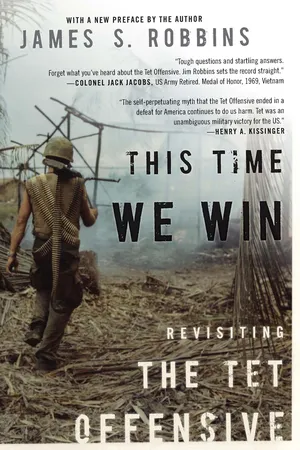
Most of what Americans have heard about the Tet Offensive is wrong. The brief battles in early 1968 during the Vietnam conflict marked the dividing line between gradual progress toward possible victory and slow descent to a humiliating defeat. That the enemy was handily defeated on the ground was considered immaterial; that it could mount attacks at all was deemed a military triumph for the Communists. This persistent view of Tet is a defeatist story line that continues to inspire America’s foreign enemies and its domestic critics of the use of force abroad.In This Time We Win, James S. Robbins at last provides an antidote to the flawed Tet mythology still shaping the perceptions of American military conflicts against unconventional enemies and haunting our troops in combat. In his re-examination of the Tet Offensive, Robbins analyzes the Tet battles and their impact through the themes of terrorism, war crimes, intelligence failure, troop surges, leadership breakdown, and media bias. The result is an explosion of the conventional wisdom about this infamous surge, one that offers real lessons for today’s unconventional wars. Without a clear understanding of these lessons, we will find ourselves refighting the Tet Offensive again and again.
- 400 pages
- English
- ePUB (mobile friendly)
- Available on iOS & Android
eBook - ePub
About this book
Information
ENDNOTES
PREFACE
1 Jim Garamone, “Official Dismisses Comparison of Kabul Attacks, Tet Offensive,” American Forces Press Service, April 16, 2012.
2 Nick Turse, “Tet ‘68, Kabul ‘12: We Still Don’t Get It,” Los Angeles Times, April aq, 2012.
CHAPTER I
1 Osama bin Laden, “Declaration of War against the Americans Occupying the Land of the Two Holy Places,” Al Quds al Arabi, Aug. 1996.
2 In On War Clausewitz defines the components of the trinity as: primordial violence, hatred, and enmity; the play of chance and probability; and war’s element of subordination to rational policy. These have been interpreted in contemporary terms to relate to the national will, the fighting forces, and the political leadership. The view was popularized by Harry Summers in On Strategy (Novato, CA: Presidio Press, 1982). Whether or not it represents a strictly doctrinaire reading of Clausewitz, it is a salient model for purposes of this discussion. For a more in-depth discussion of the issue see Christopher Bassford and Edward J. Villacres, “Reclaiming the Clausewitzian Trinity,” Parameters, Autumn 1995.
dp n="317" folio="304" ?3 Osama bin Laden audio tape released Feb. 12, 2003.
4 Osama bin Laden video tape released Nov. 9, 2001.
5 Aired on CNN, May 10, 1997.
6 Al-Jazeera TV, Oct. 31, 2006. Translation by MEMRI.
7 Quoted in Neil Munro, “Real or Fake?” National Journal, Apr. 10, 2006.
8 This discussion is based on the author’s “Baghdad Tet: How the Bad Guys Can Win,” National Review Online, Mar. 15, 2006.
9 “Grisly video of U.S. pilot is real, officials say: Footage shows pilot, on fire, being dragged after helicopter downing in Iraq,” NBC News Services, Apr. 7, 2006.
10 “The Mujahideen Shura Council in Iraq Issues a Video of the Mutilated Corpses of the Two Captured American Soldiers in al-Ysefiya,” SITE Institute, July 10, 2006.
11 “‘In Memory of the Sunnah of Our Ancestors in Mutilating the Infidels’—A Video from the Mujahideen Shura Council in Iraq Featuring the Revenge Attack Upon Two Captured American Soldiers in al-Yusufiyah,” SITE Institute, Sept. 22, 2006.
12 “Iraq war may have same psychological effect as Tet offensive,” U.S.A Today, June 30, 2004, p. 10A.
13 One possible point of comparison is that the attacks occurred during a holiday, although this is not significant since there was no “Ramadan ceasefire” to exploit in order to gain the element of surprise.
14 Arthur Schlesinger, Jr., “This is Bush’s Vietnam: The Wrong War, at the Wrong Time, in the Wrong Place, The Independent, Apr. 15, 2004. The gratuitous reference to LBJ’s choosing not to seek another term as President was no doubt a well-considered comment in an election year.
15 “Press, political pressure helped ‘lose’ Fallujah, report says,” The Washington Times, Jan. 2, 2008.
16 Patrick Cockburn: “The Crushing of Al-Fallujah Will Not End the War in Iraq,” The Independent, Nov. 9, 2004. In Apr. 2007 Sgt. Maj. Kent was selected as Sergeant Major of the Marine Corps, the highest enlisted rank in the service.
17 Editorial: “Insecurity,” Paris Liberation, June 25, 2004.
18 Rory Carroll, “Iraq Insurgents Snatch Victory from Defeat,” The Guardian, June 24, 2005. A similar massed attack in April 2005 on Abu Ghraib prison was defeated in the same manner. See the author’s “Going for Broke: Seeking Martyrdom in an Indifferent World,” National Review Online, Apr. 6, 2005.
19 Thomas Friedman, “Barney and Baghdad,” New York Times, Oct. 18, 2006. In his piece Friedman noted the August 2006 Global Islamic Media Front working paper (mentioned above) that stated he was the type of person the Islamists would seek to influence. Ironically and unintentionally his article had exactly the kind of effect the GIMF would have wanted.
20 Tony Snow had said, “I think Friedman may be right, but we’ll have to see.”
21 The support given to the insurgency by Iran notwithstanding.
22 Ironically, the highest monthly total was in May 1968 during the so-called “Little Tet.”
23 “McCain fears ‘Tet-style’ offensive in Iraq,” Associated Press [hereafter cited as AP], Feb. 12, 2007.
24 Frederick W. Kagan and William Kristol, “Like Vietnam, New Al Qaeda Offensive Aimed At Sapping Americans’ Morale,” Weekly Standard, June 17, 2007.
25 Robert H. Reid, “Top Commander Expects Big Iraq Strikes,” AP, July 7, 2007.
CHAPTER II
1 John P. Roche (1923—1994) was a political scientist, writer, and political activist who served as an adviser to John F. Kennedy, Hubert Humphrey, and Lyndon Johnson. Roche’s role in the Johnson White House was to serve as an honest broker, a person without a constituency or external vested interests. He was someone the president could rely on for advice, knowing that it would be plainspoken and objective. Roche was born in Brooklyn and attended Hofstra College and Cornell. He served in the Army Air Force during World War II as a staff sergeant. Roche was a liberal Social Democrat and anti-Communist, whose scholarship focused on American political thought and foreign policy. His groundbreaking article, “The Founding Fathers: A Reform Caucus in Action,” was the most reprinted article from the prestigious American Political Science Review. Roche taught at Haverford College, founded the government department and served as academic dean at Brandeis University, and headed the program in Civilization and Foreign Affairs at the Fletcher School of Law and Diplomacy. In the mid-1960s he was the chairman of Americans for Democratic Action, and he held impeccable liberal credentials. Roche never let his access to power go to his head. He was skilled in the ways of Washington without being a power seeker. He saw government service the same way the Roman general Cincinnatus did, as something to be done well and then to be done with. He was frequently “inside” but would never brag about being an “insider.” He knew all of the custodial and kitchen staff of the White House on a first-name basis, and while on long trips on Air Force One he would occupy his time playing poker with the Secret Service agents.
2 “Can a Free Society Fight a Limited War?” in John P. Roche, Sentenced to Life (New York: Macmillan Publishing Co., 1974), p. 67.
3 For a comprehensive review of the Diem period and the circumstances of his overthrow, see Mark Moyar, Triumph Forsaken: The Vietnam War, 1954—1965 (Cambridge: Cambridge University Press, 2006).
4 A second attack reported on August 4 was later found not to have taken place, but the report did have an impact on the Tonkin Gulf Resolution debate.
5 One notes the similarity to the strategic objectives in Operation...
Table of contents
- Praise
- Title Page
- Dedication
- Preface
- I. - INTRODUCTION
- II. - VIETNAM, THE LIMITED WAR
- III. - THE WAR AND PUBLIC OPINION
- IV. - THE VIEW FROM HANOI
- V. - THE LIGHT AT THE END OF THE TUNNEL
- VI. - CODE NAME: BUTTERCUP
- VII. - INTELLIGENCE FAILURE
- VIII. - THE EMBASSY ATTACK
- IX. - “THE SHOT SEEN ROUND THE WORLD”
- X. - ASSESSING THE BROADER OFFENSIVE
- XI. - THE BATTLE OF HUE
- XII. - HUE AND MY LAI
- XIII. - KHE SANH
- XIV. - THE WALTER CRONKITE MOMENT
- XV. - JOHNSON SURRENDERS
- XVI. - LOAN AGONISTES
- XVII. - TET’S LEGACY
- ENDNOTES
- Acknowledgments
- INDEX
- Copyright Page
Trusted by 375,005 students
Access to over 1.5 million titles for a fair monthly price.
Study more efficiently using our study tools.
Frequently asked questions
Yes, you can cancel anytime from the Subscription tab in your account settings on the Perlego website. Your subscription will stay active until the end of your current billing period. Learn how to cancel your subscription
No, books cannot be downloaded as external files, such as PDFs, for use outside of Perlego. However, you can download books within the Perlego app for offline reading on mobile or tablet. Learn how to download books offline
Perlego offers two plans: Essential and Complete
- Essential is ideal for learners and professionals who enjoy exploring a wide range of subjects. Access the Essential Library with 800,000+ trusted titles and best-sellers across business, personal growth, and the humanities. Includes unlimited reading time and Standard Read Aloud voice.
- Complete: Perfect for advanced learners and researchers needing full, unrestricted access. Unlock 1.5M+ books across hundreds of subjects, including academic and specialized titles. The Complete Plan also includes advanced features like Premium Read Aloud and Research Assistant.
We are an online textbook subscription service, where you can get access to an entire online library for less than the price of a single book per month. With over 1.5 million books across 990+ topics, we’ve got you covered! Learn about our mission
Look out for the read-aloud symbol on your next book to see if you can listen to it. The read-aloud tool reads text aloud for you, highlighting the text as it is being read. You can pause it, speed it up and slow it down. Learn more about Read Aloud
Yes! You can use the Perlego app on both iOS and Android devices to read anytime, anywhere — even offline. Perfect for commutes or when you’re on the go.
Please note we cannot support devices running on iOS 13 and Android 7 or earlier. Learn more about using the app
Please note we cannot support devices running on iOS 13 and Android 7 or earlier. Learn more about using the app
Yes, you can access This Time We Win by James S Robbins in PDF and/or ePUB format, as well as other popular books in History & Vietnam War. We have over 1.5 million books available in our catalogue for you to explore.