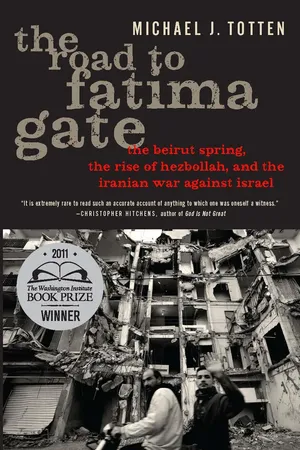
The Road to Fatima Gate is a first-person narrative account of revolution, terrorism, and war during history’s violent return to Lebanon after fifteen years of quiet. Michael J. Totten’s version of events in one of the most volatile countries in the world’s most volatile region is one part war correspondence, one part memoir, and one part road movie.He sets up camp in a tent city built in downtown Beirut by anti-Syrian dissidents, is bullied and menaced by Hezbollah’s supposedly friendly "media relations” department, crouches under fire on the Lebanese-Israeli border during the six-week war in 2006, witnesses an Israeli ground invasion from behind a line of Merkava tanks, sneaks into Hezbollah’s postwar rubblescape without authorization, and is attacked in Beirut by militiamen who enforce obedience to the "resistance” at the point of a gun.From the Cedar Revolution that ousted the occupying Syrian military regime in 2005 to the devastating war between Israel and Hezbollah in 2006 to Hezbollah’s slow-motion but violent assault on Lebanon’s elected government and capital, Totten’s account is both personal and comprehensive. He simplifies the bewildering complexity of the Middle East; gains access to major regional players as well as to the man on the street; and personally witnesses most of the events he describes. The Road to Fatima Gate should be indispensable reading for anyone interested in the Middle East, Iran’s expansionist foreign policy, the Arab-Israeli conflict, asymmetric warfare, and terrorism in the aftermath of September 11.
eBook - ePub
The Road to Fatima Gate
The Beirut Spring, the Rise of Hezbollah, and the Iranian War Against Israel
- 376 pages
- English
- ePUB (mobile friendly)
- Available on iOS & Android
eBook - ePub
The Road to Fatima Gate
The Beirut Spring, the Rise of Hezbollah, and the Iranian War Against Israel
About this book
Information
CHAPTER ONE
state within a state
Pity the nation divided into fragments, each fragment deeming itself a nation.
–KAHLIL GIBRAN
In 1979 a coalition of Iranian liberals, leftists, and Islamists overthrew the tyrannical Mohammad Reza Shah Pahlavi—and a new regime more dangerous and brutal than the last took its place.
An alliance of liberals, leftists, and Islamists made sense at first. The Shah oppressed them all more or less equally. But the Iranian Revolution, like so many others before it, devoured its children. Ayatollah Ruhollah Khomeini and his Islamists emerged the strong horse in the post-revolutionary struggle for power, and they liquidated the liberals and leftists. Drunk on power and with the wind at its back, his new Islamic Republic regime exploded outward from the ancient Persian heartland into the Arab world with a campaign of imperialism and terrorism.
During the crucible of Lebanon’s civil war in 1982, when Christian, Sunni, Shia, Palestinian, and Druze militias were slugging it out with each other and with the Israelis, Iranian Revolutionary Guard Corps commanders secretly organized disaffected members of Lebanon’s Shia community into militant cells of their own. They proved that their revolution wasn’t only exportable to Shia Muslims who were not Persian; they proved it was durable and resilient.
And it was devastating.
On October 23, 1983, a suicide bomber rammed a Mercedes-Benz truck packed with 12,000 pounds of explosives into the U.S. Marine barracks near Lebanon’s international airport, killing 241 American service members. It was the deadliest single attack against Americans since World War II and the deadliest against the Marine Corps since the Battle of Iwo Jima.
Just two minutes later, France suffered the worst single attack against its forces since the end of the Algerian War. In this attack, fifty-eight paratroopers were killed by another suicide truck bomber near the beach in West Beirut’s Ramlet el Baida.
The French and Americans were neither invaders nor occupiers of Lebanon. They were guests of the government on a peacekeeping mission. Both countries soon withdrew their armed forces, and Lebanon continued to burn for seven more years.
A mysterious group calling itself the Islamic Jihad Organization claimed credit for the attacks. You may never have heard of a terrorist group in Lebanon calling itself Islamic Jihad. That’s because it never really existed. Islamic Jihad was simply the nom de guerre of Hezbollah at the time.
Hezbollah’s name in Arabic—Hizb Allah—means “Party of God.” It also described itself on its logo and flag as the Islamic Revolution in Lebanon.
When the Iranian regime thrust itself into the Arab world, Hezbollah was the tip of its spear, and its leaders weren’t shy about saying so. “We are,” according to Hezbollah’s 1985 Open Letter,1 “the Party of God (Hizb Allah) the vanguard of which was made victorious by God in Iran.... We obey the orders of one leader, wise and just, that of our tutor and faqih (jurist) who fulfills all the necessary conditions: Ruhollah Musawi Khomeini. God save him!” “Death to Israel” and “Death to America” became its rallying cries, just as they were for the Islamic Republic in Iran.
dp n="39" folio="31" ?Hezbollah’s rhetoric was as brazen as its actions. “We combat abomination and we shall tear out its very roots,” the manifesto said, meaning “America, its Atlantic Pact allies, and the Zionist entity.” The struggle against Israel, Hezbollah said, “will end only when this entity is obliterated.”
Syria conquered and occupied most of Lebanon at the end of the civil war, but an Israeli occupation force stayed behind in a narrow strip of land in the south to prevent Hezbollah attacks from the Lebanese side of the border. But in 2000, after more than a decade of grinding counterinsurgency, the worn-out Israelis withdrew their armed forces. Hezbollah had proved itself to be the most powerful guerrilla army in the whole Middle East and the only Arab army of any kind that could plausibly claim victory against Israel.
By the time I moved to Beirut in 2005, Hezbollah was better armed, better trained, and better equipped than even the Lebanese army. With its own de facto state within a state in the suburbs south of Beirut and in South Lebanon along the border with Israel, it was the first and by far the most successful outpost of Khomeinist rule outside Iran.
Its very existence as a militia was illegal under the Taif Agreement 2 that ended the civil war in 1989, and it violated United Nations Security Council Resolution 1559, passed in 2004, that mandated the disarmament of every militia in Lebanon. Hezbollah tried to skirt this by declaring itself no longer a militia but a “resistance” army struggling against Israel.
But the Party of God faced enormous pressure to surrender its weapons, as Lebanon’s other militias had already done, and renounce its loyalty to a foreign power. Hezbollah Secretary General Hassan Nasrallah refused to even discuss it. He threatened3 to “cut off any hand that reaches out to our weapons” and to “fight them like the martyrs of Karbala.”
It’s obvious in hindsight that when I decided to relocate to Beirut, I was moving to a country in a state of prewar. It was not, however, obvious at the time. I was a bit more seduced than I should have been by the revolution that had recently forced the withdrawal of the Syrians, but the Cedar Revolution in Lebanon had yet to contend with the Iranian Revolution in Lebanon.
dp n="40" folio="32" ?I stayed in a cheap hotel on the east side of the city while looking for an apartment. While I drove around with my real estate agent in his expensive red sports car, he asked me something out of the blue that I didn’t expect. “Do you think Lebanon will be okay?” His voice cracked when he said “okay.”
He seemed confident, even arrogant, most of the time, but all of a sudden he sounded choked up and frightened. It was the first time since I met him that he spoke to me as though I knew more than he did about Lebanon. I didn’t, of course. And he knew that. He just wanted me to make him feel better.
I moved to Lebanon partly because I thought his country would be okay, that it might even help the Middle East in general turn out okay in the long run. And I wanted to cover that story from the Arab world’s freest country.
“I think Lebanon will be okay,” I said.
He seemed to relax slightly, as though I were some sort of sage who had a better feel for the future than he did. But I was wrong.

Lebanese people are educated, talented, and industrious, and they take naturally to freewheeling capitalism. Unlike most Arab countries, Lebanon never went through a suffocating socialist phase where the state owned and controlled most major industries. Beirut’s central government was so weak in 2005 it couldn’t even police, let alone stifle, its people or its economy.
There were almost as many Lebanese people in America as there were in Lebanon then. There were even more in Brazil than there were in America. Like Jews and Armenians, they thrived in the Diaspora. Their homeland wasn’t as wealthy as it should have been at the time because it had been strangled and looted by Syria’s Soviet-style regime for so long.
Though less glamorous in the daytime, the port city of Jounieh and the suburbs north of Beirut looked a bit like Hong Kong at night. If Lebanon’s international airport were north of the capital, arriving visitors might have thought they had just landed in a country as modern and prosperous as Israel.
dp n="41" folio="33" ?Instead, the airport is situated south of Beirut, where land is cheap and the snow-capped mountains rise less abruptly from the shoreline. Among the first things visitors saw in 2005, then, were madness and squalor. For the airport was built right next to territory Hezbollah controlled, and everyone had to drive through it to reach the city center.
Even so, the airport road was controlled by the Lebanese government. If you squinted hard enough or paid little attention to the ramshackle housing and billboards portraying Hezbollah’s grinning Secretary General Hassan Nasrallah, you wouldn’t necessarily realize what kind of place you were in. There were no checkpoints or militiamen on the sides of the road waving rifles. The hard Hezbollah-controlled core was a bit to the east and mostly out of sight.
Any travelers who ventured off the airport road, however, would quickly find themselves in the middle of the capital of a de facto Iranian satellite state inside Lebanon.
Charles Chuman took me down there. He is a Lebanese American from Chicago who had lived in Beirut for years, and he knew the country better than almost anyone I ever met.
“Hezbollah is only ten minutes from here,” he said one night while we walked along pleasant French-looking streets on the Christian side of the city.
I stopped in my tracks. Beirut was an attractive glittering bubble, and I had almost forgotten the stronghold of the Party of God was so close. It was hard to believe a place resembling Gaza was just ten minutes away from the Arab world’s answer to the French Riviera.
But it was true, and Charles said he would show it to me.
The Hezbollah-controlled suburb of Haret Hreik south of Beirut was known as the dahiyeh, which simply means “suburb.” There were many suburbs north, east, and south of the city, but everyone in Lebanon knew exactly which was meant by “the suburb”—it was the notorious one, the capital of Hezbollah’s state within a state, where the Party of God’s command and control center was located.
The U.S. State Department was right to warn American citizens to stay out of there. I had little choice, though, but to ignore the warning and go.
dp n="42" folio="34" ?Charles didn’t own a car, but his friend Hassane did. And Hassane said he would be happy to drive me and Charles there if his girlfriend, Rama, could come with us.
I rode in the front seat. Rama and Charles sat in the back. We drove along the civil war-era Green Line dividing predominantly Sunni West Beirut from the mostly Christian east.
Hassane and Rama were Sunnis. Like most in their West Beirut community, they attended the anti-Syrian rally on March 14.
She wore a hijab, an Islamic headscarf, over her hair, and she wore it because she felt like it. Feminists who said she shouldn’t frustrated her as much as radical Islamists in Iran and Saudi Arabia who would use their power to force her.
As we drove farther south along the Green Line, Beirut looked less and less prosperous. Gone were the skyscraping steel and glass hotels, the gourmet restaurants where the rich and would-be rich hoped to be seen, and the fashionable clothing stores like those in Milan and Paris. Unassuming churches proliferated on the east side of the road, and the minarets of small community mosques gave the skyline some punch on the west side. Starbucks chains yielded to simpler cafés with plastic chairs. Very little architecture was recognizably French any longer. South Beirut was conservative and a bit hard-bitten, but it was still Beirut.
Then we crossed an invisible line into the dahiyeh, and everything changed.
Hezbollah propaganda was everywhere.
Portraits of suicide bombers and “martyrs” killed in battle with Israel hung from the sides of lampposts and electrical poles. A fresh one appeared every couple of feet. The entire urban area was blanketed with the ghostly faces of dead men.
Hassane squinted through the windshield, stuck out his jaw, and gripped the steering wheel hard. “This isn’t my country,” he said.
He had a point.
Lebanese army soldiers and police officers were forbidden from setting foot in the area, as though an invisible international boundary ringed the periphery. Beirut’s government wasn’t allowed to operate schools in the dahiyeh, build medical facilities there, or even collect garbage. Hezbollah ruled the roost, and that was final. If the Lebanese army and police tried to retake the area, it would mean war.
I saw hardly any evidence that we were still even in Lebanon. The national flag depicting one of the ancient cedars of Lebanon was nowhere to be seen. The green and yellow Hezbollah flag, with its upraised AK-47 assault rifle logo, had taken its place.
One poster after another portrayed Iran’s Ayatollah Khomeini as though he were the ruler of Lebanon. Portraits of Syria’s tyrant Bashar al-Assad also made several appearances. The dahiyeh looked, alternately, like a slum of Tehran or Damascus.
Laundry lines slashed across the facades of nondescript concrete apartment blocks that looked like smaller versions of Stalinist towers in communist countries. Large balcony curtains billowed in the wind like dirty ship sails. The tangled mess of electrical wires looked like cobwebs of cable between all the buildings. A few smaller structures heaved over the sidewalks toward the streets as though their fronts were slowly sinking.
Not a single international chain store or restaurant was in sight. No one would have invested foreign capital in the dahiyeh even if Hezbollah would have allowed it—and Hezbollah didn’t. Economic globalization reeked of a sinister plot in Hezbollah circles. Those who earned substantial amounts of money independent of the Party of God would no longer need Hezbollah’s social services; could form their own civil society organizations if they wanted; and might, at least in the long run, demand more freedom to operate without stifling controls as Lebanese could elsewhere.
I brought a small tourist camera with me. It easily fit in my pocket, and I could quickly take pictures through the windshield without drawing attention as long as the car wasn’t stopped.
“Don’t let them see your camera,” Charles said, though his warning was hardly necessary. As we rounded a corner onto a main artery through the area, a stocky militiaman took an AK-47 from the trunk of a car and slung it over his shoulder. He didn’t look like the kind of man who would be pleased to appear in my pictures.
Windows in several buildings were sandbagged. Surveillance watchtowers were erected in front of restaurants and stores.
dp n="44" folio="36" ?“They’ve definitely ramped up the security since the last time I was down here,” Charles said. “They’re extremely paranoid now that the country has turned against Syria.”
Much of the construction was illegal and had been built when waves of poor Shias fled north from the Israeli border region to the outskirts of Beirut during the war. Known at that time as the “belt of misery” by Lebanese and as Hooterville4 by U.S. peacekeeping Marines, the area was still one of the poorest and most ramshackle urban places in the country even fifteen years later.
Most of Lebanon’s Shias had always been locked out of the bustling economy and were still locked out in 2005. They had been, for most of their history, simple people who worked the land while Christians and Sunnis in the coastal cities supplied Lebanon with her merchants, traders, and professionals. For Westerners, Beirut was the economic gate to the East, and vice versa. The Shias in the south and in Bekaa Valley were neither needed nor relevant, from Beirut’s point of view. Nor were the Shias, unfamiliar with the city and its ways, really welcome.
Lebanese American historian Fouad Ajami was born and raised a Shia Muslim in the south before his family moved to Beirut when he was a child. Some of his aunts and uncles of an earlier generation tried to build a life for themselves in the city and failed. “Beirut was too harsh and alien for them,” he wrote5 in Beirut: City of Regrets. “It was a Sunni Muslim world, and the generatio...
Table of contents
- Praise
- Title Page
- Dedication
- Introduction
- CHAPTER ONE - state within a state
- CHAPTER TWO - hanging with hezbollah
- CHAPTER THREE - we know where you live
- CHAPTER FOUR - the shatter zone
- CHAPTER FIVE - welcome to hezbollahland
- CHAPTER SIX - something dark is coming
- CHAPTER SEVEN - everything could explode at any moment
- CHAPTER EIGHT - the july war
- CHAPTER NINE - hezbollah’s putsch
- CHAPTER TEN - from jerusalem to beirut
- CHAPTER ELEVEN - so this is our victory
- CHAPTER TWELVE - the siege of ain ebel
- CHAPTER THIRTEEN - the solution is in tehran
- CHAPTER FOURTEEN - guns in the capital
- CHAPTER FIFTEEN - götterdämmerung
- CHAPTER SIXTEEN - the mystic in his bunker
- CHAPTER SEVENTEEN - the arabist in his palace
- CHAPTER EIGHTEEN - the warlord in his castle
- CHAPTER NINETEEN - a hurricane in the land of the cedars
- EPILOGUE
- Acknowledgments
- ENDNOTES
- INDEX
- Copyright Page
Trusted by 375,005 students
Access to over 1.5 million titles for a fair monthly price.
Study more efficiently using our study tools.
Frequently asked questions
Yes, you can cancel anytime from the Subscription tab in your account settings on the Perlego website. Your subscription will stay active until the end of your current billing period. Learn how to cancel your subscription
No, books cannot be downloaded as external files, such as PDFs, for use outside of Perlego. However, you can download books within the Perlego app for offline reading on mobile or tablet. Learn how to download books offline
Perlego offers two plans: Essential and Complete
- Essential is ideal for learners and professionals who enjoy exploring a wide range of subjects. Access the Essential Library with 800,000+ trusted titles and best-sellers across business, personal growth, and the humanities. Includes unlimited reading time and Standard Read Aloud voice.
- Complete: Perfect for advanced learners and researchers needing full, unrestricted access. Unlock 1.5M+ books across hundreds of subjects, including academic and specialized titles. The Complete Plan also includes advanced features like Premium Read Aloud and Research Assistant.
We are an online textbook subscription service, where you can get access to an entire online library for less than the price of a single book per month. With over 1.5 million books across 990+ topics, we’ve got you covered! Learn about our mission
Look out for the read-aloud symbol on your next book to see if you can listen to it. The read-aloud tool reads text aloud for you, highlighting the text as it is being read. You can pause it, speed it up and slow it down. Learn more about Read Aloud
Yes! You can use the Perlego app on both iOS and Android devices to read anytime, anywhere — even offline. Perfect for commutes or when you’re on the go.
Please note we cannot support devices running on iOS 13 and Android 7 or earlier. Learn more about using the app
Please note we cannot support devices running on iOS 13 and Android 7 or earlier. Learn more about using the app
Yes, you can access The Road to Fatima Gate by Michael J. Totten in PDF and/or ePUB format, as well as other popular books in History & Middle Eastern History. We have over 1.5 million books available in our catalogue for you to explore.