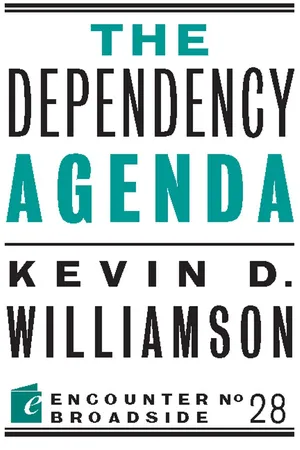
Each year, the United States spends $65,000 per poor family to "fight poverty” – in a country in which the average family income is just under $50,000. Meanwhile, most of that money goes to middle-class and upper-middle-class families, and the current U.S. poverty rate is higher than it was before the government began spending trillions of dollars on anti-poverty programs.In this eye-opening Broadside, Kevin D. Williamson uncovers the hidden politics of the welfare state and documents the historical evidence that proves Lyndon B. Johnson’s "Great Society” was designed to do one thing: maximize the number of Americans dependent upon the government. The welfare state was never meant to eliminate privation; it was created to keep Democrats in power.
- 48 pages
- English
- ePUB (mobile friendly)
- Available on iOS & Android
eBook - ePub
The Dependency Agenda
About this book
Trusted by 375,005 students
Access to over 1.5 million titles for a fair monthly price.
Study more efficiently using our study tools.
Information
Subtopic
Política socialLBJ AND THE GREAT CONUNDRUM
I’ll have them niggers voting Democratic for 200 years. –Lyndon Baines Johnson, 1964, as reported in Ronald Kessler’s Inside the White House
IN THE MID-1960s, the administration of President Lyndon Baines Johnson was in crisis. The Democrats enjoyed a crushing victory in 1964, but December of that year also saw the first march against the war in Vietnam, an unpopular military misadventure that was regarded as being mainly a Kennedy-Johnson project – which, of course, it was, though the sainted JFK has largely been exempted from blame for it. While Johnson’s Democratic Party was still largely dominated by fiercely anti-Communist hawks such as Senator Henry “Scoop” Jackson – who had been a trenchant critic of what he considered the recklessly soft national-defense posture of the Eisenhower administration – it was increasingly the political home of the more radical elements of the left and those who sympathized with them. That the Democrats became the partisan home of the far left in the ‘60s is illuminating in that it speaks to the political calculations that were made regarding the two thorniest issues of that decade: the confrontation with the Soviet Union abroad and the wrenching debate over African Americans’ rights at home.
The left could not make common cause with the Republican Party, even though the party had been – in both its legislative and executive branches – a champion of the political and economic rights of African Americans. Republicans had a tradition of consistent and energetic anti-Communism, which extended back to the pre–New Deal era, and a refreshed postwar commitment to free enterprise over state central planning. But the left found that it could make common cause with the Democratic Party under Johnson, which was curious. On top of prosecuting an unpopular war as president, Johnson – as Senate majority leader only a few years earlier – had rallied such Democratic worthies as Senator Robert Byrd, a veteran of the Ku Klux Klan, and Senator William Fulbright, a remorseless segregationist and signer of the Southern Manifesto, in undermining President Dwight D. Eisenhower’s Civil Rights Act of 1957. That Johnson did so while successfully posing as a champion of civil rights is testament to his unique political genius, unmatched on the national scene until the presidency of Bill Clinton. Contrary to the popular myth, Democratic opposition to Eisenhower’s landmark civil-rights bill was hardly confined to the so-called Dixiecrats: Senator John F. Kennedy voted against it, while his eventual Republican nemesis, Richard Nixon, had helped shepherd the bill through Congress. Johnson, for his part, not only opposed civil-rights legislation but also Republican-backed antilynching legislation – and had done so consistently.
While President Eisenhower was finally successful in getting the 1957 act through Congress – in spite of an unprecedented marathon 24-hour filibuster by Democratic Senator Strom Thurmond (who regaled the Senate with, among other things, his grandmother’s biscuit recipe) – Senator Johnson succeeded in watering down the key provisions of what he called in private the “nigger bill,” excising its enforcement clauses and thereby rendering the legislation almost entirely toothless.
Some years later, President Johnson, one of the canniest political operators in American history, could draw upon his own deep experience in legislative politics to calculate where this would all end. While racial animus was indeed a ghastly fact of life in American politics, particularly in Southern politics, he knew that there were stronger forces at play. As The New York Times put it, “He won his seat in Congress because, in 1937, central Texas was still deep in the Depression and he was able to demonstrate a connection to Franklin D. Roosevelt, who was a god there.” Johnson’s constituents during his time in the House may have broadly shared his troglodytic racial outlook, but it was the New Deal, not the Lost Cause, that had brought Johnson to Washington. When he became a U.S. senator, the Times says, Johnson found himself representing a constituency that “made up for being less intensely segregationist than the rest of the South by being more intensely anti-Communist.”

The left valued the toleration of revolutionary socialism abroad and the piecemeal implementation of the welfare state at home over the civil rights of African Americans.
Johnson found himself and his party in a position that would in the long term prove untenable. The elements of the Democratic Party that were strongly anti-Communist and in favor of civil rights – the faction represented by Senator Jackson and others of that stripe – were sure to be repelled by the influx of leftist radicals that the antiwar movement was bringing into the fold. At the same time, those who were mainly motivated by the paramount domestic issue of fully integrating African Americans into national political and economic life had the recent experience of watching the Democrats, led by Johnson, do red-in-tooth-and-claw battle against the Civil Rights Act of 1957 and again against the Civil Rights Act of 1960. The latter act sought to remedy some of the defects of the earlier legislation and again found Senator Johnson in the shadows leading Senate Democrats in a record-breaking continuous filibuster, this one lasting some 43 hours. In 1960, as in 1957, the disproportionately Republican congressional civil-rights caucus overcame Democratic parliamentary obstacles and sent landmark legislation to the desk of a Republican president.
All of this puts paid to the utterly dishonest account of the ‘50s and ‘60s cultivated by the Democratic Party today: that conservative Southern Democrats exited the party en masse to join up with a Republican Party that shared their primitive racist views. Conservative Southerners did in fact abandon the Democrats during and after the ‘60s, but they did so to join a Republican Party whose legislators and president had achieved significant civil-rights progress over bitter Democratic opposition. Whatever their motive was, it was not for the sake of racism that they were abandoning the party of the Ku Klux Klan and Byrd (who held the ridiculous title of Exalted Cyclops in that ridiculous organization) for the party of Abraham Lincoln, Eisenhower, and the Civil Rights Acts of 1957 and 1960 – or because of later landmark civil-rights legislation either. Even Johnson’s own keystone civil-right legislation, the Civil Rights Act of 1964, was much more strongly supported by congressional Republicans (75 percent voted for it) than by Democrats (just over half voted for it).
The question of what really happened with the political realignment of the ‘60s and the subsequent decades, which saw great numbers of conservative Democrats leaving their party and joining the Republicans, is complex. The short version is that the left valued the toleration of revolutionary socialism abroad and the piecemeal implementation of the welfare state at home over the civil rights of African Americans, and it therefore made common cause with the segregationist Johnson Democrats over the antisegregationist Eisenhower Republicans, while many conservative Democrats – dedicated to opposing the welfare state at home and Communism abroad – followed the opposite course. The antiwar movement and the radicalization of the Democratic left certainly played a leading role in that drama, particularly among national-security conservatives. But the most critical factor was President Johnson’s decision to try to maneuver his way out of the mess he found himself in by revisiting the political agenda that first brought him to Congress: the New Deal. Not to put too fine a point on it, but the Democrats were on the verge of losing both the blacks and the rednecks, and Johnson had a plan to buy their loyalties with a program he called the Great Society.
THE NEW DEAL AND THE POLITICS OF CONTROL
The New Deal differed from the Great Society and most subsequent additions to the welfare state in important ways. It was adopted during a time of national (indeed, global) emergency. The Great Depression had led to an unprecedented decline in U.S. economic output and the sudden impoverishment of millions of Americans. (Many New Deal programs, notably the intentional reduction of U.S. agricultural production, would in fact make this problem worse, contrary to the economic theory under which Roosevelt and his advisers were operating.) In the background, the increasing possibility of another war in Europe informed a great deal of economic thinking at the time. This was true well before Adolf Hitler’s formal ascent to power, though it is notable that this happened during the same dark year – 1933 – that saw the first New Deal programs instituted. The European situation was a critical factor for two reasons. First, Roosevelt was far from alone in his belief that a United States in economic disarray was poorly positioned to be a credible military actor in an unstable world. The second and less well-understood fact is that a great many American intellectuals and politicians considered the totalitarian systems of the early 20th century to be successful to varying degrees: Roosevelt famously spoke well of Benito Mussolini (“that admirable Italian gentleman”), while leaders ranging from Henry Ford to David Lloyd George found things to admire about the Third Reich and its charismatic leader. Further, the rapid industrialization of the Soviet Union under Communism had made an impression in the West, much as the rapid industrialization of China under Communism at the turn of the century would make on similarly naive American intellectuals. For a great many U.S. leaders in the 1930s, it seemed apparent that fascism, Nazism, and Communism had all taken steps toward solving what they believed to be the pre-eminent problem of the day: the failure of capitalism and its necessary replacement with rational central-planning regimes. As the influential liberal economist John Kenneth Galbraith noted, “Hitler also anticipated modern economic policy … by recognizing that a rapid approach to full employment was only possible if it was combined with wage and price controls. That a nation oppressed by economic fear would respond to Hitler as Americans did to FDR is not surprising. … In economics, it is a great thing not to understand what causes you to insist on the right course.” Galbraith, who became a senior official in Roosevelt’s Office of Price Administration during the war, was typical in his view of the necessity of centralizing government power to ameliorate the vagaries of capitalism.
The New Deal, for all its failures, was not in the main a project dedicated to the cultivation of economic dependency for the purposes of political gain.
The New Dealers may be partly exonerated for the subsequent sins of statism inasmuch as the ideas behind their program were largely untested; in the context of the 1930s, a centrally planned economy under the management of teams of highly specialized experts and selfless elites must have seemed a plausible alternative to the economic dislocations of the time. No similar exculpation can be offered to the architects of the Great Society, who were not operating during an international emergency and who had plentiful experience in which to root sensible expectations about the likely effects of their agenda. The social-welfare and wealth-transfer aspects of the Great Society were to play the role for middle-class whites that Johnson’s loveless embrace of civil rights played for blacks (and, inevitably, for other groups in subsequent years): a tool for building a permanent Democratic majority under which the interests of the state would be made identical to the interests of the Democratic Party – and state dependents made in effect dependents of the Democratic Party.
The New Deal, for all its failures, was not in the main a project dedicated to the cultivation of economic dependency for the purposes of political gain. Indeed, Roosevelt himself worried about creating long-term dependency. In his 1935 State of the Union speech – in which he proposed the creation of Social Security, federal unemployment benefits, and what would become Aid to Families with Dependent Children, he declared:
A large proportion of these unemployed and their dependents have been forced on the relief rolls. … The lessons of history, confirmed by the evidence immediately before me, show conclusively that continued dependence upon relief induces a spiritual disintegration fundamentally destructive to the national fiber. To dole our relief in this way is to administer a narcotic, a subtle destroyer of the human spirit. It is inimical to the dictates of a sound policy. It is in violation of the traditions of America. Work must be found for able-bodied but destitute workers.
The federal government must and shall quit this business of relief.
Roosevelt’s solution was to have the government become an employer rather than a caregiver:
I am not willing that the vitality of our people be further sapped by the giving of cash, of market baskets, of a few hours of weekly work cutting grass, raking leaves, or picking up papers in the public parks. We must preserve not only the bodies of the unemployed from destitution but also their self-respect, their self-reliance, and courage and determination.
… This group was the victim of a nationwide depression caused by conditions which were not local but national. The federal government is the only governmental agency with sufficient power and credit to meet this situation. We have assumed this task, and we shall not shrink from it in the future. It is a duty dictated by every intelligent consideration of national policy to ask you to make it possible for the United States to give employment to all of these 3½ million people now on relief, pending their absorption in a rising tide of private employment.
It is my thought that, with the exception of certain of the normal public building operations of the government, all emergency public works shall be united in a single new and greatly enlarged plan.
With the establishment of this new system, we can supersede the Federal Emergency Relief Administration with a coordinated authority which will be charged with the orderly liquidation of our present relief activities and the substitution of a national chart for the giving of work.
If it occurred to President Roosevelt that an American employed by the government on noneconomic terms is as much of a dependent as one receiving welfare payments, he does not ever seem to have spoken of the fact. But it is clear that – with some important exceptions such as the creation of Social Security – much of the New Deal was intended as a set of temporary emergency measures. The various initiatives of the Works Pr...
Table of contents
- Cover
- Table of Contents
- LBJ and the Great Conundrum
- Encounter Broadsides Series
- Copyright
Frequently asked questions
Yes, you can cancel anytime from the Subscription tab in your account settings on the Perlego website. Your subscription will stay active until the end of your current billing period. Learn how to cancel your subscription
No, books cannot be downloaded as external files, such as PDFs, for use outside of Perlego. However, you can download books within the Perlego app for offline reading on mobile or tablet. Learn how to download books offline
Perlego offers two plans: Essential and Complete
- Essential is ideal for learners and professionals who enjoy exploring a wide range of subjects. Access the Essential Library with 800,000+ trusted titles and best-sellers across business, personal growth, and the humanities. Includes unlimited reading time and Standard Read Aloud voice.
- Complete: Perfect for advanced learners and researchers needing full, unrestricted access. Unlock 1.5M+ books across hundreds of subjects, including academic and specialized titles. The Complete Plan also includes advanced features like Premium Read Aloud and Research Assistant.
We are an online textbook subscription service, where you can get access to an entire online library for less than the price of a single book per month. With over 1.5 million books across 990+ topics, we’ve got you covered! Learn about our mission
Look out for the read-aloud symbol on your next book to see if you can listen to it. The read-aloud tool reads text aloud for you, highlighting the text as it is being read. You can pause it, speed it up and slow it down. Learn more about Read Aloud
Yes! You can use the Perlego app on both iOS and Android devices to read anytime, anywhere — even offline. Perfect for commutes or when you’re on the go.
Please note we cannot support devices running on iOS 13 and Android 7 or earlier. Learn more about using the app
Please note we cannot support devices running on iOS 13 and Android 7 or earlier. Learn more about using the app
Yes, you can access The Dependency Agenda by Kevin D. Williamson in PDF and/or ePUB format, as well as other popular books in Política y relaciones internacionales & Política social. We have over 1.5 million books available in our catalogue for you to explore.