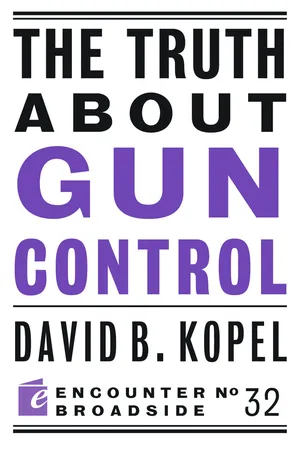
Who is sovereign in the United States? Is it the people themselves, or is it an elite determined to rule citizens who are seen as incapable of making choices about their own lives? This is the central question in the American gun-control debate.In this Broadside, David Kopel explains why the right to keep and bear arms has always been central to the American identity – and why Americans have always resisted gun control. The American Revolution was sparked by British attempts to confiscate guns. After the Civil War, the U.S. changed the Constitution to defeat the nation’s first gun-control organization, the Ku Klux Klan. When Hitler and Stalin demonstrated how gun registration paves the way for gun confiscation, which paves the way for genocide, Americans resolved to make sure it never happens here.Gun control is not an issue of left vs. right or urban vs. rural. The right to bear arms is crucial to prevent large-scale tyranny by criminal governments and small-scale tyranny by ordinary criminals – and to protect our Constitution.
- 999 pages
- English
- ePUB (mobile friendly)
- Available on iOS & Android
eBook - ePub
The Truth About Gun Control
About this book
Information
THE SECOND AMENDMENT is under siege, and not for the first time. Today’s war on Second Amendment rights, led by President Obama and New York City Mayor Michael Bloomberg, continues an American culture war that has been going on for half a century. The roots of the gun-control movement can be traced back even further, to Reconstruction and attempts to disarm the freedmen, and before that to the British gun-confiscation program that sparked the American Revolution.
President Obama, having finished his last election, is wielding his newfound flexibility and using the murders at Sandy Hook Elementary School in Newtown, Conn., to promote massive bans on firearms and magazines. Yet the president’s prohibitions would have made no difference at Sandy Hook. The killer fired 150 rounds during the 20 minutes it took the police to arrive – a rate of fire that could be duplicated by any firearm produced in the past 150 years. He changed magazines repeatedly, dumping half-full magazines on the floor.
The gun-control debate always has its micro-issues du jour – plastic guns, “cop-killer bullets,” so-called assault weapons, waiting periods, gun registration, and so on. The first three things on the list do not really exist. All the issues are simply the battles of the day in a much larger struggle. What is ultimately at stake is the same question that precipitated the American Revolution: whether the American people are the sovereigns in their own country or whether they should be ruled from above, for their own good, according to the supposedly benevolent commands of the elitist rulers of a top-down, European-style society.
THE HISTORY OF THE RIGHT TO KEEP AND BEAR ARMS
Self-defense is the most fundamental of all natural rights. So agreed the founders of international law, including Francisco de Vitoria, Francisco Suárez, Hugo Grotius, Samuel Pufendorf, and Emmerich de Vattel. They built the classical system of international law through moral and logical reasoning, starting with self-evident truths about individual human rights. Foremost among these rights was self-defense.
A necessary corollary to the natural right of self-defense is the right to defensive arms.

What is ultimately at stake is the same question that precipitated the American Revolution: whether the American people are the sovereigns in their own country or whether they should be ruled from above.
For most people, some sort of arm is the only practical way in which they can vindicate their inherent right of self-defense. A woman who is attacked by a gang of three rapists usually needs a weapon to defend herself.
Thus, as the U.S. Supreme Court correctly stated in the 1876 case U.S. v. Cruikshank, the Second Amendment right to bear arms, like the First Amendment right to assemble, is an inherent human right that predates the Constitution. The First and Second Amendments protect these rights but do not create them. Rather, each right “is found wherever civilization exists.”
Or, as John Locke wrote in The Second Treatise of Civil Government, because God has created every person, every person therefore has the right and the duty to protect his or her God-given life from criminals, including criminal governments.
John Adams and Thomas Jefferson disagreed on much. But they agreed on the fundamental right to self-defense. Adams supported “arms in the hands of citizens, to be used at individual discretion” for “private self-defence.” Like Adams, Jefferson was a great admirer of the Italian scholar Cesare Beccaria, who founded the modern science of criminology, with his international best seller On Crimes and Punishments (Dei Delitti e Delle Pene). An oft-quoted passage from Beccaria observes:
The laws which forbid men to bear arms … only disarm those who are neither inclined nor determined to commit crimes. Can it be supposed that those who have the courage to violate the most sacred laws of humanity and the most important in the civil code will respect the lesser and more arbitrary laws…? These laws make the victims of attack worse off and improve the position of the assailant. They do not reduce the murder rate but increase it, because an unarmed man can be attacked with more confidence than an armed man.
THE COLONIES, THE REVOLUTION, AND THE CONSTITUTION
To the Americans of the 13 colonies, self-defense was both a right and a duty. Americans had been used to having firearms from the first days of European settlement. Unlike in Europe – where the aristocracy maintained a monopoly on hunting – hunting in America was wide open from the first days of white settlement (indeed, from the days when the first Indians crossed the Bering Strait).
All colonies except Pennsylvania required gun ownership by militiamen (most adult males). Many colonies also mandated gun ownership by the head of a household – including a woman, if she was the head – and sometimes required the carrying of guns when traveling or when going to public meetings, such as church services.
The right and duty of self-defense applied to a householder protecting her children and to militiamen protecting their communities from foreign enemies or from tyranny. Self-defense was a seamless web; the difference between self-defense against a criminal invader in the home, against a gang of highway robbers, or against a criminal tyrant with his standing army was only one of scale. The tyrant’s gang was just bigger than the other ones.
The American Revolution began because of gun control. For years the Americans and the British intensely disputed whether the king and Parliament had the authority to govern the domestic affairs of the Americans and tax their internal trade. The dispute turned into a war when King George and his ministers attempted to disarm the Americans.
In the fall of 1774, the king embargoed the delivery of firearms and gunpowder to America. At the same time, royal governors began sending out the Redcoats to seize the “public arms” – the firearms and ammunition that some colonies stored in central armories to supply arms to militiamen who could not afford their own. The reason these seizures did not start an immediate war was that they were carried out in predawn raids, before any resistance could assemble.
The right and duty of self-defense applied to a householder protecting her children and to militiamen protecting their communities from foreign enemies or from tyranny.
But in the early hours of April 19, 1775, Paul Revere and William Dawes rode to warn the people that the British were coming. The spark struck out by their steeds in their flight kindled the land into flame.
Church bells rang and guns fired, spreading alarm. The Americans turned back the British at Concord Bridge. Although the British accomplished their objective to seize guns during house-to-house searches at Lexington and Concord, the Americans swarmed into action, harrying the British on their retreat back to Boston. “Every man was his own commander,” one American later recalled. The British suffered far more casualties than the Americans that day and might have been wiped out, had not the Americans begun to run out of gunpowder.
The British gun-confiscation campaign continued, with the British navy burning down Falmouth (today known as Portland, Maine) when the citizens refused to surrender their arms.
During the war, the American militia usually needed support from the Continental Army to prevail in open-field battles against British regulars. But everywhere, the militia, on their own, denied the British access to the countryside. Although the British, with control of the sea, could move quickly from one seaport to another, wherever they went there would be instant armed resistance, for the militia would rise wherever the British deployed. As historian Daniel Boorstin later put it, “The American center was everywhere and nowhere – in each man himself.”
Recognizing that an armed people could not be governed without consent, the British proposed (as detailed in British Under Secretary of State William Knox’s “What Is Fit to Be Done with America?”) that once the Americans had been defeated, “the Arms of all the People should be taken away.” American manufacture of firearms would be outlawed and the militias prohibited. Firearms were not only a tool that the Americans used to fight for self-government, but firearms possession in itself also fostered the spirit of self-government.
The original public meaning of the Second Amendment, and its analogues in state constitutions, was safeguarding the natural right to own and carry arms for all legitimate purposes. This included the inherent natural right of self-defense (which was not controversial at the time), and it also ensured that there would be an armed body of people from whom the militia could be drawn. As Michigan Supreme Court Justice Thomas Cooley, the most eminent constitutional scholar of the latter 19th century, wrote, “The meaning of the provision undoubtedly is, that the people, from whom the militia must be taken, shall have the right to keep and bear arms; and they need no permission or regulation of law for the purpose.”
Before the Civil War, the great antislavery writer Lysander Spooner used the Second Amendment to argue that slavery was unconstitutional.
THE RACIST ORIGINS OF GUN CONTROL
Before the Civil War, the great antislavery writer Lysander Spooner used the Second Amendment to argue that slavery was unconstitutional. Since a slave is a person who cannot possess arms, and the Second Amendment guarantees that all persons can possess arms, no person in the United States, therefore, can be a slave. “The right of a man ‘to keep and bear arms,’ is a right palpably inconsistent with the idea of his being a slave,” Spooner wrote.
On the other hand, in the infamous Dred Scott decision, U.S. Supreme Court Chief Justice Roger B. Taney announced that free blacks were not citizens; if they were, he warned, free blacks would have the right “to keep and carry arms wherever they went.”
Immediately after the Civil War, Southern states enacted Black Codes that were designed to keep the ex-slaves in de facto slavery and submission. Mississippi’s provision was typical: no freedman “shall keep or carry fire-arms of any kind, or any ammunition” without police permission. In areas where the Ku Klux Klan took control, “almost universally the first thing done was to disarm the negroes and leave them defenseless,” recounted the civil-rights attorney Albion Tourgée, who represented Homer Plessy in Plessy v. Ferguson. The Ku Klux Klan was America’s first gun-control group, as well as America’s first domestic terrorist organization.
Congress responded with the Freedmen’s Bureau Act, insisting that “the constitutional right to bear arms, shall be secured to and enjoyed by all the citizens.” Congress followed up with the Civil Rights Act and the 14th Amendment to ensure that no state could ever again violate the civil rights of Americans.
Repeatedly, the congressional proponents of the 14th Amendment announced that one of its key purposes was to guarantee that the freedmen could exercise their Second Amendment right to own guns for self-defense, especially against Klansmen. Senator Samuel Pomeroy (R-Kan.) extolled the three “indispensable” “safeguards of liberty under our form of government”: the sanctity of the home, the right to vote, and “the right to bear arms … [so] if the cabin door of the freedman is broken open and the intruder enters … then should a well-loaded musket be in t...
Table of contents
- Cover
- Table of Contents
- The History of the Right to Keep and Bear Arms
- Encounter Broadsides Series
- Copyright
Trusted by 375,005 students
Access to over 1.5 million titles for a fair monthly price.
Study more efficiently using our study tools.
Frequently asked questions
Yes, you can cancel anytime from the Subscription tab in your account settings on the Perlego website. Your subscription will stay active until the end of your current billing period. Learn how to cancel your subscription
No, books cannot be downloaded as external files, such as PDFs, for use outside of Perlego. However, you can download books within the Perlego app for offline reading on mobile or tablet. Learn how to download books offline
Perlego offers two plans: Essential and Complete
- Essential is ideal for learners and professionals who enjoy exploring a wide range of subjects. Access the Essential Library with 800,000+ trusted titles and best-sellers across business, personal growth, and the humanities. Includes unlimited reading time and Standard Read Aloud voice.
- Complete: Perfect for advanced learners and researchers needing full, unrestricted access. Unlock 1.5M+ books across hundreds of subjects, including academic and specialized titles. The Complete Plan also includes advanced features like Premium Read Aloud and Research Assistant.
We are an online textbook subscription service, where you can get access to an entire online library for less than the price of a single book per month. With over 1.5 million books across 990+ topics, we’ve got you covered! Learn about our mission
Look out for the read-aloud symbol on your next book to see if you can listen to it. The read-aloud tool reads text aloud for you, highlighting the text as it is being read. You can pause it, speed it up and slow it down. Learn more about Read Aloud
Yes! You can use the Perlego app on both iOS and Android devices to read anytime, anywhere — even offline. Perfect for commutes or when you’re on the go.
Please note we cannot support devices running on iOS 13 and Android 7 or earlier. Learn more about using the app
Please note we cannot support devices running on iOS 13 and Android 7 or earlier. Learn more about using the app
Yes, you can access The Truth About Gun Control by David B Kopel in PDF and/or ePUB format, as well as other popular books in History & North American History. We have over 1.5 million books available in our catalogue for you to explore.