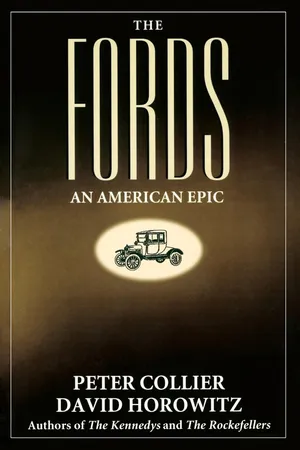
The Fords: An American Epic is the dramatic story of three generations of Fords and of the dramatic conflict between fathers and sons played out against the backdrop of America's greatest industrial empire. The story begins with Henry I, the mechanical wizard, tinkerer, and mad genius who drove the automobile into the heart of American life and conquered the world with it. But in the end he became an embittered crank who so possessively loved the company he built that when his son, Edsel, tried to change it to suit the times, Henry destroyed him. It was left to Edsel's son, Henry II, to avenge him and save the Ford Motor Company. From the details of Henry I's illicit affair, which produced an illegitimate son, to the life and loves of "Hank the Deuce" and his celebrated feud with Lee Iacocca, this is an engrossing account of a vital chapter in American history. The authors have added a new preface to this now classic work, showing how Henry II's line lost out to the line of his brother William Clay Ford in the quest to control the company in the twentieth century.
- 300 pages
- English
- ePUB (mobile friendly)
- Available on iOS & Android
eBook - ePub
About this book
Information
PART I
CRAZY HENRY
It will take a hundred years to tell whether he helped us or hurt us, but he certainly didn’t leave us where he found us.
—Will Rogers

ONE
LATER IN HIS LIFE, AFTER he had become the world’s richest and most controversial man, Ford would hire genealogists to help him search for his origins. John D. Rockefeller and other of the great industrialists who had attained sudden riches and power in America also looked for their past, anxious to see if this New World success had been prefigured by a coat of arms on the Continent. But Ford wasn’t interested in finding some noble ancestor. In fact, he was scornful of such motives; he wanted the answers to more profound questions: What was the heritage that had produced him? Did it somehow account for his accomplishment? Who was he?
The inquiry centered on Ireland. There, at the height of the potato famine of 1847, his grandparents John and Thomasina Ford were evicted from an Englishman’s estate in County Cork called “Madame” where they had worked as tenant farmers. Their eldest son, William, who, at twenty-one, was almost on his own when the famine struck, convinced them that there was no future in Ireland, even if the Great Hunger should someday end. And so, early in the spring, they made the decision to emigrate. After urging them forward and helping them get ready, William packed his carpenter’s tools onto the cart of a cousin, who drove him to Bandon Station, where he caught a train for Queenstown and joined his family in boarding a packet ship headed for the United States. He was of medium height, with a thewy strength, gray agate eyes and a serious demeanor. In the Irish manner he was called a “boy” because his father was still alive, but he was very much the leader of their party, which included not only his parents but also his brothers Henry and Samuel and his sisters Rebecca, Jane, Nancy and Mary.
Like other desperate Irish packed into the dread “coffin ships,” the Fords suffered a tragedy when Thomasina became ill and died and was buried at sea. But they were different from most of the immigrants who would define the Irish experience in America. For one thing, they were Protestant, descendants of English from Somersetshire who had been settled in Ireland by Queen Elizabeth in the late sixteenth century as part of a program to pacify that trouble-some nation. Tradition had it that soon after arriving in County Cork these English yeomen—Ford ancestors among them—had put up a sign on the outskirts of Bandon with this message:
A Turk, a Jew or an Atheist
May live in this town but no Papist.
The fact that relations would never be good with the indigenous Irish was suggested by the rejoinder that was soon scrawled underneath that couplet:
He that wrote these lines did write them well
As the same is written on the gates of Hell.
Outsiders even in the homeland they were fleeing, people like the Fords would not maintain a sentimental attachment to the Old Country and its ways when they reached the New World. Their survival strategy was a fierce adaptability. Another thing that set William Ford and his family apart from the Catholic Irish packed beside them in their ship was that they were not merely fleeing tragedy. They were also traveling toward something, an ideal of prosperity and independence that made America more than a refuge from tragedy. They had experienced the promise of this new land vicariously in the letters of William’s uncles Samuel and George, who had journeyed to the United States fifteen years earlier, letters which told of wild forests, individual rights and cheap land.
But the most important difference between the Fords and the masses of Irishmen fleeing the Old Country was that they did not stop at Boston or New York, falling into the wage slavery that went along with teeming tenement life and the sordid political machinery that seemed its only antidote. Instead they went by oxcart and then by boat down the Erie Canal, and finally on foot to Detroit, and from there to the small neighboring town of Dearborn, determined to buy a piece of the new land and achieve self-sufficiency and rugged individualism.
The legendary uncles Samuel and George Ford were there to greet them, well settled and land rich. When they had arrived in 1832, Dearborn was still a dense wilderness filled with deer, wolves and bear, as well as Indians who would appear as if by magic in clearings, sometimes walking curiously into the settlers’ log houses, fingering their possessions for a moment and then disappearing as quickly as they had come. Even in 1847 Dearborn still had a frontier atmosphere, although the town was served by its own railroad and also by a plank road called Michigan Avenue which ultimately stretched to Chicago. By the time William arrived, there were dozens of Fords in the Dearborn area, Samuel and George having had large families in which the same names—an Old World device for binding a clan together—recurred so often that geography, location, appearance and paternity were used to distinguish one of them from another. As one member of the family said later on, “There was Big Sam, Little Sam, Uncle Sam, William’s Sam, Henry’s Sam; there was Red-Headed George, George on the Hill, Foxy George; there was Uncle Henry, Hank, Uncle Will, John’s William, and so on.” Newcomer William was dubbed William South because the eighty acres his father bought immediately upon their arrival was below the land of a Cousin William who became known as William North.
Soon after the family had established itself in Dearborn, William’s younger brother Henry left, lured by the prospect of quick riches to the gold fields of California, where he laboriously scrawled out letters shuddering with memories of the one Michigan winter he had scarcely had time to experience: “i like the Climate in California so well on a Count of no Snow in the winter and Pleasant in the Summer.” The romance and excitement of his brother’s letters tugged at William, but as firstborn he had a duty to the family. He worked with his father to clear his land, and also helped pay off the $350 the eighty acres had cost by hiring himself out as a carpenter to the Michigan Central Railroad. Only after the family had sent roots down into the fertile soil of Dearborn did William begin to think of himself and begin looking for ways to make money to buy a plot of his own. By the late 1850s he was working as a handyman for his neighbor and countryman Patrick O’Hern.
Originally from Fairlane, County Cork, O’Hern had come to America about the same time as the first Fords, George and Samuel, although his route—joining the British Army, deserting in Quebec, and taking the ferry to Detroit—had been less direct. O’Hern and his wife, Margaret, were relatively well off in terms of land (their holdings were assessed at $1,000 as of 1850), but were impoverished in family, having been unable to have children of their own. Hearing of four children who were orphaned when their father, William Litogot, an immigrant from Belgium, died in a fall off a house he was roofing, they adopted one of them, three-year-old Mary, and raised her as their own.
A teenager by the time William Ford began working for her adoptive parents, Mary Litogot O’Hern soon blossomed into an attractive and accomplished young woman who had “brown hair and dark eyes,” as her daughter Margaret later wrote, “and a manner and vivacity which were well remembered by all who knew her.” These qualities made an impression on William, who, although fourteen years older, waited for Mary to graduate from the local Scotch Settlement School and then asked her to marry him. They posed for pictures soon after the wedding in 1861. She was young, her proud face conveying a sense of hidden strength and withheld emotions. William was lean and handsome, with curly brindle-colored hair and beard, and eyes so clear they looked as though they had been implanted by taxidermy.
William Ford got not only a wife from the marriage, but property as well. Patrick O’Hern sold him ninety-one of his prime acres at a low price with the understanding that he and his wife would live with the newlyweds. To make this easier, O’Hern also helped William raise a handsome two-story house. Mary planted evergreens in the front yard, a pear tree along one side and an apple orchard on the other. A large willow at the rear shaded the house from the noonday sun.
By the time they set up housekeeping, Dearborn was growing up. Its horizon was smudged with haze made by Detroit’s factories and by the smokestacks of the freighters moving nonstop between Lake Huron and Lake Erie with copper ore from Michigan’s upper peninsula and timber from its forest primeval—cargoes ultimately worth a billion dollars more than all the gold taken out of California by the Forty-Niners. There was a less visible but nonetheless keenly felt excitement in the air because of the war between the states. William’s cousin Henry, son of Samuel Ford, played the fife in the Dearborn band, whose members wore Phil Sheridan mustaches or Abe Lincoln beards. Mary’s two Litogot brothers, also grown up from orphanhood, joined the Union Army and fought side by side at the battle of Fredericksburg, where one of them was killed and the other was wounded when a bullet hit the stock of his rifle and took off two fingers at the first knuckle.
William Ford spent the war years at home developing his farm. He planted hay and wheat; raised pigs, cows and horses; grew his own vegetables and smoked his own meats; tapped maples for sugar and carpentered for pay. As a sign of his prosperity, he was the first Ford in Dearborn able to afford a buggy with a top on it. Entering middle age, he had become a churchwarden and justice of the peace, the sort of steady civic figure named to a committee that Detroiters sent to Cleveland to investigate how that city had made the transition from horse-drawn trolleys to electric streetcars.
He was also a father. Mary’s first child, a boy, had died at birth early in 1862. Her next pregnancy, coming to term the following summer, was therefore a time of anxiety. On the night of July 30, 1863, William got up and rode out into the full moon to get the midwife, Granny Holmes, and a few hours later a son was born, named Henry after William’s brother, who had long since given up prospecting for gold but continued to live in California. Other children followed for William—John, Margaret, Jane, William and Robert, the boys’ names particularly linking them with the extended Ford family. But none of the others would give him the pride and heartache of his firstborn.
Henry Ford’s earliest recollections involved his father:
The first thing I remember in my life is my father taking my brother John and myself to see a bird’s nest under a large oak…. John was so young he could not walk. Father carried him. I being two years older could run along with them…. I remember the nest with four eggs and also the bird and hearing its song…. The next thing I remember is having the ague the summer I was six in 1869. I would be all right in the forenoon and would have fever, chills and shakes in the afternoon. I remember seeing the red head woodpecker, swallow, blue birds and robins. My grandfather [O’Hern] told me the names of all the birds.
William Ford figured prominently in Henry’s dreams and memories, and gave him a profound love of nature that would last throughout Henry’s long and complex life. His father was the solid object Henry would repeatedly run into, defining himself by the collision. But his mother was in much sharper focus. Henry was struck by her tart, aphoristic reactions to life—always perceptive, always emphasizing responsibility and accomplishment. “You must earn the right to play,” Mary Litogot Ford would say. “The best fun follows a duty done.” Her lectures made such an impact on him that Henry carried them with him the rest of his life, often quoting them verbatim to people who asked what his mother had been like. (“Life will give you many unpleasant tasks to do,” went one of her well-remembered maxims, “and your duty will be hard and disagreeable and painful to you at times, but you must do it. You may have pity on others, but you must not pity yourself.”) Henry later said that Mary Ford was “of that rarest type, one who so loved her children that she did not care whether they loved her. What I mean by this is that she would do whatever she considered necessary for our welfare even if she thereby lost our good will.”
She taught him to read long before he began trudging off each day to Dearborn’s one-room Scotch Settlement School. But he was no prodigy. In fact, his attention wandered and he often got into trouble, as his best friend Edsel Ruddiman, who had the desk next to his, recalled in a letter written when they were both young adults: “Do you remember how we used to write notes to each other in school? And the alphabet we devised so that the teacher couldn’t read it…. I remember distinctly one time Miss Proctor kept us there on the back seat in the corner and gave us a lecture on being better boys. I am afraid she labored in vain to reform two such hard cases as we are.” The only aspect of his schooling that seemed to make an impact on Ford was the lessons in the McGuffey Reader, which taught through exercises promoting a sharp sense of duty so like his mother’s, and through maxims which, like hers, stuck into the conscience like little pins.
Because of his mother’s discipline, Henry became quiet and relentlessly inward. As he remembered it later on, his approach to life as a youngster was almost mystical, and he always tried to discover epiphanies of meaning about an experience. He remembered being taught to box, for instance, by a Canadian fighter who worked for his father as a laborer. The man made a head of rags which he put on a fencepost and painted with human features, then taught Henry and his brothers to punch for maximum effect on the temple just above the ear. Soon there was a chance to implement what Henry had learned. “A boy in school kicked my lunch over and when I kicked his foot he started chasing me,” Henry later recalled. “A woman leaning out of her window having seen what had happened yelled, ‘You lick that boy or I will.’ At that I turned and hit the boy in the temple. He fell kicking to the ground. Never did I use that blow again.”
Another thi...
Table of contents
- Cover
- Title Page
- Copyright
- Contents
- Prologue
- Part I: Crazy Henry
- Part II: Hank the Deuce
- Epilogue
- Afterword, 2001
- Bibliographic Note
- Notes
- Index
Trusted by 375,005 students
Access to over 1.5 million titles for a fair monthly price.
Study more efficiently using our study tools.
Frequently asked questions
Yes, you can cancel anytime from the Subscription tab in your account settings on the Perlego website. Your subscription will stay active until the end of your current billing period. Learn how to cancel your subscription
No, books cannot be downloaded as external files, such as PDFs, for use outside of Perlego. However, you can download books within the Perlego app for offline reading on mobile or tablet. Learn how to download books offline
We are an online textbook subscription service, where you can get access to an entire online library for less than the price of a single book per month. With over 1.5 million books across 990+ topics, we’ve got you covered! Learn about our mission
Look out for the read-aloud symbol on your next book to see if you can listen to it. The read-aloud tool reads text aloud for you, highlighting the text as it is being read. You can pause it, speed it up and slow it down. Learn more about Read Aloud
Yes! You can use the Perlego app on both iOS and Android devices to read anytime, anywhere — even offline. Perfect for commutes or when you’re on the go.
Please note we cannot support devices running on iOS 13 and Android 7 or earlier. Learn more about using the app
Please note we cannot support devices running on iOS 13 and Android 7 or earlier. Learn more about using the app
Yes, you can access The Fords by Peter Collier, David Horowitz in PDF and/or ePUB format, as well as other popular books in History & North American History. We have over 1.5 million books available in our catalogue for you to explore.