James Piereson examines the bizarre aftermath of John F. Kennedy's assassination: Why in the years after the assassination did the American Left become preoccupied with conspiratorial thinking? How and why was Kennedy transformed in death into a liberal icon and a martyr for civil rights? In what way was the assassination linked to the collapse of mid-century liberalism, a doctrine which until 1963 was the reigning philosophy of the nation?
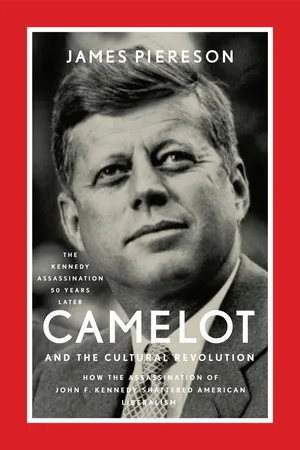
eBook - ePub
Camelot and the Cultural Revolution
How the Assassination of John F. Kennedy Shattered American Liberalism
- 296 pages
- English
- ePUB (mobile friendly)
- Available on iOS & Android
eBook - ePub
Camelot and the Cultural Revolution
How the Assassination of John F. Kennedy Shattered American Liberalism
About this book
Information
NOTES
INTRODUCTION
1 Robert Dallek, An Unfinished Life: John F. Kennedy, 1917–1963 (New York: Little, Brown & Co., 2003). See also Barbara Leaming, Jack Kennedy: The Education of a Statesman (New York: W. W. Norton & Co., 2006); Michael O’Brien, John F. Kennedy: A Biography (New York: Thomas Dunne Books, 2005); Seymour M. Hersh, The Dark Side of Camelot (New York: Little, Brown & Co., 1997); Geoffrey Perret, Jack: A Life Like No Other (New York: Random House, 2001); Thomas C. Reeves, A Question of Character: A Life of John F. Kennedy (New York: Macmillan, 1991); and John Hellmann, The Kennedy Obsession: The American Myth of JFK (New York: Columbia University Press, 1997).
2 On Jacqueline Kennedy Onassis, see, for example, Sarah Bradford, America’s Queen: The Life of Jacqueline Kennedy Onassis (New York: Penguin Books, 2000); C. David Heymann, A Woman Named Jackie (New York: Birch Lane Press, 1995); Christopher Andersen, Jackie after Jack: Portrait of the Lady (New York: William Morrow, 1998); Edward Klein, Just Jackie: Her Private Years (New York: Ballantine Books, 1998); John H. Davis, Jacqueline Bouvier: An Intimate Memoir (New York: John Wiley & Sons, 1996).
3 An ABC News poll in 2003 found that 22 percent of respondents believed that Oswald acted alone, while 70 percent said that a wider conspiracy was responsible. A Gallup Poll taken the same year placed the proportion believing in a conspiracy at 76 percent.
4 On Oswald’s anti-American outlook, see Norman Mailer, Oswald’s Tale (New York: Random House, 1997); and Jean Davison, Oswald’s Game (New York: W. W. Norton & Co., 1983), pp. 29–40, esp. pp. 38–39.
5 Arthur Schlesinger Jr., A Thousand Days (Boston: Houghton Mifflin, 1965); and Theodore C. Sorensen, Kennedy (New York: Bantam Books, 1966). Other works of this genre include Paul B. Fay, The Pleasure of His Company (New York: Harper & Row, 1966); and Pierre Salinger, With Kennedy (New York: Doubleday, 1966).
6 Schlesinger, A Thousand Days, p. 1031.
7 Merrill D. Peterson, Lincoln in American Memory (New York: Oxford University Press, 1994), p. 35.
dp n="251" folio="216" ?ONE: LIBERALISM
1 Richard Hofstadter, The Age of Reform (New York: Vintage Books, 1955), p. 14.
2 Summaries of the Progressive point of view (especially the twin emphases on democracy and expertise) may be gleaned from several works of the period, especially: Walter Weyl, The New Democracy (New York; Macmillan, 1912).; Herbert Croly, The Promise of American Life (1909; New York: Capricorn Books, 1964); Walter Lippmann, Drift and Mastery (1913; Madison: University of Wisconsin Press, 1986).
3 Hofstadter, The Age of Reform, p. 18.
4 On the differences between Progressive and New Deal reform, see Hofstadter, The Age of Reform, ch. 7; and Arthur Schlesinger Jr., The Vital Center (Boston: Houghton Mifflin, 1948), ch. 8.
5 For an insightful critique of postwar liberalism, see Christopher Lasch, The New Radicalism in America, 1889–1963 (New York: W. W. Norton & Co., 1965), ch. 9.
6 Schlesinger, The Vital Center, p. 182.
7 Ibid., ch. 6 .
8 Sen. Joseph McCarthy, “Enemies from Within,” speech at Wheeling, West Virginia, February 9 , 1950; reproduced at http://historymatters.gmu.edu/d/6456/.
9 Quotation from Daniel Bell, “Interpretations of American Politics, 1955,” in The Radical Right, ed. Bell (New York: Doubleday & Co., 1963), p. 58.
10 Quoted in Clinton Rossiter, Conservatism in America: The Thankless Persuasion (New York: Vintage Books, 1962), p. 93.
11 Louis Hartz, The Liberal Tradition in America (New York: Harcourt, Brace & World, 1955).
12 On these points, see ibid., ch. 11.
13 Daniel Bell, ed., The Radical Right (New York: Doubleday & Co., 1963). This volume was an expanded and updated version of The New American Right (Criterion Books, 1955).
14 Richard Hofstadter, “The Pseudo-Conservative Revolt,” 1955, in The Radical Right, ed. Bell, p. 76. Hofstadter’s harsh treatment of American conservatism suggests why Clinton Rossiter subtitled his book on this subject (cited above), “The Thankless Persuasion.”
15 Hofstadter, “The Pseudo-Conservative Revolt,” p. 85.
16 Ibid., p. 83.
dp n="252" folio="217" ?17 Daniel Bell, “The Dispossessed,” in The Radical Right, ed. Bell, pp. 3–8.
18 On the subject of status and its link to radicalism, see Bell, “The Dispossessed”; and Hofstadter, “The Pseudo-Conservative Revolt.”
19 Bell, “The Dispossessed,” p.10.
20 Richard Hofstadter, “The Paranoid Style in American Politics,” in The Paranoid Style in American Politics and Other Essays (Cambridge, Mass.: Harvard University Press, 1965). The article originally appeared in Harper’s, October 1964, based on a lecture delivered at Oxford University in November 1963. For a more general discussion of Hofstadter’s thought, see David S. Brown, Richard Hofstadter: An Intellectual Biography (Chicago: University of Chicago Press, 2006).
21 See Hofstadter, The Paranoid Style in American Politics, p. 37.
22 On Goldwater and the Republicans, see Hofstadter, “The Paranoid Style in American Politics,” p. 3.
23 Richard Hofstadter, Anti-Intellectualism in American Life (New York: Random House, 1964).
24 Daniel Bell, The End of Ideology: On the Exhaustion of Political Ideas in the 1950s (New York: The Free Press, 1962), pp. 402–3. Bell’s argument drew heavily from an earlier suggestive essay by Edward Shils, “The End of Ideology,” Encounter, November 1955, pp. 52–58. The theme is also taken up in Seymour Martin Lipset, Political Man (Garden City, N.Y.: Anchor Books, 1963), ch. 13, “The End of Ideology?”
25 Herbert Butterfield, The Whig Interpretation of History (London, 1931; New York: W. W. Norton & Co., 1965). See also George Orwell, “Looking Back on the Spanish War,” in The Collected Essays, Journalism, and Letters of George Orwell, Vol. 2, My Country Right or Left, 1940–43, ed. Sonia Orwell and Ian Angus (Boston: David R. Godine, 2004), p. 259.
26 Richard Hofstadter, The Progressive Historians: Turner, Beard, Parrington (1968; New York: Vintage Books, 1970), pp. 42–43.
27 Arthur Schlesinger Jr., The Age of Jackson (Boston: Little Brown, 1945). For a critique of Schlesinger’s interpretation of Jackson, see Lee Benson, The Concept of Jacksonian Democracy (Princeton, N.J.: Princeton University Press, 1961).
28 Hofstadter, The Progressive Historians (first published by Random House, 1968).
29 See Peter Viereck, “The Revolt against the Elite,” in The Radical Right, ed. Bell, p. 169.
30 See Lasch, The New Radicalism in America.
dp n="253" folio="218" ?31 Ibid., p. 90.
32 Lionel Trilling, The Liberal Imagination (New York: Anchor Books, 1950). Quotations cited are from the Preface, pp. xi–xii. On Trilling see also Gertrude Himmelfarb, The Moral Imagination: From Edmund Burke to Lionel Trilling (Chicago: Ivan R. Dee, 2006), pp. 219–29.
33 Trilling, The Liberal Imagination, p. xii.
TWO: KENNEDY
1 Kennedy’s approval rating was at 58 percent according to a Gallup Poll taken November 8–10, 1963.
2 Victor Lasky, J.F.K.: The Man and the Myth (New York: Macmillan, 1963). Lasky’s was the first comprehensive and critical study of Kennedy’s career. His book laid the foundation for subsequent Kennedy biographies. Kennedy was killed before he and his aides could mount a counter-campaign against the book. After the assassination, Lasky’s publisher withdrew the book from circulation. However, subsequent biographies by members of Kennedy’s inner circle, particularly Schlesinger’s A Thousand Days, can be read as official answers to th...
Table of contents
- Praise
- Title Page
- Foreword
- FOREWORD TO THE PAPERBACK EDITION
- Introduction
- ONE · LIBERALISM
- TWO · KENNEDY
- THREE · MARTYR: LINCOLN
- FOUR · MARTYR: KENNEDY
- FIVE · CONSPIRACY
- SIX · ASSASSIN
- SEVEN · CAMELOT
- EIGHT · THE OLD LIBERALISM AND THE NEW
- Acknowledgments
- NOTES
- BIBLIOGRAPHY
- INDEX
- Copyright Page
Trusted by 375,005 students
Access to over 1.5 million titles for a fair monthly price.
Study more efficiently using our study tools.
Frequently asked questions
Yes, you can cancel anytime from the Subscription tab in your account settings on the Perlego website. Your subscription will stay active until the end of your current billing period. Learn how to cancel your subscription
No, books cannot be downloaded as external files, such as PDFs, for use outside of Perlego. However, you can download books within the Perlego app for offline reading on mobile or tablet. Learn how to download books offline
Perlego offers two plans: Essential and Complete
- Essential is ideal for learners and professionals who enjoy exploring a wide range of subjects. Access the Essential Library with 800,000+ trusted titles and best-sellers across business, personal growth, and the humanities. Includes unlimited reading time and Standard Read Aloud voice.
- Complete: Perfect for advanced learners and researchers needing full, unrestricted access. Unlock 1.5M+ books across hundreds of subjects, including academic and specialized titles. The Complete Plan also includes advanced features like Premium Read Aloud and Research Assistant.
We are an online textbook subscription service, where you can get access to an entire online library for less than the price of a single book per month. With over 1.5 million books across 990+ topics, we’ve got you covered! Learn about our mission
Look out for the read-aloud symbol on your next book to see if you can listen to it. The read-aloud tool reads text aloud for you, highlighting the text as it is being read. You can pause it, speed it up and slow it down. Learn more about Read Aloud
Yes! You can use the Perlego app on both iOS and Android devices to read anytime, anywhere — even offline. Perfect for commutes or when you’re on the go.
Please note we cannot support devices running on iOS 13 and Android 7 or earlier. Learn more about using the app
Please note we cannot support devices running on iOS 13 and Android 7 or earlier. Learn more about using the app
Yes, you can access Camelot and the Cultural Revolution by James Piereson in PDF and/or ePUB format, as well as other popular books in Politics & International Relations & Political History & Theory. We have over 1.5 million books available in our catalogue for you to explore.