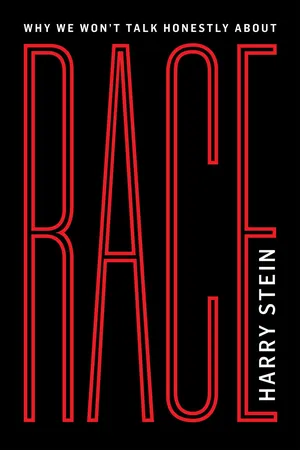
In the Age of Obama, the ugly charge of racism is more prevalent than ever. Why? Because telling the truth about racial profiling, crime, the social fallout of single parent homes, and the ways racial preferences distort the very meaning of equity and justice would mean facing up to the soul-destroying pathologies of urban black culture. Instead, black leaders and their guilty white allies focus tirelessly on historic oppression and the supposed need for more government aid, and demonize those who challenge their shopworn views as—what else?—racist.In Why We Won't Talk Honestly About Race (formerly No Matter What... They'll Call This Book Racist ), Harry Stein attacks the rigid prohibitions that have long governed the conversation about race, not to offend or shock (though they certainly will) but to provoke the serious thinking that liberal enforcers have until now rendered impossible. Stein examines the ways in which the regime of racial preferences has sown division, corruption, and resentment in this country. He pays special attention to the stifling falsehood that it is racism that continues to mire millions of underclass blacks in physical and spiritual poverty. By far the greater problem, says Stein, is the culture of destructive attitudes and behaviors that denies those in its grip the means of escape.For all the remarkable progress this country has made on race in the past half century, liberals insist, for their own political and psychological purposes, on clinging to the notion of America as irredeemably racist. All of us—and especially black people—for too long have been living with the terrible consequences of that cruel canard.
- 240 pages
- English
- ePUB (mobile friendly)
- Available on iOS & Android
eBook - ePub
Why We Won't Talk Honestly About Race
About this book
Information
LET’S PRETEND NO. 1
AFFIRMATIVE ACTION IS REASONABLE, NOT RACIST
Affirmative action is a nightmare.
Indeed, racial preferences—the less weaselly term for the thing—might as well have been designed to mock everything that America stands for in principle. From the 18th-century aphorisms of Ben Franklin to the moral lessons of Horatio Alger a hundred years later, to the sorts of advice offered by business best sellers and iconic sports coaches today, Americans have always embraced the notion that our country is an aristocracy of merit, a place where, regardless of background or social standing, anything is possible if one has the talent and works hard enough. And even to the extent we sometimes fall short of this animating ideal, it is one we cling to, and seek to pass on to our kids. For the more than two and a quarter centuries of our existence as a nation, it is this uniquely American sense of possibility that has impelled people from all parts of the world to leave behind their old lives and come here; if not for their own sake, for their children’s.
dp n="89" folio="66" ?I think back on my Uncle Sol. He was four years old in the first decade of the 20th century when he arrived with my grandparents on these shores from what is now Poland. A dozen years later, through dogged effort, he succeeded in winning a full scholarship to New York University and went on to graduate first in his class with a degree in chemical engineering. But this was the mid-1920s, and at the time major chemical companies, like DuPont, were not hiring Jews; in two years of trying, Sol failed to land a job in his chosen field. So he returned to school and became a pharmacist instead. Yet odd as it may strike the modern sensibility, he was never bitter. For all his loathing of discrimination, he never stopped believing in America and its promise, and lived long enough to see the inequities he most detested—the quotas that barred so many Jews from certain industries and elite universities—disappear.
As it happens, Sol died shortly before affirmative action became standard practice in American higher education and the business world, which is fortunate. For the notion that today people like him would again be discriminated against—only this time for being white and male—might have killed him all over again.
Of course, that is not how most black people (and to a lesser extent, Hispanics) see it. According to a typical poll, released by Quinnipiac in 2009, when asked “Do you think affirmative action programs that give preferences to blacks and other minorities in hiring, promotions and college admissions should be continued, or do you think these affirmative action programs should be abolished?” whites favored “abolished” 64–27, while blacks favored “continued” by a staggering 78–14.
Given that so many blacks buy into the notion that, even today, it is primarily racism that is keeping them down, this is understandable. After all, if things really were so stacked against them, there would be no possible way for them to succeed in meaningful numbers in today’s America without the benefit of what in any other universe would be regarded as an unfair advantage. And if such a remedy means that blameless others get screwed in the process, so be it.
Or, wait, maybe that’s just a mean-spirited, conservative characterization of an enlightened system that seeks only to put everyone on an equal footing. Having found myself in innumerable heated exchanges over the years with affirmative action proponents, most of them white liberals, I have no doubt most truly believe racial preferences are about fairness. And justice. And, indeed, far from turning our backs on what we profess to believe, living up to it.
Then, again, more than once, after the affirmative action supporter’s gotten a few drinks in him, I’ve also heard about score settling. Sure, preferences are discriminatory, one liberal family member acknowledged at a family gathering a few years back, but so what! Black people suffered for centuries, while we whites reaped every imaginable benefit. So—this is verbatim—“Tough, now it’s their turn.”
In jousting with such people, I like to bring up their own children, and wonder how they’d feel if it were they losing out on a place at college or a good job to a less qualified minority. Alas, in the case of this woman, the question actually elicited a new burst of self-satisfaction. “Something like that probably did happen when my son got turned down at Yale,” she said. “I told him that it was a necessary sacrifice—and he understood.” What’s worse, I’m not even sure she was lying.
However such conversations with white liberals begin, and no matter where they go, somewhere along the way they always end up touching on the “legacy of slavery,” and the ways “the old boys network” has long privileged whites, and how while things may be getting better, “we’re not there yet.”
dp n="91" folio="68" ?This has been the line for quite a while now. Affirmative action got seriously going under President Lyndon B. Johnson, and we can argue forever about how necessary it was even then; certainly, a far more compelling case could have been made. But what’s beyond question is that the returns have been diminishing for a long time now, and that at this point the vast preferences machine endlessly churns into the American mainstream a toxic mix of bitterness and misunderstanding between the races.
I was exposed to an extended dose of it back in the spring of 2008, when my wife and I spent some time in St. Louis gathering signatures for a proposed initiative aimed at getting an anti-affirmative action measure on the Missouri state ballot. We soon figured out that among the most likely places to find eager signers was in the parking lots outside Lowes or Home Depot superstores. We’d get there early, around 7:30 a.m., because that’s when contractors would begin showing up in their pickups or vans. My come-on was brief and to the point—“Sign my petition to end affirmative action?”—and it was generally greeted with some version of either: a resigned “That’ll never happen, not in this lifetime”; or an eager “How many times can I sign?” Often, those replies came with harangues about the government and its misbegotten policies—a particular sore spot was the “minority set aside” that left them ineligible for work on a new stadium being built across the state in Kansas City—and sometimes, too, there were stories. Several guys told me they’d had to hire blacks to front their businesses, so as to nab contracts for which they’d otherwise not have been considered; one had made the elderly black woman who cared for his mother “president” of his firm. Another guy reported he had a black friend who’d managed to get himself named to the boards of several construction firms, each of which paid him a stipend for doing nothing at all.
dp n="92" folio="69" ?Almost to a man, and they were all men, the early arrivals were white. We rarely saw a black guy until after nine, which is usually just before an officious employee would emerge from the store and inform us there’d been a complaint and we’d better depart the property or they’d have to call the cops. The same thing happened at one of my other most productive signature gathering spots, outside a White Castle during lunch hour. Clipboard in hand, I simply stood by the drive leading to the take-out window and made my pitch to drivers as they pulled alongside. In 10 minutes I got more than 30 signatures by this method, before a car pulled up with a black woman behind the wheel. “Sign my petition to end affirmative action?” I asked, smiling.
“No!” she coldly shot back, the voice of doom. I managed to get only a couple of more signatures before she reached the window.
Truth be told, I generally avoided asking black people to sign, even when doing so wouldn’t have meant instant eviction. There was simply no percentage in it, either practically or emotionally. The chances of bagging a signature were slight, and those of being regarded with loathing were pretty high. Had I been interested in getting into arguments about how I was not a racist, there were less uncomfortable people to have it with, starting with the smug NPR types we were continually running across.
But once in a while such a request was unavoidable—and in every such case, I got my signature, which made these episodes especially instructive. For each time I asked a black person to sign my petition, it was when he was among white people, so seemingly feeling pressure not to be the odd man out. These moments were usually a matter of happenstance. One day, for instance, I went into a place in a strip mall that produced and sold trophies and made my pitch to the guy behind the counter. He was so delighted at the prospect of seeing such a measure on the ballot that after signing, he led me out back, where the things were manufactured, so I could gather more. There were eight or 10 guys working the molds and presses, and one by one he took me to their work stations. All signed enthusiastically, one even requesting blank petitions so he could pass them around to friends. The black guy, middle aged with heavy horn-rimmed glasses, was at one of the louder machines, which he turned off; and after a long moment, he gave me his signature, but wordlessly and clearly without enthusiasm. Even as I thanked him, I felt a sharp twinge of sympathy for the guy, not just because I’d put him in this position, but because for him there so obviously was no right answer. Clearly a key part of the tight-knit trophy factory family, definitely not a beneficiary of racial preferences himself, perhaps even in general agreement with his co-workers on the issue, he nonetheless left me keenly feeling that his signature constituted for him an act of betrayal.
In this sense, and there are others, this corrosive, misbegotten system is also a terrible deal for black people. The look on the face of that guy in the trophy place bespoke an anguish every bit as real as that of the white guys getting screwed out of work because of the color of their skin. They know full well how affirmative action affects the ways they are viewed by their fellow citizens; and, too, inevitably, conveying as it does the unmistakable message that they’re so fundamentally handicapped they can’t make it on their own, in innumerable cases it distorts how they see themselves.
Excellence is always a matter of pride and self-belief, the very qualities racial preferences undermine by definition. If there is no need to out-hustle one’s competitors, and no expectation that one will, why even try? Perpetually focused on past inequities rather than future possibilities, the victim mindset epitomized by affirmative action not only saps energy and initiative, it justifies the absence of energy and initiative.
Not, to be sure, that very many of the minority contractors I encountered on the receiving end of the racial spoils system would willingly surrender the tremendous edge over white competitors handed them by their government. Versed in the rhetoric of victimization, encouraged in that attitude by guilty whites, “civil rights activists,” and a popular culture that dwells endlessly on the bad old days, many feel legitimately entitled. Besides, as Democrats know—and count on every election season—no one likes his particular something-for-nothing taken away.
Yet no matter how readily they may justify that advantage based on their forebears’ tragic history or even slights they’ve suffered personally, most surely grasp on some level that they’re gaming the system. Nor does it take a doctorate in human behavioral science to know that such an assumption becomes internalized and self-fulfilling.
When I was discussing affirmative action not long ago with a liberal acquaintance, he brought up baseball, asserting “a black player has to be twice as good as a white guy to get the same job.” This is one of those liberal truisms that was once inarguably true—and never more so than in the case of Jackie Robinson, which is part of what made his performance and that of the other black baseball pioneers so heroic. But it is simply no longer so, as a quick review of current major league rosters will show; not even in the case of marginal “bench” players, once useful as the centerpiece of such a claim. To the contrary, it is far more accurate to observe that in many realms of American life today (if not in sports), the black guy need be only half as good.
In fact, the elaborate system of pretense and outright falsehood at the heart of racial preferences must inevitably lead to inefficiency and corruption. As Heather Mac Donald points out in a piece on preferences in the construction industry, aptly titled “The Set-Aside Boondoggle,” the rarely acknowledged reality is that “the real problem underlying minority under representation in the construction business” is not bias, but “inadequate skills.” Indeed, she adds, “Government set-aside programs actually require inefficiency in infrastructure projects by demanding that the least competitive contractors be hired to work on them.” Among her other deeply politically incorrect but on-target observations: Such programs “virtually force companies into deception, since there are not enough competent minority-owned companies to fill the quotas”; and “when ‘disadvantaged’ companies do actually participate on a project, rather than just acting as fronts, their suboptimal skills can require the hiring of additional workers to oversee or redo the quota employees’ contribution.”
The “suboptimal skills” of minorities of course bears perhaps even more directly on the controversy over affirmative action in college admissions. By now almost every junior and senior in every high school with a large college-bound student population is keenly aware of the advantages conferred upon those with the right skin pigmentation, or, for that matter, a lucky family history. In my kids’ school, the father of one upper-middle-class fellow student happened to have been born and lived several years in Argentina, a stop in the family’s postwar journey between Europe and America, which, never mind that he didn’t speak a word of Spanish, enabled college admissions bean counters to slot him into the Hispanic category. Since he was a decent student, the kid was courted by several of the Ivies, while friends with comparable GPAs held zero interest for those same schools. Then there was the day my son and his friends were anxiously discussing their college prospects over lunch, when the black kid in the group nonchalantly observed, “Oh, I’ll get in everywhere, because I’m black.” And, of course, he was right.
“The new options have forced colleges to confront thorny questions, including how to account for various racial mixes in seeking diversity,” reported the New York Times, in an approving June 2011 front-page piece on applicants of mixed race. “Is a student applying as black and Latino more desirable in terms of diversity than someone who is white and black? Or white and Vietnamese? Should the ethnicities of one’s distant relatives be considered fair game, or just parents? And what should be done about students who skip the race question altogether—a sizable number of whom, some studies have shown, are white, and do so either in protest or out of fear that identifying as merely white could hurt rather than help their chances in this new environment?”
The Times piece prompted my friend Roger Kimball, terming affirmative action “that great jewel of Orwellian Newspeak,” to speculate in print that perhaps when it comes time for his white, middle-class son to apply to college, “he can argue, with all the authority of the latest PoMo theorists, that since race, like sex and nationality, is just a social construction, he is really a female black Indian from Nigeria? Maybe it’s worth a try.”
Kimball’s piece elicited many spirited online responses, but one was especially winning. “When I was in high school, one of the most amazing things happened,” wrote the reader, identifying himself as Zombie, and it is worth reproducing in full. “Our school had a Black Student Club which, as you might imagine, was populated entirely by black students. (Not all the black students, obviously—my school was 40 percent black at the time—the club was mostly joined by those black students who wanted to get into good colleges and beef up their resumes.) Well, word went around one day early in 12th grade that there was some sort of scholarship being made available for members of the Black Student Club who had above a certain grade point average. Sounded like a sweet deal.
“So, two smart-aleck white boys—not brainiacs, not jocks, not racists, just two sarcastic class clowns who thought it would be funny to see if they could get some of that scholarship cash—went down to the sign-up meeting for the Black Students Club and tried to join.
“Well, you can imagine the fracas that broke out. The teacher who sponsored the club (a black social studies teacher who wore a dashiki and an Africa-shaped pendant) told the boys they couldn’t join and tried to kick them out of the room. The smart-alecks were not intimidated—they asked ‘Why can’t we join?’ And the response was emphatic: ‘Because you’re not black!’
“And then the boys did something amazing. They said, ‘Yes, we are!’ The teacher thundered, ‘No, you’re not!’ And so the boys threw down the gauntlet: ‘PROVE IT! Prove we’re not black! Otherwise, you have to let us in.’
“Wow! Suddenly, the school was in a hell of a pickle. In order to keep the white-looking boys out of the club, the district would have to conduct some sort of racial purity trial to prove, legally, that the boys did not possess sufficient amounts of the desirable African-American blood. It would have been something straight out of the Nazi era or the Jim Crow south. A trial to prove someone was of a certain race so that they could be discriminated against!
“After several tense days, the school district decided that this was a lose-lose scenario for them, and that a trial would have been a public relations disaster of epic proportions. So they ordered the black teacher-sponsor to admit the white students to the Black Students Club.
dp n="98" folio="75" ?“The teacher was outraged, but had no choice. He let them in. The two boys then became sort of playground heroes for smashing the race-based policies of the asshole adults.
“But the story has a not-so-happy ending. Shortly thereafter, the Black Students Club met en masse and voted to disband the club entirely, for the specific reason of not letting the white boys remain as members. And then later, when the hubbub died down, they formed a ‘new’ club called the African-American Students Club, with all the same members—except the two white boys.
“This time, they didn’t bother repeating their stunt. Their point had been made.
“I think that if this concept was repeated across the country, all race-based policies would crumble.”
Would that it were so.
In fact, part of the rarely mentioned collateral damage of affirmative action is that it turns the idealistic young into hardened cynics.
For when it comes to race and college admissions, cynicism is not just the name of the game, but its very essence. It has been at least since 1978, when the Supreme Court’s Regents of the University of California v. Bakke decision introduced millions of unsuspecting Americans to the way racial preferences operate in our finest institutions of higher learning. Twice turned down for admission to the medical school at the University of California, Davis despite having better grades and test scores than most accepted minorities, Allan Ba...
Table of contents
- Praise
- Title Page
- Dedication
- Preface
- Introduction
- RACISM TODAY, RACISM TOMORROW, RACISM FOREVER
- MEDIA ENABLERS AND OTHER RACE MONGERS
- LET’S PRETEND NO. 1 - AFFIRMATIVE ACTION IS REASONABLE, NOT RACIST
- BOOKER T. WASHINGTON - THE NEGLECTED PROPHET
- IT’S NOT BRAINS, STUPID, IT’S CULTURE
- LET’S PRETEND NO. 2 - FATHERS DON’T MATTER
- LET’S PRETEND NO. 3 - CRIME HAS NOTHING TO DO WITH RACE
- LET’S PRETEND NO. 4 - MULTICULTURALISM MAKES FOR BETTER EDUCATION
- LET’S PRETEND NO. 5 - “ACTING WHITE” IS A PROBLEM (NOT THE SOLUTION)
- BLACK CONSERVATIVES - THE HEROES—AND HOPE—OF OUR TIME
- AFTERWORD
- Acknowledgments
- Copyright Page
Trusted by 375,005 students
Access to over 1.5 million titles for a fair monthly price.
Study more efficiently using our study tools.
Frequently asked questions
Yes, you can cancel anytime from the Subscription tab in your account settings on the Perlego website. Your subscription will stay active until the end of your current billing period. Learn how to cancel your subscription
No, books cannot be downloaded as external files, such as PDFs, for use outside of Perlego. However, you can download books within the Perlego app for offline reading on mobile or tablet. Learn how to download books offline
Perlego offers two plans: Essential and Complete
- Essential is ideal for learners and professionals who enjoy exploring a wide range of subjects. Access the Essential Library with 800,000+ trusted titles and best-sellers across business, personal growth, and the humanities. Includes unlimited reading time and Standard Read Aloud voice.
- Complete: Perfect for advanced learners and researchers needing full, unrestricted access. Unlock 1.5M+ books across hundreds of subjects, including academic and specialized titles. The Complete Plan also includes advanced features like Premium Read Aloud and Research Assistant.
We are an online textbook subscription service, where you can get access to an entire online library for less than the price of a single book per month. With over 1.5 million books across 990+ topics, we’ve got you covered! Learn about our mission
Look out for the read-aloud symbol on your next book to see if you can listen to it. The read-aloud tool reads text aloud for you, highlighting the text as it is being read. You can pause it, speed it up and slow it down. Learn more about Read Aloud
Yes! You can use the Perlego app on both iOS and Android devices to read anytime, anywhere — even offline. Perfect for commutes or when you’re on the go.
Please note we cannot support devices running on iOS 13 and Android 7 or earlier. Learn more about using the app
Please note we cannot support devices running on iOS 13 and Android 7 or earlier. Learn more about using the app
Yes, you can access Why We Won't Talk Honestly About Race by Harry Stein in PDF and/or ePUB format, as well as other popular books in History & North American History. We have over 1.5 million books available in our catalogue for you to explore.