In the wake of the clergy abuse scandal of the last decade, many media commentators predicted the “end” of the Catholic priesthood. Demands for an end to celibacy, coupled with calls for women’s ordination, dominated discussions on the effectiveness of the Catholic Church in America. Renewal argues that rather than a decline of the priesthood and a diminishing influence of the Catholic Church, we are living in a time of transformation and revitalization. The aging generation of progressives that continues to lobby Church leaders to change Catholic teachings on reproductive rights, same-sex marriage and women's ordination is being replaced by younger men and women who are attracted to the Church because of the very timelessness of its teachings.
eBook - ePub
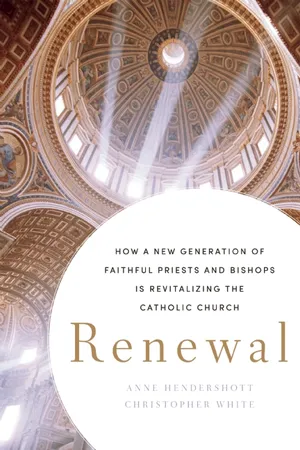
Renewal
How a New Generation of Faithful Priests and Bishops Is Revitalizing the Catholic Church
- 248 pages
- English
- ePUB (mobile friendly)
- Available on iOS & Android
eBook - ePub
Renewal
How a New Generation of Faithful Priests and Bishops Is Revitalizing the Catholic Church
About this book
Information
1
THE STRUGGLE FOR CATHOLIC IDENTITY
More than a decade ago, during a Mass for the members of the National Center for the Laity, Chicago’s Cardinal Francis George gave a homily that startled the faithful by pronouncing liberal Catholicism “an exhausted project . . . parasitical on a substance that no longer exists.” Declaring that Catholics are at a “turning point” in the life of the Church in this country, the cardinal concluded that liberal Catholicism had shown itself “unable to pass on the faith in its integrity and inadequate to foster the joyful self-surrender called for in Christian marriage, in consecrated life, in ordained priesthood.” Cardinal George concluded that liberal Catholicism “no longer gives life.”1
While shocking to some of the attendees, this was hardly a revelation to faithful Catholics. Orthodox Catholics have been complaining for more than forty years about what they saw as an attempted coup by progressive Catholics—wondering if their bishops had noticed, or worse, whether their bishops shared the sentiments of the liberals. But for the faithful listening to Cardinal George’s homily, there were only a few moments of silent celebration before he moved on to anger some of them when he said that the answers to the problems in the Church “are not to be found in a type of conservative Catholicism obsessed with particular practices and so sectarian in its outlook that it cannot serve as a sign of unity in all peoples in Christ.”2
For Cardinal George, neither radical liberal nor radical conservative Catholics can help the Church to flourish. He believes that neither side can do the work of evangelization that all Catholics must do. Rather, Cardinal George believes, the answer is “simply Catholic.” Simply Catholic embodies a faith that is able to distinguish itself from any cultures and able to engage and transform them all. It is a faith that is joyful in all the gifts Christ wants to give us and open to the world he died to save. Cardinal George believes that the Catholic faith shapes a Church with a lot of room for differences in pastoral approach, and for discussion and debate. Faithful Catholics believe that Christ cannot be adequately known except from within his Body, the Church. And, within the Church, the bishops are what Cardinal George calls the “reality check for the apostolic faith.” The bishops are not free to change established dogma or create new doctrines—no matter how much liberal Catholics may want them to—because the Catholic Church locates power in Christ and in his gift of authority to the Twelve. Catholics who are “simply Catholic” accept these teachings.
Similarly, in his recent work Evangelical Catholicism, Catholic commentator George Weigel argues for a new understanding of the role of the Church in the world today, which, as his title suggests, he labels an evangelical Catholicism. Rejecting the divides of progressive Catholics or traditional Catholics, Weigel advocates for a Church that is both known and understood as a mission, anchored in a deep and personal friendship with Jesus Christ. Only through an embrace of this type of Catholicism will Catholics assent to the truths and teachings—even the difficult ones—that Christ has established for his Church.3
Understanding this helps explain the reason for the struggle over Catholic identity, both internally and externally. Faithful Catholics want to preserve the unchangeable doctrines and dogma of the faith. Although they understand Cardinal George’s concerns about conservatives who “take refuge in earlier cultural forms of faith expression and absolutize them for all times and all places,” they recognize a much greater threat from the liberal or progressive Catholics who want the Church to change her infallible teachings on what faithful Catholics know are impossible to change. Denying the legitimate authority of the bishops as the successors of the apostles, progressive Catholics want a church whose priestly ministry is open to any of the baptized—including women and noncelibate men. They want the Church to deny that homosexual acts are morally wrong; a church that celebrates a woman’s right to choose abortion and artificial contraception; and a church that only views marriage as a secular union—not a sacrament that is meant to last for a lifetime.
We believe that Cardinal George was correct when he described the motivations and the behaviors of both sides of this struggle. As members of what we believe to be the side that is faithful to the nonnegotiable teachings of the Church on faith and morals, we are grateful that the cardinal was willing to speak these words out loud. Had we been at that Mass on that cold January day in 1998, we too would have celebrated the courage of the cardinal. However, we would go a step further. In the following pages, we argue that the reason the Catholic Church is as strong as she is today lies in her response to the warring factions within. For more than two centuries, the Church has battled enemies both within and outside her gates. We maintain that the battles have not just helped her to survive; we believe that she is at her best when she holds steadfast to the bold commitments that have sustained her throughout the years.
Certainly, we understand Cardinal George’s desire to end the battles, and we understand that most bishops would welcome a unified congregation in which all followers agreed on everything. But no institution—especially a cultural institution like the Catholic Church—can exist without conflict. The late sociologist Philip Rieff, author of Triumph of the Therapeutic and Sacred Order, Holy Order: My Life among the Deathworks, has written about this battle for identity. He has pronounced: “where there is culture, there is struggle . . . culture is the form of fighting before the firing actually begins.”4 For Rieff, culture is the continuation of war by other—normative—means. By its very nature, the work of culture is “the matter and manner of disarming competing cultures,” something that always threatens sacred order. Rieff also reminded us that no culture in history has sustained itself merely as a culture: cultures—including Catholic culture—are dependent on their predicative sacred orders and will break into mere residues whenever their predicates are broken. What Rieff calls “verticals in authority” are absolutely necessary.
This is not to say that the Church must be resistant to all change. Change is inevitable, and through conflict, there will always be change. Conflict is inherent to culture. The Church, like all institutions, is constantly being “re-created.” But this re-creation must be guided by the ultimate authority. It cannot be guided by the changing values of a given culture at a given time. The Church can never change the infallible teachings of the Magisterium, including the dignity of the human person, the sacredness of the family, and the institution of the priesthood. These are not just “values”—they are definitive teachings. For Rieff, “values give no stability—they fluctuate in the values market.”5 Yet progressive Catholics believe the Church should change as the culture changes. In contrast, orthodox Catholics believe that God—the ultimate authority—is active in our lives, and it is through trust and obedience, with the guidance of the bishops and priests as teaching authorities, that the people of God will flourish. Consider just one example of this: in 1968 when Pope Paul VI resisted the widespread cultural embrace of contraception—a trend in which Protestant churches radically altered their long-held positions—he predicted that in the long run, this embrace of contraception would be bad for society. In the encyclical Humanae Vitae, he noted that this would lead to four resulting trends: conjugal infidelity, a lowering of moral standards, a loss of respect for women on the part of men, and increased governmental coercion.6 Now, almost fifty years later, we are seeing just how prescient Pope Paul VI was. This is precisely the type of long-term wisdom that the Church has to offer—the ability to resist cultural fads and influences in favor of ultimate truth and human flourishing. Yet this role—and mission—of authority is one that is constantly under assault from the liberal wing of the Catholic Church.
We must acknowledge that all Catholics, both progressive and orthodox, like to think of themselves as good people—acting with compassion, and treating others fairly and with respect. But in some ways, this is where the battle lines are drawn. All Catholics want their Church to reflect the same standards or definitions of “goodness” that they hold for themselves. And for the past four decades, Catholics have been battling over opposing visions of what constitutes the good. As liberal or progressive Catholics believe that the only way to respect the dignity of all is to ordain women to the priesthood, traditional or orthodox Catholics maintain that women can never be called to the priesthood, as the priests are not simply leaders, they are a representative of Christ himself. While most progressive Catholics believe that the only way to show respect to gay and lesbian Catholics is to support committed sexual relationships by providing access to marriage, the other side maintains that although gay men and lesbian women should always be treated with dignity, the very essence of marriage is—and only can ever be—the permanent union between one man and one woman. And in the debates over abortion, most progressive Catholics maintain that they can still be good Catholics at the same time they respect a woman’s right to control her reproductive decisions. Pro-life Catholics maintain that sacrificing the life of an unborn child for a distorted definition of women’s equality is always wrong.
There are many issues that divide Catholics—and both sides in the Catholic culture wars claim that theirs is the side that truly respects the dignity of the individual. Orthodox Catholics assert that Revealed Truth is on their side. They point to scripture, as it comes to us through the Magisterium—the official teachings of the Church—as what we need to rely on when we are speaking of the sinfulness of abortion, the impossibility of women’s ordination, and the disordered nature of homosexual acts. Adopting the language of postmodernism, progressive Catholics deny the possibility of Truth—claiming that there are many truths—all based on the “lived” experiences of individual Catholics. For example, in The Idea of a Catholic University, George Dennis O’Brien, a progressive Catholic, claims that the hierarchical authority model used by the Vatican is “improper both to faith and academic freedom” and argues for a model that “respects different kinds of truth.”7 More recently, O’Brien published The Church and Abortion: A Catholic Dissent, which continues his assault on the Magisterium and argues that the Church should stay out of the debate on abortion.8 Claiming that “there is a level of irrationality in the unbending condemnation of abortion that has created a silence in the Church akin to the silence of a dysfunctional family,” O’Brien is critical of the “absolutism of Catholic anti-abortion” and says he is “disturbed by the harshness of anti-abortion rhetoric and the tendency of abortion to become the single issue for Catholics in the public square.”9
Progressives like O’Brien believe that the only way we can truly respect the dignity of the individual is to “look to the subject,” or look to the experiences of individual Catholics. They privilege the experiences of gay men or lesbian women who want the Church to recognize their loving relationships through marriage; women who are desperate to end an unwanted pregnancy; and women and noncelibate men who claim that God himself has called them to the priesthood. They negate the sacred teaching authority of the bishops and instead propose to build a Church in which there is no truth and no sacred order.
dp n="25" folio="16" ?Beyond the moral issues of abortion and homosexuality, some of the greatest internal struggles in the Catholic Church focus on the priesthood and the requirements for ordination. In his article on the need for orthodoxy, Archbishop Elden Curtiss wrote that he was “personally aware” of progressive Catholic vocation directors, vocation teams, and evaluation boards who have turned away orthodox candidates for the priesthood who do not support the possibility of ordaining women, who defend the church’s teachings about artificial birth control, or who exhibit a strong piety toward certain devotions, such as the Rosary. He also suggested that the priesthood has been damaged by those who do not support faithful priestly candidates who are loyal to the magisterial teaching of the pope and bishops. And he charges that these same people have discouraged excellent candidates from seeking priesthood and vowed religious life as the Church defines these ministries.10 Then, once they have discouraged such candidates, those progressives who precipitated the decline in vocations by their negative actions or their writings called for the ordination of married men and women to replace the vocations they have discouraged.
The shortage of priests is actually celebrated by many Catholic progressives and is especially attractive to people like the aforementioned Gary Wills and the late Richard Schoenherr, a former priest and coauthor of Full Pews, Empty Altars, who advised the bishops that there was nothing they could do to address the decline in priests—except ordain women and married priests.11 And more than two decades ago, former Jesuit priest Bernard Cooke predicted that “liturgical starvation” would lead the Church to ordain women and married men.12 Claiming that although a liturgical leader may preside, “it is the community that celebrates the Eucharist,” Cooke told a gathering on the University of San Diego campus that “the existence of a socially privileged group (priests) within the Church is not meant to be.... I hope that in a relatively short time, the inappropriate division between clergy and laity will vanish.”13 Many progressives view the shortage of priests as an opportunity to demand structural changes in the Church—including the ordination of women and married men.
Unfortunately, the case for the structural changes that Wills, Lakeland, Cooke, and Schoenherr have been making has, at times, been aided by a number of priests and even bishops who seem to have become conscripts for the progressive side of debates over Catholic identity. Three decades ago, Albany’s Bishop Hubbard wrote to his priests that rather than clinging to “one’s own identity or vested interest” one needed to work to empower the laity in ministry. Appearing to refocus the role of the priest away from the primacy of his sacramental role, Bishop Hubbard wrote: “I envision your role to be initiators, coordinators and facilitators of ministries.”14 Bishop Hubbard’s admonishment to priests that they should not cling to their identity as priests was prescient. It is difficult today to avoid thinking that this has been a major problem in many dioceses as the line between the laity and the ordained became increasingly blurred—as some seem to have forgotten the divine origins of the priesthood. Hierarchical structures are problematic for progressives who believe that these authority structures infringe on the rights of the individual. In the past, some bishops appeared to have become swept up in the quest for social equality and egalitarianism that permeated even the priesthood and the United States Catholic Conference of Bishops (USCCB) in the past four decades.
But times have changed, as a new generation of priests and bishops have emerged. This new generation, appointed by Pope John Paul II and Pope Benedict XVI, is no longer willing to compromise with progressives on the infallible teachings of the Church. Progressive pundits have been calling these more orthodox bishops the “culture war bishops” because they are here for the fight—no longer willing to back down from battles over federal funding for abortion and threats to religious liberty. Courageous bishops like New York’s Cardinal Dolan, Chicago’s Cardinal George, Philadelphia’s Archbishop Chaput, Phoenix’s Bishop Olmsted, Newark’s Archbishop Meyers, and Baltimore’s Archbishop William Lori are no longer willing to allow State or Federal interference in Church matters as was recently attempted by the legislature in the state of Connecticut, and by the Health and Human Services attempt to mandate coverage for contraceptives—including abortifacients—by Catholic institutions.
All of this has angered the progressive side. Blogger John Gehring, a former employee of the USCCB, laments the renewed activism by the bishops. Working now at the George Soros–funded progressive advocacy organization, Faith in Public Life, Gehring longs for the days when “social justice” was the primary goal of the bishops’ directives. He quotes someone he calls a “widely respected, now retired Church official,” who served for several decades in his diocese’s social justice office, who complained:
I am concerned about the tone of the bishops. What is missing today is the conciliatory, collaborative, politically astute leadership of the bishops of the ’80s and ’90s. To compromise is considered weak by this crowd. The bishops have become captives of the corporate elites, the National Right to Life, and conservative lay organizations. They have access and influence that eclipse that of progressive Catholics.15
The retired diocesan official also bemoaned the fact that “the church’s social justice work is increasingly being drowned out by abortion politics, the fight against same-sex marriage and deep animus against the Democratic Party.”16 Many orthodox Catholics would counter that the USCCB, which has historically been staffed by progressives like John Gehring, has spent much of its institutional life since the 1960s as an adjunct of the Democratic Party—refusing to acknowledge the culture of death that has permeated the radically pro-choice political party.
Progressives like Gehring suggest that the bishops need to be more “conciliatory.” They suggest that we all should try to ignore our differences, resigning ourselves to their incompatibility. They say that the two sides just need to agree not to argue about our differences anymore. But, as any sociologist knows—and certainly, Philip Rieff knew well—there are strong institutional pressures within the Church that drive members to a kind of uniformity of culture. These institutional dynamics operate whether Catholics like them or not, and they shape the ways in which young Catholics are taught; they shape the ways in which seminarians are formed; and they shape the everyday experience of the Catholics in the pews. The “taken for granted” dynamics then become an invisible part of the culture. Until recently, it has seemed to most conservatives that liberal Catholicism was the default position at the national bishops’ conference. With their highly touted and most visible statements centering on nuclear disarmament, environmental sustainability, and community organizing, it was understandable when faithful Catholics were dismayed when Catholic politici...
Table of contents
- Title Page
- Acknowledgments
- Introduction
- 1 - THE STRUGGLE FOR CATHOLIC IDENTITY
- 2 - BUILDING BETTER SEMINARIES
- 3 - A PROBLEM WITH AUTHORITY
- 4 - BEST PRACTICES OF TRANSFORMATIONAL LEADERS
- 5 - NO CHARISMA WITHOUT CREED
- 6 - BLURRING THE BOUNDARIES
- 7 - THE CAMPUS CULTURE WARS
- 8 - FORGING ALLIANCES
- 9 - PRIESTS MATTER
- 10 - CATHOLIC RENEWAL: THE GOOD NEWS
- APPENDICES
- NOTES
- INDEX
- Copyright Page
Trusted by 375,005 students
Access to over 1.5 million titles for a fair monthly price.
Study more efficiently using our study tools.
Frequently asked questions
Yes, you can cancel anytime from the Subscription tab in your account settings on the Perlego website. Your subscription will stay active until the end of your current billing period. Learn how to cancel your subscription
No, books cannot be downloaded as external files, such as PDFs, for use outside of Perlego. However, you can download books within the Perlego app for offline reading on mobile or tablet. Learn how to download books offline
Perlego offers two plans: Essential and Complete
- Essential is ideal for learners and professionals who enjoy exploring a wide range of subjects. Access the Essential Library with 800,000+ trusted titles and best-sellers across business, personal growth, and the humanities. Includes unlimited reading time and Standard Read Aloud voice.
- Complete: Perfect for advanced learners and researchers needing full, unrestricted access. Unlock 1.5M+ books across hundreds of subjects, including academic and specialized titles. The Complete Plan also includes advanced features like Premium Read Aloud and Research Assistant.
We are an online textbook subscription service, where you can get access to an entire online library for less than the price of a single book per month. With over 1.5 million books across 990+ topics, we’ve got you covered! Learn about our mission
Look out for the read-aloud symbol on your next book to see if you can listen to it. The read-aloud tool reads text aloud for you, highlighting the text as it is being read. You can pause it, speed it up and slow it down. Learn more about Read Aloud
Yes! You can use the Perlego app on both iOS and Android devices to read anytime, anywhere — even offline. Perfect for commutes or when you’re on the go.
Please note we cannot support devices running on iOS 13 and Android 7 or earlier. Learn more about using the app
Please note we cannot support devices running on iOS 13 and Android 7 or earlier. Learn more about using the app
Yes, you can access Renewal by Anne Hendershott,Christopher White in PDF and/or ePUB format, as well as other popular books in Social Sciences & Christian Denominations. We have over 1.5 million books available in our catalogue for you to explore.