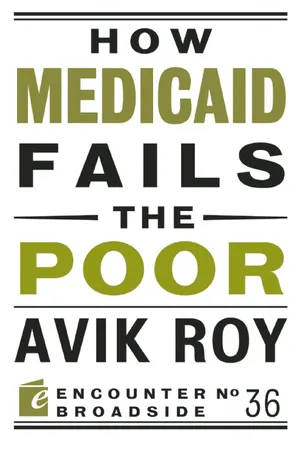
Medicaid, America’s government-run health insurance program for the poor, should be a lifeline that provides needed health care to Americans with no other options. Surprisingly, however, it doesn’t. The medical literature reveals a $450 billion-a-year scandal: that people on Medicaid have far worse health outcomes than those with private insurance, and no better outcomes than those with no insurance at all.Why is this so? In How Medicaid Fails the Poor, Avik Roy explains how Medicaid’s clumsy design and perverse incentives make it hard for people on Medicaid to get the medical care they need. Medicaid doesn’t reimburse doctors or hospitals for the cost of caring for Medicaid enrollees, forcing many doctors to opt out of the program.The Affordable Care Act, otherwise known as Obamacare, doubles down on this broken system. Roy shows us that there are better ways, using private insurance, to provide needed care to our poorest citizens.
- 48 pages
- English
- ePUB (mobile friendly)
- Available on iOS & Android
eBook - ePub
How Medicaid Fails the Poor
About this book
Information

ENCOUNTER BROADSIDES: Inaugurated in the fall of 2009, Encounter Broadsides are a series of timely pamphlets and e-books from Encounter Books. Uniting an 18th century sense of public urgency and rhetorical wit (think The Federalist Papers, Common Sense) with 21st century technology and channels of distribution, Encounter Broadsides offer indispensable ammunition for intelligent debate on the critical issues of our time. Written with passion by some of our most authoritative authors, Encounter Broadsides make the case for ordered liberty and the institutions of democratic capitalism at a time when they are under siege from the resurgence of collectivist sentiment. Read them in a sitting and come away knowing the best we can hope for and the worst we must fear.
Table of Contents
Cover
Encounter Series Page
Copyright
THE PLIGHT of American health care is best told through the eyes of a seventh-grader named Deamonte Driver.
Deamonte was born on the wrong side of the tracks, in Prince George’s County, Md. Prince George’s was founded in 1696 and was named for the Danish prince who married Queen Anne of Great Britain. In 1791, a chunk of the county was ceded to help create the District of Columbia.
Today, Prince George’s sits directly east of the nation’s capital. Aided by the decades-long expansion of federal spending, Prince George’s is now the wealthiest county in America in which the majority of the population is black. But Deamonte was not one of the wealthy ones. He was an African-American child on welfare. He was raised by a single mother. He spent his childhood in and out of homeless shelters. He died in 2007, at the age of 12.
Deamonte, however, did not die in a drive by shooting, or in a drug deal gone bad. He died of a toothache.
In September 2006, Deamonte started complaining to his mother, Alyce, that his teeth hurt. Alyce started calling around, looking for a dentist who would see him. But every dentist she called said no. Months later, after she had made several dozen phone calls, she found one.
The dentist she finally found told her that her son had six abscessed teeth, and he recommended that Deamonte see a surgeon to take them out. That took another round of phone calls. It took another several months for Alyce to find Deamonte an oral surgeon who was willing to take the job.
Within a week of the long-anticipated surgical appointment, Deamonte told his mother that his head ached. It turned out that the infection from one of his abscessed teeth had spread to his brain. Deamonte was taken to the hospital, where he underwent emergency brain surgery. He got better for a while but began to have seizures and was operated on again. Several weeks later, Deamonte was dead.
According to Ezra Klein of the Washington Post, Deamonte Driver’s story shows us why it would be immoral to repeal the Affordable Care Act, a.k.a. Obamacare, a law that strives to expand health insurance coverage to the uninsured. “To repeal the bill without another solution for the Deamonte Drivers of the world? And to do it while barely mentioning them? We’re a better country than that. Or so I like to think.”
There are many problems with Obamacare. But the law’s cruelest feature is what it will do to low-income Americans who are already struggling.
But Deamonte Driver did not die because he was uninsured. Indeed, Deamonte Driver died because he was insured – by the government. It turns out that Deamonte was on Medicaid.
* * *
Obamacare does not offer better health care to the Deamonte Drivers of the world. Under Obamacare, if Deamonte were still alive today, he would still be stuck with the same dysfunctional Medicaid coverage that he was stuck with before. Indeed, Medicaid is likely to get much worse. According to the Congressional Budget Office, Obamacare will shove 17 million more Americans into Medicaid, the developed world’s worst health care system.
There are many problems with Obamacare. But the law’s cruelest feature is what it will do to low-income Americans who are already struggling. Study after study shows that patients on Medicaid do no better, and often worse, than those with no insurance at all.
There is a way to provide high-quality health care to the poor, one that would spend substantially less than Medicaid while ensuring that low-income Americans are protected against costly medical bills. But to understand the solution, we must first understand what went wrong.
* *...
Table of contents
- Cover
- Encounter Series Page
- Copyright
Trusted by 375,005 students
Access to over 1.5 million titles for a fair monthly price.
Study more efficiently using our study tools.
Frequently asked questions
Yes, you can cancel anytime from the Subscription tab in your account settings on the Perlego website. Your subscription will stay active until the end of your current billing period. Learn how to cancel your subscription
No, books cannot be downloaded as external files, such as PDFs, for use outside of Perlego. However, you can download books within the Perlego app for offline reading on mobile or tablet. Learn how to download books offline
Perlego offers two plans: Essential and Complete
- Essential is ideal for learners and professionals who enjoy exploring a wide range of subjects. Access the Essential Library with 800,000+ trusted titles and best-sellers across business, personal growth, and the humanities. Includes unlimited reading time and Standard Read Aloud voice.
- Complete: Perfect for advanced learners and researchers needing full, unrestricted access. Unlock 1.5M+ books across hundreds of subjects, including academic and specialized titles. The Complete Plan also includes advanced features like Premium Read Aloud and Research Assistant.
We are an online textbook subscription service, where you can get access to an entire online library for less than the price of a single book per month. With over 1.5 million books across 990+ topics, we’ve got you covered! Learn about our mission
Look out for the read-aloud symbol on your next book to see if you can listen to it. The read-aloud tool reads text aloud for you, highlighting the text as it is being read. You can pause it, speed it up and slow it down. Learn more about Read Aloud
Yes! You can use the Perlego app on both iOS and Android devices to read anytime, anywhere — even offline. Perfect for commutes or when you’re on the go.
Please note we cannot support devices running on iOS 13 and Android 7 or earlier. Learn more about using the app
Please note we cannot support devices running on iOS 13 and Android 7 or earlier. Learn more about using the app
Yes, you can access How Medicaid Fails the Poor by Avik Roy in PDF and/or ePUB format, as well as other popular books in Business & Insurance. We have over 1.5 million books available in our catalogue for you to explore.