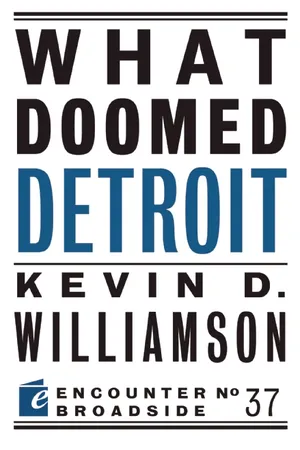
Many cities have struggled with the decline of key industries, from Philadelphia’s shipyards to New York’s textile industry, but Detroit—which is now in bankruptcy—is both a victim of the decline of the Michigan automobile industry and a cause of it. A city with a history of civil disorder—it is the only American city occupied on three separate occasions by federal troops—its poisonous blend of race-based politics and union domination has left it impoverished and diminished. Once the fourth-largest city in the country, it is today smaller than Fort Worth. Once the nation’s most prosperous city, it is today the poorest. Even in its reduced state, it is the largest U.S. city ever to file for bankruptcy—and yet its city payroll maintains twice as many government employees per resident as does San Jose. More terrifying is the fact that the imbalance between public-sector consumption and private-sector production that helped make Detroit what it is today is by no means limited to the Motor City—in fact, there are four large U.S. cities that are in arguably worse shape. Detroit is not just a case study, but a portent.
- 40 pages
- English
- ePUB (mobile friendly)
- Available on iOS & Android
eBook - ePub
What Doomed Detroit
About this book
Information

ENCOUNTER BROADSIDES: Inaugurated in the fall of 2009, Encounter Broadsides are a series of timely pamphlets and e-books from Encounter Books. Uniting an 18th century sense of public urgency and rhetorical wit (think The Federalist Papers, Common Sense) with 21st century technology and channels of distribution, Encounter Broadsides offer indispensable ammunition for intelligent debate on the critical issues of our time. Written with passion by some of our most authoritative authors, Encounter Broadsides make the case for ordered liberty and the institutions of democratic capitalism at a time when they are under siege from the resurgence of collectivist sentiment. Read them in a sitting and come away knowing the best we can hope for and the worst we must fear.
Table of Contents
Cover
Broadsides Series Page
Copyright
“Better to reign in Hell than serve in Heaven
JOHN MILTON, Paradise Lost
IN THE SPACE of a single generation, Detroit managed to ruin itself. Some of the factors that led to the immolation of Detroit are unique to the city and its politics, but some are not. As the nation watches the city descend into insolvency and chaos, the question is: Is Detroit an outlier, or is it just ahead of the curve?
The proximate cause of Detroit’s bankruptcy is its inability to make good on debts owed to the funds paying out pensions and health care benefits to current and retired city workers. Those obligations make up the great majority of Detroit’s $20 billion or so in outstanding debt. While the city’s population has been plummeting since the 1950s, its public sector has continued to grow relative to the size of its population. In 2011, it maintained nearly 13,000 city employees, or one municipal employee for every 55 residents, twice the number of larger cities such as Charlotte and Fort Worth. (That one may write “larger cities such as Charlotte and Fort Worth” speaks volumes about what has become of Detroit.) When staffing reductions have been proposed, both the unions and city officials resisted. When modest reductions were proposed in 2011, city Finance Director Tom Lijana protested, “You can’t do this in one year…. I’m going to be picking up your garbage once a month. I’m only going to turn on power to your house every once in a while. You just can’t do that.” Yet the city of Austin, hardly a Spartan outpost of small-government skinflintery, manages to provide what are generally conceded to be very good municipal services with far fewer city employees per resident than Detroit. San Jose does so with half the per capita municipal workforce that Detroit maintains.
Detroit is an extreme example of the fact that public-sector employment has become in effect a supplementary welfare state, with salaries and benefits – and, above all, pensions – entirely disconnected from legitimate municipal purposes. Unionized public-sector employees with a high degree of political discipline fortified by narrow financial self-interest become an unstoppable constituency, and the government becomes its own special-interest group. But while salaries more or less have to be paid out of current revenue and therefore impose at least a measure of pain on taxpayers, promised future benefits need not be backed by anything more than good intentions. While there were areas in which the city proceeded responsibly – as late as 2011, its police and firefighter pension fund was being adequately provided for – many future obligations were not funded at all, or funded to only a tiny degree of the liabilities accruing. A 2012 Kennedy School study found that Detroit had set aside less than half of what it would need to fund its pensions and was attempting to fund its health-insurance and life-insurance plans on a pay-as-you-go basis, resulting in unfunded liabilities amounting to a massive $5 billion.
Detroit is an extreme example of the fact that public-sector employment has become in effect a supplementary wel...
Table of contents
- Cover
- Broadsides Series Page
- Copyright
Trusted by 375,005 students
Access to over 1.5 million titles for a fair monthly price.
Study more efficiently using our study tools.
Frequently asked questions
Yes, you can cancel anytime from the Subscription tab in your account settings on the Perlego website. Your subscription will stay active until the end of your current billing period. Learn how to cancel your subscription
No, books cannot be downloaded as external files, such as PDFs, for use outside of Perlego. However, you can download books within the Perlego app for offline reading on mobile or tablet. Learn how to download books offline
Perlego offers two plans: Essential and Complete
- Essential is ideal for learners and professionals who enjoy exploring a wide range of subjects. Access the Essential Library with 800,000+ trusted titles and best-sellers across business, personal growth, and the humanities. Includes unlimited reading time and Standard Read Aloud voice.
- Complete: Perfect for advanced learners and researchers needing full, unrestricted access. Unlock 1.5M+ books across hundreds of subjects, including academic and specialized titles. The Complete Plan also includes advanced features like Premium Read Aloud and Research Assistant.
We are an online textbook subscription service, where you can get access to an entire online library for less than the price of a single book per month. With over 1.5 million books across 990+ topics, we’ve got you covered! Learn about our mission
Look out for the read-aloud symbol on your next book to see if you can listen to it. The read-aloud tool reads text aloud for you, highlighting the text as it is being read. You can pause it, speed it up and slow it down. Learn more about Read Aloud
Yes! You can use the Perlego app on both iOS and Android devices to read anytime, anywhere — even offline. Perfect for commutes or when you’re on the go.
Please note we cannot support devices running on iOS 13 and Android 7 or earlier. Learn more about using the app
Please note we cannot support devices running on iOS 13 and Android 7 or earlier. Learn more about using the app
Yes, you can access What Doomed Detroit by Kevin D. Williamson in PDF and/or ePUB format, as well as other popular books in Economics & Economic Policy. We have over 1.5 million books available in our catalogue for you to explore.