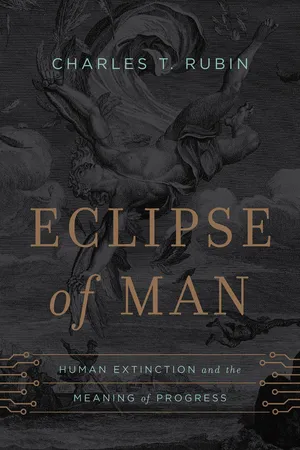
Tomorrow has never looked better. Breakthroughs in fields like genetic engineering and nanotechnology promise to give us unprecedented power to redesign our bodies and our world. Futurists and activists tell us that we are drawing ever closer to a day when we will be as smart as computers, will be able to link our minds telepathically, and will live for centuries—or maybe forever. The perfection of a "post-human” future awaits us.Or so the story goes. In reality, the rush toward a post-human destiny amounts to an ideology of human extinction, an ideology that sees little of value in humanity except the raw material for producing whatever might come next.In Eclipse of Man, Charles T. Rubin traces the intellectual origins of the movement to perfect and replace the human race. He shows how today’s advocates of radical enhancement are—like their forebears—deeply dissatisfied with given human nature and fixated on grand visions of a future shaped by technological progress.Moreover, Rubin argues that this myopic vision of the future is not confined to charlatans and cheerleaders promoting this or that technology: it also runs through much of modern science and contemporary progressivism. By exploring and criticizing the dreams of post humanity, Rubin defends a more modest vision of the future, one that takes seriously both the limitations and the inherent dignity of our given nature.
- 200 pages
- English
- ePUB (mobile friendly)
- Available on iOS & Android
eBook - ePub
About this book
Information
Topic
PhilosophieCHAPTER ONE

The Future in the Past
THE ASPIRATIONS of transhumanism are not entirely new because the human desires to change unsatisfactory aspects of our lives or to extend our powers are not new. Yet these deeper, perduring aspirations have gained a new force in the modern age, as the world has come increasingly to be defined by the ability of modern science and technology to change it significantly. It has become possible to think seriously about progress, about what it would mean if these achievements were increasingly to shape our lives, building one on another.
Progress does not inevitably have to point to the kind of future transhumanists envision. Science fiction authors, and others who think about the future in less overtly fictional ways, have had no trouble thinking about some pretty remarkable and very distant futures in which humanity persists in an eminently recognizable form. This does not represent a mere failure of imagination on the part of these futurists; in some ways, it arguably takes even more imagination to depict a future in which mankind has survived without becoming radically different.1
To understand why the transhumanists believe progress requires human extinction, we can study some of their intellectual forebears—authors who, while not all widely remembered today, were in their own time influential on the way people understood where science and technology might be taking us. We begin with one of the greatest of Enlightenment prophets of progress, Marie Jean Antoine Nicolas de Caritat, the French aristocrat known as the Marquis de Condorcet (1743–1794).
Condorcet was a mathematician and philosopher, an abolitionist and advocate of women’s equality and religious toleration, an admirer and biographer of Voltaire, an economic liberal, and a genial enthusiast—an embodiment, in short, of all things enlightened.2 A prominent public intellectual, he was “one of the few Enlightenment thinkers to witness the [French] Revolution and to participate fully in its constitutional aftermath. . . . He was, in short, an outstanding disciple of the Enlightenment, uniquely located at the center of great events.”3 A leader in the early days of the French Revolution, he was forced into hiding as the political winds shifted.4 Concealed in the house of one Madame Vernet in 1793–94, he wrote his most influential work, a little book called Outlines of an Historical View of the Progress of the Human Mind. He was eventually arrested and thrown in prison, where he died the day after his arrest, under circumstances that “have been the subject of much speculation ever since.”5 But his final great work was published the next year, and it became a landmark of Enlightenment thinking and would shape how generations understood the idea of progress.
In the book, Condorcet is convinced that the progress of reason has gone too far to allow any future lapse into barbarism, but he is still chagrined at how little progress has been made to increase human happiness. “The friend of humanity,” he writes, “cannot receive unmixed pleasure but by abandoning himself to the endearing hope of the future.”6 And what a future Condorcet expects it to be:
May it not be expected that the human race will be meliorated by new discoveries in the sciences and arts, and, as an unavoidable consequence, in the means of individual and general prosperity; by farther progress in the principles of conduct, and in moral practice; and lastly by the real improvement of our faculties, moral, intellectual and physical, which may be the result either of improvement of the instruments which increase the power and direct the exercise of these faculties, or of the improvement of our natural organization itself?7
How is this “improvement of our faculties” and “natural organization” to take place? Growing liberty, equality, and prosperity within nations and among nations, Condorcet writes, will raise the general level of instruction, and that in itself will improve human ability. More instruction will in turn produce more knowledge, and Condorcet expects that as we come to understand the world better and improve our ability to teach that understanding, what once might have required genius to uncover or comprehend can become a subject of general knowledge. The result is that we advance the starting point for yet further attainments in the arts and sciences, which in turn increases our powers of action—an upward spiral of enlightenment. As a result, better food, better sanitation, and better medicine will extend the human lifespan, as will “the destruction of the two most active causes of deterioration, penury and wretchedness on the one hand, and enormous wealth on the other.”8 Likewise, Condorcet foresees that “contagious disorders” will be brought under control, as well as occupational and environmental illness. The net result:
Would it even be absurd to suppose this quality of melioration in the human species as susceptible of an indefinite advancement; to suppose that a period must one day arrive when death will be nothing more than the effect of extraordinary accidents, or of the slow and gradual decay of the vital powers; and that the duration of the middle space, of the interval between the birth of man and this decay, will itself have no assignable limit? Certainly man will not become immortal; but may not the distance between the moment in which he draws his first breath, and the common term when, in the course of nature, without malady or accident, he finds it impossible any longer to exist, be necessarily protracted?9
Despite his denial of the possibility of immortality, Condorcet expects “that the mean duration of life will for ever increase.”10 It is one of the “laws of nature” that living things are subject to “perfectibility or deterioration.”11 The breeding of animals already shows that we could improve our own physical capacities and senses, but perhaps our “quality of melioration” suggests that a good deal more is possible for us by other means as well.12 Hence Condorcet wonders whether better-educated parents might not transmit the superior “organization” they have achieved directly to their children.13
Condorcet’s vision of the future, so familiar to those of us in the West who live it on a daily basis, is very much a reflection of the project laid out more than a century earlier by the English philosopher Francis Bacon for “the enlarging of the bounds of Human Empire, to the effecting of all things possible.”14 Condorcet sees how the increase of our power over nature will soften the hard edges of the human condition by improving the material conditions of life, which will allow at the same time an improvement in the moral conditions. He adds an intimation of accelerating progress; one generation can build on the work of another. A smarter and healthier generation sets the stage for even greater achievement by the next generation. He may have hedged on the question of immortality, but as we shall see, not everyone who came after him was so modest.
Condorcet’s thesis—that mankind would improve and expand, growing wiser and healthier and much longer-lived—soon received a powerful rebuttal. Thomas Robert Malthus (1766–1834) was a political economist whose Essay on the Principle of Population explicitly attacked Condorcet’s depiction of progress.15 Malthus believed that finite resources limit what human beings can ever hope to accomplish, and that because human reproduction always races ahead of available food, our future holds great misery and scarcity. Malthus’s ideas influenced many fields, including biology, where Charles Darwin (1809–1882) adapted them to help explain the workings of evolution, a kind of natural progress caused by competition for limited resources.16 Through to our own day, much of the debate about progress has arisen from tensions among these three men’s ideas: Condorcet’s optimism about human perfectibility, the Malthusian problem of resource scarcity, and the Darwinian conception of natural competition as a force for change over time. The transhumanists, as we shall see, reconcile and assimilate these ideas by advocating the end of humanity.
THE INVENTION OF IMMORTALITY
In 1872, the British author and adventurer William Winwood Reade (1838–1875) revisited the project of progress that Condorcet had laid out. Reade, born in Scotland, was a failure as a novelist but had modest success as an African explorer and war correspondent. He was in correspondence with Darwin, who is said to have used in The Descent of Man (1871) some information from Reade’s expedition to West Africa.17 While it seems like in his short life Reade never quite lived up to his own expectations for himself, his attempt at a universal history—an 1872 book called The Martyrdom of Man—was once highly regarded. W. E. B. Du Bois, Cecil Rhodes, H. G. Wells, and George Orwell all found reasons to praise it.18 Perhaps even the character Sherlock Holmes was a fan: in The Sign of the Four, Holmes says to Watson, “Let me recommend this book—one of the most remarkable ever penned. It is Winwood Reade’s Martyrdom of Man. I shall be back in an hour.”19 From its original publication to 1910 the book went through eighteen editions in England and seventeen in the United States; one can only imagine that many a Baker Street Irregular has felt compelled to track it down.
The Martyrdom of Man began, Reade says, as an effort to give the hitherto neglected story of “Inner Africa” its due place within European history.20 But in the writing, the book became very much more: an effort to place human history within a larger natural history that eventually takes Reade right back to the development of the solar system and the origins of life.21 He adopts his own version of a Darwinian perspective, along with the theories about a geologically dynamic Earth, which were still rather recent in his day. Reade’s naturalism is particularly deployed in extensive efforts to provide non-supernatural explanations for the rise of religions.
But there is one crucial aspect of his argument that distinguishes it from most similar presentations in our own day: Reade believes that nature is purposive—and indeed, that something like a cunning of nature is evident in human history.22 That is to say, human activities like war and religion, or conditions like inequality, serve developmental purposes within a natural scheme of things beyond what is intended by the human beings participating in those activities.23 “Thus when Nature selects a people to endow them with glory and with wealth her first proceeding is to massacre their bodies, her second, to debauch their minds. She begins with famine, pestilence, and war; next, force and rapacity above; chains and slavery below. She uses evil as the raw material of good; though her aim is always noble, her earliest means are base and cruel. But, as soon as a certain point is reached, she washes her black and bloody hands, and uses agents of a higher kind.”24
To put it another way, Reade believes that there is a natural imperative for higher abilities and capacities to grow out of lower ones: “The philosophic spirit of inquiry may be traced to brute curiosity, and that to the habit of examining all things in search of food. Artistic genius is an expansion of monkey imitativeness. Loyalty and piety, the reverential virtues, are developed from filial love. Benevolence and magnanimity, the generous virtues, from parental love. The sense of decorum proceeds from the sense of cleanliness; and that from the instinct of sexual display.”25 Reade’s claim that the higher derives from the lower does not just apply to human beings. It is a characteristic of life itself, indeed a characteristic of matter, which he regards as inseparable from mind.26
We ought not to think there is anything degrading about thus understanding the higher in light of the lower, Reade argues. Indeed, his reductionism opens the door to remarkable possibilities:
It is Nature’s method to take something which is in itself paltry, repulsive, and grotesque, and thence to construct a masterpiece by means of general and gradual laws; those laws themselves being often vile and cruel. This method is applied not only to single individuals, but also to the whole animated world; not only to physical but also to mental forms. And when it is fully realised and understood that the genius of man has been developed along a line of unbroken descent from the simple tendencies which inhabited the primeval cell, and that in its later stages this development has been assisted by the efforts of man...
Table of contents
- Cover
- Title Page
- Copyright
- Contents
- Dedication
- Introduction
- Chapter One: The Future in the Past
- Chapter Two: Discovering Inhumanity
- Chapter Three: Enabling Inhumanity
- Chapter Four: Perfecting Inhumanity
- Chapter Five: The Real Meaning of Progress
- Acknowledgments
- Notes
- Index
Trusted by 375,005 students
Access to over 1.5 million titles for a fair monthly price.
Study more efficiently using our study tools.
Frequently asked questions
Yes, you can cancel anytime from the Subscription tab in your account settings on the Perlego website. Your subscription will stay active until the end of your current billing period. Learn how to cancel your subscription
No, books cannot be downloaded as external files, such as PDFs, for use outside of Perlego. However, you can download books within the Perlego app for offline reading on mobile or tablet. Learn how to download books offline
Perlego offers two plans: Essential and Complete
- Essential is ideal for learners and professionals who enjoy exploring a wide range of subjects. Access the Essential Library with 800,000+ trusted titles and best-sellers across business, personal growth, and the humanities. Includes unlimited reading time and Standard Read Aloud voice.
- Complete: Perfect for advanced learners and researchers needing full, unrestricted access. Unlock 1.5M+ books across hundreds of subjects, including academic and specialized titles. The Complete Plan also includes advanced features like Premium Read Aloud and Research Assistant.
We are an online textbook subscription service, where you can get access to an entire online library for less than the price of a single book per month. With over 1.5 million books across 990+ topics, we’ve got you covered! Learn about our mission
Look out for the read-aloud symbol on your next book to see if you can listen to it. The read-aloud tool reads text aloud for you, highlighting the text as it is being read. You can pause it, speed it up and slow it down. Learn more about Read Aloud
Yes! You can use the Perlego app on both iOS and Android devices to read anytime, anywhere — even offline. Perfect for commutes or when you’re on the go.
Please note we cannot support devices running on iOS 13 and Android 7 or earlier. Learn more about using the app
Please note we cannot support devices running on iOS 13 and Android 7 or earlier. Learn more about using the app
Yes, you can access Eclipse of Man by Charles T. Rubin in PDF and/or ePUB format, as well as other popular books in Philosophie & Philosophie & Ethik in der Wissenschaft. We have over 1.5 million books available in our catalogue for you to explore.