The United States is a nation in crisis. While Washington’s ability to address our most pressing challenges has been rendered nearly impotent by ongoing partisan warfare, we face an array of foreign-policy crises for which we seem increasingly unprepared. Among these, none is more formidable than the unprecedented partnership developing between Russia and China, suspicious neighbors for centuries and fellow Communist antagonists during the Cold War. The two longtime foes have drawn increasingly close together because of a confluence of geostrategic, political, and economic interests—all of which have a common theme of diminishing, subverting, or displacing American power. While America’s influence around the world recedes—in its military and diplomatic power, in its political leverage, in its economic might, and, perhaps most dangerously, in the power and appeal of its ideas—Russia and China have seen their influence increase. From their support for rogue regimes such as those in Iran, North Korea, and Syria to their military and nuclear buildups to their aggressive use of cyber warfare and intelligence theft, Moscow and Beijing are playing the game for keeps. Meanwhile America, pledged to "leading from behind,” no longer does much leading at all. In The Russia-China Axis, Douglas E. Schoen and Melik Kaylan systematically chronicle the growing threat from the Russian-Chinese Axis, and they argue that only a rebirth of American global leadership can counter the corrosive impact of this antidemocratic alliance, which may soon threaten the peace and security of the world.
eBook - ePub
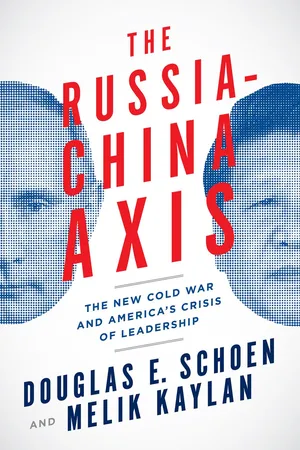
The Russia-China Axis
The New Cold War and America's Crisis of Leadership
- 224 pages
- English
- ePUB (mobile friendly)
- Available on iOS & Android
eBook - ePub
The Russia-China Axis
The New Cold War and America's Crisis of Leadership
About this book
Information
CHAPTER 1
The New Terrain
“In my opinion, the competition between China and the U.S. in the 21st century should be a race, that is, a contest to see whose development results are better, whose comprehensive national power can rise faster, and to finally decide who can become the champion country to lead world progress.”
—GENERAL LIU YAZHOU, CHINA1
“What preserved peace, even in Cold War conditions, was a balance of forces.”
—VLADIMIR PUTIN2
“After my election, I have more flexibility.”
—PRESIDENT BARACK OBAMA3
Xi Jinping’s visit to Moscow in March 2013 was dramatic, but the event was a long time coming. It was foreshadowed, in fact, more than a decade earlier, in 2001—the historic year that saw the 9/11 attacks on New York and Washington and the launch of America’s War on Terror. Those attacks fundamentally transformed American foreign policy and American relations with both countries and the rest of the world. But while America geared up to fight a shadowy, multinational enemy, Russia and China were playing a much older, more traditional game: the time-honored practice of two strong nations identifying common interests and formalizing an alliance.
In June 2001, in Shanghai, the two countries created a kind of alternative NATO: the Shanghai Cooperation Organization (SCO). Evolving out of a predecessor organization, the Shanghai Five, and originally something of a vague concord between Russia and China, the SCO has developed more recently into a comprehensive effort to strengthen economic, military, and cultural ties and to provide mutual security. Vladimir Putin has called the SCO “a reborn version of the Warsaw Pact.”4 Unlike the old Warsaw Pact, however, which excluded China, the SCO is a joint Russian-Chinese alliance that includes the four “stan” countries that have tilted against democracy: Uzbekistan, Kazakhstan, Tajikistan, and Kyrgyzstan. Putin has made clear in recent years that he now sees the SCO as an explicit response to Western attempts to expand NATO—an effort that he views as a betrayal after his cooperation with the West, especially after 9/11.
Working together in the SCO, Russia and China have forged strong relationships with enemies of the U.S., such as Iran (which has observer status), and with those that have contentious relationships with the U.S., such as Pakistan (which has applied for full membership). The SCO has also allowed observer status to India, Afghanistan, and Mongolia; Turkey became a “dialogue partner” in 2013.5 For Iran, in particular, SCO membership would guarantee stability in its relationships with Russia and China and further its interests in Central Asia.6 Because of the SCO, the United States has a difficult time building consensus on nuclear nonproliferation, drug trafficking, trade rules, and a host of other issues.
That difficulty would probably grow if the SCO’s membership became much larger—a likely possibility. Its member states already cover an area of more than 30 million square kilometers, with a combined population of 1.46 billion. If India were to join, the organization would contain the two most populous countries. “The leaders of the states sitting at this negotiation table are representatives of half of humanity,” said the host of the SCO’s 2005 SCO summit. That was a bit of an overstatement at the time, but the words may soon reflect reality.
Only a month after the SCO’s founding, Russia and China signed the Treaty of Good-Neighborliness and Friendly Cooperation, the most significant agreement between the two powers since the historic 1950 compact signed by Stalin and Mao. The 2001 pact was a 20-year strategic treaty in which both parties formalized their shared positions on sovereignty issues and their opposition to “uni-polarity,” code for American influence abroad. The treaty made sense to both powers for many reasons. First and foremost, it increased their leverage internationally in relation to United States power, which was at a historic high. Both countries saw American unilateralism as a threat to their interests and traditional spheres of influence.
The treaty also served individual needs on both sides. The Russians’ greatest need was for capital investment, and the Chinese had capital to burn. The Russians, meanwhile, had massive energy reserves and a willing and needy buyer in the Chinese. The Chinese were also eager to buy Russian military technology. All in all, for the Russian economy, the treaty was vital. For the Chinese, modernizing their armed forces and securing stable energy supplies were two of the most pressing national issues. The treaty helped fulfill both needs.
Few observers at the time, however, understood the significance of the alliance between the two longtime foes. “If China and Russia decide to get into bed with each other,” Ralph A. Cossa had written in the New York Times a few years earlier, “the appropriate response is to wish both of them pleasant dreams, since each will surely feel compelled to sleep with one eye open.”7 Such skepticism about a Chinese-Russian partnership made sense at the time. After all, with so much adversarial history between them, how close could the two nations get?
Yet, with the benefit of hindsight, it now seems clear that the seeds were planted during those years for the culminating moment of 2013, when Xi visited Moscow to so much political pomp and ceremony. By the time they met in Moscow, Xi and Putin were seeking more than just expressions of friendship. They were pursuing a substantive agenda of cooperation and partnership, signing at least 35 agreements covering a range of issues—economics, travel and tourism, agriculture, banking, science and technology, military technology, and geopolitical cooperation. These agreements represent only the latest illustration of a Russian-Chinese collaboration that has been deepening for years—most of it in opposition to U.S. interests. Let’s take a look at the key areas.
FACILITATING ROGUE REGIMES AND FORGING A “LEAGUE OF AUTOCRACIES”
Vladimir Putin was riding high in February 2014, as Russia hosted the Winter Olympics in Sochi. It was the first time Russia had ever hosted a Winter Games, and Putin was determined to revel in every minute of it. And so he hosted a lavish reception in the Atrium ballroom of the Rus Sanatorium, a structure that dates to the Stalin era. Yet, as the Wall Street Journal put it drily, “Mr. Putin’s guest list ha[d] some big gaps.” While most prominent Western leaders stayed away, Putin entertained President Xi along with then-President Viktor Yanukovych of Ukraine, President Aleksander Lukashenko of Belarus—and North Korea’s second-highest-ranking official, even though Pyongyang was sending no delegation of athletes to Sochi.8 If, as the old saying has it, we know someone by his friends, Putin’s Olympic reception provided a fresh reminder.
“It takes time for societies and policymakers to understand that a major shift in global affairs is afoot. But what we see clearly, in recent months, is the emergence of a new constellation of powers,” wrote William C. Martel in The Diplomat. The new grouping includes China, Russia, Iran, North Korea, Syria, and Venezuela. On the surface, these nations are surely distinct; in some cases, indeed, they have conflicting interests. But for the most part, they are united in that their economic and geostrategic goals are inimical to U.S. interests. “There are two common fears that animate the policies of these authoritarian governments,” Martel noted. “One is their apparent fear of democracy, freedom, and liberty, which each of these societies work aggressively to curtail. Second, these authoritarian regimes fear the power and influence of the United States and the West.”9 Thus, they are eager to work together when possible, or at minimum stay out of one another’s way. As Russian Foreign Minister Dmitri Lavrov said of China: “We appreciate Beijing’s measured and impartial stance on the Ukrainian crisis, as well as China’s manifest understanding of all its manifold aspects, including the historic ones.”10
Russia and China are both directly and indirectly supporting and facilitating the efforts of U.S. adversaries around the world—especially the Iranian and North Korean nuclear programs. Russia provides technical assistance and nuclear know-how to Tehran and has sold advanced weapons to defend Iran’s nuclear sites from air strikes. Russia is Iran’s biggest provider of foreign weapons, supplying $3.442 billion in total arms sales since 1991.11 The Russians have also assisted Iran in constructing its Bushehr I nuclear reactor, which critics say is abetting Iran’s pursuit of a nuclear bomb. The Russians have used their position on the UN Security Council to argue against a military strike on Iran or the imposition of harsh sanctions.12 That stance seemed to soften in 2012, when both Russia and China voted in favor of UN sanctions against Iran. On the surface, it looked as if they had finally come around to seeing things the West’s way. In reality, the action was almost certainly motivated by a common desire on the part of Russia and China to keep Iran from ever aligning with the United States. Permanent enmity between the U.S. and Iran, in their thinking, is the best way to keep the Americans out of Central Asia.
Under the terms of an “interim” six-month agreement reached in Geneva in November 2013, Iran pledged to freeze and even curb some nuclear activities in exchange for an easing of economic sanctions. The Obama administration trumpeted the accords as a major step forward, and they are—for Iran. As John Bolton, a former UN ambassador, wrote, the deal accomplished three major Iranian goals: First, it “bought time to continue all aspects of its nuclear-weapons program the agreement does not cover.” These include centrifuge manufacture, weaponization research, and the ballistic-missile program—hardly trivial areas. Second, Iran “gained legitimacy” by being welcomed back into the international community. And third, Tehran has escaped, perhaps forever, the crippling impact of U.S. economic sanctions; the more time passes, the more difficult it will be to reimpose them.13 The lessening of U.S. sanctions will wind up boosting the Iranian economy by at least $7 billion, and perhaps much more. In short, the agreement is woefully, dangerously inadequate. It fails to rein in the Iranians’ ability to enrich uranium; nor does it force them to get rid of their centrifuges or even to slow their heavy-water reactor. For all practical purposes, the Iranian program carries on.
Time will tell whether opponents of the agreement in Washington can mend the damage done. A bipartisan majority in Congress wants tighter sanctions against Iran now, but President Obama opposes them. Polls show that the American public has deep reservations about the deal and overwhelmingly mistrusts the Iranian government as partners in any agreement.14 If something positive is to be salvaged from these dealings, the U.S. will have to rediscover its negotiating power. Certainly it cannot count on the Russians to halt their support of Iran’s nuclear program, despite Moscow’s role in the negotiations as a member of the P5+1.15
China does business with Iran as well and singlehandedly props up a North Korean regime that seems to be ever more volatile and dangerous. The Chinese have refused to discourage Pyongyang from building up its stockpile of nuclear warheads or from developing even more sophisticated and deadly nuclear weapons that could hit Alaska or the U.S. West Coast.
While China positions itself as a supporter of sanctions against North Korea, it does nothing to help enforce them. At heart, China doesn’t want the North Korean problem resolved. An intimidating, unpredictable North Korea keeps South Korea in check and the Americans off balance in the Far East, while terrifying such staunch American allies as Japan and the Philippines. This is all to the good, from the Chinese perspective. More recently, it is true, the North Koreans got too provocative even for China’s tastes, and the Chinese have been working behind the scenes to rein them in. But they do this to protect their strategic interests, not out of solidarity with the West.
China’s facilitation is also essential to perhaps the most disturbing alliance of all: the long-running Iran–North Korea “axis of proliferation,” as Claudia Rosett calls it in Forbes. In this weapons trade, North Korea for the most part is the seller and Iran the buyer, though the two rogue nations also work together on developing missile technology.16
All of these efforts are part of a broader Russian-Chinese goal: to build a counter-Western alliance of antidemocratic nations, what might be called a League of Autocracies—quite the opposite of the “League of Democracies” John McCain has called for.17 These autocratic nations include not only North Korea and Iran but also Syria, Venezuela, Sudan, and Myanmar (Burma), among others. Both Russia and China sell arms to state sponsors of terrorism and have strengthened the hand of such terrorist groups as Hamas, Hezbollah, and even al-Qaeda affiliates in hopes of weakening the United States and thwarting its strategic goals.
In one of the deadliest places in the world—Sy...
Table of contents
- Cover
- Title Page
- Copyright
- Contents
- Authors’ Note
- Foreword
- Introduction
- CHAPTER 1: The New Terrain
- CHAPTER 2: Rogue Regimes: How the Axis Uses Proxies to Win
- CHAPTER 3: Cyber Security: The New Battlefield
- CHAPTER 4: Military Supremacy: America’s Fading Edge
- CHAPTER 5: Nuclear Security: They Build Up, We Build Down
- CHAPTER 6: The Economic Contest: America on the Sidelines
- CHAPTER 7: Intelligence Wars: Stealing America’s Secrets
- CHAPTER 8: Propaganda Wars: Losing Ground in the Battle for Hearts and Minds
- CHAPTER 9: Countermoves: Some Thoughts on Fighting Back
- CONCLUSION: Why America Must Wake Up
- WHAT TO DO: Russia
- WHAT TO DO: China
- WHAT TO DO: The New Axis
- WHAT TO DO: Rebuilding Alliances
- Endnotes
- Index
Trusted by 375,005 students
Access to over 1.5 million titles for a fair monthly price.
Study more efficiently using our study tools.
Frequently asked questions
Yes, you can cancel anytime from the Subscription tab in your account settings on the Perlego website. Your subscription will stay active until the end of your current billing period. Learn how to cancel your subscription
No, books cannot be downloaded as external files, such as PDFs, for use outside of Perlego. However, you can download books within the Perlego app for offline reading on mobile or tablet. Learn how to download books offline
Perlego offers two plans: Essential and Complete
- Essential is ideal for learners and professionals who enjoy exploring a wide range of subjects. Access the Essential Library with 800,000+ trusted titles and best-sellers across business, personal growth, and the humanities. Includes unlimited reading time and Standard Read Aloud voice.
- Complete: Perfect for advanced learners and researchers needing full, unrestricted access. Unlock 1.5M+ books across hundreds of subjects, including academic and specialized titles. The Complete Plan also includes advanced features like Premium Read Aloud and Research Assistant.
We are an online textbook subscription service, where you can get access to an entire online library for less than the price of a single book per month. With over 1.5 million books across 990+ topics, we’ve got you covered! Learn about our mission
Look out for the read-aloud symbol on your next book to see if you can listen to it. The read-aloud tool reads text aloud for you, highlighting the text as it is being read. You can pause it, speed it up and slow it down. Learn more about Read Aloud
Yes! You can use the Perlego app on both iOS and Android devices to read anytime, anywhere — even offline. Perfect for commutes or when you’re on the go.
Please note we cannot support devices running on iOS 13 and Android 7 or earlier. Learn more about using the app
Please note we cannot support devices running on iOS 13 and Android 7 or earlier. Learn more about using the app
Yes, you can access The Russia-China Axis by Douglas E. Schoen, Melik Kaylan in PDF and/or ePUB format, as well as other popular books in Politics & International Relations & Diplomacy & Treaties. We have over 1.5 million books available in our catalogue for you to explore.