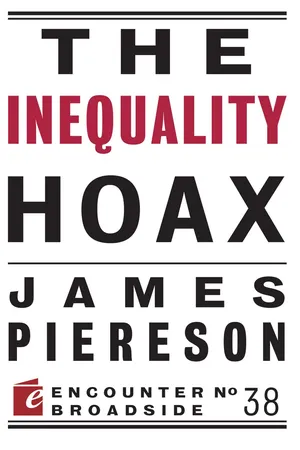
The controversy over inequality has gathered steam with the publication of Thomas Piketty’s new book, Capital in the Twenty-First Century, a dense work of economic history that documents the rise of income inequality in recent decades and sets forth an agenda of taxation to deal with it. Piketty’s treatise has turned into a rallying point for those favoring income redistribution and higher taxes on the rich.In this Broadside, James Piereson explains how Piketty’s book is flawed and advances a narrow understanding of the market system. While misjudging the era in which we are living and misunderstanding the sources of inequality, Piketty’s book proposes solutions that will make matters worse for everyone – the wealthy, the middle class, and the poor alike.
- 56 pages
- English
- ePUB (mobile friendly)
- Available on iOS & Android
eBook - ePub
The Inequality Hoax
About this book
Information
LIBERALS AND PROGRESSIVES seem to thrive on crises. They are, in any case, unusually proficient in creating or calling attention to them, often as excuses to impose new taxes and regulations or to gain additional power and influence for themselves. In the 1960s they gave us the “poverty crisis” and the “urban crisis,” followed in the 1970s and 1980s by the “environmental crisis,” the “energy crisis,” and the “homeless crisis.” Later we had the “health care crisis” and, more recently, the civilization-threatening “global-warming crisis.” None of these ever qualified as a genuine crisis, if by that term we mean a moment of danger that must be navigated by wise statesmanship or effective policy. Some have found it useful to turn multifaceted problems into crises in order to stampede the public into adopting policies it would otherwise (quite sensibly) reject.
Today the issue of the hour is the “inequality crisis,” another overhyped issue that is being seized upon as an excuse to raise taxes, attack “the rich,” and discredit policies that gave us three decades of prosperity, booming real estate and stock markets, and an expanding global economy. For several years, ever since the financial crisis of 2008, journalists and academics have been turning out books and manifestos bearing such titles as The New Gilded Age; The Killing Fields of Inequality; The Great Divergence: America’s Growing Inequality Crisis and What We Can Do About It; and The Price of Inequality: How Today’s Divided Society Endangers Our Future, to list just a few of the many dozens of works on the subject that have appeared of late. The common message of these books is not subtle: the rich have manipulated the political system to lay claim to wealth they have not earned and do not deserve, and they have done so at the expense of everyone else.
In the past, those who wrote about inequality focused on poverty and the challenge of elevating the poor into the working and middle classes. No more. Today they are preoccupied with the rich and with schemes to redistribute their wealth downward through the population. Many of the new egalitarians – professors at Ivy League universities, well-paid journalists, or heirs to family wealth – are well-off and comfortable by any reasonable standard. In interpreting their complaints about “the rich” or the top “1 percent,” one naturally thinks of Samuel Johnson’s barbed comment about the reformers of his day: “Sir,” he said, “your levelers wish to level down as far as themselves; but they cannot bear leveling up to themselves.” There is a sense in this controversy that we are watching members of the top 2 percent or 3 percent of the income distribution perform class warfare against the top 1 percent, while everyone else looks on from a distance, apparently convinced that the new class struggle has little to do with their own circumstances.
THE PIKETTY BUBBLE
The controversy over inequality gathered additional steam in recent weeks with the publication of Thomas Piketty’s new book, Capital in the Twenty-First Century (Belknap/Harvard University Press), a dense and data-filled work of economic history running to nearly 700 pages that makes the case against

There is a sense in this controversy that we are watching members of the top 2 percent or 3 percent of the income distribution perform class warfare against the top 1 percent.
inequality far more extensively and exhaustively than any work that has appeared heretofore. His book, published in March 2014, climbed to the top of the best-seller lists by mid-April, where it remained for several weeks thereafter. Bookstores in New York City, Washington, D.C., and Boston quickly sold out of copies, and even Amazon could not keep up with public demand for the book. The Piketty “phenomenon” arrived as a surprise to just about everyone, most especially to the publisher. “We’ve printed and printed and printed, and the market soaks up whatever we print,” the book’s editor at Harvard University Press said in April, just a few weeks after the publication date. “The American reception of the book has re-energized interest in France. Now the French edition is sold out.” The editor was not complaining; this is the kind of problem publishing houses like to have.
All this attention quickly turned Piketty, a scholarly-looking professor at the Paris School of Economics, into something of a literary celebrity and his treatise into a rallying point for those favoring income redistribution and higher taxes for the rich. The New York Times called the author “the newest version of a now-familiar specimen: the overnight intellectual sensation whose stardom reflects the fashions and feelings of the moment.” Paul Krugman, in a review essay in The New York Review of Books, called the book “magnificent” and “awesome.” Martin Wolf of the Financial Times described it as “extraordinarily important,” while a reviewer for The Economist suggested that Piketty’s book is likely to change the way we understand the past two centuries of economic history. A columnist for the Financial Times called the mass of commentary surrounding the book a “Piketty bubble.” Meanwhile, The Spectator in London helpfully offered tips to people wishing to bluff their way to appearing well informed about the book without having taken the trouble to read it. Not since the 1950s and 1960s, when John Kenneth Galbraith published The Affluent Society and The New Industrial State, has an economist written a book that has garnered so much public attention and critical praise.
But the furor might have been anticipated in light of the effective way that the book taps into pre-existing worries about economic inequality. Liberals and progressives of all stripes have hailed it as the indictment of free-market capitalism they have been waiting decades to hear. The market revolutions of the past three decades have placed them on defense in public debates over taxation, regulation, and inequality, and Piketty’s book provides them with the intellectual ammunition with which to fight back. It documents their belief that inequalities of income and wealth have grown rapidly in recent decades in the United States and across the industrial world, and it portrays our era as a new “gilded age” of concentrated wealth and out-of-control capitalism. It suggests that things are getting worse for nearly everyone, save for a narrow slice of the population – the “I percent” – that lives off exploding returns on capital, and it pointedly supports their agenda of redistributive taxation.
IS PIKETTY A MARXIST?
Some have compared Capital in the Twenty-First Century to Karl Marx’s Das Kapital both for its similarity in title and its updated analysis of the historical dynamics of the capitalist system. Though Piketty deliberately chose his title to promote the association with Marx’s tome, he is not a socialist or a Marxist, as he reminds the reader throughout the book. He does not endorse collective ownership of the means of production; historical materialism; class struggle; the labor theory of value; or the inevitability of revolution. He readily acknowledges that communism and socialism are failed systems. He wants to reform capitalism, not destroy it.
At the same time, he shares Marx’s assumption that returns on capital are the dynamic force in modern economies, and, like Marx, he claims that such returns lead ineluctably to concentrations of wealth in fewer and fewer hands. For Piketty, like Marx, capitalism is all about “capital,” and not much more. Along the same lines, he also argues that there is an intrinsic conflict between capital and labor in market systems so that greater returns on capital must come at the expense of wages and salaries. In this sense, rather like Marx, he advances an interpretation of market systems that revolves around just a few factors: the differential returns on capital and labor and the distribution of wealth and income through the population.
Though he borrows some ideas from Marx, Piketty writes more from the perspective of a modern progressive or social democrat. His book, written in French but translated into English, bears many features of that ideological perspective, particularly in its focus on the distribution rather than the creation of wealth, in its emphasis upon progressive taxation as
The market revolutions of the past three decades have placed liberals on defense over taxation, regulation, and inequality, and Piketty’s book provides them with the intellectual ammunition with which to fight back.
the solution to the inequality problem, and in the confidence it expresses that governments can manage modern economies in the interest of a more equal distribution of incomes. He is worried mainly about equality and economic security, much less so about freedom, innovation, and economic growth.
His book has some admirable features. It is, first of all, a work of economic history, a field that economists have abandoned over the past several decades in favor of building statistical models and formulating abstract theories. Piketty takes academic economists to task for the irrelevance of much of their work to the pressing problems of the day and for ignoring the lessons that history has to teach. The author takes seriously the history of economic ideas, mining the works of Adam Smith, David Ricardo, Thomas Robert Malthus, Karl Marx, and John Maynard Keynes in search of insights into the operation of the market system. He demonstrates that these theorists still have much to tell us about ongoing economic controversies, despite the fact that few economists today bother to read their works. There is much in this book to digest and reflect upon, even for those who do not share the author’s point of view.
The popularity of his book is another sign that established ideas never really die but go in and out of fashion with changing circumstances. Liberals, progressives, and social democrats were shocked by the comeback of free-market ideas in the 1980s after they assumed those ideas had been buried once and for all by the Great Depression. In a similar vein, free-market and “small government” advocates are now surprised by the return of social-democratic doctrines that they assumed had been discredited by the “stagflation” of the 1970s and the success of low-tax policies in the 1980s and 1990s. Piketty’s book has garnered so much attention because it is the best statement we have had in some time of the redistributionist point of view.
Despite the attention and praise the book has received, it is a flawed production in at least three important respects. First, it misjudges the era in which we are living and those through which we have passed. Second, it misunderstands the sources of the “new inequality.” Third, the solutions it proposes will make matters worse for everyone – the wealthy, the middle class, and the poor alike. The broader problem with the book is that it advances a narrow understanding of the market system that singles out returns on capital as its central feature but in the process ignores the really important factors that account for its success over an extended period of 2½ centuries.
THE “IRON LAW” OF CAPITALISM
Piketty organizes his book around an old question dating back to the 19th century: Does the capitalist process tend to produce over time a growing equality or inequality in incomes and wealth? In doing so he assumes without argument that equality rather than some other measure or mix of measures – such as growth, innovation, living standards, or freedom – is the basic standard according to which the system should be judged.
The dominant view throughout the 19th century was that rising inequality was an inevitable by-product of the capitalist system. In the United States, Thomas Jefferson tried to preserve an agricultural society for as long as possible in the belief that the industrial system would destroy the promise of equality upon which the new nation was based. In Great Britain, David Ricardo, writing in the early 19th century, argued that because agricultural land was scarce and finite, landowners would inevitably claim larger shares of national wealth at the expense of laborers and factory owners. Ricardo did not foresee that land prices in Great Britain would level off due to free trade and technological innovations that increased the supply and reduced the price of food.
Later, as the industrial process gained steam, Marx argued that because of competition among capitalists, ownership of capital in the form of factories and machinery would become concentrated in fewer and fewer hands, while workers continued to be paid subsistence wages. Marx did not foresee that productivity-enhancing innovations, allied perhaps with the unionization of workers, would cause wages to rise and thereby allow workers to enjoy more of the fruits of capitalism.
For Piketty, like Marx, capitalism is all about “capital,” and not much more.
The perspective on the equality-inequality issue changed in the 20th century due to the rise in incomes for workers, continued improvements in worker productivity, the expansion of the service sector and the welfare state, and the general prosperity of the postwar era. In addition, the Great Depression and two world wars tended to wipe out the accumulated capital that sustained the lifestyles of the upper classes. In the 1950s, Simon Kuznets, a prominent American economist, showed that wealth and income disparities leveled out in the United States from 1913 to 1952. On the basis of his research, he proposed the so-called Kuznets curve to illustrate his conclusion that inequalities naturally increased in the early phases of the industrial process but then declined as the process matured, as workers relocated from farms to cities, and as human capital replaced physical capital as a source of income and wealth. His thesis suggested that modern capitalism would gradually produce a middle-class society in which incomes did not vary greatly from the mean. This optimistic outlook was nicely expressed in John F. Kennedy’s oft-quoted remark that “a rising tide lifts all boats.”
From the perspective of 2014, Piketty makes the case that Marx was far closer to being right than Kuznets. Kuznets, in Piketty’s view, was simply looking at data from a short period of history and made the error of extrapolating his findings into the future.
Piketty argues that capitalism, left to its own devices and absent government intervention, creates a situation in which returns on capital grow more rapidly than returns on labor and the overall growth in the economy. This is Piketty’s central point, which he takes to be a basic descriptive theorem of the capitalist order. He tries to show that when returns on capital exceed growth in the economy for many decades or generations, owners of capital disproportionately accrue wealth and income, and capital assets gradually claim larger shares of national wealth, generally at the expense of labor. This, he argues, is something close to an “iron law” of the capitalist order.
He estimates that since 1970, the market value of capital assets has grown steadily in relation to national income in all major European and North American economies. In the United States, for example, the ratio increased from almost 4 to 1 in 1970 to almost 5 to 1 today, in Great Britain from 4 to 1 to about 6 to 1, and in France from 4 to 1 to 7 to 1. Measured from a different angle, income from capital also grew throughout this period as a share of national income. From 1980 to the present, income from capital grew in the United States from 20 percent to 25 percent of the national total, in Great Britain from 18 percent to nearly 30 percent, and in France from 18 percent to about 25 percent. While these do not appear to be earthshaking changes, they weigh heavily in Piketty’s narrative that stresses the outsize role that capital has seized in recent decades in relation to labor income.
The weak patterns in the data summarized above suggest that Piketty may have overstated the claims for his iron law. There is nothing particularly original or radical in the proposition that returns on capital generally exceed economic growth. Economists and investors regard it as something of a truism, at least over the long run. For example, the long-term returns on the U.S. stock market are said to be about 7 percent per annum (minus taxes and inflation), while real growth in the overall economy has been closer to 3 percent. This is generally thought to be a good thing, since returns on capital encourage greater investment, and this in turn drives inn...
Table of contents
- Cover
- Table of Contents
- The Piketty Bubble
- Is Piketty a Marxist?
- Copyright
Trusted by 375,005 students
Access to over 1.5 million titles for a fair monthly price.
Study more efficiently using our study tools.
Frequently asked questions
Yes, you can cancel anytime from the Subscription tab in your account settings on the Perlego website. Your subscription will stay active until the end of your current billing period. Learn how to cancel your subscription
No, books cannot be downloaded as external files, such as PDFs, for use outside of Perlego. However, you can download books within the Perlego app for offline reading on mobile or tablet. Learn how to download books offline
Perlego offers two plans: Essential and Complete
- Essential is ideal for learners and professionals who enjoy exploring a wide range of subjects. Access the Essential Library with 800,000+ trusted titles and best-sellers across business, personal growth, and the humanities. Includes unlimited reading time and Standard Read Aloud voice.
- Complete: Perfect for advanced learners and researchers needing full, unrestricted access. Unlock 1.5M+ books across hundreds of subjects, including academic and specialized titles. The Complete Plan also includes advanced features like Premium Read Aloud and Research Assistant.
We are an online textbook subscription service, where you can get access to an entire online library for less than the price of a single book per month. With over 1.5 million books across 990+ topics, we’ve got you covered! Learn about our mission
Look out for the read-aloud symbol on your next book to see if you can listen to it. The read-aloud tool reads text aloud for you, highlighting the text as it is being read. You can pause it, speed it up and slow it down. Learn more about Read Aloud
Yes! You can use the Perlego app on both iOS and Android devices to read anytime, anywhere — even offline. Perfect for commutes or when you’re on the go.
Please note we cannot support devices running on iOS 13 and Android 7 or earlier. Learn more about using the app
Please note we cannot support devices running on iOS 13 and Android 7 or earlier. Learn more about using the app
Yes, you can access The Inequality Hoax by James Piereson in PDF and/or ePUB format, as well as other popular books in Economics & Economic History. We have over 1.5 million books available in our catalogue for you to explore.