This remarkable book shatters just about every myth surrounding American government, the Constitution, and the Founding Fathers, and offers the clearest warning about the alarming rise of one-man rule in the age of Obama.Most Americans believe that this country uniquely protects liberty, that it does so because of its Constitution, and that for this our thanks must go to the Founders, at their Convention in Philadelphia in 1787.F. H. Buckley’s book debunks all these myths. America isn’t the freest country around, according to the think tanks that study these things. And it’s not the Constitution that made it free, since parliamentary regimes are generally freer than presidential ones. Finally, what we think of as the Constitution, with its separation of powers, was not what the Founders had in mind. What they expected was a country in which Congress would dominate the government, and in which the president would play a much smaller role.Sadly, that’s not the government we have today. What we have instead is what Buckley calls Crown government: the rule of an all-powerful president. The country began in a revolt against one king, and today we see the dawn of a new kind of monarchy. What we have is what Founder George Mason called an "elective monarchy,” which he thought would be worse than the real thing.Much of this is irreversible. Constitutional amendments to redress the balance of power are extremely unlikely, and most Americans seem to have accepted, and even welcomed, Crown government. The way back lies through Congress, and Buckley suggests feasible reforms that it might adopt, to regain the authority and respect it has squandered.
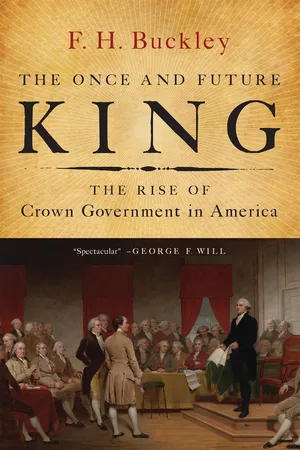
- 416 pages
- English
- ePUB (mobile friendly)
- Available on iOS & Android
eBook - ePub
About this book
Information
-I-

The Fall and Rise of Crown Government
-1-
REX QUONDAM, REX FUTURUS
The prejudice of Englishmen, in favor of their own government . . . arises as much or more from national pride than reason.
—THOMAS PAINE, COMMON SENSE
Over the last 250 years there have been four American constitutions. Each has resulted in a different form of government. We have seen three thus far, and now are on the cusp of a fourth.
The first constitution, in the prerevolutionary thirteen colonies, was one of Crown government, in which royal governors exercised enormous powers. This was swept aside by the American Revolution, and (after the interregnum of the Articles of Confederation) the Framers, at their Convention in Philadelphia in the summer of 1787, produced the second constitution, one designed to correct the flaws of Crown government and the Articles of Confederation. What they proposed was a form of congressional government, with power centered in a Senate and House of Representatives.
The third constitution was one of separation of powers, of power divided between the legislative and executive branches. Its seeds were found in the second constitution, and matured over the next fifty years, as the president came to be popularly elected, and his office emerged as the modern executive—commanding, decisive, and possessing all the authority of the only person elected by the nation at large. Contrary to popular belief, this was not what the Framers had intended. It was not even what James Madison had wanted at the Philadelphia Convention, although it is often referred to as the Madisonian Constitution because of his defense of separationism in the Federalist Papers.1 Instead, the separation of powers between the executive and legislative branches is much more a creature of the unexpected rise of democracy.
We have now entered into a fourth constitution, one of strong presidential government. The executive has slipped off many of the constraints of the separation of powers. The president makes and unmakes laws without the consent of Congress and spends trillions of government dollars; and the greatest of decisions—whether to commit his country to war—is made by him alone. His ability to reward friends and punish enemies exceeds anything seen in the past. He is rex quondam, rex futurus—the once and future king. And all of this is irreversible.
The long arc of American constitutional government has bent from the monarchical principle of the colonial period to congressional government, then to the separation of powers, and finally back again to Crown government and rule by a single person. The same pattern can be observed in Britain’s Westminster system of parliamentary government, which was exported first to Canada, and then throughout the Commonwealth. As in America, there have been four British constitutions since the Revolutionary War.
First came the “personal government” of George III, who chose his ministers and was supported by a large block of “King’s Friends” in Parliament. While sharing power with Parliament, the King dominated the government, and the American Revolution was itself a consequence of his unpopular resistance to the colonists’ demands. George III was not a tyrant, however. His rule did not represent a sharp break from the constitutional practice that prevailed after the 1689 English Bill of Rights, and his ministers could not long survive when opposed by a determined majority in the House of Commons. Nevertheless, this was still a form of Crown government.
This changed in 1782 after the fall of George III’s prime minister, Lord North, when the monarch’s power lessened and that of the House of Commons increased; and this I call the second British constitution. It was one in which power was shared between King and Parliament, and looked at from the distant prospect of Philadelphia, it seemed to the Framers to feature a separation of powers between the executive branch, in the form of the monarch, and the legislative branch in Parliament.
Over the next fifty years, as the American Constitution evolved from congressional government to the separation of powers, the British constitution also changed, though in the opposite direction. By the time of the Great Reform Act of 1832, the monarch and House of Lords were well on their way to political insignificance. What there was of a separation of powers was abandoned, and of Britain’s third constitution all that remained was an all-powerful House of Commons. There was a similar evolution in Canada, with a movement from rule by governors general and fractious assemblies to government by the House of Commons alone. The three countries had crossed paths, with America moving from legislative government to the separation of powers, and Britain and Canada moving from the separation of powers to legislative government.
A fourth constitution is now emerging in Britain and Canada, one that parallels the move to the strong presidentialism of America’s fourth revolution. Under Britain’s third constitution its government was led by the ruling party’s principal politicians, and was labeled “cabinet government” by the nineteenth-century essayist Walter Bagehot.2 Today, however, this has given way to rule by a prime minister who dominates his cabinet and Parliament.
What more than anything explains the move toward Crown government in all three countries is the growth of the regulatory state, where the role of legislation has diminished and that of regulatory rule making has expanded, with the regulators responsible to the executive branch and not to the legislature. Modernity, in the form of the regulatory state, is the enemy of the separation of powers and diffuse power, and insists on one-man rule. As in America, moreover, this is unlikely to change in Britain and Canada.
Crown government might seem to be coded in the constitutional DNA of monarchies such as Britain and Canada. For Americans, however, the return to one-man rule may appear a betrayal of the Revolution and its promise of republican government. So it seemed to George Mason, who complained at the Philadelphia Convention that a popularly elected president would “degenerate” into an “elective monarchy,”3 which was worse, he thought, than the real thing. A hereditary king like George III lacked the legitimacy conferred by voters, and therefore had to share power with the legislature. An elective president would not be so constrained, and would thus be more dangerous to liberty.
To paraphrase John Stuart Mill, he who knows only his own country knows little enough of that.4 One who seeks to understand American government should therefore also know something of other political systems, especially those of similar societies such as Britain and Canada. Where there are similarities, one looks for an explanation beyond the realm of constitutional law from something outside the system, such as a common British heritage in the eighteenth century, the rise of democracy in the nineteenth century, and the growth of the regulatory state in the twentieth century. Where there are differences, one looks for evidence that one constitutional regime, more than the other, is better adapted to the demands placed upon it. That is how constitutions are evaluated. One is apt to think one lives under the best of all possible governments, but unless one is willing to put it to the test, this is little more than the prejudice of Thomas Paine’s hypothetical Englishman.
AMERICA AND BRITAIN CHANGE PLACES
Everyone knows how America came to adopt the separation of powers in government. The delegates to the Philadelphia Convention who drafted the Constitution were sophisticated legal theorists. They had studied “the celebrated Montesquieu” and wisely applied the French Enlightenment philosopher’s defense of the separation of powers. “When legislative power is united with executive power in a single person or in a single body of the magistracy, there is no liberty,” said Montesquieu,5 and the American Framers would follow him and protect liberty through a Constitution in which a separately elected president, Senate, and House of Representatives would each have to consent before a bill was enacted.
I tell a different story in chapter 2. The modern presidential system, with its separation of powers, was an unexpected consequence of the democratization of American politics, and not a prominent feature of the Framers’ Constitution. It was a near run thing, decided only on day 105 of a 116-day convention. The delegates debated the presidential appointment process on twenty-one different days, and took more than thirty votes on the subject, with sixteen roll calls alone on how to select the president. In six of these (one unanimously), they voted for a president appointed by Congress, a system that would have resembled a parliamentary regime. Once they voted 8 to 2 for a president appointed by state legislatures. On one thing they were wholly clear: they did not want a president elected by the people. That question was put to them four times, and lost each time.
The Framers wanted a government with a much weaker separation of powers. James Madison came to Philadelphia with a proposal that came to be called the Virginia Plan, in which an elected House of Representatives would appoint senators, and the House and Senate together would appoint the president. Such a system would have more closely resembled the British Westminster system of parliamentary government, and the gridlock that characterizes Washington today would largely be absent. The party that won the White House would typically win the legislative branch, giving us the winner-take-all government of parliamentary systems.
The delegates rejected the Virginia Plan, but not to vindicate the principle of the separation of powers. What instead was at issue was the division of power between the states and the federal government, with supporters of states’ rights from the smaller states and nationalists from the larger ones on opposite sides. Delegates favoring states’ rights took the first trick, on the membership of the Senate. The states would appoint senators and each state, irrespective of size, would have two. States’-rights delegates feared the centralization of power in the federal government, and believed that a senate so constituted would prevent this from happening. They might have had a point.
As for the presidency, the nationalists wanted a president chosen by the people, as he would be the only person elected by voters across the country and would thus have greater legitimacy to resist encroachments by the states. Once again, however, states’-rights supporters voted this down. What they chose instead was an elaborate system in which state legislatures would determine how presidential electors would be chosen, but in which the electors would not choose the president unless they gave him a majority of their votes. This, the Framers thought, would seldom happen, since they did not expect that, after George Washington, candidates with national appeal would emerge. In the case where no candidate received a majority of electoral votes, the election would be thrown to the House of Representatives, voting by state. What the Framers expected, then, was that the House would almost always choose the president, just as Madison had wanted in the Virginia Plan. Congressmen could not serve as president or sit in the cabinet, but responsibilities would be mingled and Congress would dominate the government. What the Framers envisaged was a separation of persons more than of powers.
In time all of this changed, as a consequence of the growth of political parties and political pressure to let voters elect politicians directly. Presidents came to be chosen by popular ballot, as the nationalists had wanted, rather than by electors selected by states. National candidates emerged and received a majority of electoral votes, so that after 1824 the choice of president never fell to the House. After the Seventeenth Amendment was adopted in 1913, senators were elected by popular vote; and even before this, people had voted for their state legislators with an eye on how they would pick senators. The American system of separation of powers was more an unintended by-product of the growth of democracy than the deliberate choice of the Framers.
Where one did find contemporary support for separationism was in Britain, as I note in chapter 3. The eighteenth-century Westminster system required the assent of King, House of Lords, and House of Commons to enact a bill. Over the ensuing half-century, the monarch and House of Lords lost power to the House of Commons, and by the passage of the 1832 Reform Bill the House of Commons had emerged as the dominant branch of government. A determined House of Commons could now insist on getting its way, and might require the King to appoint new peers to the House of Lords to overcome any objections from that body. Looking backward in 1867, it seemed clear to Walter Bagehot, writing in The English Constitution, that the “efficient secret of the English Constitution may be described as the close union, the nearly complete fusion, of the executive and legislative powers.”6 Time’s arrow moved always in the direction of democracy, but while it dispatched separationism from Britain, it delivered it to America.
Naturalized citizens sometimes assert their superiority to native citizens, who did not choose their nationality. In the same way, the Canadian adoption of a Westminster system, which I discuss in chapter 4, might be thought more deliberate and voluntary than Great Britain’s, for the Canadians had choices. Britons could not become Americans, but that was always an option for Canadians. They could have adopted an American separation of powers, or they could simply have moved next door when the wage differential exceeded their attachment to the monarchical principle. That possibility always weighed on one’s mind, as Canadian humorist Stephen Leacock noted. He wrote of an elderly Ontario politician who announced that he would soon go to that place to which all men must go, and none returns. The politician expected some sign of emotion from his audience, but there was none—they thought he was planning to move to the States.7
The attraction of America was so great that it took an act of will for Canadians to resist their dangerous neighbor. In negotiating the 1871 Treaty of Washington, America sought Canada as compensation for the damage to American shipping inflicted by the Confederate raider Alaba...
Table of contents
- Cover
- Title Page
- Copyright
- Dedication
- Contents
- Preface to the Paperback Edition
- PART I: The Fall and Rise of Crown Government
- PART II: The Pitfalls of Presidentialism
- Appendix A: The Framers
- Appendix B: Presidentialism and Liberty
- Appendix C: Presidents and Corruption
- Acknowledgments
- Notes
- Index
Trusted by 375,005 students
Access to over 1.5 million titles for a fair monthly price.
Study more efficiently using our study tools.
Frequently asked questions
Yes, you can cancel anytime from the Subscription tab in your account settings on the Perlego website. Your subscription will stay active until the end of your current billing period. Learn how to cancel your subscription
No, books cannot be downloaded as external files, such as PDFs, for use outside of Perlego. However, you can download books within the Perlego app for offline reading on mobile or tablet. Learn how to download books offline
Perlego offers two plans: Essential and Complete
- Essential is ideal for learners and professionals who enjoy exploring a wide range of subjects. Access the Essential Library with 800,000+ trusted titles and best-sellers across business, personal growth, and the humanities. Includes unlimited reading time and Standard Read Aloud voice.
- Complete: Perfect for advanced learners and researchers needing full, unrestricted access. Unlock 1.5M+ books across hundreds of subjects, including academic and specialized titles. The Complete Plan also includes advanced features like Premium Read Aloud and Research Assistant.
We are an online textbook subscription service, where you can get access to an entire online library for less than the price of a single book per month. With over 1.5 million books across 990+ topics, we’ve got you covered! Learn about our mission
Look out for the read-aloud symbol on your next book to see if you can listen to it. The read-aloud tool reads text aloud for you, highlighting the text as it is being read. You can pause it, speed it up and slow it down. Learn more about Read Aloud
Yes! You can use the Perlego app on both iOS and Android devices to read anytime, anywhere — even offline. Perfect for commutes or when you’re on the go.
Please note we cannot support devices running on iOS 13 and Android 7 or earlier. Learn more about using the app
Please note we cannot support devices running on iOS 13 and Android 7 or earlier. Learn more about using the app
Yes, you can access The Once and Future King by F. H. Buckley in PDF and/or ePUB format, as well as other popular books in Politik & Internationale Beziehungen & Amerikanische Regierung. We have over 1.5 million books available in our catalogue for you to explore.