Democratic presidential candidates, including Hillary Clinton and Bernie Sanders, along with progressive economists like Thomas Piketty and Paul Krugman, have made a case for redistributing income from the wealthy to the poor as a means of reducing inequalities in income and wealth. Meanwhile, public opinion polls show that voters reject programs of redistribution in favor of policies designed to promote overall economic growth and job creation. While voters are concerned about inequality, they are more skeptical of the capacity of the government to do anything about it without making matters worse for everyone.
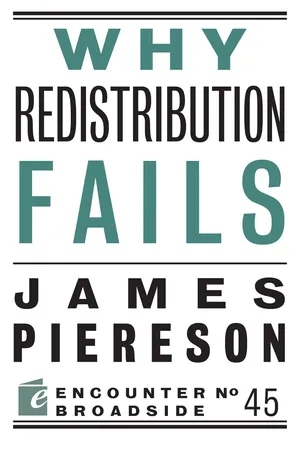
In this Broadside, James Piereson explains why the voters are right and the progressive politicians and economists are wrong. As he demonstrates, the progressive case is based upon a serious fallacy: it assumes that the government is actually capable of redistributing income from the wealthy to the poor. For reasons of policy, tradition, and constitutional design, this is not the case. The United States currently has one of the more progressive income tax systems in the industrial world but it does little to redistribute income from the wealthy to the poor. One reason for this is that, though the government spends vast sums on programs to aid the poor, most of these funds flow to providers of services rather than to the poor themselves. Thus, whatever one may think of inequality, redistributive tax and spending policies are unlikely to do much to ameliorate it but will instead line the pockets of providers and advocates who wield great influence in Washington.
- 48 pages
- English
- ePUB (mobile friendly)
- Available on iOS & Android
eBook - ePub
Why Redistribution Fails
About this book
Information
HILLARY CLINTON launched her presidential campaign in spring 2015 by venturing from New York to Iowa to rail against income inequality and to propose new spending programs and higher taxes on the wealthy as remedies for it. She re-emphasized these dual themes of inequality and redistribution in the “relaunch” of her campaign in June 2015 and in the occasional campaign speeches she delivered over the course of the summer. Clinton’s campaign strategy has been interpreted as a concession to influential progressive spokesmen like Senators Elizabeth Warren and Bernie Sanders, who have loudly pressed these redistributionist themes for several years, in response to the financial meltdown in 2008 and out of a long-standing wish to reverse the “Reagan Revolution” of the 1980s. In view of Clinton’s embrace of the progressive agenda, there can be little doubt that inequality, higher taxes, and proposals for new spending programs will be central themes in the Democratic presidential campaign in 2016.

While voters are worried about inequality, they are far more skeptical of the capacity of the government to do anything about it without making matters worse for everyone.
The intellectual case for redistribution has been outlined in impressive detail in recent years by a phalanx of progressive economists – including Thomas Piketty, Joseph Stiglitz, and New York Times opinion columnist Paul Krugman – who have called for redistributive tax and spending policies to address the challenge of the growth of inequalities in income and wealth. Piketty’s best-selling book, Capital in the Twenty-First Century (2014), made a case for raising the top marginal tax rate in the United States from 39.6 percent (where it stands today) to 80 percent or more (where it was during the 1940s and 1950s), and then relying upon the U.S. government to redistribute those funds from the wealthy to households in greater need of them. Nobel Laureate Robert Solow of MIT put the matter bluntly in a 2014 exchange with Harvard’s Gregory Mankiw, saying that he is in favor of dealing with inequality by “taking a dollar from a random rich person and giving it to a random poor person,” presumably with the federal government acting as the middleman to implement the transaction.
Public-opinion polls over the years have consistently shown that voters overwhelmingly reject programs of redistribution in favor of policies designed to promote overall economic growth and job creation. More-recent polls suggest that while voters are increasingly concerned about inequality and question the high salaries paid to executives and bankers, they nevertheless reject redistributive remedies like higher taxes on the wealthy. According to those studies, voters do not support redistributive policies because they do not believe the government is capable of implementing them in effective ways. While voters are worried about inequality, they are far more skeptical of the capacity of the government to do anything about it without making matters worse for everyone.
Here, as is often the case, there is more wisdom in the public’s outlook than in the campaign speeches of Democratic presidential candidates and in the books and opinion columns of progressive economists. Leaving aside the morality of redistribution, the progressive case is based upon a significant fallacy: it assumes that the U.S. government is actually capable of redistributing income from the wealthy to the poor. For reasons of policy, tradition, and institutional design, this is not the case. Whatever one may think of inequality, redistributive fiscal policies are unlikely to do much to reduce it, a point that the voters seem instinctively to understand.
* * *
One need only look at the effects of federal tax and spending policies over the past 3½ decades to see that this is so. The chart on page 7, based upon data compiled by the Congressional Budget Office (CBO), displays the national shares of before- and after-tax income for the top 1 percent and 10 percent of the income distribution from 1979 to 2011, along with the same figures for the bottom quintile of the distribution. For purposes of this study, the CBO defined income as market income plus government transfers, including cash payments and the value of in-kind services and payments, such as health care (Medicare and Medicaid) and food stamps. The chart thus represents a comprehensive portrait of the degree to which federal tax and spending policies redistribute income from the wealthiest to the poorest groups, and to households in between.
...Table of contents
- Cover
- Table of Contents
- Beginning
- Copyright
Trusted by 375,005 students
Access to over 1.5 million titles for a fair monthly price.
Study more efficiently using our study tools.
Frequently asked questions
Yes, you can cancel anytime from the Subscription tab in your account settings on the Perlego website. Your subscription will stay active until the end of your current billing period. Learn how to cancel your subscription
No, books cannot be downloaded as external files, such as PDFs, for use outside of Perlego. However, you can download books within the Perlego app for offline reading on mobile or tablet. Learn how to download books offline
Perlego offers two plans: Essential and Complete
- Essential is ideal for learners and professionals who enjoy exploring a wide range of subjects. Access the Essential Library with 800,000+ trusted titles and best-sellers across business, personal growth, and the humanities. Includes unlimited reading time and Standard Read Aloud voice.
- Complete: Perfect for advanced learners and researchers needing full, unrestricted access. Unlock 1.5M+ books across hundreds of subjects, including academic and specialized titles. The Complete Plan also includes advanced features like Premium Read Aloud and Research Assistant.
We are an online textbook subscription service, where you can get access to an entire online library for less than the price of a single book per month. With over 1.5 million books across 990+ topics, we’ve got you covered! Learn about our mission
Look out for the read-aloud symbol on your next book to see if you can listen to it. The read-aloud tool reads text aloud for you, highlighting the text as it is being read. You can pause it, speed it up and slow it down. Learn more about Read Aloud
Yes! You can use the Perlego app on both iOS and Android devices to read anytime, anywhere — even offline. Perfect for commutes or when you’re on the go.
Please note we cannot support devices running on iOS 13 and Android 7 or earlier. Learn more about using the app
Please note we cannot support devices running on iOS 13 and Android 7 or earlier. Learn more about using the app
Yes, you can access Why Redistribution Fails by James Piereson in PDF and/or ePUB format, as well as other popular books in Politics & International Relations & Essays in Politics & International Relations. We have over 1.5 million books available in our catalogue for you to explore.