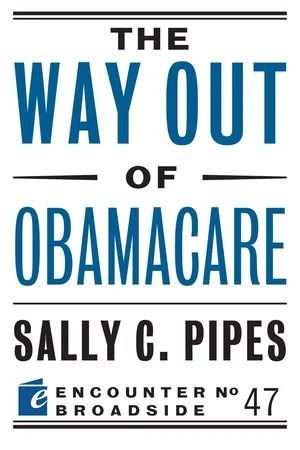
President Barack Obama has declared that his signature health reform law – the Patient Protection and Affordable Care Act – is "here to stay.” But his days in the White House are numbered, and the law has failed: insurance premiums and deductibles have skyrocketed, patients are losing access to doctors, and economic growth has been crushed.In this Broadside, Sally C. Pipes provides an actionable blueprint for health care reform this campaign season, which the next president can implement on Day One. This book provides a replacement plan for Obamacare – one that will provide affordable, accessible, quality health care for all Americans.
- 56 pages
- English
- ePUB (mobile friendly)
- Available on iOS & Android
eBook - ePub
The Way Out of Obamacare
About this book
Information
HOW KING V. BURWELL SAVED OBAMACARE – AT LEAST TEMPORARILY
THE FUTURE OF American health care was never less certain than in the days before June 25, 2015.i The U.S. Supreme Court had yet to issue a ruling in King v. Burwell, a potentially fatal challenge to the Patient Protection and Affordable Care Act, President Barack Obama’s signature health reform package.
At stake? The future of Obamacare’s insurance exchanges. A judgment against the administration would have effectively dismantled these marketplaces – and the law with them. A verdict in the government’s favor would have preserved the status quo and saved Obamacare.
King v. Burwell asked the high court to consider whether the Affordable Care Act allowed the Internal Revenue Service to provide tax credits subsidizing health coverage through the federal government’s HealthCare.gov exchange. The law’s text explicitly states that credits are available through “an Exchange established by the State.”ii
The meaning of State was far from academic. Thirty-four states opted not to build their own exchanges – and left the task to the federal government.
If the court read State at face value, then millions of Americans shopping in the federally operated exchange would lose the subsidies that made their health insurance affordable. And if millions of customers left HealthCare.gov, the cost of insurance for those remaining would spiral upward. After all, only those who thought they’d have expensive medical bills would keep paying for coverage.
As that process repeated, Obamacare’s exchanges would collapse. And so would the law.
So in those first few days of the summer of 2015, the nation waited to learn whether the Supreme Court would save Obamacare as it had three summers prior, in June 2012.iii
A Difference of Interpretation
Here’s how King v. Burwell ended up before the U.S. Supreme Court.
Four cases challenging the IRS’s authority to distribute subsidies through the federal exchange were launched in different parts of the country.
A three-judge panel of the U.S. Court of Appeals for the D.C. Circuit ruled against the government in Halbig v. Burwell in July 2014.iv The U.S. District Court for the Eastern District of Oklahoma also ruled against the federal government in Pruitt v. Burwell in September 2014.v The U.S. District Court for the Southern District of Indiana heard arguments in Indiana v. IRS in October 2014.vi
The U.S. Supreme Court chose to hear the fourth case. A Virginia man named David King, along with three others, hoped to avoid the requirement that he purchase health insurance. With subsidies, his insurance through HealthCare.gov would run $275 a month – an amount deemed “affordable” by the law and thus subjecting him to the law’s individual mandate.
Without subsidies, he’d face monthly premiums of $648. The Affordable Care Act considered this latter sum “unaffordable,” so King would be allowed to flout the individual mandate without penalty.vii
In other words, the subsidies would actually make King worse off by forcing him to spend $275 every month that he otherwise would not have spent.
King lost his case before the U.S. Court of Appeals for the Fourth Circuit and appealed to the Supremes.viii
Burwell in the case is Secretary of Health and Human Services Sylvia Mathews Burwell. Since her agency oversaw the implementation of the subsidy rule at the center of the case, she was named the defendant.ix
The plaintiff argued that he shouldn’t have had to accept the federal government’s largesse. Obamacare’s text provided subsidies “through an Exchange established by the State.” A straightforward reading would take State to mean one of the 50. On top of that, the law specifically defines State as “each of the 50 States and the District of Columbia.”x
King was shopping for coverage in Virginia – one of the 34 states that never established its own insurance exchange.xi But the Obama administration gave residents of the Old Dominion tax credits anyway. In doing so, the plaintiff argued, the IRS overstepped its authority and broke the law.xii

For King v. Burwell’s dissenters, the majority’s decision amounted to a willful misreading of the law.
The administration, by contrast, posited that Obamacare’s overall structure superseded one inartfully drafted phrase. Without subsidies, the exchanges would crumble. Congress couldn’t possibly have meant for four words located deep within section 36B to blow up the entire law.xiii
It followed, the government claimed, that any interpretation of the law prohibiting subsidies for federal-exchange customers was mistaken.xiv
Saved by the Court
The Supreme Court ended up ruling 6-3 against the plaintiffs. Chief Justice John Roberts wrote for the majority: “Congress passed the Affordable Care Act to improve health insurance markets, not to destroy them. If at all possible, we must interpret the Act in a way that is consistent with the former, and avoids the latter.”xv
Tax credits would continue to flow through the federally operated exchanges. Approximately 5 million people would keep their subsidized coverage.xvi
For the case’s dissenters, the majority’s decision amounted to a willful misreading of the law. Writing for the minority, Justice Antonin Scalia expressed his concerns with characteristic bluntness: “Words no longer have meaning if an Exchange that is not established by a State is ‘established by the State.’”xvii
The majority’s “somersaults of statutory interpretation,” he continued, reveal the “discouraging truth that the Supreme Court of the United States favors some laws over others, and is prepared to do whatever it takes to uphold and assist its favorites.”xviii
“We should start calling the law SCOTUScare,” he concluded.
The Supreme Court had rescued Obamacare once again. Chief Justice Roberts had provided the same brand of “creative” legal reasoning he’d found to uphold the individual mandate back in 2012.
He may have believed that Congress did not intend to destroy America’s health insurance market by passing Obamacare. But that’s exactly what has happened.
* * *
THE IMPLICATIONS OF KING V. BURWELL
The King decision left Obamacare’s systemic flaws intact. Those flaws have made coverage less affordable, diminished access to care for millions of Americans, limited networks of doctors and hospitals for those in the exchanges, and stymied economic growth.
Things will only get worse in the months and years to come – if Obamacare is not repealed and replaced.
Not-So-Affordable Care
The price of coverage has skyrocketed since the Affordable Care Act (ACA) took effect.
Consider the rise in deductibles – the amount a consumer must pay before an insurance policy kicks in. In 2006, prior to Obamacare, the average individual plan deductible was $584, according to the Kaiser Family Foundation (KFF).xix By 2015, post-ACA, it had more than doubled – to $1,318.xx
For many Americans, these costs are too much to bear. Another KFF study found that 24 percent of non-elderly, non-poor families with private coverage don’t have enough in liquid assets to cover the $1,200 to $2,400 deductible for a midrange insurance plan. Only two-thirds of that group have enough for a higher deductible.xxi
The growth in deductibles doesn’t just sap household finances. It also puts patients’ health at risk. Two in five adults with deductibles totaling at least 5 percent of their income reported avoiding or putting off necessary medical care, according to the Commonwealth Fund.xxii
Deductibles are only part of the problem. Insurance premiums have also risen at an alarming rate since the ACA took effect...
Table of contents
- Cover
- Table of Contents
- How King v. Burwell Saved Obamacare – At Least Temporarily
- The Implications of King v. Burwell
- Copyright
Trusted by 375,005 students
Access to over 1.5 million titles for a fair monthly price.
Study more efficiently using our study tools.
Frequently asked questions
Yes, you can cancel anytime from the Subscription tab in your account settings on the Perlego website. Your subscription will stay active until the end of your current billing period. Learn how to cancel your subscription
No, books cannot be downloaded as external files, such as PDFs, for use outside of Perlego. However, you can download books within the Perlego app for offline reading on mobile or tablet. Learn how to download books offline
Perlego offers two plans: Essential and Complete
- Essential is ideal for learners and professionals who enjoy exploring a wide range of subjects. Access the Essential Library with 800,000+ trusted titles and best-sellers across business, personal growth, and the humanities. Includes unlimited reading time and Standard Read Aloud voice.
- Complete: Perfect for advanced learners and researchers needing full, unrestricted access. Unlock 1.5M+ books across hundreds of subjects, including academic and specialized titles. The Complete Plan also includes advanced features like Premium Read Aloud and Research Assistant.
We are an online textbook subscription service, where you can get access to an entire online library for less than the price of a single book per month. With over 1.5 million books across 990+ topics, we’ve got you covered! Learn about our mission
Look out for the read-aloud symbol on your next book to see if you can listen to it. The read-aloud tool reads text aloud for you, highlighting the text as it is being read. You can pause it, speed it up and slow it down. Learn more about Read Aloud
Yes! You can use the Perlego app on both iOS and Android devices to read anytime, anywhere — even offline. Perfect for commutes or when you’re on the go.
Please note we cannot support devices running on iOS 13 and Android 7 or earlier. Learn more about using the app
Please note we cannot support devices running on iOS 13 and Android 7 or earlier. Learn more about using the app
Yes, you can access The Way Out of Obamacare by Sally C. Pipes in PDF and/or ePUB format, as well as other popular books in Politics & International Relations & Social Policy. We have over 1.5 million books available in our catalogue for you to explore.