David Horowitz spent the first part of his life in the world of the Communist-progressive left, a politics he inherited from his mother and father, and later in the New Left as one of its founders. When the wreckage he and his comrades had created became clear to him in the mid-1970s, he left. Three decades of second thoughts then made him this movement’s principal intellectual antagonist. "For better or worse,” as Horowitz writes in the preface, "I have been condemned to spend the rest of my days attempting to understand how the left pursues the agendas from which I have separated myself, and why.”When Horowitz began his odyssey, the left had already escaped the political ghetto to which his parents’ generation and his own had been confined. Today, it has become the dominant force in America’s academic and media cultures, electing a president and achieving a position from which it can shape America’s future. How it achieved its present success and what that success portends are the overarching subjects of Horowitz’s conservative writings. Through the unflinching focus of one singularly engaged witness, the identity of a destructive movement that constantly morphs itself in order to conceal its identity and mission becomes disturbingly clear.Horowitz reflects on the years he spent at war with his own country, collaborating with and confronting radical figures like Huey Newton, Tom Hayden and Billy Ayers, as he made his transition from what the writer Paul Berman described as the American left’s "most important theorist” to its most determined enemy.
eBook - ePub
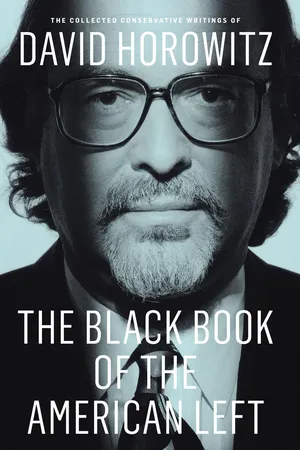
The Black Book of the American Left
The Collected Conservative Writings of David Horowitz
- 416 pages
- English
- ePUB (mobile friendly)
- Available on iOS & Android
eBook - ePub
The Black Book of the American Left
The Collected Conservative Writings of David Horowitz
About this book
Information
PART I
Reflections From My Life
1
Left Illusions
For most of my adult and professional life, I regarded myself as a man of the left. The identification was stronger than just politics. Ever since marching in my first May Day parade down New York’s Eighth Avenue 30 years ago, I had looked on myself as a soldier in an international class-struggle that would one day liberate all humanity from poverty, oppression, racism and war. It was a romantic conception to be sure, but then revolution as conceived in the Marxist and socialist canons is a romantic conception; it promises the fulfillment of hopes that are as old as mankind; it posits a break with the whole burdened progress of human history—freedom from the chains that have bound master and slave, lord and peasant, capitalist and proletariat from time immemorial.
Not long after the end of the Vietnam War, I found myself unable to maintain any longer the necessary belief in the Marxist promise. Along with many other veterans of the 1960s struggles, I ceased to be politically active. It was a characteristic and somewhat unique feature of our radical generation, as distinct from previous ones, that we did not then join the conservative forces of the status quo. Instead, politics itself became suspect. We turned inward—not, I would say, out of narcissism but out of a recognition in some ways threatening to our radical ideas that failure (like success) is never a matter merely of “the objective circumstances” but has a root in the acting self.
Few of us, I think, felt at ease with the political limbo in which we found ourselves. It was as though the radicalism we shared was in some deep, perhaps unanalyzable sense a matter of character rather than of commitment. It was as though giving up the vision of fundamental change meant giving up the better part of oneself. So we continued to feel a connection to the left that was something more than sentimental, while our sense of loss led to conflicts whose appearance was sometimes less than fraternal. Such feelings, I believe, were an unspoken but significant element in the controversy over Joan Baez’s open letter to the Vietnamese, and in the Ronald Radosh-Sol Stern article on the Rosenbergs in The New Republic.1
Antonio Gramsci once described the revolutionary temperament as a pessimism of the intellect and an optimism of the will. For the veterans of my radical generation, the balance was tipped when we sustained what seemed like irreparable damage to our sense of historical possibility. It was not even so much the feeling that the left would not be able to change society; it was rather the sense that, in crucial ways, the left could not change itself.
Above all, the left seems trapped in its romantic vision. In spite of the defeats to its radical expectations, it is unable to summon the dispassion to look at itself critically. Despite the disasters of 20th-century revolutions, the viability of the revolutionary goals remains largely unexamined and unquestioned. Even worse, radical commitments to justice and other social values continue to be dominated by a moral and political double standard. The left’s indignation seems exclusively reserved for outrages that confirm the Marxist diagnosis of capitalist society. Thus there is protest against murder and repression in Nicaragua but not Cambodia, in Chile but not Tibet, South Africa but not Uganda, Israel but not Libya or Iraq. Political support is mustered for oppressed minorities in Western countries but not in Russia or the People’s Republic of China, while a Third World country that declares itself “Marxist” puts itself—by the very act—beyond reproach. In the same vein, almost any “liberation movement” is embraced as just that, though it may be as unmistakably atavistic and clerically fascist on first sight as the Ayatollah Khomeini’s in Iran.2
This moral and political myopia is compounded by the left’s inability to accept responsibility for its own acts and commitments. Unpalatable results like the outcome of the Revolution in Russia are regarded as “irrelevant”—and dismissed—as though the left in America and elsewhere played no role in them, and as though they have had no impact on the world the left set out to change. Or they are analyzed as anomalies—and dismissed—as though there were in fact a standard of achieved revolution by which the left could have confidence in its program and in its understanding of the historical process.
Recently the shock of events in Indochina—mass murder committed by Cambodia’s Communists, the invasion and unacknowledged occupation of Cambodia by Vietnam, the invasion of Vietnam by China—has produced new and promising responses among radicals still committed to the socialist cause.3 Paul Sweezy, the dean of America’s independent Marxists, wrote in Monthly Review this June of “a deep crisis in Marxian theory” because not one of the existing “socialist” societies behaves the way Marx and “most Marxists . . . until quite recently . . . thought they would.” Classes haven’t been eliminated; nor, he observes, is there any visible intention to eliminate them. The state, far from disappearing, has grown more powerful, and Marxist regimes “go to war not only in self-defense but to impose their will on other countries—even ones that are also assumed to be socialist.”
The current dimensions of the left’s intellectual crisis are more readily grasped in a writer like Noam Chomsky, who, as an anarchist, has never had illusions about existing “socialisms” and has no attachment, intellectual or visceral, to pristine Marxism. Chomsky’s intellectual integrity and moral courage, to my mind, set a standard for political intellectuals.4 Yet in a manner that is not only characteristic of the non-Trotskyist left but seems endemic to its political stance, Chomsky refuses to devote his tenacious intelligence to a systematic scrutiny of “socialist” regimes or even anti-Western regimes of the Third World.
Thus, in a passage from his new book Language and Responsibility, Chomsky criticizes the absence of socialist journalists in the mass media and comments: “In a sense, we have over here the ‘mirror image’ of the Soviet Union, where all the people who write in Pravda represent the position they call ‘socialism’—in fact, a certain variety of highly authoritarian state socialism.” Chomsky attributes this conformity to “ideological homogeneity” among the U.S. intelligentsia and to the fact that the mass media are capitalist institutions. Chomsky then offers examples of press conformity in connection with the Vietnam War and concludes: “It is notable that despite the extensive and well-known record of Government lies during the period of the Vietnam War, the press, with fair consistency, remained remarkably obedient, and quite willing to accept the Government’s assumptions, framework of thinking, and interpretation of what was happening.”
The questions I find myself asking, when I read these words just now, are: By what standard does Chomsky judge the obedience of the American press remarkable? Is there a national press that is not obedient in the sense described? Does Chomsky mean that the American press was remarkably more obedient to its government during the Vietnam War than other national presses would have been in similar circumstances? Looking back at those events from the present historical juncture, one would be inclined to say exactly the reverse. Not only did the American press provide much of the documentation on which the antiwar movement’s indictment of the American war effort was based—including the My Lai atrocities—but in defiance of its government and at the risk of prosecution for espionage and treason, it published the classified documents known as the “Pentagon Papers,” which provided a good deal of the tangible record of official lies to which Chomsky refers.5
This is not to say that Chomsky’s characterization of press subservience is wrong but rather to put the criticism in perspective. Within the framework of ideological conformity and institutional obedience that Chomsky rightly deplores, a body of dissent developed during the 1960s which has continued to influence the conduct of America foreign policy and the structure of international relations in the present decade. Who would have thought ten years ago that the anti-American revolution in Iran, the linchpin of America’s imperial interests in the Middle East, would not trigger an immediate American military intervention? Who would have believed that the 25,000 military “advisors” in Africa’s civil conflicts in the 1970s would be Cubans rather than Americans?
Consider, too, for a moment, Chomsky’s misleading comparison of the Soviet and American presses as “mirror images.” In fact, the ignorance imposed on the Soviet public by government-controlled media and official censorship is mind-boggling by Western standards. At a bare minimum, the information necessary to carry on a public debate over government policies in areas such as foreign policy and defense is not available to the Soviet citizen (who would be forbidden to use it, if it were). Censorship is carried to such an extreme that the Soviet citizen may be uninformed about such noncontroversial threats to his wellbeing as natural disasters, man-made catastrophes or even military provocations by the United States. When Washington mined Haiphong Harbor and dared Russian vessels to challenge the blockade, a crisis—compared at the time to the 1962 confrontation over Cuban missiles—ensued. For twenty days during this crisis, the Soviet people were not informed that the mining had taken place. (The purpose of the blackout was to allow the Soviet leadership to capitulate to the American threat without domestic consequences.)
Why bring this up? Why dwell on the negative features of the Soviet system (or of other Communist states) which in any case are widely reported in the American media? What is the relevance? These are questions the apologists of the left raise when they are confronted by the Soviet case. Unfortunately, the consequences of ignoring the flaws of practical Communism are far-ranging and real. To begin with, the credibility of the left’s critique is gravely undermined. Chomsky’s article is a good example. The American press does not look inordinately servile when compared with its real-world counterparts—and especially its socialist opposites. Only when measured against its own standards and the ideals of a democratic society does it seem so. Yet it is Chomsky who raises the Soviet comparison, precisely because the United States and the Soviet Union are in an adversary relationship—a political fact of prime importance that the left often prefers to ignore, when it suits their purposes—and he does so in a misleading way. The result is that his argument is vitiated, or at least seriously weakened, for anyone who has not internalized the special expectations of the left that a future socialist press would be really independent, critical and accurate.
Latent in Chomsky’s critique is a comforting illusion: namely, that the left’s failure to sustain itself as a political force with a radical alternative social vision is due to the absence of socialist journalists in the capitalist media, rather than to its own deficiencies—the failure of the left’s ideals in practice; its moral inconsistency; its inability to formulate and fight for realistic programs; in short, the fact that it cannot command moral and political authority among its constituencies.
The blind-spot toward the Soviet Union provides a good instance of the left’s lack of political realism. The Soviet Union is one of the two predominant military powers in the world. That alone makes it a crucial subject of any contemporary political analysis that claims to be comprehensive. Radicals often seem to think that Western policy can be explained independently of Soviet behavior by reference to the imperatives of the system, the requirements of the “disaccumulation crisis,” etc. This was always a weakness in the radical perspective; but now, as a result of the continuing development of Soviet power in the last decade, it has passed a critical point and has become crippling.
During the 1950s, and even in the 1960s, the Soviet Union was significantly weaker militarily than the United States. The celebrated “missile gap” was all on the other side. Hence, whatever Soviet intentions, Washington’s influence on the dynamics of the arms race and the cold war was preponderant. This is no longer the case. The Soviet Union has now achieved nuclear parity with the United States for ...
Table of contents
- Cover
- Title Page
- Copyright
- Acknowledgement
- Contents
- Preface to The Black Book of the American Left
- Introduction to My Life and Times
- Part I · Reflections From My Life
- Part II · Reflections on the Left
- Part III · Slander as Political Discourse
- Part IV · Two Talks on Autobiographical Themes
Trusted by 375,005 students
Access to over 1.5 million titles for a fair monthly price.
Study more efficiently using our study tools.
Frequently asked questions
Yes, you can cancel anytime from the Subscription tab in your account settings on the Perlego website. Your subscription will stay active until the end of your current billing period. Learn how to cancel your subscription
No, books cannot be downloaded as external files, such as PDFs, for use outside of Perlego. However, you can download books within the Perlego app for offline reading on mobile or tablet. Learn how to download books offline
Perlego offers two plans: Essential and Complete
- Essential is ideal for learners and professionals who enjoy exploring a wide range of subjects. Access the Essential Library with 800,000+ trusted titles and best-sellers across business, personal growth, and the humanities. Includes unlimited reading time and Standard Read Aloud voice.
- Complete: Perfect for advanced learners and researchers needing full, unrestricted access. Unlock 1.5M+ books across hundreds of subjects, including academic and specialized titles. The Complete Plan also includes advanced features like Premium Read Aloud and Research Assistant.
We are an online textbook subscription service, where you can get access to an entire online library for less than the price of a single book per month. With over 1.5 million books across 990+ topics, we’ve got you covered! Learn about our mission
Look out for the read-aloud symbol on your next book to see if you can listen to it. The read-aloud tool reads text aloud for you, highlighting the text as it is being read. You can pause it, speed it up and slow it down. Learn more about Read Aloud
Yes! You can use the Perlego app on both iOS and Android devices to read anytime, anywhere — even offline. Perfect for commutes or when you’re on the go.
Please note we cannot support devices running on iOS 13 and Android 7 or earlier. Learn more about using the app
Please note we cannot support devices running on iOS 13 and Android 7 or earlier. Learn more about using the app
Yes, you can access The Black Book of the American Left by David Horowitz in PDF and/or ePUB format, as well as other popular books in Politics & International Relations & Political Biographies. We have over 1.5 million books available in our catalogue for you to explore.