What caused the eurozone debacle and the chaos in Greece? Why has Europe’s migrant crisis spun out of control, over the heads of national governments? Why is Great Britain calling a vote on whether to leave the European Union? Why are established political parties declining across the continent while protest parties rise? All this is part of the whirlwind that EU elites are reaping from their efforts to create a unified Europe without meaningful accountability to average voters. The New Totalitarian Temptation: Global Governance and the Crisis of Democracy in Europe is a must-read if you want to understand how the European Union got to this point and what the European project fundamentally is. This is the first book to identify the essence of the EU in a utopian vision of a supranationally governed world, an aspiration to achieve universal peace through a global legal order.The ambitions of the global governancers are unlimited. They seek to transform not just the world’s political order, but the social order as well—discarding basic truths about human nature and the social importance of tradition in favor of a human rights policy defined by radical autonomy and unfettered individual choice. And the global governance ideology at the heart of the EU is inherently antidemocratic. EU true believers are not swayed by the common sense of voters, nor by reality itself.Because the global governancers aim to transfer core powers of all nations to supranational organizations, the EU is on a collision course with the United States. But the utopian ideas of global governance are taking root here too, even as the European project flames into rancor and turmoil. America and Europe are still cultural cousins; we stand or fall together. The EU can yet be reformed, and a commitment to democratic sovereignty can be renewed on both sides of the Atlantic.
eBook - ePub
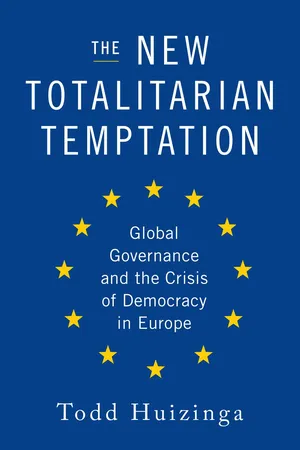
The New Totalitarian Temptation
Global Governance and the Crisis of Democracy in Europe
- 280 pages
- English
- ePUB (mobile friendly)
- Available on iOS & Android
eBook - ePub
The New Totalitarian Temptation
Global Governance and the Crisis of Democracy in Europe
About this book
Information
Subtopic
Politica europeaPART ONE
DEFINING THE SOFT UTOPIA
CHAPTER 1:
SOMETHING COMPLETELY DIFFERENT
If you spend any time at all in Brussels, the de facto capital city of the European Union, you are bound to hear that the EU is sui generis, Latin for “the only one of its kind.” The EU is unlike anything that came before it, and most definitely not to be understood as anything like an international organization in the usual sense of the term.
The uniqueness of the EU lies primarily in the degree of supranationalism it exhibits.* In fact, supranationalism has been its primary distinguishing feature and the overriding ideal of its acolytes ever since the creation of the EU’s first direct institutional forerunner, the European Coal and Steel Community. In their joint declaration upon signing the Treaty of Paris to establish the ECSC on April 18, 1951, the six signatory ministers said:
In signing the Treaty establishing the European Coal and Steel Pool . . . the Contracting Parties have given proof of their determination to set up the first supra-national institution and thus to lay the real foundations of an organized Europe.
All European countries are free to participate in such an organized Europe. We sincerely hope that other nations will associate themselves with our efforts.1
WHAT THE EU IS NOT
The EU’s uniqueness comes out in sharp relief when one compares it with other international organizations that might seem at first glance to be similar. What sets the EU apart is the ceding of significant sovereign powers of the member states to the EU itself, as embodied in its institutions.
Take the Organization of American States (OAS), for example. Like the EU, the OAS is a regional organization. Its member states span the Americas, from Chile and Argentina in the south to Canada in the north. Similarly, the EU’s member states span most of Europe, from Spain and Cyprus in the south to Sweden and Finland in the north. The EU boasts twenty-eight member states and the OAS includes thirty-five member states. Both have common institutions, and the OAS member states, like the EU member states, make declarations and cooperate on economic and political affairs.
But after that, the differences begin to outweigh the similarities. The OAS is an international organization of sovereign member states, in which national governments of the Western Hemisphere come together to discuss issues and solve problems in their mutual national interests. OAS members do not give up any sovereignty when they join. In fact, Article 1 of the OAS Charter explicitly stresses the member states’ sovereignty and expressly forbids the organization from intervening in their internal affairs.2 Of course, there are inevitable attempts to hijack the OAS in the service of political agendas that cannot be achieved in the member states by democratic means, notably having to do with LGBT rights and “sexual and reproductive health,”3 but this does not change the basic nature of the OAS as an international organization of sovereign member states, rather than a supranational organization like the EU in which member states pool their sovereignty.
Many people think of the EU as essentially an economic entity based on a free-trade agreement, perhaps like the United States, Canada and Mexico under the North American Free Trade Agreement (NAFTA). This impression may derive from the name of the predecessor organization of the EU, the European Economic Community (EEC), or from concepts such as the single market and the European Monetary Union, which gave birth to the euro.
Certainly the EU is, in part, an economic entity. Like NAFTA, it is a free-trade bloc. But it is much more than that. The EU is also a customs union. And this entails closer, more restrictive ties than free trade, as Daniel Hannan, a British Conservative member of the European Parliament, explains: “A customs union involves internal free trade, but also a common external tariff. Its members surrender their separate commercial policies, and give up the right to sign trade agreements. Instead, trade negotiations are conducted, and treaties signed, by the bloc as a whole.”4
Beyond this, most of the EU member states are united by a common currency. Nineteen of the twenty-eight member states share the euro. Most of the other nine member states aspire to have it in the future, but they do not yet meet the qualifications for the eurozone. These are mostly countries that were communist satellites of the Soviet Union, with planned economies. They are still developing as free markets and are expected to join the eurozone when they qualify. The only countries in the EU that qualify for the euro but freely choose (for now) not to join are the United Kingdom, Denmark and Sweden.
THE EU INSTITUTIONS
The EU, as we have seen, differs from international organizations such as the OAS and from free-trade areas such as NAFTA mainly in that the member states of the EU have relinquished substantial aspects of their sovereign powers to the EU institutions. In this respect, the EU is not just an economic entity but also a profoundly political one. It is better described not as an international organization, but as a supranational or at least a transnational organization, with “managing” institutions to which the member states have transferred considerable powers. The principal five EU institutions are the European Commission, the Council of the European Union, the European Parliament, the European Council and the European Court of Justice.
The European Commission is the executive arm of the EU. It administers EU law and policy and enforces its implementation in the member states. It also possesses formidable legislative power, known as the “right of initiative.” Under the EU treaties only the Commission can initiate legislation, other than under certain exceptional conditions.
The Council of the European Union is an institution in which the governments of the member states are represented by cabinet-level ministers, so it is also known as the Council of Ministers. The Council meets in multiple configurations, depending on the issue area. For example, the foreign ministers of EU member states meet once per month as the Foreign Affairs Council; environment ministers meet as the Environmental Affairs Council; economic and finance ministers meet as the ECOFIN Council; and so on. All in all, the Council of Ministers has ten configurations. Thus, while it is referred to in the singular, it is not really one council, but ten councils – a phenomenon that only the impenetrably complex EU could pull off. And although it is made up of ministerial-level officials of the executive branches of the member states, it primarily serves a quasi-legislative function within the European Union. In conjunction with the European Parliament, it reviews, amends and passes EU legislation as drafted by the Commission.
The European Parliament (EP) is a supranational legislature made up of 751 members who are elected by voters in their respective member states. The members of the European Parliament (MEPs) generally belong to a national political party in their respective member states. These parties join forces in EU-wide “political groups.” For example, the center-right political group, the European People’s Party, is made up of national Christian Democratic and Conservative parties from the member states. The center-left political group, the Progressive Alliance of Socialists and Democrats, is composed of Social Democratic and Socialist parties from the member states. There are similar political groups of Green parties, liberal parties, Euroskeptic conservative parties, and others. The European Parliament does not draft legislation; that is the sole prerogative of the European Commission. The EP does not have the power to levy taxes. Neither does the EP have MEPs belonging to a governing coalition and other MEPs representing the opposition, as in the parliaments of the member states, because there is no elected EU government and thus no opposition. So what does the European Parliament do? It amends legislation, along with the Council of Ministers, and its approval of legislation, along with the Council’s, is necessary in most policy areas in order for it to become law. Importantly for the United States, the EP’s assent is needed too for most international agreements that the EU wants to enter into. The EP also helps shape EU policies in areas such as foreign affairs and human rights, by writing reports, issuing declarations and resolutions, and carefully scrutinizing other EU actors’ words and actions on those issues.
The European Council, not to be confused with the Council of the European Union described above nor with the Council of Europe (an organization that is separate and distinct from the European Union), is made up of the presidents and prime ministers of the EU member states. Headed by a president who is appointed by the member states and not a part of any member-state government, the European Council is the top decision-making body in the EU. It meets at least four times per year and sets EU policy at the highest level.
The European Council is the only EU institution that was established in practice rather than in a treaty.5 Its beginning can be traced back to the Yom Kippur War of 1973 and the ensuing global energy crisis. In October 1973 a coalition of Arab states invaded territories that had been occupied by Israel since the 1967 Arab-Israeli war, thus igniting the Yom Kippur War. In quick succession came the war itself, Soviet threats of intervention, an American-brokered ceasefire, and the reduction of oil deliveries to the West by Arab oil-exporting nations, precipitating a global energy crisis. All of this happened with nary a peep from Europe. Acutely unsettled by their own insignificance, the leaders of the European Economic Community member states decided to meet more often so that Europe “could speak with one voice on important global issues.”6 Approximately a year later, in 1974, the new French president, Valéry Giscard d’Estaing, succeeded in establishing the European Council as a regular meeting of heads of state and government to decide authoritatively on the most important matters of foreign policy and European integration. Since then, the European Council has become the most important embodiment of what Luuk van Middelaar, an EU analyst and philosopher, calls the “in-between sphere.”7 In the European Council, leaders of EU member states do not represent just their own governments nor the EU itself, but become actors “in between” the two.
A final very important EU institution is the Court of Justice of the European Union (CJEU). Actually consisting of three distinct courts, the CJEU resembles the U.S. judiciary in that it functions like an independent branch of government, with the highest of its courts, the European Court of Justice (ECJ), analogous to the U.S. Supreme Court. It provides the final interpretation of the treaties and can declare EU legislation or actions in line with the treaties, thus clearing the way for their entry into effect, or out of line with the treaties, thus rendering them null and void. The judiciary has been a true motor of European integration, in having declared EU law to supersede the national law of the member states, and in having introduced the doctrine of direct effect, meaning that citizens of EU member states – since they are directly affected by EU legislation – can, as individuals, dispute the validity of a national law of their member state if they can show that it impinges on their rights under EU legislation. This was a game-changing step in the development of the EU into an organization whose decisions take precedence over member-state policy and law.8
THE EU’S MEMBER STATES
The EU has undergone a series of enlargements ever since the European Coal and Steel Community was established in 1952 with six founding members: Germany, France, Italy, the Netherlands, Belgium and Luxembourg. Now it is easier to name the European countries that are not members of the EU. In Western Europe, the only nonmembers are Norway, Iceland and Switzerland, along with microstates such as Liechtenstein, Monaco and Andorra. In Central and Eastern Europe, west of the former Soviet Union, the only nonmembers are Albania and some of the countries that emerged out of Yugoslavia: Serbia, Kosovo, Macedonia, Bosnia-Herzegovina, Montenegro. These countries all desire to join, a desire that is shared by the EU but will not be realized for several years, perhaps decades. The former Yugoslav republic of Croatia is the newest member state, having joined on July 1, 2013. All of the former satellite states of the Soviet Union (which constituted the Warsaw Pact) are now EU members. Even three of the countries that used to be part of the Soviet Union itself are now in the EU, namely the Baltic states – Latvia, Lithuania, Estonia. EU membership is a distant possibility for other former Soviet republics – Ukraine, Moldova, Belarus; and perhaps even a possibility for Georgia, Armenia and Azerbaijan. Turkey is a uniq...
Table of contents
- Cover
- Title Page
- Contents
- Dedication
- Introduction: Understanding the EU
- Part One – Defining The Soft Utopia
- Part Two – Intended and Unintended Consequences
- Part Three – Case Studies in Soft Utopia
- Part Four – Transforming Human Rights
- Part Five – Our Best Friends and Our Worst Antagonists
- Part Six – Soft Utopia at a Crossroads
- Epilogue: Will America Follow the EU into the Soft Utopia?
- Acknowledgments
- Notes
- Index
- Copyright
Trusted by 375,005 students
Access to over 1.5 million titles for a fair monthly price.
Study more efficiently using our study tools.
Frequently asked questions
Yes, you can cancel anytime from the Subscription tab in your account settings on the Perlego website. Your subscription will stay active until the end of your current billing period. Learn how to cancel your subscription
No, books cannot be downloaded as external files, such as PDFs, for use outside of Perlego. However, you can download books within the Perlego app for offline reading on mobile or tablet. Learn how to download books offline
Perlego offers two plans: Essential and Complete
- Essential is ideal for learners and professionals who enjoy exploring a wide range of subjects. Access the Essential Library with 800,000+ trusted titles and best-sellers across business, personal growth, and the humanities. Includes unlimited reading time and Standard Read Aloud voice.
- Complete: Perfect for advanced learners and researchers needing full, unrestricted access. Unlock 1.5M+ books across hundreds of subjects, including academic and specialized titles. The Complete Plan also includes advanced features like Premium Read Aloud and Research Assistant.
We are an online textbook subscription service, where you can get access to an entire online library for less than the price of a single book per month. With over 1.5 million books across 990+ topics, we’ve got you covered! Learn about our mission
Look out for the read-aloud symbol on your next book to see if you can listen to it. The read-aloud tool reads text aloud for you, highlighting the text as it is being read. You can pause it, speed it up and slow it down. Learn more about Read Aloud
Yes! You can use the Perlego app on both iOS and Android devices to read anytime, anywhere — even offline. Perfect for commutes or when you’re on the go.
Please note we cannot support devices running on iOS 13 and Android 7 or earlier. Learn more about using the app
Please note we cannot support devices running on iOS 13 and Android 7 or earlier. Learn more about using the app
Yes, you can access The New Totalitarian Temptation by Todd Huizinga in PDF and/or ePUB format, as well as other popular books in Politica e relazioni internazionali & Politica europea. We have over 1.5 million books available in our catalogue for you to explore.