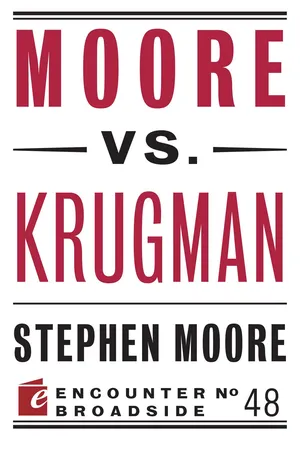
What happens when a leading conservative economist goes mano a mano with today’s most influential exponent of left-liberal economics, over free markets versus government interventionism? Here are highlights of that showdown between Stephen Moore of the Heritage Foundation and Paul Krugman, Nobel laureate.Moore and Krugman sparred over eight major economic issues in our national debate – from whether the policy response to the crisis of 2008 was successful, to the outlook for Obamacare, to the "red state / blue state” divide. The contest was cordial and spiced with wit. (Does air conditioning explain the migration from blue to red states? Is Houston still uninhabitable?)This high-powered matchup illuminates a clash of worldview that leads to opposing policy prescriptions. More important, it will help you draw conclusions about which economic policies work.
- 56 pages
- English
- ePUB (mobile friendly)
- Available on iOS & Android
eBook - ePub
Moore vs. Krugman
About this book
Information
I am not a defender of socialism or big government!
PAUL KRUGMAN
IN JULY 2015, I debated the Nobel Prize–winning economist Paul Krugman in front of more than 2,000 people at FreedomFest in Las Vegas. This was billed as the economic showdown of the year: the lead economics columnist for the New York Times versus the former senior economics writer for the Wall Street Journal. The overall theme was “socialism versus capitalism.” Do we need more government in the economy to achieve more growth and economic fairness?
The debate was moderated by Mark Skousen, the founder of FreedomFest. It was cordial, and the back-and-forth was illuminating, especially for understanding the clash of worldview between left and right. But it was primarily a debate about results, not ideology. My old boss Representative Dick Armey used to say, “I don’t need faith in free markets. I have evidence.” Liberalism, alas, is based on wishful thinking and good intentions (but not even always that). I don’t think it’s any exaggeration to say that Paul Krugman is the most influential left-liberal economist in America today. Democrats and academicians absorb his analyses and recommendations as gospel, so this exchange offers a window into their mindset.
We dueled on almost all the major economic and financial issues in today’s national policy discourse and in the presidential campaign – from the minimum wage, to Obamacare, to remedies for our economic malaise. Here I replay highlights of the punches and counterpunches, by quotation and paraphrase, along with some of the supporting graphics that were presented. I have tried to do justice to Krugman’s arguments in this abridged version of our debate. At the end of each topic, I have added brief comments in summary. We offered Krugman the opportunity to add his own additional comments, but he declined.
As you will discover, Krugman is witty, well-versed on the issues, and quick on his feet. He is also a staunch advocate of nearly everything that government does – and it’s fair to say he thinks that unfettered free-market policies lead to severe inequality and ruinous outcomes. He defended the Postal Service, Obamacare, Medicare, the minimum wage, and the welfare state, which he claims is rapidly shrinking.
I’m biased, but I believe that on nearly all of the issues I carried the day. Krugman knows more about health care than I do, so that discussion may have been a draw. A poll taken of the attendees after the debate showed me the clear winner. Unfortunately, the day before the debate, Krugman vetoed television cameras in the auditorium – no Fox or CNN or C-SPAN. The blackout prevented potentially hundreds of thousands of people from viewing the debate live. Fortunately, a full-length video of the festivities is now available on YouTube. A full transcript is also available on request.
1. Why did we have a recession, and did the Obama stimulus fail?
PAUL KRUGMAN
“We just had the mother of all financial crises, or actually the stepmother of all financial crises, because the mother was the 1930s. But this was a pretty close second. And it takes a long time to recover from those even with the best policies, which we did not have.” The errors were: “We cut government spending too quickly. We failed to have sufficiently aggressive monetary policies. So it’s been a long hangover. Although compared with anyplace else in the advanced world, the U.S. economy looks pretty good right now.”
Economic growth has been much slower over the past 30 years than in the three decades following World War II, but “we’ve done not too badly by many measures.” The problem is that the new wealth has not “trickled down to ordinary working families,” so we’ve had rapidly rising inequality in the midst of decent economic growth.
STEVE MOORE
“Just about everything we’ve done in Washington for the past seven years has been exactly the wrong thing to do. We’ve made the economy much worse with these governmental interventions. And it’s not just under Barack Obama but under George Bush.”
The bailouts were a mistake, creating “a great moral hazard for the economy” and bringing about a centralization of the banks. The $830 billion stimulus plan did not create jobs. Obamacare, tax increases, cash for clunkers – all mistakes. The massive spending added $7 trillion to the national debt in six years. It was “a big Keynesian experiment,” and did anything go right?
It’s true that Obama inherited an economic crisis. But so did Reagan, when we had “20 percent mortgage interest rates and 14 percent inflation, and every economist in the day was saying that America was in permanent decline. And these two presidents used entirely different approaches to dealing with the crisis.” Reagan’s philosophy in brief: “the government is not the solution, government is the problem.” Obama’s philosophy: “the government really is the solution to a lot of our problems.”
If the Reagan recovery had been replicated under Obama, we would have $2.75 trillion more in GDP and about 5 million more jobs today.
KRUGMAN
“The recessions of 2008–9 and of 1981–82 were very, very different beasts.” In the earlier case, “the Federal Reserve wanted to bring down inflation. And it raised interest rates sky high. And then after they felt that the economy had suffered enough, they brought interest rates way down. And so you had a rapid recovery.”
In the recent recession, “we’d had a financial system that ran out of c...
Table of contents
- Cover
- Table of Contents
- Beginning
- Copyright
Trusted by 375,005 students
Access to over 1.5 million titles for a fair monthly price.
Study more efficiently using our study tools.
Frequently asked questions
Yes, you can cancel anytime from the Subscription tab in your account settings on the Perlego website. Your subscription will stay active until the end of your current billing period. Learn how to cancel your subscription
No, books cannot be downloaded as external files, such as PDFs, for use outside of Perlego. However, you can download books within the Perlego app for offline reading on mobile or tablet. Learn how to download books offline
Perlego offers two plans: Essential and Complete
- Essential is ideal for learners and professionals who enjoy exploring a wide range of subjects. Access the Essential Library with 800,000+ trusted titles and best-sellers across business, personal growth, and the humanities. Includes unlimited reading time and Standard Read Aloud voice.
- Complete: Perfect for advanced learners and researchers needing full, unrestricted access. Unlock 1.5M+ books across hundreds of subjects, including academic and specialized titles. The Complete Plan also includes advanced features like Premium Read Aloud and Research Assistant.
We are an online textbook subscription service, where you can get access to an entire online library for less than the price of a single book per month. With over 1.5 million books across 990+ topics, we’ve got you covered! Learn about our mission
Look out for the read-aloud symbol on your next book to see if you can listen to it. The read-aloud tool reads text aloud for you, highlighting the text as it is being read. You can pause it, speed it up and slow it down. Learn more about Read Aloud
Yes! You can use the Perlego app on both iOS and Android devices to read anytime, anywhere — even offline. Perfect for commutes or when you’re on the go.
Please note we cannot support devices running on iOS 13 and Android 7 or earlier. Learn more about using the app
Please note we cannot support devices running on iOS 13 and Android 7 or earlier. Learn more about using the app
Yes, you can access Moore vs. Krugman by Stephen Moore in PDF and/or ePUB format, as well as other popular books in Politics & International Relations & Political History & Theory. We have over 1.5 million books available in our catalogue for you to explore.