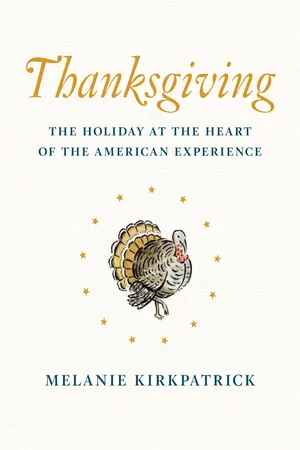
We all know the story of Thanksgiving. Or do we? This uniquely American holiday has a rich and little-known history beyond the famous Pilgrim feast of 1621.
Melanie Kirkpatrick journeys through four centuries to craft a vivid portrait of our nation's best-loved tradition in Thanksgiving: The Holiday at the Heart of the American Experience. Drawing on newspaper accounts, official documents, private correspondence, and cookbooks, she illuminates what the holiday has meant to generations of Americans.
Presidents play key parts: Washington proclaimed our first national day of Thanksgiving amid controversy over his constitutional power to do so. Lincoln aimed to heal a fractured nation when he called for all Americans to mark a Thanksgiving Day. FDR sparked a debate on states' rights by changing the traditional date of the holiday. The story also includes the evolution of Thanksgiving dinner, how football became part of the celebration, and how Native Americans view the holiday.
While the rites and rituals have evolved, the essence of Thanksgiving remains the same: family and friends feasting together in a spirit of hospitality and gratitude. Kirkpatrick's exploration of America's oldest tradition offers a fascinating look into the meaning of the holiday we celebrate on the fourth Thursday of November.
With Readings for Thanksgiving Day and historic Recipes & Bills of Fare.
- 272 pages
- English
- ePUB (mobile friendly)
- Available on iOS & Android
eBook - ePub
About this book
Trusted by 375,005 students
Access to over 1.5 million titles for a fair monthly price.
Study more efficiently using our study tools.
Information
CHAPTER ONE
The First Thanksgiving
It is a good thing to give thanks unto the Lord.
—Psalm 92
I am standing in the grand exhibition hall on the upper level of the Pilgrim Hall Museum in Plymouth, Massachusetts, admiring a painting titled The First Thanksgiving at Plymouth. The museum’s amiable director, Patrick Browne, is about to give me a reality check.1
The First Thanksgiving at Plymouth is an iconic work of American art. It has appeared countless times in books, calendars, and greeting cards since it was created by Jennie Brownscombe in 1914. Most Americans would recognize it. Every American would know at a glance that its subject is Thanksgiving.
This is the First Thanksgiving as we picture it in our mind’s eye. Pilgrims and Indians are gathered around a long dining table that is set outdoors on a beautiful autumn day. The sun is sparkling off flame-colored maple trees in the background; the placid waters of Plymouth Bay are visible in the distance. As I am silently taking in the painting, Patrick cuts into my thoughts.
The First Thanksgiving at Plymouth is full of historical inaccuracies, he tells me. That is not what it looked like. The Pilgrims wore bright colors—reds, blues, greens, violets—not the sober hues pictured here. The Indians of New England never donned feathered headdresses, as in this painting, which seems to have been inspired by the Plains Indians of the American West. If there had been a table, the Pilgrim women would not have been seated with the men; they would have been busy preparing the food. The First Thanksgiving may not even have taken place in the fall; it could have been late summer, when the harvest would have been gathered. In short, there is not a whole lot that the artist seems to have gotten right about the event other than the fact that it was held outdoors. The First Thanksgiving at Plymouth is an interpretation, Patrick emphasizes, and we can enjoy it as such; but it is not historically accurate.
On that score—interpretation—it seems to me that Brownscombe’s rendering of the First Thanksgiving deserves high marks. The focal point of the painting is an elderly Pilgrim who is saying grace. He is standing behind his seat at the table, head lifted to heaven, eyes closed, hands raised and clasped together in prayer. The artist may have fallen short on the historical details, but she captured the most important aspect of the First Thanksgiving and of every Thanksgiving that has followed: giving thanks.
Downstairs in another gallery are various artifacts that belonged to the Pilgrims. Many of them were brought over on the Mayflower and may have been used at that three-day harvest feast of 1621. These ordinary household items hold at least as much power as Brownscombe’s painting. View them, and the Pilgrims’ story comes to life.
We start with Governor William Bradford’s Bible. It is the 1560 Geneva translation, which the Pilgrims favored as more accurate than the 1611 King James Version used by the Church of England. Most Pilgrim households had a Geneva Bible, and the one on display was printed in London in 1592. One of the Geneva Bible’s most important innovations was to divide the text into verses as well as chapters. Another was to use roman rather than gothic type. How much easier these simple changes must have made it for ordinary readers to follow and understand the words of the Bible.
Bradford’s Bible embodies the entire history of the Pilgrims. This is the volume that accompanied them through their voyages and whose words sustained them through ordeal after ordeal. “You look at it and you think of the fact that when the Pilgrim congregation was gathering together in England, William Bradford was reading this Bible,” Patrick tells me. “When they went to Holland, he was reading this Bible. When they came over on the Mayflower, he was reading this Bible. This is the Bible that was in that primitive little house he built a few blocks over from here. And now it’s right in front of us.”
We move on to examine more Pilgrim belongings: Myles Standish’s sword; Peter Brown’s beer tankard; Constance Hopkins’s beaver hat; and a pair of armless spectacles made of glass, horn, leather, and wood that belonged to an unknown Pilgrim, presumably of middle age, whose eyesight was failing. There is a faded piece of needlework made by Standish’s daughter that is the earliest known American-made sampler. It is long and narrow and embroidered with a pious verse that begins:
Loara Standish is my name
Lord guide my heart that I may do thy will.
We take a look at Myles Standish’s iron cooking pot. It boasts two handles, convenient for lifting it on and off the hearth. In another display case is a large wooden bowl fashioned from burl maple. The bowl was used by the Wampanoag for preparing and serving food. It is one of the few Native American artifacts in the museum’s collection.
We also see the cradle of the first European child to be born in New England. The cradle rocked Peregrine White, son of Susanna and William White. Susanna was pregnant when she and William and their five-year-old son Resolved boarded the Mayflower, and she knew she would need a safe place to lay a newborn infant.
Peregrine was born aboard the Mayflower as it lay at anchor off the tip of Cape Cod. It was late November 1620, a few weeks before a scouting team decided on Plymouth as the location for the Pilgrims’ permanent settlement. Susanna and William chose a name for their son consistent with the circumstances of his birth. The name derives from the Latin word peregrinus, which means wanderer or foreigner, and is the source of the English word pilgrim. Like his fellow Pilgrims, little Peregrine was a stranger in a strange land. By the time of the First Thanksgiving in the late summer or early autumn of 1621, he would have been old enough to crawl.
Susanna White was one of eighteen Pilgrim wives who accompanied their husbands on the Mayflower. Several men left wives behind, planning to send for their families after they were established in America. Only four of the eighteen Mayflower wives survived to the time of the First Thanksgiving. Susanna lived, but her husband, William, died three months after Peregrine’s birth, during the wretched first winter in Plymouth.
All together, only half of the men, women, and children who had sailed on the Mayflower were still alive a year after landing in the New World. Many fell victim to an illness that scholars theorize was a virulent form of influenza. The Pilgrims called it “the great sickness.” Whatever it was, the weak, poorly nourished settlers started falling ill about two weeks after arriving in Plymouth. Most of the sick were crowded into the small common house that the settlers had managed to construct quickly. But not everyone could fit into it, so others were kept aboard the Mayflower, anchored in Plymouth Harbor. Both the ship and the common house were overcrowded, and the illness spread rapidly. The few people who stayed well had to prepare the food, get the water, and care for the sick.
As I examine the artifacts Patrick shows me, I wonder what role they might have played in the First Thanksgiving. Did Susanna set the cradle under the shade of a tree with baby Peregrine asleep inside, while she prepared food for the outdoor feasting? In The First Thanksgiving at Plymouth, Brownscombe paints Peregrine in his cradle, with Susanna seated nearby.
What of the cooking pot that belonged to Myles Standish and his late wife, Rose, who had died in January? Did the four surviving wives press the Standish cooking pot into service when they set about feeding the Pilgrims and their many Wampanoag guests? Constance Hopkins, then fourteen years old, surely lent a hand as the women worked. I can picture her wearing that wide-brimmed beaver hat with the peaked top. And what of Governor Bradford himself? Did he read aloud from his Bible to the assembled Pilgrims? Did he take a break from the hubbub and seek a quiet corner to read the Scriptures by himself?
Many of the Pilgrim artifacts have sorrowful stories associated with them—the cradle that rocked a fatherless child, the cooking pot that often would have been empty for lack of food to put in it, the sword whose owner was prepared to use it against the “savages” he expected to encounter. In the face of such sadness, deprivation, and terror, how is it that in the late summer or early autumn of 1621, the Pilgrims came together with grateful hearts to celebrate their first harvest in the New World and give thanks?

There are two eyewitness accounts of the First Thanksgiving. William Bradford, Plymouth’s longtime governor, penned one.2 Edward Winslow is the author of the other. Both accounts are brief but vivid. Bradford’s weighs in at one hundred sixty-seven words. Winslow’s is only one hundred fifty-one words.3 Read them and you find yourself in familiar territory. As described by the two Pilgrim leaders, the event that Americans have come to call the First Thanksgiving was remarkably similar to the holiday we mark today. There was feasting and game playing, and an all-round mood of good cheer.
In their separate accounts, Bradford and Winslow each make much of the bounty on hand in New England, an abundance that presages the dining tables at modern-day Thanksgiving dinners. Bradford tells of the “great store of wild turkeys, of which they took many.” He also notes the “cod and bass and other fish, of which they took good store.” Winslow offers an anecdote about the rich natural resources of the American continent that would have wowed his readers back in England. The governor dispatched a shooting party for the occasion, he writes, and the four Pilgrims killed enough birds in one day to serve the community for almost a week.
It is from Winslow that we learn that a large group of Wampanoag warriors joined the Pilgrim feast. In telling how the Pilgrims welcomed the Wampanoag to their celebration, Winslow homes in on other attributes of the holiday, then and now: hospitality, generosity, neighborliness. He describes, too, how the guests returned the favor. The Wampanoags’ “greatest king Massasoit” and his men “went out and killed five deer,” which they “bestowed on our Governor [Bradford], and upon the Captain [Myles Standish] and others.” So, too, a modern guest, upon accepting an invitation to Thanksgiving dinner, is likely to ask his host: What can I bring?
The central similarity between the First Thanksgiving and today’s holiday is something less tangible: the spirit of thankfulness. From the first, as Bradford and Winslow imply, Thanksgiving has been a time to stop and take stock of the blessings enjoyed by family and community. As the English settlers overcame the trials they faced that first year in Plymouth, qualities that Americans have come to honor as integral to our national identity were on full display: courage, perseverance, diligence, piety. These are the virtues that helped to shape the American character.
The Pilgrims displayed another virtue, one they practiced every day and which stood at the heart of the First Thanksgiving. Cicero called it the greatest of the virtues and the parent of all the rest: gratitude.
And yet, here is an odd thing—odd, at least, for the modern-day reader of the Pilgrims’ accounts. The word “thanksgiving” does not appear in either description. Neither Bradford nor Winslow referred to the feast as Thanksgiving.
If you could travel back in time to 1621, tap a Pilgrim on the shoulder, and ask him to define “Thanksgiving Day,” his answer might surprise you. For the Pilgrims, a “day of thanksgiving” was not marked by feasting, family, and fellowship—the happy hallmarks of the holiday we now celebrate. It was a different matter altogether.
The Pilgrims brought with them from England a religious custom of marking days of thanksgiving, along with their counterpart, days of fasting and humiliation. Days of thanksgiving, usually including a communal meal, were called in response to specific beneficences such as a successful harvest, propitious weather, or a military victory.4 Fast days were called to pray for God’s help and guidance in time of trouble or difficulty. For the Pilgrims, then, a “thanksgiving day” was imbued with religious meaning, and set aside for prayer and worship.
Some contemporary observers like to stress this historical usage, arguing that the event known today as the First Thanksgiving was therefore not a true “thanksgiving day.” These naysayers aren’t just being Thanksgiving Scrooges. They are right that the Pilgrims would not have viewed the harvest feast of 1621 as a thanksgiving in their understanding of the word. But it is also true that the spirit of gratitude was very much present on that occasion. The Pilg...
Table of contents
- Cover
- Title Page
- Copyright
- Dedication
- Contents
- Introduction: Newcomers
- Chapter 1: The First Thanksgiving
- Chapter 2: Before the Pilgrims
- Chapter 3: America Discovers the Pilgrims
- Chapter 4: George Washington Sets the Stage
- Chapter 5: Thanksgiving’s Godmother
- Chapter 6: The Turkey Bowl
- Chapter 7: Happy Franksgiving
- Chapter 8: Day of Mourning
- Chapter 9: Helping Hands
- Chapter 10: Turkey Day
- Afterword: Five Kernels of Corn
- Readings for Thanksgiving Day
- Thanksgiving Recipes and Bills of Fare
- Acknowledgments
- Notes
- Index
Frequently asked questions
Yes, you can cancel anytime from the Subscription tab in your account settings on the Perlego website. Your subscription will stay active until the end of your current billing period. Learn how to cancel your subscription
No, books cannot be downloaded as external files, such as PDFs, for use outside of Perlego. However, you can download books within the Perlego app for offline reading on mobile or tablet. Learn how to download books offline
We are an online textbook subscription service, where you can get access to an entire online library for less than the price of a single book per month. With over 1.5 million books across 990+ topics, we’ve got you covered! Learn about our mission
Look out for the read-aloud symbol on your next book to see if you can listen to it. The read-aloud tool reads text aloud for you, highlighting the text as it is being read. You can pause it, speed it up and slow it down. Learn more about Read Aloud
Yes! You can use the Perlego app on both iOS and Android devices to read anytime, anywhere — even offline. Perfect for commutes or when you’re on the go.
Please note we cannot support devices running on iOS 13 and Android 7 or earlier. Learn more about using the app
Please note we cannot support devices running on iOS 13 and Android 7 or earlier. Learn more about using the app
Yes, you can access Thanksgiving by Melanie Kirkpatrick in PDF and/or ePUB format, as well as other popular books in History & North American History. We have over 1.5 million books available in our catalogue for you to explore.