New medicines in the pipeline can extend lives, save money, and even help prevent disease before symptoms appear – if we don’t discourage their innovators and investors by trying to lower drug prices artificially. Unlocking Precision Medicine explores the environment necessary for creation of these health care game-changers, and explains how the marketplace can effectively make them more affordable to all without killing the golden goose.
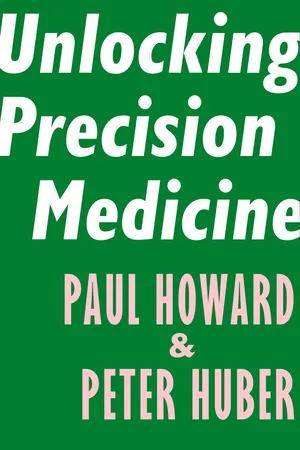
- 48 pages
- English
- ePUB (mobile friendly)
- Available on iOS & Android
eBook - ePub
Unlocking Precision Medicine
About this book
Information
Chapter 1 · Prescription Miracles
Stephanie Dunn Haney would have been dead for eight years by now. In 2007, the thirty-nine-year-old nonsmoker and mother of two small girls was diagnosed with stage IV lung cancer. After her diagnosis, Stephanie was put on standard therapy for lung cancer: chemotherapy with Avastin, a drug designed to block blood supply to tumors. Her cancer initially responded to treatment but then grew resistant, as most cancers do.
So her doctors switched her to a targeted cancer medicine, which bought her more time. Her tumors again grew resistant to the new medicine, but by that time she qualified for a clinical trial to test a new drug. Researchers had recently discovered that a small percentage of lung cancer patients have a defective gene that promotes tumor growth, called ALK. The trial was testing a drug designed to block ALK expression, and Stephanie’s tumor both contained the gene and responded to the experimental drug.
As of May 2016, Stephanie had been living with metastatic lung cancer for nine years.1 Yet, she described her life as “relatively normal.”2 But in 2007, the ability to lead a “normal” existence wouldn’t have been predicted. That year, Stephanie wrote she had “learned a majority of late-stage lung cancer patients die within one year. Just one year. One birthday. One summer.”3
Now take the case of Emily Whitehead, who was just five years old when she was diagnosed with leukemia. After her cancer resisted standard treatments twice, her parents enrolled her in a clinical trial at the Children’s Hospital of Philadelphia, where researchers extracted immune-system T cells from her body, genetically modified them to attack her cancerous B cells, and then reinjected them. Today, she is a happy, thriving ten-year-old—and has been cancer-free for the past four years.4
Thanks to many advances in treatment and detection, stories like those of Stephanie and Emily are increasingly common. That means more birthdays, holidays, weddings, and anniversaries to celebrate. Cancer mortality has fallen by 23 percent over the past two decades.
More Americans than ever are living longer with a cancer diagnosis. Better drugs with fewer side effects also mean that many of those diagnosed with the disease can return to work and live relatively normal lives for longer periods of time. New treatments will eventually allow us to manage cancer in a similar way to how we do chronic illnesses like diabetes or HIV/AIDs. Customized cures targeted to the biology of individual patients like Stephanie are also being developed to enable greater success in the treatment of severe depression,5 heart disease6, diabetes,7 and Parkinson’s.8
It’s no exaggeration to say that America stands on the cusp of a Golden Age of Medicine. A look back at just the last few decades shows astonishing progress across many diseases. Patients with the blood-clotting disorder hemophilia used to have an average lifespan of just thirteen years. Today, thanks to effective blood-clotting treatments, people diagnosed with the disease decades ago are now planning for their lives after they retire in their midsixties.9 New approaches like gene therapy may eventually allow these patients to wean themselves off of daily injections of clotting factor, a functional cure.10
Thanks to many advances in treatment and detection, stories like those of Stephanie and Emily are increasingly common. That means more birthdays, holidays, weddings, and anniversaries to celebrate.
From 1969 to 2013, death rates from heart disease plummeted by 67 percent, thanks in part to lower smoking rates—but also thanks to the wider use of medicines like statins, which lower cholesterol. Since the 1970s, stroke-related mortality has fallen from third to fifth place as a leading cause of death in the United States. This is primarily due to the widespread use of effective drugs for hypertension.11
New treatments for rheumatoid arthritis (RA) can slow or even halt this progressive joint disease that would have led to severe disability in the past. The last two decades have seen a 40 percent12 reduction in disability caused by RA, thanks to more aggressive treatment with effective medicines.
When the HIV/AIDS virus was first tentatively identified in the United States in 1983, after having incubated for decades in Africa, scientists were baffled and the public was terrified. There were predictions that AIDS would be the next “black death.” But, by 1996, the FDA had approved the first combination HIV-AIDs drug cocktails, and they turned out to be life-saving treatments. Between 1996 and 1997, mortality rates fell by 40 percent. Today, many HIV-infected patients—especially when they are treated early on—can expect to have close-to-normal life spans.
Of course, not every treatment discovery will lead to similarly powerful breakthroughs, but even modest improvements delivered by a succession of new medicines can add up to large gains for patients facing serious chronic illnesses, which account for 86 percent of US health care spending.
Many diseases incubate in our bodies silently for decades before producing symptoms. The good news is that drug companies, medical researchers, and tech companies are joining forces to create and mine large databases containing genetic information and detailed patient histories to home in on the molecular drivers of complex chronic diseases.13 Over time, the new normal in medicine will become stopping diseases at their molecular inception—halting their progression before they become serious enough to generate clinical symptoms.14 A world with much-less disease-related suffering and death is the future our children and grandchildren will enjoy as a result.
The bad news is that it won’t come fast enough to help many patients who need it today. And because many of these medicines are new, and are therefore still protected by patents and therefore expensive, they can come with high copays and coinsurance. For today’s patient, the cost of hope can seem painfully high—if not out of reach. An August 2015 Kaiser Family Foundation poll found that 72 percent of Americans consider drug prices unreasonable, with 24 percent saying they’re having difficulty affording the prescriptions. And 74 percent of respondents also think drug companies put profits before people.15
If vulnerable patients are going without access to critical medicines because of high costs and copays,16 insurers, drug makers, and policy makers need to find solutions that broaden access.
And they need to start now.
But we need them to accomplish this without derailing the incentives driving the industry to innovate. Because America’s laws allow for the market pricing of medicines, thus providing an incentive for private investors to finance the massive cost and long delays associated with drug innovation, we now lead the world in developing precision medicine for diseases once regarded as untreatable or incurable. The possibility of a big payday, should a new medicine be effective, is what keeps investors eagerly engaged in seeking the next breakthrough.
But who can blame Americans—suffering from stagnant wages and rising health care costs—for wanting the government to tamp down the cost of the prescription drugs they’re paying more for at pharmacies and hospitals?
Again, there is good news and bad news. The good news is that there are things that Washington can do to allow prescription drug prices to fall naturally. The bad news is that none of these constructive solutions get enough attention in election years.
Instead, we mainly hear rhetoric that devalues and demonizes the drug industry. The Democratic presidential contender, Hillary Clinton, proudly calls the pharmaceutical industry one of her personal enemies.17 She wants the government to negotiate drug prices, and favors cheaper imports from Canada.18
The Republican contender, Donald Trump, isn’t much different. He has likened drug makers to public utilities, and promised to save $300 billion by having the government get tough when it buys drugs for Medicare.
Similar proposals are popping up outside Washington. In California, the AIDS Healthcare Foundation is sponsoring a ballot initiative that would prohibit state programs like Medi-Cal from purchasing any drug at a higher price than that paid by the Veteran’s Administration.19 The VA commands steeper discounts, in part, as in-kind repayment for the military service of its patients.
In Massachusetts, the state attorney general threatened to sue the pharmaceutical company Gilead, jawboning the company to lower the price it charges the Bay State for its hepatitis-C drug, so that it comes closer to what the company charges poorer countries like India and Egypt.
But manufacturers must be assured that drugs are selling in richer countries like the United States before they’ll sink money into drug development in the first place. Once they do, they can afford to sell at much-lower prices in poorer countries. Demanding Egyptian prices for the United States is a good way to get fewer drugs for wealthy Americans and fewer drugs for poor Egyptians.
Gilead’s Sovaldi, approved by the FDA in late 2013 for the treatment of chronic hepatitis-C infection, was a giant leap forward in hepatitis treatment. Hep C is a disease that kills more...
Table of contents
- Cover
- Table of Contents
- Chapter 1: Prescription Miracles
- Chapter 2: Don’t Kill the Golden Goose
- Chapter 3: Sickness Is More Expensive Than Health
- Chapter 4: Customized Cures, with an Assist from Silicon Valley
- Chapter 5: Building a Better Medical Future
- Copyright
Trusted by 375,005 students
Access to over 1.5 million titles for a fair monthly price.
Study more efficiently using our study tools.
Frequently asked questions
Yes, you can cancel anytime from the Subscription tab in your account settings on the Perlego website. Your subscription will stay active until the end of your current billing period. Learn how to cancel your subscription
No, books cannot be downloaded as external files, such as PDFs, for use outside of Perlego. However, you can download books within the Perlego app for offline reading on mobile or tablet. Learn how to download books offline
Perlego offers two plans: Essential and Complete
- Essential is ideal for learners and professionals who enjoy exploring a wide range of subjects. Access the Essential Library with 800,000+ trusted titles and best-sellers across business, personal growth, and the humanities. Includes unlimited reading time and Standard Read Aloud voice.
- Complete: Perfect for advanced learners and researchers needing full, unrestricted access. Unlock 1.5M+ books across hundreds of subjects, including academic and specialized titles. The Complete Plan also includes advanced features like Premium Read Aloud and Research Assistant.
We are an online textbook subscription service, where you can get access to an entire online library for less than the price of a single book per month. With over 1.5 million books across 990+ topics, we’ve got you covered! Learn about our mission
Look out for the read-aloud symbol on your next book to see if you can listen to it. The read-aloud tool reads text aloud for you, highlighting the text as it is being read. You can pause it, speed it up and slow it down. Learn more about Read Aloud
Yes! You can use the Perlego app on both iOS and Android devices to read anytime, anywhere — even offline. Perfect for commutes or when you’re on the go.
Please note we cannot support devices running on iOS 13 and Android 7 or earlier. Learn more about using the app
Please note we cannot support devices running on iOS 13 and Android 7 or earlier. Learn more about using the app
Yes, you can access Unlocking Precision Medicine by Paul Howard, Peter Huber in PDF and/or ePUB format, as well as other popular books in Business & Pharmaceutical, Biotechnology & Healthcare Industry. We have over 1.5 million books available in our catalogue for you to explore.