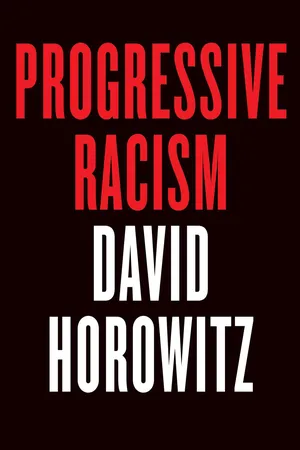
Progressive Racism is about the transformation of the civil rights movement from a cause opposing racism—the denigration of individuals on the basis of their skin color - into a movement endorsing race preferences and privileges for select groups based on their skin color. It describes the tragic changes of this cause under the leadership of racial extortionists like Al Sharpton, who took a movement in support of American pluralism and turned it into a movement governed by a lynch mob mentality in which white Americans are regarded as guilty before the fact and African Americans are regarded as innocent even when the facts prove them guilty, even when their crimes are committed against other African Americans.The author of Progressive Racism, David Horowitz, is a witness to these events and betrayals. Horowitz was a participant in the civil rights movement of the 1960s, and in 2001 led a national campaign against a proposal for "slavery reparations” that would have required Hispanic, Asian and other Americans who had no role in slavery to pay reparations to African Americans who were never slaves. Progressive Racism examines how the term "racism” has been drained of its original meaning and is now used as a weapon to bludgeon opponents into silence. It describes how the so-called civil rights movement has become an oppressor of African Americans by supporting a failed school system that blights the lives of millions of African American children and a welfare system that has destroyed the black family and created a "underclass” dependent on government charity. It is an indictment of the hypocrisy that today governs discourse on race issues, so that a lynch mob in Ferguson, Missouri seeking to hang a police officer because he was white can be described as a civil rights protest and be supported by the first African American president of the United States.
- 320 pages
- English
- ePUB (mobile friendly)
- Available on iOS & Android
eBook - ePub
Progressive Racism
About this book
Information
PART I
The Reds and the Blacks
The Reds and the Blacks
The Communist Manifesto is probably the only Marxist text that most of his millions of followers have actually read. During the last century, his disciples went about killing a hundred million people in attempts to create the utopia he promised, but these disasters have had no effect on the fantasy that inspired them. It is almost a decade since the collapse of the empires that Marxists built, but it is already evident that its lessons have not been learned. Today, few people outside the halls of academia may think of themselves as Marxists, or publicly admit to pursuing socialist illusions.1 But behind protective labels like “populist,” “progressive” and even “liberal,” the old socialist left is alive and powerful, and in steady pursuit of its destructive agendas.
Three ideas advanced in Marx’s famous tract make up the core of this contemporary leftist faith. The first and most important is the belief that modern, secular, democratic societies are ruled by oppressive “alien powers” (as Marx referred to them). In Marx’s vision, even though industrial nations had dethroned their hereditary rulers and vested sovereignty in the people, this did not mean they were actually free. Though liberated from serfdom, workers were now “wage-slaves,” chained to capital as effectively as they had been chained to the land under feudalism. According to Marx and his disciples, capital is the alien power that rules the modern world in the same way landed aristocracies presided over it in the past. Electoral democracies are fictions within the framework of capitalist societies. Behind the democratic facade, the capitalist “ruling classes” control political outcomes and keep their citizens effectively in chains.
The second idea of the Manifesto flows naturally from the first: politics is war conducted by other means, and specifically class war. The third idea is that victory in this class war leads to a world without chains—a rupture with the entire history of humanity’s enthrallment to alien powers.2
In response to the collapse of communism, and to distance itself from that failure, the modern left has revised its vocabulary and expanded the notion of alien powers to include race and gender. The target is rarely described anymore as a “ruling class,” but as a trinity of oppressors: a class-race-and-gender caste. In the war against these hierarchies, race carries the greatest moral weight and political impact. Consequently, racial grievance is the spearhead of the modern radical cause, although gender and class grievances are not far behind. Oppressed blacks and their grievances are deployed to undermine the bulwarks of the social order. And they are effective. In the past several decades, racial preferences to redress past injustices have been the most successful elements of the assaults on the standards and practices of the old order based on individual rights and equality before the law.
The left’s stated goal in subverting these classical liberal norms is to “level the playing field,” which is a precise translation of Marx’s classless society into politically palatable terms. According to those who hold this view, the Civil Rights Acts failed to achieve “real” equality, meaning an equality of results—which is the communist ideal. Previous civil rights reforms had focused on making institutional processes fair, and eliminating legal barriers to political power, education and jobs—in other words, to providing individual opportunity. For Martin Luther King and the civil rights movement he led, leveling the playing field meant extending to blacks the constitutional protections accorded to all Americans; making all citizens, regardless of color, equal before the law. It meant creating neutral rules that rendered color or ethnicity irrelevant to the competitions of civic and economic life. This was King’s idea of a “color-blind” society. Color would no longer affect individual outcomes, certainly not through the agency of the state. In King’s vision, the playing field would be level once government ceased to play racial favorites, as was the practice in the segregated South.
But the elimination of racial barriers through the passage of the Civil Rights Acts did not lead to equal results. To the left, whose collectivist vision discounted individual achievement and individual failure, this could only be explained by the persistence of covert prejudice—“institutional racism,” which is the contemporary left’s version of Marx’s alien power. According to the left, procedural fairness, the original goal of civil rights reforms, was actually a mask for an “institutional bias” that preserved an unequal status quo. Just as Marx had derided “bourgeois democracy” as a political smokescreen to preserve the power of a ruling class, so the post-King civil rights left dismissed equality of opportunity as a smokescreen to preserve the superior position of a dominant race. The term “white supremacy,” favored by racist demagogues like Louis Farrakhan, now became a term loosely applied by broad sectors of the left.
According to the new ideologues, educational admissions tests, for example, are culturally rigged to appear neutral while in practice they favor applicants of the dominant color. If facts alone were the issue, this claim would be easily refuted. Asian immigrants, who struggle with both a foreign language and an alien culture, consistently score in the highest ranges on standardized tests, surpassing whites and gaining admission to the best schools available. In fact, affirmative action measures in education are designed by the left to limit opportunities for Asian minorities, while favoring low-scoring Hispanics and blacks.3 But where ideology is concerned, facts do not matter. Within the ideology, only one explanation is possible for persistent inequalities: the hierarchies of race, class and gender, and their system of oppression.
When the left demands a level playing field, it is not interested in neutral rules and equitable standards. It is interested in combating the alien powers of the race-class-gender hierarchy and their alleged oppression of blacks and other designated minorities—the new stand-ins for Marx’s proletarians. The left is oblivious to the experience of persecuted minorities who have been successful, such as Asians, Armenians, and Jews. It is not interested in the cultural factors that shape individual choices. It is not interested in individuals and their freedom, and therefore in securing an equitable process. It is only rhetorically interested even in equal results. What drives the left is its quest for the power to fundamentally reshape the social order by state fiat, to enforce its own prejudices and preferences, which it calls “social justice.”
If the left actually set out to achieve an equality of results, it would have to invade and then control every inch of the private sphere. Consider what it would mean to implement this demand. It is true that 40 percent of America’s African-American children are poor, a condition that handicaps them in any educational competition. The left accounts for the resultant disparities by its mythical construct, “institutional racism,” which allegedly blocks their way. Since the fault is “institutional” rather than individual, the remedy is institutional reform: rigging educational and performance standards to force an equality that doesn’t currently exist.
But the primary reason that African-American children are poor is cultural, not institutional or racial. If it were racial, there would be no (or only a small) black middle class, whereas the black middle class is now the majority of the black population. Statistically speaking, a child born into a single-parent family is five times more likely to be poor than a child born into a family with two parents, regardless of race.4 Eighty-five percent of African-American children in living in poverty grow up in single-parent households.5 It is that circumstance—and not “institutional racism”—which actually handicaps a portion of the African-American population and denies them opportunity. By the time such children are ready to compete, they may suffer from dysfunctional behaviors, or have developed disabling habits, or have internalized attitudes hostile to academic achievement, or simply lack the supportive environment that a middle-class, two-parent home provides. The excessive dropout rates among students who take advantage of racial preferences to overcome these inequalities are the statistical indicators that these parenting handicaps are real, and that no rigging of institutional standards can make up for them.6
In the face of such realities, what can “leveling the playing field” mean? How can the state make up for the irresponsible behaviors and mistakes of the biological parents? By forcing them to get married? By compelling them to look after their children? By requiring them to teach their offspring to study hard and not be self-abusive? Is this even practical? Is it wise? Should the state become a Big Brother for those who fall behind, taking over their lives and curtailing their individual freedom? Yet that is the logical inference of the proposals of the left.
To achieve the benevolent outcomes that progressives promise would require a government both omniscient and wise, a utopia that has never existed. Such a state would have to mandate comprehensive transfers of opportunity and wealth, and would conduct a relentless battle against human nature to overcome the resistance to its impositions by those unwilling to give up their liberty or the fruits of their labor. The call to level the playing field, pushed to its unavoidable conclusion, is a call for the systematic subversion of American individualism and democracy, the destruction of individual freedom and the creation of a totalitarian state. The level playing field requires a totalitarian state to eliminate the disparities resulting from human nature and private circumstance. Yet the totalitarian state is itself a hierarchy of forbidding dimensions.
In the aftermath of communism’s collapse, such a prospect may seem remote, which is why the dangers inherent in these progressive reforms are often discounted. But the efforts to undermine the system of individual rights are already well advanced. Moreover, it is the nihilistic ambition behind the radical assault that presents the most immediate threat. For it is possible to destroy the foundations of social trust without establishing a socially viable alternative. Underlying the idea of racial preferences is a corrosive premise that the white majority is fundamentally racist and cannot be fair. For those who embrace the idea, the institutions, traditions, rules and standards that white majorities have arrived at over the course of centuries merit no respect. Affirmative action race preferences are an assault on the very system of economic and legal neutrality that underpins...
Table of contents
- Cover
- Title Page
- Copyright
- Contents
- Preface
- Introduction
- Part I: The Reds and the Blacks
- Part II: Decline and Fall of the Civil Rights Movement
- Part III: Racial Correctness
- Part IV: Reparations for Slavery
- Part V: Progressive Racism
- Index
Trusted by 375,005 students
Access to over 1.5 million titles for a fair monthly price.
Study more efficiently using our study tools.
Frequently asked questions
Yes, you can cancel anytime from the Subscription tab in your account settings on the Perlego website. Your subscription will stay active until the end of your current billing period. Learn how to cancel your subscription
No, books cannot be downloaded as external files, such as PDFs, for use outside of Perlego. However, you can download books within the Perlego app for offline reading on mobile or tablet. Learn how to download books offline
Perlego offers two plans: Essential and Complete
- Essential is ideal for learners and professionals who enjoy exploring a wide range of subjects. Access the Essential Library with 800,000+ trusted titles and best-sellers across business, personal growth, and the humanities. Includes unlimited reading time and Standard Read Aloud voice.
- Complete: Perfect for advanced learners and researchers needing full, unrestricted access. Unlock 1.5M+ books across hundreds of subjects, including academic and specialized titles. The Complete Plan also includes advanced features like Premium Read Aloud and Research Assistant.
We are an online textbook subscription service, where you can get access to an entire online library for less than the price of a single book per month. With over 1.5 million books across 990+ topics, we’ve got you covered! Learn about our mission
Look out for the read-aloud symbol on your next book to see if you can listen to it. The read-aloud tool reads text aloud for you, highlighting the text as it is being read. You can pause it, speed it up and slow it down. Learn more about Read Aloud
Yes! You can use the Perlego app on both iOS and Android devices to read anytime, anywhere — even offline. Perfect for commutes or when you’re on the go.
Please note we cannot support devices running on iOS 13 and Android 7 or earlier. Learn more about using the app
Please note we cannot support devices running on iOS 13 and Android 7 or earlier. Learn more about using the app
Yes, you can access Progressive Racism by David Horowitz in PDF and/or ePUB format, as well as other popular books in Politica e relazioni internazionali & Diritti civili in politica. We have over 1.5 million books available in our catalogue for you to explore.